
TL;DR
- Upwork pays agencies more. Average Upwork project is $800, with 32% of 2026 jobs at $1,000+. Fiverr's average order is $50 to $500, with $342 spent per buyer per year.
- The fee gap is real, but it is a range and not a number. Fiverr takes a flat 20% from sellers on every order. Upwork's freelancer service fee is variable, 0% to 15%, and set per contract. At a 10% service fee, Upwork's all-in cost for an agency lands around 12% to 14% once Connects and withdrawal fees are counted.
- Fiverr was built for gig buyers. Upwork was built for agencies. Upwork has a dedicated agencies page, Enterprise talent clouds, and 145,000 clients spending $5K+ per year. Fiverr Pro sells individual vetted freelancers, not agencies.
- The calculator below models your monthly revenue on each platform and lets you set the service fee your Upwork contracts actually carry. At $20K/month gross with a 10% service fee, Upwork leaves about $1,660 more per month than Fiverr. At Upwork's 15% ceiling that shrinks to roughly $680.
- If you're building an agency past $5K/month, Fiverr is a trap. Use it for small-ticket work, not pipeline.
What's in this article
Every quarter, two or three agency owners in GigRadar's onboarding calls ask me the same question: should I run my agency on Upwork or Fiverr?
My answer is the same every time. If your average project is above $300, Upwork. If your average project is under $100, Fiverr.
There is almost no middle ground, and the math behind it is cleaner than most people expect.
The platforms look similar from the outside. Both charge sellers a commission, both have millions of buyers, both let you list services or apply to projects.
Inside, they run on entirely different economics. Fiverr is a product catalog where buyers pick gigs off a shelf.
Upwork is a marketplace where projects get posted and agencies bid with proposals. One rewards volume at $50 per order, the other rewards relationships at $5,000 per contract.
This piece breaks down which platform actually pays agencies more in 2026, with the fee math, the buyer behavior, and the calculator I use when agencies ask me to run the numbers for them.
The number that decides everything: average project size
I pulled the most recent platform data I could find. Upwork's average hourly rate sits between $30 and $50 per hour for agency-tier talent, with 32% of 2026 contracts paying $1,000+ per project. Backlinko's analysis of Upwork user data shows 145,000 clients spend over $5,000 per year on the platform, and 4,000 clients spend over $100,000 per year.
Fiverr publishes different numbers. Their 2024 investor reports show 3.1 million annual active buyers spending an average of $342 per year. The average order value sits between $50 and $500, with the long tail heavily weighted toward the $50 side.
For an agency, that single stat is the whole argument.
If you need to hit $20,000 in monthly revenue, on Upwork you need 25 contracts at $800 each. On Fiverr you need 58 orders at $342 each.
The math is not close.
Fiverr averages are skewed by $5 and $10 gigs that make up the majority of listings. For an agency with 3 to 5 people, the sustainable ticket size on Fiverr is usually $150 to $500. That still sounds fine until you remember Fiverr buyers expect one-shot delivery. No ongoing retainer, no monthly engagement, no upsell. Every order is a new sale.
Upwork vs Fiverr fee calculator (interactive)
Before we get into buyer behavior, run the math on your own numbers. Enter your monthly revenue target, your average project size, and the Upwork service fee your contracts actually carry.
If you are not sure what that fee is, open any active Upwork contract and read the rate off it. The calculator then shows net take-home on each platform after fees, plus the project volume you'd need to hit your target.
Upwork vs Fiverr Agency Revenue Calculator
Enter your monthly gross revenue target, your average project size, and the service fee on your Upwork contracts. The tool calculates your real take-home on each platform.
The real fee math on each platform in 2026
Platform fees get oversimplified on both sides. "Upwork takes 10%" and "Fiverr takes 20%" are wrong in different ways.
Fiverr's 20% is real and flat. Upwork's number is not one number at all.
Upwork's 2026 fee structure
Upwork does not charge one rate. On its own fee calculator page, Upwork states that freelancers pay "a variable freelancer service fee ranging from 0-15% on all earnings, including bonuses."
The rate is set per contract, not per client and not per account. Upwork's Fee and ACH Authorization Agreement says the fee is calculated from factors including client demand, freelancer supply, job category and membership plan, and that the rate applying to a contract is fixed for the life of that contract.
That is the part agencies miss. Two contracts running side by side inside the same agency can carry different service fees, and neither rate moves as you bill more with that client.
The old tiered model is retired. Upwork's fee agreement now refers to the sliding 20/10/5% rates only as "Legacy Tiered Pricing", which covers grandfathered contracts and not anything you sign today.
Two rates are fixed rather than variable. Contracts with an Enterprise client carry a 10% service fee, and Freelancer Initiated Direct Contracts are a flat 5%.
Because the marketplace fee is a range, your effective take rate is a range too. Here is the full stack for an agency doing $20K/month gross on Upwork, and our breakdown of Upwork fees covers the client-side charges that sit on top of it:
| Cost | Rate | On $20K/month |
|---|---|---|
| Freelancer service fee (variable, set per contract) | 0% to 15% | $0 to $3,000 |
| Connects (bidding) | $0.15 per Connect (2026 rate) | $150 to $400 |
| Withdrawal fees (Payoneer/wire) | 1% to 2% | $170 to $400 |
| Agency membership (optional) | $20/month | $20 |
| Effective take rate | 2% to 19% (about 12% to 14% at a 10% service fee) | |
Fiverr's 2026 fee structure
Fiverr has no variable rate to model. Its Payment Terms state that each order you complete "credits your account with Earnings equal to 80% of the purchase amount", which is a flat 20% seller commission on every order and every hourly weekly report.
The buyer pays on top of that. The same Payment Terms put the client-side service fee at 5.5% of the purchase amount, plus a $3.50 small order fee on purchases under $200 and a $5 order initiation fee on new hourly contracts.
None of those buyer fees touch your take, but they affect your pricing because every buyer sees the higher total.
| Cost | Rate | On $20K/month |
|---|---|---|
| Seller commission (flat) | 20% | $4,000 |
| Promoted gigs (optional) | Auction CPC | $50 to $300 |
| Withdrawal fees (PayPal/Payoneer) | ~1% | $160 |
| Seller Plus (optional) | $29/month | $29 |
| Effective take rate | 21% to 22% | |
Fiverr's effective take rate is 21% to 22% no matter what you sell. Upwork's is a range, and where your contracts land inside it decides the size of the gap.
At a 10% service fee, the difference on $20K gross is about $1,660 per month, close to $20,000 a year in fees you would not pay on Upwork. At Upwork's 15% ceiling the monthly gap narrows to roughly $680.
Agencies often forget Connects are a real marketing expense. A 12-Connect proposal costs $1.80. At a 10% reply rate and 25% close rate, that's $72 per hire in proposal spend. Most agencies overestimate Connects cost per hire and underestimate withdrawal fees. Run your real numbers before deciding which platform is cheaper.
Upwork was built for agencies. Fiverr was built for gig buyers.
Platform structure tells you everything about what they actually want from you. Upwork runs a dedicated agencies landing page with an explicit "Scale your business with an agency" headline and a trusted-by strip carrying Coinbase, Semrush, Zapier and Wayfair. Fiverr does not have an equivalent page. Fiverr Pro exists, but it sells individual vetted freelancers, not agencies.

Upwork's dedicated agency landing page, upwork.com/agencies, captured August 2026. No equivalent exists on Fiverr.
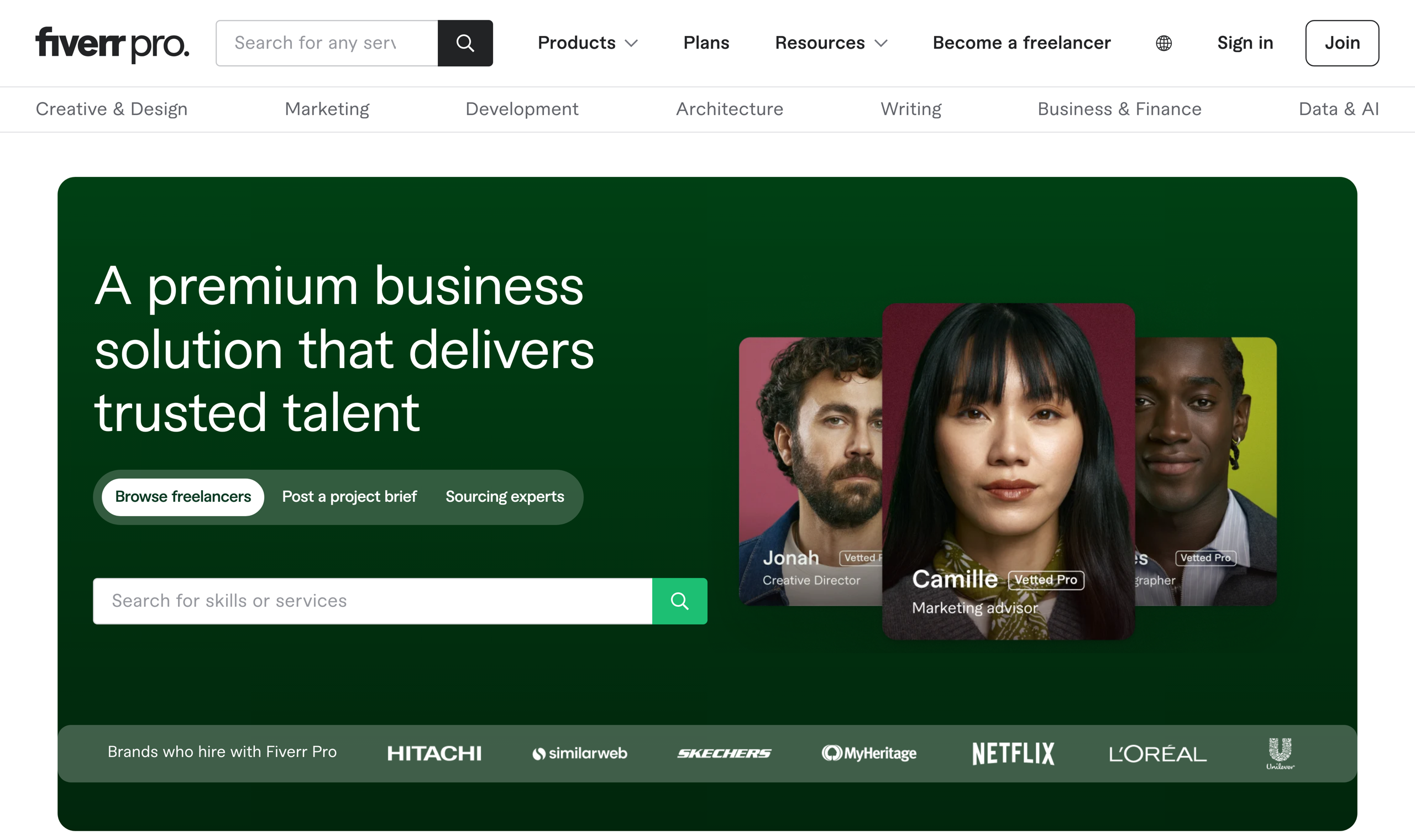
Fiverr Pro pitches individual vetted talent. Agencies are treated as customers here, not sellers.
This is not cosmetic. Every agency-oriented feature on Upwork (Talent Clouds, Enterprise, Plus memberships with per-agency seats) flows from the same assumption: agencies are sellers, and the platform wants them to win. Fiverr's product treats agencies as an edge case.
The practical consequence shows up in buyer behavior. A client posting on Upwork usually knows they want an ongoing relationship.
They describe the project, the timeline, and the budget. A buyer on Fiverr picks a gig card off a shelf and places an order.
One is a sales conversation. The other is a transaction.
Fiverr Pro marketing implies it's a gateway to high-end clients. For agencies, that positioning is misleading. Fiverr Pro buyers still browse gigs; they're just vetted companies. The sales motion is identical to regular Fiverr. No RFP, no proposal, no call. If your agency model requires a discovery call to scope properly, Fiverr structurally fights you at every step.
Who pays for ongoing work: Upwork vs Fiverr buyer intent
The deepest gap between the platforms is what buyers actually want. I pulled this from Backlinko's 2026 Upwork data and Fiverr's own investor reports. The pattern is almost identical to what I see in GigRadar customer accounts.
| Metric | Upwork | Fiverr |
|---|---|---|
| Active buyers (annual) | 794,000 paying clients | 3.1 million buyers |
| Avg annual spend per buyer | $5,035 | $342 |
| Avg project size | $500 to $5,000 | $50 to $500 |
| Repeat engagement | High (retainers common) | Low (one-shot typical) |
| Clients spending $5K+/year | 145,000 (18%) | Rare |
| Clients spending $100K+/year | 4,000 | Effectively zero |
| Typical hiring signal | Posts project, invites proposals | Browses gigs, places order |
The Upwork buyer base is 4x smaller than Fiverr's, but spends roughly 15x more per buyer annually. If you're an agency built around retainers, monthly engagements, or anything resembling a long relationship, that math never reverses in Fiverr's favor.
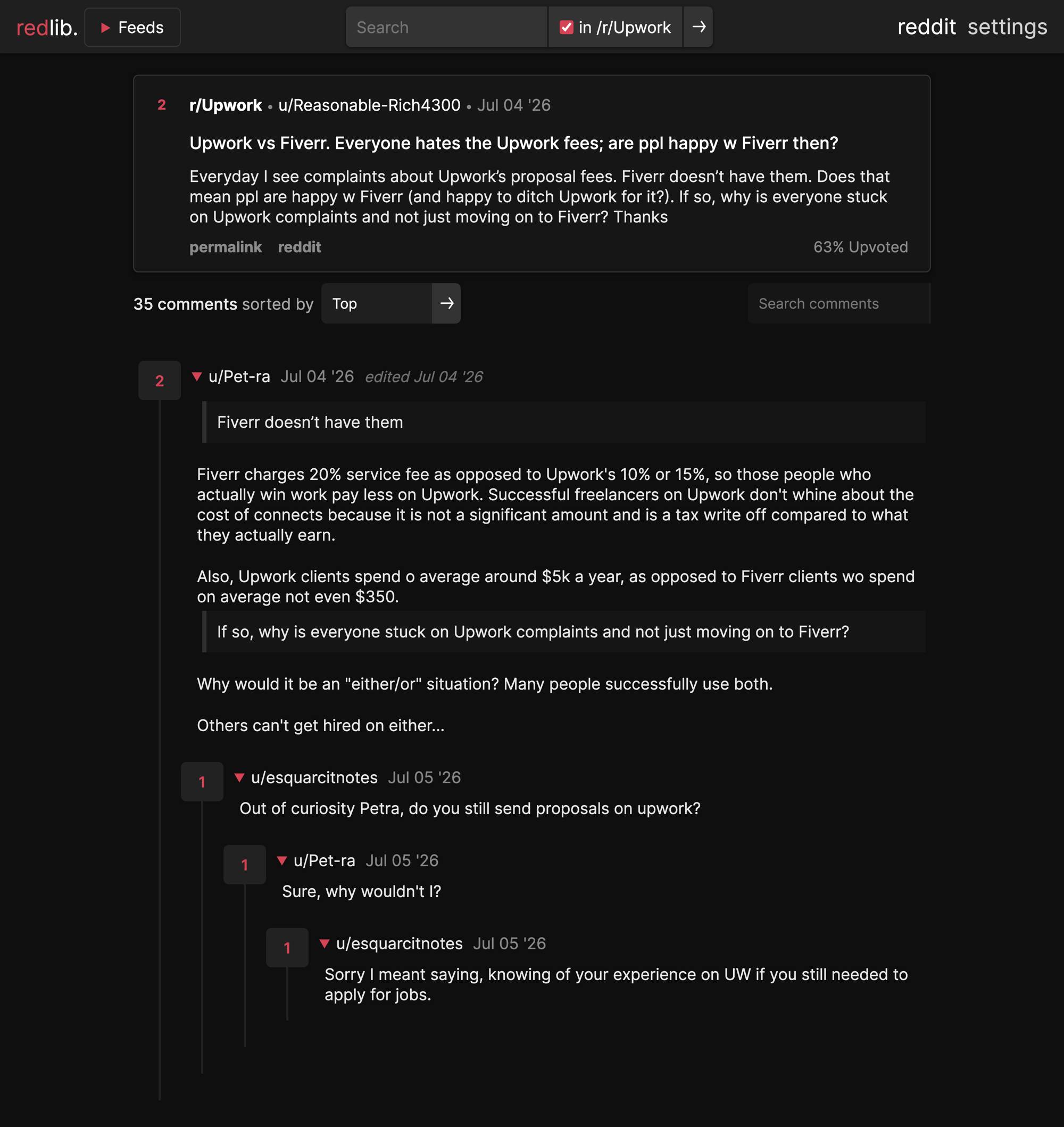
r/Upwork, July 2026. The fee math is the standard answer when someone asks why frustrated Upwork sellers do not simply leave for Fiverr.
That Reddit thread is the pattern I see repeatedly. Agencies frustrated with Upwork look at Fiverr as a fallback.
Then they run the fee math. Fiverr's 20% is flat and unavoidable, while Upwork's service fee tops out at 15% and is frequently lower.
They stay.
Decision tree: which platform for your agency?
Here is how I help agencies decide in my onboarding calls. Three questions, honest answers.
What is your average project size?
Under $100: Fiverr makes sense. You can compete on catalog-style gigs with fast delivery. $100 to $500: It's a coin flip. Run both and see which platform your ideal clients post on. Above $500: Upwork. Fiverr's average order is $50 to $500. Your agency doesn't fit Fiverr's buyer expectations.
Do you want retainer clients or one-shot work?
Retainer: Upwork. Buyers post jobs looking for ongoing relationships, and turning a first Upwork contract into a retainer is a standard agency motion. Fiverr has no native retainer mechanic. One-shot: Fiverr. Single orders, fast turnaround, no discovery calls. Both platforms can technically do both, but the dominant buyer behavior pushes you toward the platform's shape.
Is your agency positioned on expertise or on output?
Expertise-led: Upwork. Proposals let you show understanding, case studies, and strategy. Gigs on Fiverr are effectively spec'd deliverables. Output-led: Fiverr can work. If you sell "10 logos for $200" at volume, Fiverr's catalog format sells for you.
Most agencies I talk to answer Upwork on 2 of 3 questions. That's usually enough to commit.
How GigRadar makes Upwork's fee gap work for you
Picking Upwork over Fiverr is step one. Making the Upwork pipeline work at agency scale is step two.
The average agency burns through Connects faster than they realize. Most bid on 60% of jobs they shouldn't have, because sorting feed noise from real fit in real time is hard.
GigRadar filters your Upwork feed for fit before the Connects fire. We pull your positioning, your portfolio, your avg project size, and score every incoming job in real time. The average GigRadar customer bids on fewer jobs, replies from higher-fit matches, and pays roughly $48 per hire in Connects spend at a 25% close rate. Every figure below prices a Connect at Upwork's published $0.15 list rate, the same rate used in the fee table above.
Those numbers are what a well-filtered Upwork pipeline looks like. $48 per hire beats every cold email service, LinkedIn ad, and trade show on the market.
It also beats Fiverr, where your Connects equivalent (promoted gigs spend plus Fiverr's 20% take) lands closer to $200 per acquired client.
Common questions agencies ask before switching platforms
Can I run my agency on both Upwork and Fiverr at the same time?
Yes, and I usually recommend it for the first 60 days. List your catalog-style services on Fiverr (anything delivered same-day or same-week) and run your proposal pipeline on Upwork.
After 60 days, look at which platform drove revenue and which drove noise. The answer is almost always Upwork for agencies above $5K/month.
Is Fiverr Pro worth it for an agency?
Fiverr Pro vets individual freelancers, not agencies. If one of your team members passes Pro vetting, they can list solo gigs under Pro.
The agency as an entity does not get Pro status. For positioning purposes, Upwork Enterprise Talent Clouds are a closer parallel.
What is Upwork's effective fee really, after Connects and withdrawal?
It depends on the service fee your contracts carry, because Upwork sets that per contract anywhere from 0% to 15%. At a 10% service fee, an agency running an active pipeline lands around 12% to 14% all-in once 1% to 2% withdrawal fees and Connects spend are counted.
At Upwork's 15% ceiling the all-in figure lands in the 17% to 19% band, depending on how hard you push Connects. Fiverr's effective take rate is 21% to 22% regardless of what you sell.
Do Upwork clients have bigger budgets than Fiverr clients?
On average, yes. The average Upwork client spends $5,035 per year, and the average Fiverr buyer spends $342 per year.
Upwork has 145,000 clients spending $5K+ per year. Fiverr has effectively none.
If you need enterprise budgets, Upwork is structurally where they are.
What if I already have a Fiverr agency making decent money?
Don't shut it down. Run both.
Let Fiverr be the catalog arm of your agency for small deliverables and fast-turn projects, and build Upwork as the retainer and high-ticket arm.
Most agencies above $30K/month eventually consolidate on Upwork, but there's no rush to kill a working Fiverr presence.
The bottom line
For agencies, the platforms are not comparable. Upwork is a higher-revenue, higher-margin platform with buyers who expect to build relationships.
Fiverr is a volume-first marketplace with buyers who expect to transact.
The fee gap amplifies the revenue gap. Even at Upwork's 15% service-fee ceiling, the Upwork fee stack still costs an agency less than Fiverr's flat 20%.
If you're starting an agency today and running one platform, run Upwork. If you already have Fiverr revenue, don't kill it.
But every hour you spend on Fiverr positioning should be matched by two hours on Upwork positioning.
The agencies that make this call early and consolidate their pipeline on Upwork are the ones scaling past $30K, $50K, and $100K per month predictably.
The agencies that hedge on Fiverr forever plateau around $10K and wonder why scaling doesn't work.
Build a filtered Upwork pipeline with GigRadar
Stop burning Connects on dead jobs. GigRadar scores every Upwork job against your positioning in real time. 14-day free trial, no credit card.
Book a demo