In May 2025, Upwork replaced its predictable tiered fee structure with a variable model ranging from 0% to 15%. The average effective rate for most freelancers settled around 12–13%, with an additional $49/month charge for client-initiated direct contracts starting July 2025. For agencies who had been converting Upwork clients to long-term direct arrangements, this was a significant cost increase.
But fees aren't the only reason agencies start looking elsewhere. A declining Job Success Score tanks your proposal visibility. Connect costs compound when reply rates are low. Accounts get suspended without warning. And the platform gives you limited tools to fix any of it. This comparison covers 13 alternatives — rated on actual fees, talent quality, platform model, and who each one genuinely serves.
Here's what you need to know before deciding:
- Zero-fee alternatives (Contra, Jobbers, Hubstaff Talent) take 0% of your earnings. Contra charges $29 per contract instead — which is effectively cheaper than Upwork on any project above ~$250.
- Premium vetted platforms (Toptal, Arc.dev) also charge freelancers 0%, but accept only the top 2–3% of applicants. If you get in, you access enterprise clients paying $80–$200+/hr without cold proposals.
- Like-for-like competitors (Fiverr, Freelancer.com) charge 10–20% but have real buyer volume and faster ramp times for freelancers building early track records.
- Niche specialists (99designs for design, Codeable for WordPress, PeoplePerHour for EU) charge more than zero but offer better client-service matching than a generalist platform ever can.
The article also includes a Platform Match Tool — answer four questions and get a tailored recommendation based on your work type, experience level, and priorities.
For most agencies, the right answer isn't switching away from Upwork entirely. It's building a two-platform system so you're not betting your revenue on a single algorithm.
- Upwork changed its fee structure in May 2025. The new variable model ranges from 0–15% and adds a $49/month fee for client-initiated direct contracts.
- The best Upwork alternatives depend on your situation: type of work, budget, whether you're a freelancer or agency, and how much vetting matters.
- For zero-fee alternatives: Contra and Jobbers take 0% commission. You keep everything you earn.
- For premium talent or agencies needing guaranteed quality: Toptal and Arc.dev vet the top 3–5% of applicants.
- For volume and variety similar to Upwork: Fiverr and Freelancer.com are the closest like-for-like competitors.
- Diversifying across 2–3 platforms reduces platform risk. If one algorithm changes, your pipeline doesn't disappear overnight.
In May 2025, Upwork introduced a variable service fee. The old tiered structure, 20% on the first $500 with a 10% band up to $10,000 and 5% above that, became a dynamic system of 0% to 15% depending on skill demand, market saturation, and factors Upwork does not fully disclose. The rate is set per service contract and stays fixed for that contract's life, and the old tiers survive only as grandfathered Legacy Tiered Pricing. Alongside that, they added a $49/month charge for client-initiated direct contracts, effective July 2025.
For many freelancers and agencies, this was the final push. Not just because of the higher cost, but because of the unpredictability. When you can't forecast your take-home rate, you can't price projects confidently. That's a structural problem, not just a fee complaint.
But fees aren't the only reason agencies start looking elsewhere. A declining Job Success Score (JSS) tanks your proposal visibility — and Upwork gives you limited control over it. Connect costs add up fast when reply rates are low. Proposal limits cap how many jobs you can apply to. And if your account gets suspended — which happens without warning and with no clear appeal timeline — you have nowhere to go.
This guide compares 13 of the most viable alternatives to Upwork in 2026 — covering fees, talent quality, how each platform actually works, and who each one is best suited for. If you're staying on Upwork but want a backup, this also covers how to build a two-platform system that protects your revenue without spreading your energy too thin.
What changed on Upwork — and why it matters
The previous Upwork model was tiered but predictable: 20% on the first $500 with a client, 10% up to $10,000, 5% above that. Experienced agencies with long-term clients hit the 5% tier and stayed there. The new variable model doesn't work that way.
Now your fee depends on factors Upwork controls — including how "in-demand" your skill category is and how saturated the market is for that skill. Two freelancers in the same niche can pay different rates. The same freelancer can see their rate shift from contract to contract. Based on community surveys and freelancer forums in late 2025, the average effective fee sits around 12–13% for most mid-level freelancers — a meaningful increase from the 10% mid-tier band that most established agencies had locked in under the old Legacy Tiered Pricing.
The $49/month per direct contract fee compounds the problem. For a 10-client retainer portfolio, that's $490/month — $5,880/year — paid to Upwork on contracts you already won and relationships you already built. Agencies who converted Upwork clients to long-term arrangements expecting to benefit from the old 5% tier now face a completely different cost structure.
That's the context. Here's what you can move to.
All 13 alternatives at a glance
| Platform | Freelancer Fee | Best For | Talent Vetting | Available Worldwide |
|---|---|---|---|---|
| Fiverr | 20% flat | Packaged services, fast delivery | Low (self-serve) | ✓ |
| Freelancer.com | 10% | Competitive bidding, broad categories | Low (self-serve) | ✓ |
| Toptal | 0% | Senior tech, finance, design talent | Very high (top 3%) | ✓ |
| Contra | 0% | Zero-fee independent work | Low (portfolio-based) | ✓ |
| Guru | 5–9% | Ongoing engagements, agencies | Low–Medium | ✓ |
| PeoplePerHour | 3.5–20% | European freelancers | Low (self-serve) | ✓ |
| Arc.dev | 0% | Senior developers (remote) | High (top 2%) | Limited |
| Lemon.io | 0% | Senior developers | High (top 1.2%) | Limited |
| Jobbers | 0% | Zero-commission freelancing | Low (self-serve) | ✓ |
| 99designs | 15–20% | Design work only | Medium (portfolio) | ✓ |
| Hubstaff Talent | 0% | Time-tracked remote teams | Low (self-serve) | ✓ |
| LinkedIn ProFinder | Varies | Professional services, consulting | Low (social proof) | Limited |
| Codeable | 17.5% | WordPress development only | High (WordPress-specific) | ✓ |
Fee comparison: how each platform takes its cut
Platform fees aren't just about the percentage. They're about when you pay, who pays, and what you get in return. Here's how the main players stack up for freelancers, expressed as a percentage of earnings taken by the platform:
*Contra charges $29/contract or $29/month for ongoing work — not a percentage, but not zero-cost either. The 0% refers to no earnings commission.
Before you switch platforms
The 20% Upwork fee only stings if your win rate is below 30%
Most agencies churn through Connects on jobs they were never going to win. GigRadar's scanners filter by client hire rate, payment verification, and budget — so the fee comes off revenue, not wasted bids.
See the scanners →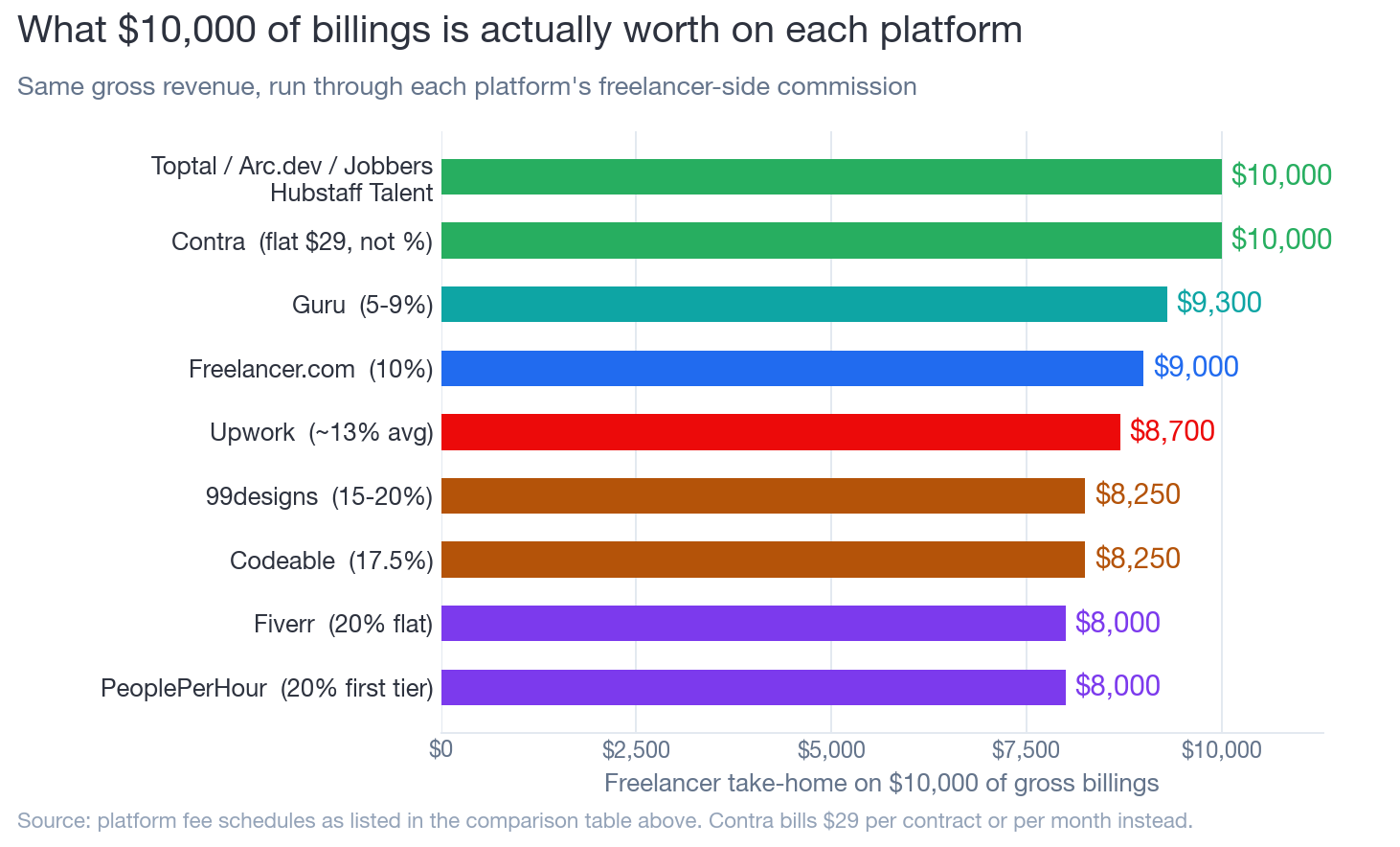
Fiverr — best for packaged, fast-delivery services
Fiverr flips the discovery model. Instead of bidding on jobs, you create "gigs" — fixed service packages — and clients come to you. This means no Connect credits, no cold proposals, and no bidding wars. For freelancers with a clearly defined service, it's genuinely faster to close work here than on Upwork.
The 20% fee is Fiverr's biggest downside — higher than Upwork's current average. But the time-per-client acquisition can be significantly lower if your gig is well-optimized. Fiverr also offers Fiverr Business for teams, which gives clients a curated pool of vetted sellers.
- Clients find you — no cold bidding
- Huge buyer base across 700+ categories
- Structured gig packages simplify pricing
- Fiverr Business adds enterprise clients
- 20% commission is the highest on this list
- 14-day payment clearance period
- Race-to-bottom pricing in saturated gigs
- Hard to negotiate outside package tiers
Toptal — best for senior talent that clients are willing to pay for
Toptal's model is fundamentally different from every other platform here. You don't create a profile and hope clients find you — you apply, pass a multi-stage screening process, and if accepted, Toptal matches you to clients directly. Freelancers pay 0% commission. Toptal charges clients a premium markup above your rate.
The vetting is real: English proficiency test, technical screens, live problem-solving, and trial projects. Most applicants don't pass. But if you do, you're working with clients who expect senior-level work and are paying for it — which means less time explaining your value and more time delivering it.
- 0% commission on everything you earn
- Premium client quality — typically F500 and funded startups
- No cold prospecting — Toptal does matching
- Vetted status is a genuine differentiator
- Very hard to get in — most applicants rejected
- Not suitable for beginners or mid-level freelancers
- Limited categories vs. Upwork's breadth
- Less control over client relationships
Freelancer.com — best for competitive bidding across a wide range of projects
Freelancer.com is the closest structural competitor to Upwork — bidding-based, large talent pool, broad categories. Freelancer.com's 10% freelancer fee does not vary, and it is lower than Upwork's current average, and the client fee (3%) is also slightly lower, which can make it more attractive for price-sensitive buyers.
The main downside: quality control is minimal, which means more low-quality clients and race-to-bottom pricing in popular categories. That said, for agencies building early track records or testing a new service line, it's a viable low-barrier environment.
- Lower fees than Upwork: Freelancer.com takes 10% and it does not vary
- Very wide category coverage
- Contests as an alternative to bidding
- Lower client fees attract more budget postings
- Very high competition, especially in tech/writing
- Low-quality client and job concentration
- Bidding still required — no passive discovery
- Platform UX lags behind Upwork
Contra — best for zero-commission self-managed work
Contra's model is different from traditional marketplaces. You list a portfolio, clients contact you, and you close contracts on the platform. Contra takes $29 per project or $29/month for ongoing work — not a percentage of your earnings. On a $5,000 project, that's 0.58% effective cost. On a $500 project, it's 5.8%. The model rewards higher-value work.
The platform is relatively young and smaller than Upwork or Fiverr, so inbound demand is lower. It works best for freelancers who already have some reputation or audience and want a professional hosting environment for their portfolio and contracts — without giving away 10–20% of every invoice.
- 0% commission — flat fee per contract
- Clean, modern UX that positions you well
- Built-in contracts, invoicing, payments
- Optional $199 boost for more visibility
- Smaller client base vs. Upwork/Fiverr
- Flat fee hurts on small projects
- Discovery is weaker — you need to drive your own traffic
- Less payment protection infrastructure
Guru — best for agencies managing ongoing client relationships
Guru has been around since 1998 and has quietly built a solid infrastructure for multi-milestone projects and ongoing engagements. The "workroom" feature gives agencies and clients a shared space to manage deliverables, milestones, and communication — closer to a proper project management tool than Upwork's contract view.
Fees range from 5% to 9% depending on membership tier (free accounts pay 9%). The client base is generally mid-market — less enterprise than Toptal, less budget-hunting than Freelancer.com. A reasonable middle ground for agencies with 3+ years of experience looking to diversify their pipeline.
- Lower fees than Upwork (5–9%)
- Good workroom tools for project management
- Flexible payment types: hourly, milestone, fixed, recurring
- Less saturated than Upwork in many niches
- Smaller client base and lower traffic than Upwork
- Outdated UI in places
- Vetting is minimal — quality varies
- Less brand recognition with high-budget clients
Arc.dev — best for vetted senior developers seeking full-time and contract work
Arc.dev sits alongside Toptal as a vetted-talent platform, but focuses exclusively on developers and has a slightly higher acceptance rate (top 2–5% vs. Toptal's top 3%). Like Toptal, developers pay 0% commission — Arc charges clients a margin above the developer's hourly rate.
Arc is particularly strong for developers who want long-term or full-time remote contracts with US and European companies. The client pool is tech-forward and the matching process is more automated than Toptal's concierge model. Vetting is thorough but somewhat faster.
- 0% commission — keep everything you earn
- Access to US/EU tech companies without cold outreach
- Good for long-term and full-time remote roles
- Slightly more accessible than Toptal
- Developers only — no other skill categories
- Still competitive to get accepted
- Smaller client base than Upwork or Toptal
- Less brand recognition with non-tech clients
Lemon.io: best for pre-vetted senior developers wanting fast-matched contracts
Lemon.io is a curated marketplace that pairs pre-vetted senior developers with startups and SMBs in about 24 hours. The global talent pool spans 1,500+ senior developers across 100+ tech stacks, with a 1.2% acceptance rate and 0% commission for developers.
It is a strong fit if you want stable full-time or part-time contracts with fast-moving teams. The clients are mostly tech-forward founders who want to skip the usual corporate red tape and hire quickly, and real people handle the matching to ensure a solid technical fit, so you skip endless screening rounds.
- 0% commission for developers
- Fast matching, frequently in under 24 hours
- Legal, invoicing, and payment operations handled for you
- Access to agile, tech-forward startups and mid-sized companies with real budgets
- Highly selective 1.2% acceptance rate
- Senior developers only, not suitable for juniors
- Limited to tech and software engineering roles
- Smaller client pool than massive open networks
PeoplePerHour, 99designs, Codeable — the niche specialists
PeoplePerHour — best for EU-based freelancers and long-term tiered savings
PeoplePerHour uses a tiered commission that starts at 20% and drops progressively to 3.5% as your total billing with a client grows. For UK and European freelancers, it has historically had stronger client density than other generalist platforms — largely because of its founding in the UK market. If you're building a client base in Europe, the lower effective long-term fee makes it more competitive than it first appears. On a client you've billed £20,000+ with, your fee is 3.5% — significantly below Upwork's current average.
99designs — best for designers who want clients that understand design
99designs operates on two models: contests (clients post a brief, multiple designers submit, one gets paid) and direct projects (one designer, standard project). The commission is 15–20%, which sounds expensive — but the buyer pool is categorically different from Upwork. Clients on 99designs know they're buying design. They've already decided to invest in professional work. There's no "can you make a logo for $30" negotiation. For logo, brand identity, packaging, and illustration specialists, this changes the client conversation fundamentally. The revenue-per-project ceiling is also higher than on Upwork's generalist design category.
Codeable — best for WordPress developers wanting curated, pre-qualified clients
Codeable is a single-niche marketplace: every client needs WordPress work, and every developer is vetted specifically for WordPress capability. The 17.5% fee is above what you'd pay on Guru or Upwork's average, but the match quality is consistently high. Clients don't post a WordPress job and receive proposals from React developers who "also know WordPress" — the filtering is built into the platform structure. For agencies that are exclusively WordPress-focused, Codeable's main benefit isn't cost savings — it's time savings from fewer mismatched client conversations.
| Platform | Niche | Fee | Key Advantage | Who Should Use It |
|---|---|---|---|---|
| PeoplePerHour | General (EU focus) | 3.5–20% tiered | Fee drops to 3.5% with repeat clients — industry low | EU freelancers, long-term client builders |
| 99designs | Design only | 15–20% | Pre-qualified buyers who understand design pricing | Logo, brand, illustration, packaging specialists |
| Codeable | WordPress only | 17.5% | All clients and developers are WordPress-specific | WordPress-only development agencies |
Zero-fee platforms: Contra, Jobbers, and Hubstaff Talent
Three platforms charge freelancers nothing at all — each with a slightly different model:
| Platform | How It's Free | Catch | Best Used When |
|---|---|---|---|
| Contra | Flat $29/contract instead of % | Flat fee hurts on small projects | You do high-value (>$1,000) work |
| Jobbers | Genuinely 0% on all projects | Smaller client base, newer platform | You can bring your own clients |
| Hubstaff Talent | Free to list, clients initiate | Discovery is passive — low volume | You want to be found without outbound effort |
The zero-fee platforms work best as a complement to — not a replacement for — a higher-traffic marketplace. The volume isn't there yet on most of them. But for converting existing leads or building a professional contract infrastructure without giving up 10–20%, they're genuinely useful.
How to choose: match your situation to the right platform
Should you leave Upwork — or just build a backup around it?
For most agencies and freelancers, the answer isn't "leave Upwork." It's "stop treating Upwork as your only source of work."
Upwork holds roughly 61% market share of the freelance marketplace category (per Statista 2025 data). The buyer intent is real — clients arrive at Upwork specifically ready to hire. That's harder to replicate on zero-fee platforms where you generate your own traffic. Walking away from dominant market share because fees went from 10% to ~13% is usually the wrong trade.
The real risk isn't the fee level. It's single-platform dependency. Here's what that risk actually looks like:
| Scenario | Single-Platform Agency | Two-Platform Agency |
|---|---|---|
| Account suspended | Revenue drops to $0 immediately | Revenue drops ~50-60% — painful but survivable |
| Algorithm/JSS decline | Proposal visibility collapses, hard to diagnose why | Secondary platform fills gap while you fix Upwork metrics |
| Upwork fee increase | Forced to absorb it or raise prices unilaterally | Shift marginal contracts to lower-fee platform |
| Direct client conversion | $49/mo per direct contract eats margin | Move known clients to Contra ($29/contract) — cheaper immediately |
| New niche testing | Any pivot risks existing JSS and standing | Test new service on alternate platform, no JSS exposure |
The smarter play is a two-platform system:
- Upwork as your primary marketplace — where client intent and inbound volume is highest
- One specialist or zero-fee platform — for converting your own leads or capturing niche clients off Upwork's fee structure
- Direct client relationships — especially for long-term retainers. At $49/month per contract, a 10-client retainer portfolio now costs $490/month in Upwork fees alone. That's ~$5,880/year. Contra's $29/contract model costs less than a quarter of that.
If Upwork suspends your account — as happened to the Updevision agency in 2025, with $12,267 frozen overnight after eight years and $1M+ earned — your pipeline needs somewhere to go. The agencies that recovered fastest were the ones who had already built a secondary presence before they needed it.
Stay or leave?
Don't migrate clients before fixing the Upwork funnel
Most agencies leave Upwork too early. Before you set up Contra or Toptal profiles, see how much of your "wasted Connects" is actually recoverable. We'll walk through your numbers in 15 minutes.
Book a 15-min demo →Frequently asked questions
Last updated: April 2026. Platform fees and features change frequently — verify current rates on each platform's pricing page before making decisions.