
Why value-based pricing is shrinking, and the version that actually works — a 90-second walkthrough. Watch on YouTube
TL;DR
- Value-based pricing adoption among agencies fell from 31% (2024) to 18% (2025), and the holdouts grew slower than agencies on plain retainers (Promethean Research). The "switch to value pricing" advice quietly stopped working.
- The reason: most agencies don't do value-based pricing. They raise their number, call it "value," and hope. If you can't independently measure the outcome, you're pricing on a guess.
- Real value pricing needs three things to line up: a measurable outcome, a client who'll share the numbers, and your ability to attribute the result. Miss any one and you should be on a scoped fixed fee, not value pricing.
- The mechanic that works: quantify the dollar value at stake, then capture 10–20% of it. The calculator below turns "the client's annual revenue + your expected impact" into a defensible fee range in five seconds.
- "Too expensive" is usually a mind-block, not a budget. A small budget means the client genuinely has $500 for a $5k job. Those need different answers.
In 2024, value-based pricing was the answer to everything. Stop selling hours, charge for outcomes, watch your margins triple.
By 2025 the share of agencies actually using it had dropped from 31% to 18%, and the holdouts grew slower than every other pricing model in the survey. That's Promethean Research's read, not mine.
I've watched a lot of agencies on Upwork make this exact move and regret it. The problem was never the idea.
It's that "value-based pricing" became a polite name for charging more without changing anything about how you measure, deliver, or prove the result.
This is the version that survives contact with a real client: when to use it, when to run from it, the math that makes a fee defensible, and the calculator that does the math for you.
Value-based pricing is shrinking, not winning
Every pricing guru, podcast, and conference panel spent three years pushing value-based pricing as the escape hatch from AI commoditizing hourly work.
The agencies listened. Then they quietly walked it back.
Look at where the money actually sits and it gets starker. Across agency revenue, project-based work makes up roughly half, retainers 44%, hourly 30%, and value-based models just 10% (SoDA and Productive's pricing survey).
Value pricing isn't the dominant model. It's a rounding error that gets disproportionate airtime.
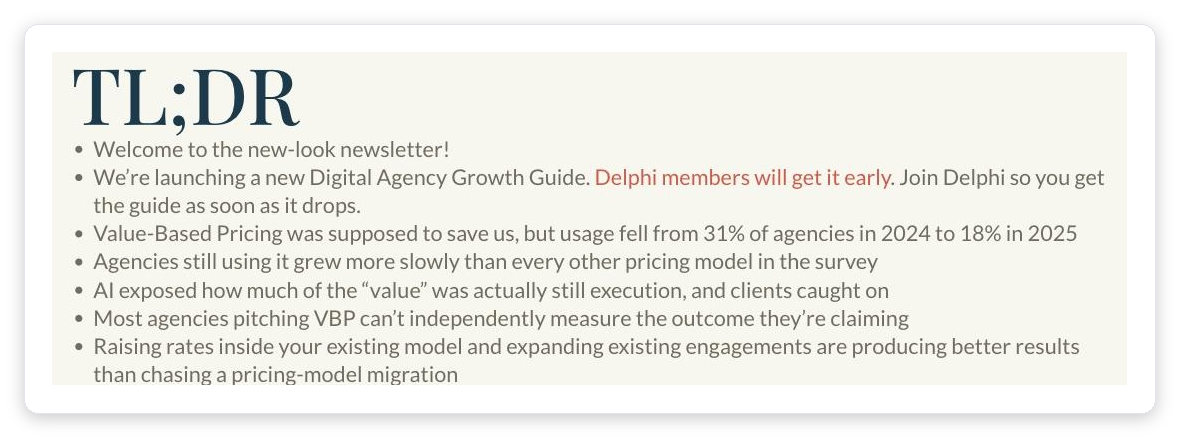
Promethean's blunt conclusion: AI exposed how much of the "value" agencies were charging for was still just execution, and clients caught on.
Raising your rate inside your existing model and expanding the engagements you already have beat chasing a pricing-model migration. So before you blow up your pricing, it's worth asking whether you're a candidate for value pricing at all.
Put a defensible number on it (calculator)
Value pricing has exactly one piece of arithmetic at its core: figure out the dollar value you'll create, then charge a slice of it. The slice is usually 10–30% of the first-year value for revenue work, or 1–2x the annual cost for problems you're eliminating.
This calculator does that for you. Put in the value at stake and your expected impact, pick how aggressively you want to capture, and it returns a fee range plus a sanity check on whether the client still comes out far enough ahead to say yes.
Interactive Tool
The Value-Based Price Calculator
Free, no email. Turns "what's this worth to the client" into a fee range you can defend on a call.
A guide, not a guarantee. The number only holds if you can measure the outcome and attribute it to your work.
Four pricing models, and the rule that picks between them
Every pricing model is a different answer to one question: who carries the risk? Hourly puts it on the client, fixed fee puts it on you.
Value pricing splits the risk and ties your upside to their outcome. None is automatically better, so the model that fits depends on what you're selling and who you're selling to.
| Model | What you sell | The hidden problem | Fits when |
|---|---|---|---|
| Hourly / T&M | Your time | You profit from being slow; the client wants you fast. Built-in conflict. | Open-ended or exploratory work with no clear scope. |
| Cost-plus | Your costs + markup | "Turns the agency into a cost center, not a value driver." Invites line-item haggling. | Almost never for agencies. Procurement-driven buyers only. |
| Fixed fee / scoped | A defined deliverable | Still hourly thinking underneath. Underestimate the scope and you eat the loss. | Well-defined, repeatable work. The safe default. |
| Value-based | A business outcome | Falls apart the moment you can't measure or attribute the result. | Measurable outcome + data-sharing client + your attribution. |
Ron Baker, who wrote the book on this, frames hourly billing as the original sin: timesheets "measure inputs, not outputs," and they don't tell you how to do the work better next time (Agency Management Institute interview). Alan Weiss puts the alternative more bluntly in Value-Based Fees: "You're not selling your time, you're selling your expertise, experience, and the results that expertise produces."
That's the aspiration. Here's the decision rule that keeps it from becoming a fantasy. Three boxes must all be checked before value pricing is even on the table:
You can name at least two numbers that move because of your work and tie to revenue or cost: conversion rate, cart abandonment, qualified pipeline. "Brand awareness" or "a fresh look" fails the test, so brand-identity work belongs on a scoped fixed fee.
No revenue figures, no average order value, no baseline conversion rate means no value pricing. As one branding agency put it, clients love the concept but hate sharing the numbers, so be ready to walk.
Karl Sakas's test: the client needs "good attribution to know that things came from your agency's efforts." If five other vendors touch the same funnel, your value claim is a coin toss.
All three boxes checked, you can value-price. Any box unchecked, charge a scoped fixed fee or a hybrid retainer instead.
Pure value pricing is the exception you earn, not the default you assume. The same logic underpins our Upwork agency pricing playbook and the margin math in retainer pricing.
You're not pricing the service. You're pricing the customer.
Here's the line that reframes everything, again from Ron Baker: "You're pricing the customer, you're not pricing the services or the scope of work."
The same landing page is worth $5k to a local plumber and $500k to a venture-backed SaaS company. Bill them the same and you've made one client overpay and handed the other a gift.
So the work isn't building a rate card. It's running a value conversation before you ever name a price. Blair Enns, who literally wrote Pricing Creativity, breaks it into four moves:
Not "what do you need built" but "where are you trying to get, and what does it look like when you're there?"
Which KPIs prove they got there? Get specific: conversion rate, pipeline, retention, average order value.
"If you process 10,000 leads a month at $100 average order value, lifting conversion one point is $10,000 a month." Now there's a real anchor.
Capture a slice of the quantified value. And always present options, because not every client wants to pay for value the same way.
The 10x rule keeps you honest
Once you know the value, the slice is the easy part. The rule of thumb borrowed from SaaS: the client should feel they're getting at least 10x what they pay, which means your fee lands around one-tenth of the value created.
Demonstrate $200k in new revenue and a $20k fee is a 10% ask the client can justify in their sleep.
Revenue / strategic work → 10–30% of first-year value created.
Cost-reduction work → 1–2x the annual cost you remove.
Default starting point → 10–20%. Above 25% you'd better have proof.
This is also why options matter. Baker calls it becoming "a price searcher rather than a price taker": present a good-better-best set of three and you let the client self-select their tier instead of forcing one number.
Agencies that switched to three tiers report it both lifts average revenue per client and slashes scope creep, because the client knows exactly what they bought.
What value-based pricing actually looks like, with real numbers
Abstractions are useless here, so here are five structures agencies actually run, with the math.
Notice that every one names a metric and a measurement method. That's the difference between value pricing and wishful pricing.
1. SEO: outcome retainer, not hours
Drop the $150/hr rate card and charge $12,000/month for "15 priority keywords on page one within 6 months," with weekly rank tracking and conversion tracking baked into the deal. Agencies running this report revenue per client up ~35% and churn down ~22%, because the client is buying a ranking, not a timesheet.
2. PPC: a cut of the incremental revenue
A 10% fee on revenue above a 15% baseline conversion rate, with a minimum floor so a bad market month doesn't zero you out. Reserved for clients spending $50k+/month on ads (the ones who'll actually share revenue data), it reports a retention lift around 40%.
3. Branding: skin in the game
15% of the projected revenue increase from a rebrand: on a $1M projected lift, that's $150k upfront plus a $50k bonus if the lift clears 25%. Win rates rise ~27% because the client sees shared risk, but it's only offered to clients with documented attribution, never early-stage companies that can't track it.
4. Web dev: price the saving
8% of the first-year value of reduced cart abandonment: cut a leaking checkout from 70% to 65% on a $1M-a-year site and you've saved roughly $250k, so the fee is ~$20k. Average project value rises ~60% versus time-and-materials, but only with a detailed statement of work that defines exactly what "success" means.
5. Full service: good-better-best tiers
$10k / $25k / $50k per month, each tier tied to a defined lift in lead quality and conversion. Average revenue per client up ~45%, scope creep down ~60%, because three clearly-priced options make the decision easy and create a built-in upsell path.
"Too expensive" is a mind-block, not a budget
The moment you name a value-based number, you'll hear "that's too expensive." The mistake is treating that like a budget problem.
It usually isn't.
The Win price talks lesson in GigRadar's Agency Success course draws the distinction sharply. A small budget means the client genuinely has $500 for a $5k job: there's no room, and you should qualify out.
"Too expensive" is a different animal. The money exists, the client just can't picture paying it.
The lesson uses a tomato. Some tomatoes sell for $10 a kilo, and plenty of people have $10 in their pocket and still can't imagine spending it on one.
Your job isn't to drop the price, it's to make the value visible. Five expert hours at $100 beat fifty cheap hours at $10, reused modules cut the timeline, and a proper discovery phase kills the endless revisions that bleed both sides.
🎥 From GigRadar's Agency Success Course: the Win price talks lesson on defending your number.
Blair Enns has a clean move for this, too: anchor against the value before you anchor on the price. "If I could guarantee you $2M in value, what would you pay?"
Once the client has sat with the size of the prize, your fee reads as a small fraction of it rather than a big standalone cost. That only works if you did the quantification in step three.
Free for Upwork agencies
Value pricing needs a steady supply of the right clients
You can only value-price clients who post outcome-shaped work and will share their numbers. GigRadar surfaces those briefs on Upwork and submits proposals through our staffed Business Manager account, so your own agency profile is never touched.
Get Your Free Agency Audit →Where value pricing breaks (and what to do instead)
The reason adoption fell isn't that the math is hard. It's that the real world keeps failing the three-box test.
The client won't share numbers. This is the most common one, and it's not always bad faith.
HubSpot's pricing playbook says you need two data points to price on value: the client's lifetime value and their cost to acquire a customer. When they won't hand those over, use public financials from comparable companies to build a benchmark, then ask the client to correct you.
People will confirm or deny a number far faster than they'll volunteer one.
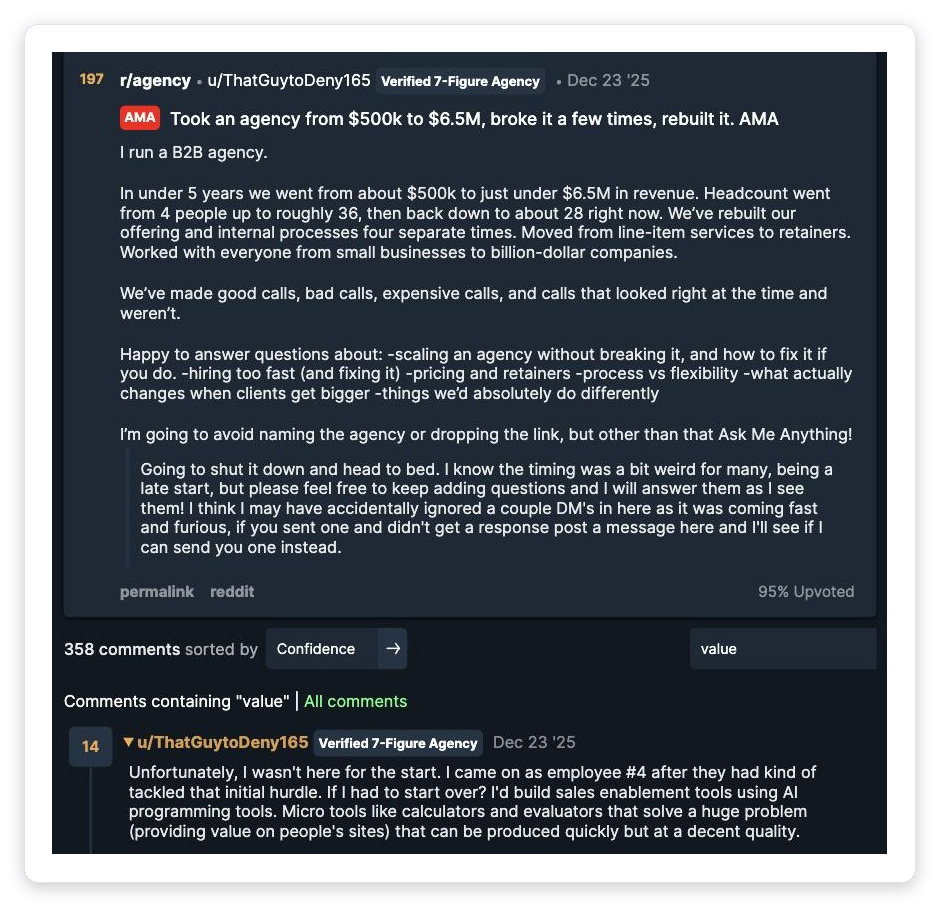
You can't actually measure the outcome. This is the trap most "value pricing" falls into: it ends up being "pricing on vibes," charging more because you believe you're worth it, not because you can prove the result.
If you don't control the client's sales team and can't see their revenue, you're guessing. The honest version isn't value-based pricing at all, it's an outcome-based partnership where both sides agree on the metric before any work starts, and you say no to projects where success can't be measured.
You over-promise the bottom of the funnel. Never tie your fee to numbers you don't control, like closed customers or total revenue, when your work only touches the top of the funnel.
Commit to performance on what your agency directly manages: qualified leads, conversion rate on pages you built, pipeline from content you produced. Sell the process and the leading indicators, not a revenue guarantee you can't keep.
The real blocker is confidence, not structure. Most agencies default to hourly because they've never sat down and worked out what their outcomes are actually worth.
The fix is unglamorous: look back at your last 12 to 18 months of closed projects, add up what you genuinely billed all-in on each, and your real market rate is hiding in the data. Set a minimum engagement floor below that, and you can quote a flat number upfront without the timesheet charade.
For the live negotiation that follows, our negotiation scripts for agencies cover the objection-by-objection responses, and pricing proposals on Upwork covers how to frame it in the bid itself.
The honest takeaway
Value-based pricing didn't fail because it's a bad idea. It failed because most agencies adopted the label without the capability underneath it, and clients eventually noticed they were paying a premium for the same execution.
The version that works is narrower and more honest than the gurus sold. Use it only where the outcome is measurable, the client shares data, and you can attribute the result.
Everywhere else, price a tight scope, protect your margin, and grow by raising rates inside the model you already run. That's not a retreat, it's the move the data says is actually working.
Filling your pipeline with the kind of outcome-shaped clients who make value pricing possible is a separate problem. It's the one our client acquisition guide and GigRadar are built to solve.