
Case study examples that win clients: the anatomy, 7 examples to steal, and where to put yours so it converts. Watch on YouTube
TL;DR
- Every strong case study example runs on the same three-beat skeleton: the client's challenge, your solution, and a quantified result with the client's name attached.
- The "results" section is the least believed part of the document. A modest, verifiable number beats a spectacular unverifiable one.
- On Upwork, the case study isn't a portfolio asset, it's a proposal attachment. Attaching a case-study PDF to a Sales & Marketing proposal lifted reply rate to 24.2% vs 9.6% in GigRadar pipeline data.
- The same PDF is flat-to-negative for software-dev jobs, where a Loom or a Dropbox link out-performs a marketing-styled PDF.
- Use the free Case Study Builder below to turn one client win into a ready-to-attach, category-matched case study.
Attach a one-page case study to a Sales & Marketing proposal on Upwork and the reply rate jumps to 24.2%. Send the identical proposal without it and you sit at 9.6%. That is a +14.7 percentage-point swing from a single PDF, and it comes straight from GigRadar pipeline data on 30,000 proposals.
So the most useful question about case study examples isn't "what should one look like." It's "where does the example actually get read." Most agency owners pour hours into a polished case-study page nobody visits, then send naked proposals into the one place a buyer is actively deciding. This guide fixes the order: the anatomy that every good example shares, seven examples worth stealing the structure from, and exactly where to put yours so it converts.
What a case study example is, and the 24% reason it matters
A case study is a short, structured story of one client outcome: who they were, what was broken, what you did, and what measurably changed. Not a testimonial (too vague), not a portfolio thumbnail (no story), not a deck of logos (no proof).
The format earns its keep because buyers trust it more than anything else you publish. Roughly 70% of B2B marketers use case studies as a core tactic, and 41% of B2B buyers say they value case studies more than blog posts or white papers, because a case study answers the one question every buyer is actually asking: "will this work for a company like mine?" The Content Marketing Institute finds content drives demand for 74% of B2B marketers, and case studies are the late-funnel asset doing the heavy lifting. They're also how most agencies turn Upwork into a steady B2B lead-generation channel instead of a race to the bottom on price.
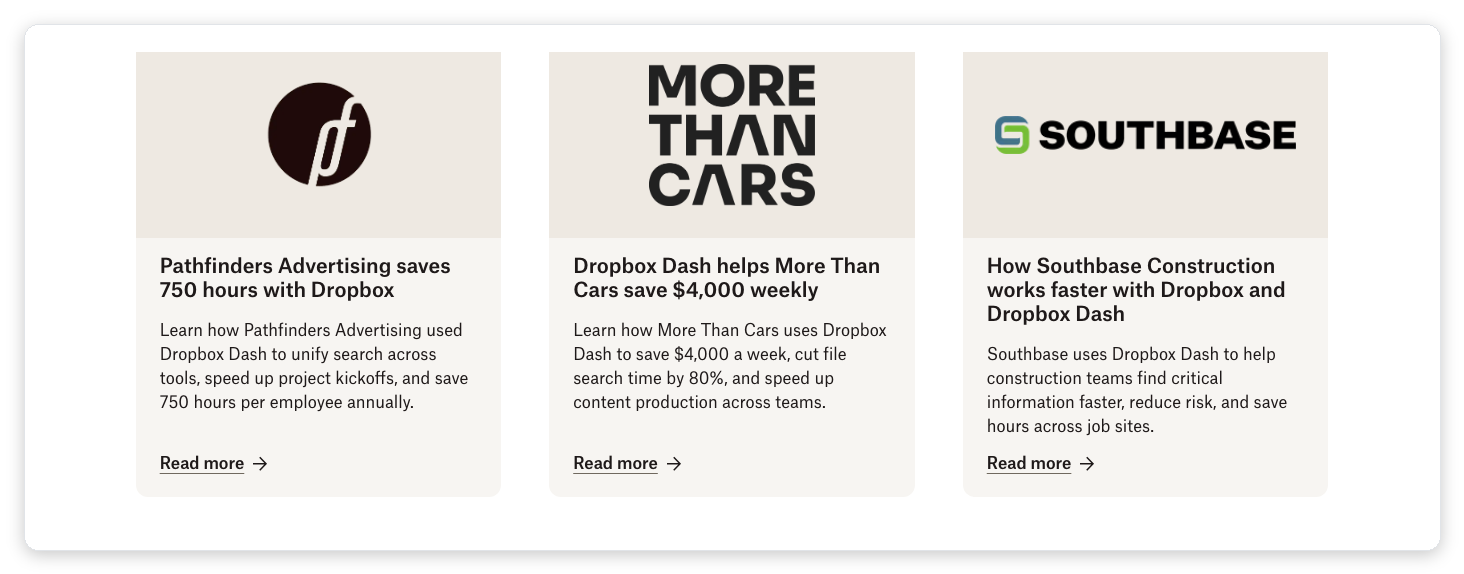
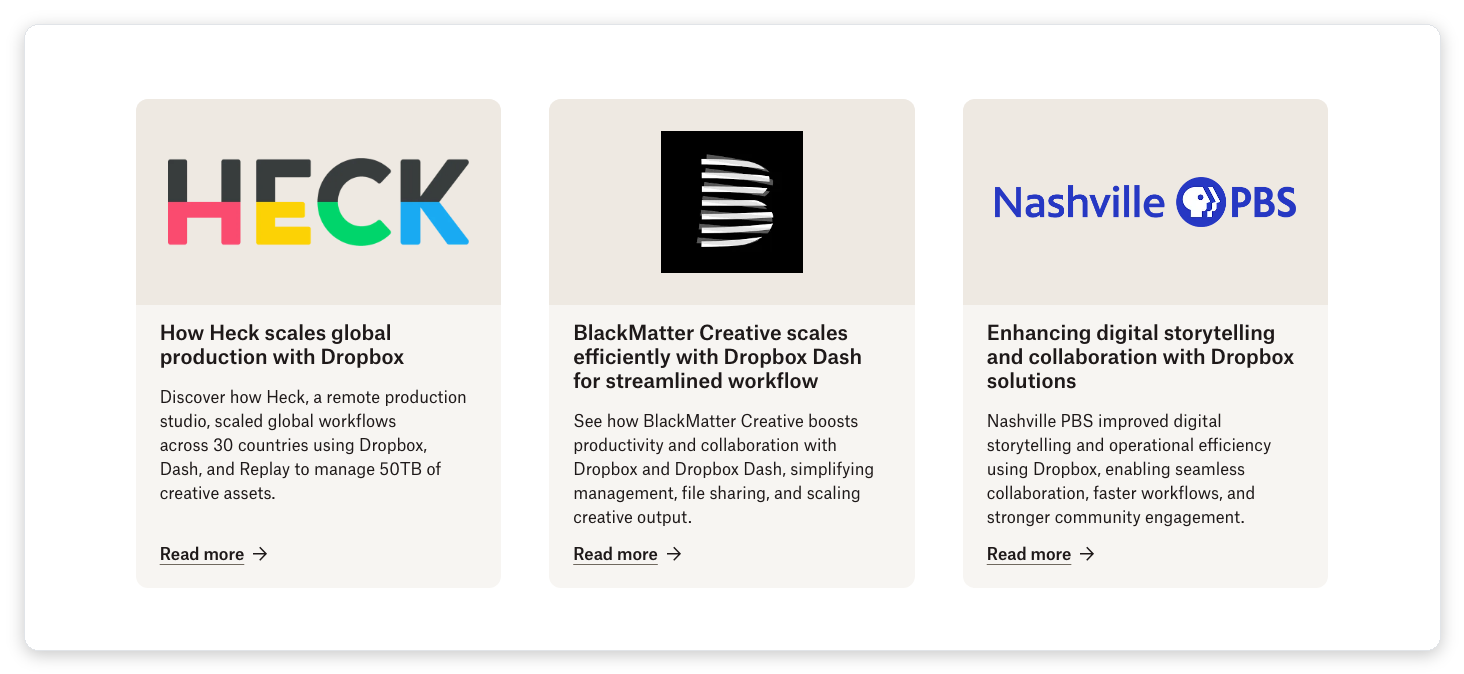
Here is the best example of "what good looks like" you can study for free. Dropbox's customer-stories hub leads every card with a quantified outcome, not a product feature.
Build a case study you can attach today (free tool)
Reading examples is the easy part. The friction is turning your own messy client win into something a buyer will actually read. Fill in the four fields below and the builder assembles a challenge-solution-results case study, scores how believable it is, and tells you the best way to deliver it for your job category, based on the reply-rate data above.
Interactive Tool
The Case Study Builder
One client win in, one ready-to-attach case study out.
The challenge-solution-results skeleton every example shares
Strip the design away from any case study that converts and you find the same load-bearing structure. B2B case-study practitioners and agencies like Walker Sands independently land on the same three beats, because each beat answers a question the buyer is silently asking.
Answers "do you understand a business like mine?" Use a real baseline number (current cost-per-lead, conversion rate, lead volume), not "they were struggling."
Answers "do you have a repeatable method?" Show the decision, not a task list. The client is the hero; you are the guide.
Answers "will it pay off?" One before-and-after metric, contextualized, beats a wall of vanity stats. New Breed calls foregrounding ROI the non-negotiable.
Lead with the result, not the client background. The reader decides whether to keep reading in the first line. "Cut cost-per-lead 38% in 60 days" earns the next paragraph; "Acme Corp is a mid-sized SaaS company" loses it.
7 case study examples worth stealing the structure from
You don't need a Fortune 500 budget to copy what makes these work. Each one nails a different part of the skeleton.
-
1. Dropbox customer success stories
Steal the headline-first format: every card opens with the outcome, then the story. Clean, scannable, customer-as-hero. (dropbox.com/customers)
-
2. VWO landing-page optimization case studies
Steal the methodology transparency: hypothesis, change, A/B test, result. Sophisticated buyers trust process they can audit. (vwo.com)
-
3. MarketingSherpa × Outback Team Building
Steal the single-metric anchor: a 40% increase in conversions carries the whole story. One strong number beats ten weak ones.
-
4. GetUplift emotional-targeting case studies
Steal the "why it worked" layer: state the emotional hypothesis behind each change, not just the tactic. Signals strategy, not button-color guessing. (getuplift.co)
-
5. Velocity Partners × Calm Business
Steal the strategic outcome: not a campaign metric but a market-position shift ("grabbed category leader status"). Proof you change trajectories, not just numbers. (velocitypartners.com)
-
6. The one-page Upwork proposal case study
Steal the compression: client type, problem, approach, approximate result, in four short paragraphs that fit on a single PDF page. Built to be skimmed in a proposal, not browsed on a site.
-
7. The anonymized, NDA-safe case study
Steal the workaround: "a 12-person Series-A fintech", relative deltas instead of raw figures. Keeps the story usable when you can't name the client.
Where most case study examples die: the results nobody believes
The genre is obsessed with the results section. It is also the part skeptical buyers discount fastest, because everyone's case study claims "increased conversions 312%." Self-reported numbers from a vendor read as marketing, not evidence.
What survives the skim is verifiable specificity. The named client and the clickable proof do the persuading, not the percentage you typed. That is why, in GigRadar's pipeline, a Dropbox link in a proposal (usually a PDF case study or project file the client can download) lifted reply rate by +8.8pp, while a generic "see my work" link to Behance or a personal site dragged it down. Substantive, downloadable proof wins; link-outs the buyer has to chase lose.
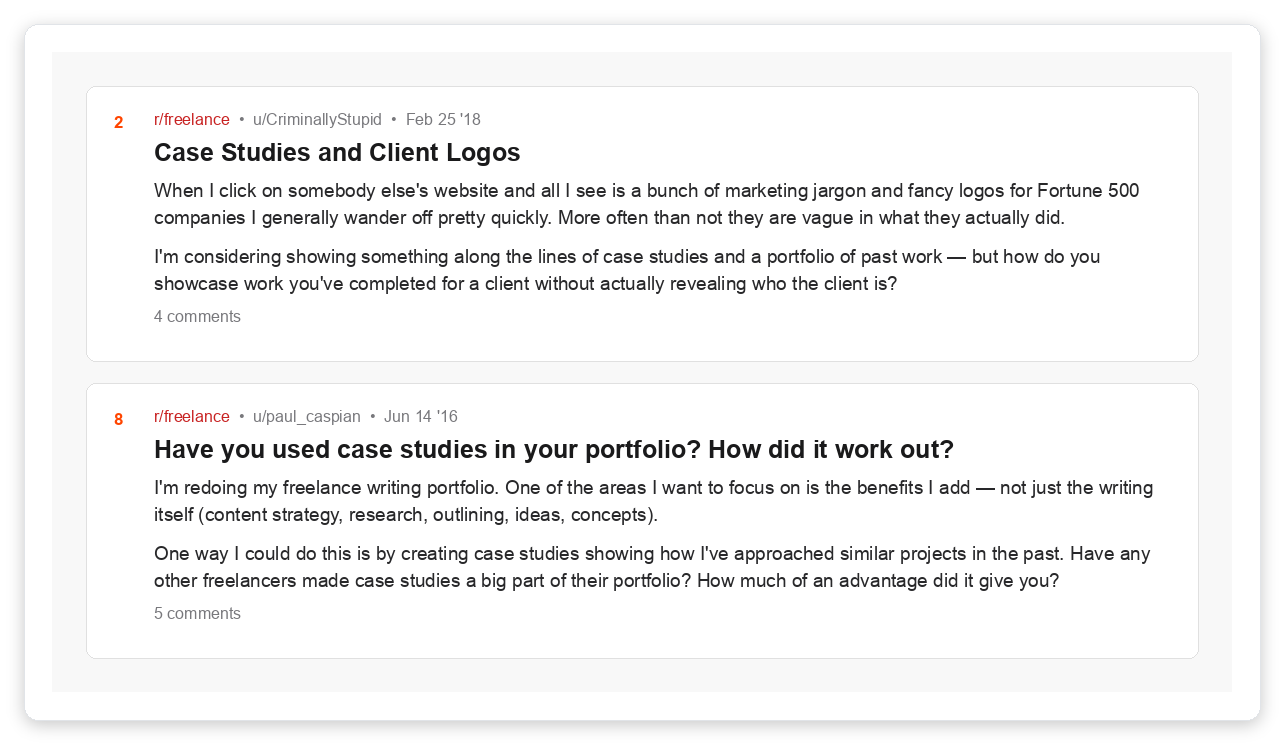
"Have you used case studies in your portfolio? How did it work out?" The thread fills with freelancers admitting clients skim past portfolios entirely, and the ones who get hired are the ones who put proof in front of the buyer instead of waiting to be found.
Paraphrased from r/freelance discussions on case studies and portfolios
If you can't name the client OR link to checkable proof, the spectacular number isn't helping you. A modest "cut cost-per-lead ~38%" with a named logo beats "312% growth" from "a client".
On Upwork, the case study belongs in the proposal, not the portfolio
Here is the part every other guide on this keyword skips. The case study is not a portfolio asset you hope a client stumbles on. It is ammunition you staple to a specific bid. Same document, two contexts: buried in a profile it's dead weight; attached to the proposal a buyer is reading right now, it more than doubles your reply rate.
But the lift is not universal. It depends entirely on who is reading. GigRadar pipeline data on 30,000 proposals shows attachments win big where the buyer thinks in proof-on-paper, and backfire where the buyer wants to inspect the work.
The takeaway is not "always attach a case study." It is "match the artifact to the reader." A polished PDF reads as proof to a marketing buyer and as a salesperson's brochure to a technical one. For dev jobs, a Loom walkthrough or an inspectable Dropbox/GitHub link does what the PDF can't.
One of the instructors in GigRadar's Agency Success course walks through structuring portfolio and case-study pieces so they land even when a client only skims:
🎥 From GigRadar's Agency Success Course: Portfolios That Sell.
| If you bid on… | Put the proof here | Reply impact |
|---|---|---|
| Sales & Marketing | One-page case-study PDF attachment | +14.7pp |
| Design & Creative | Portfolio PDF, or a Vimeo link inline | +5.9pp / +7.9pp |
| Web / Mobile / Dev | Loom walkthrough or inspectable link | PDF: −0.5pp |
| Data Science | Name tools + metrics inline | ≈ flat |
If your bids keep going quiet despite a strong portfolio, the problem usually isn't the work, it's that the proof never reaches the buyer. That's the same gap GigRadar closes by routing strong, category-matched proposals to the right jobs. See how the mechanics work in our guide to building a full-service agency on Upwork, or the deeper high-converting portfolio playbook.
Free for Upwork agencies
Your best case study is wasted in a profile nobody opens
GigRadar puts category-matched proposals (and the proof that wins them) in front of the right Upwork clients, automatically. Book a free agency audit and we'll show you where your reply rate is leaking.
Get Your Free Agency Audit →The NDA excuse, and the case study you're allowed to share
"We can't share results, it's under NDA" is how most small agencies end up with zero proof assets. But NDAs almost always protect the client's identity and raw figures, not the shape of the engagement.
You can anonymize the client and convert absolute numbers into relative deltas or ranges, and you still have a defensible, shareable case study. The structure of the win is rarely the confidential part.
The NDA-safe rewrite, step by step:
"Acme Fintech" becomes "a 12-person Series-A fintech." Specific enough to be relatable, vague enough to be safe.
"$40k to $128k MRR" becomes "roughly 3x MRR in two quarters." The proportion is the proof, not the dollar figure.
The decisions you made are yours to share and the most persuasive part anyway. That's what proves the result was repeatable, not luck.
Pair that with the builder above and you can turn even a confidential win into something you attach to your next bid. For more on positioning the proof inside a proposal, see our breakdown of pricing and proposals on Upwork and the negotiation scripts agencies use once a reply lands.
Start with one example, then attach it
You don't need a library of case studies to change your reply rate. You need one win, written to the challenge-solution-results skeleton, with a number a buyer can believe, and delivered to the right place for the job you're bidding on.
Build that one this week. A marketing buyer gets a PDF; a dev buyer gets a Loom. Then watch what a single piece of proof, put in front of the person actually deciding, does to your replies.
The 5-point case study checklist
- Opens with the result, not the client background.
- Has one before-and-after number a buyer can believe.
- Names the client, or anonymizes safely ("a 12-person Series-A fintech").
- Fits on one page so it works as a proposal attachment.
- Delivered in the right format for the job: PDF for marketing, Loom for dev.