
Watch: 2-minute walkthrough of the cold email subject line formula
TL;DR
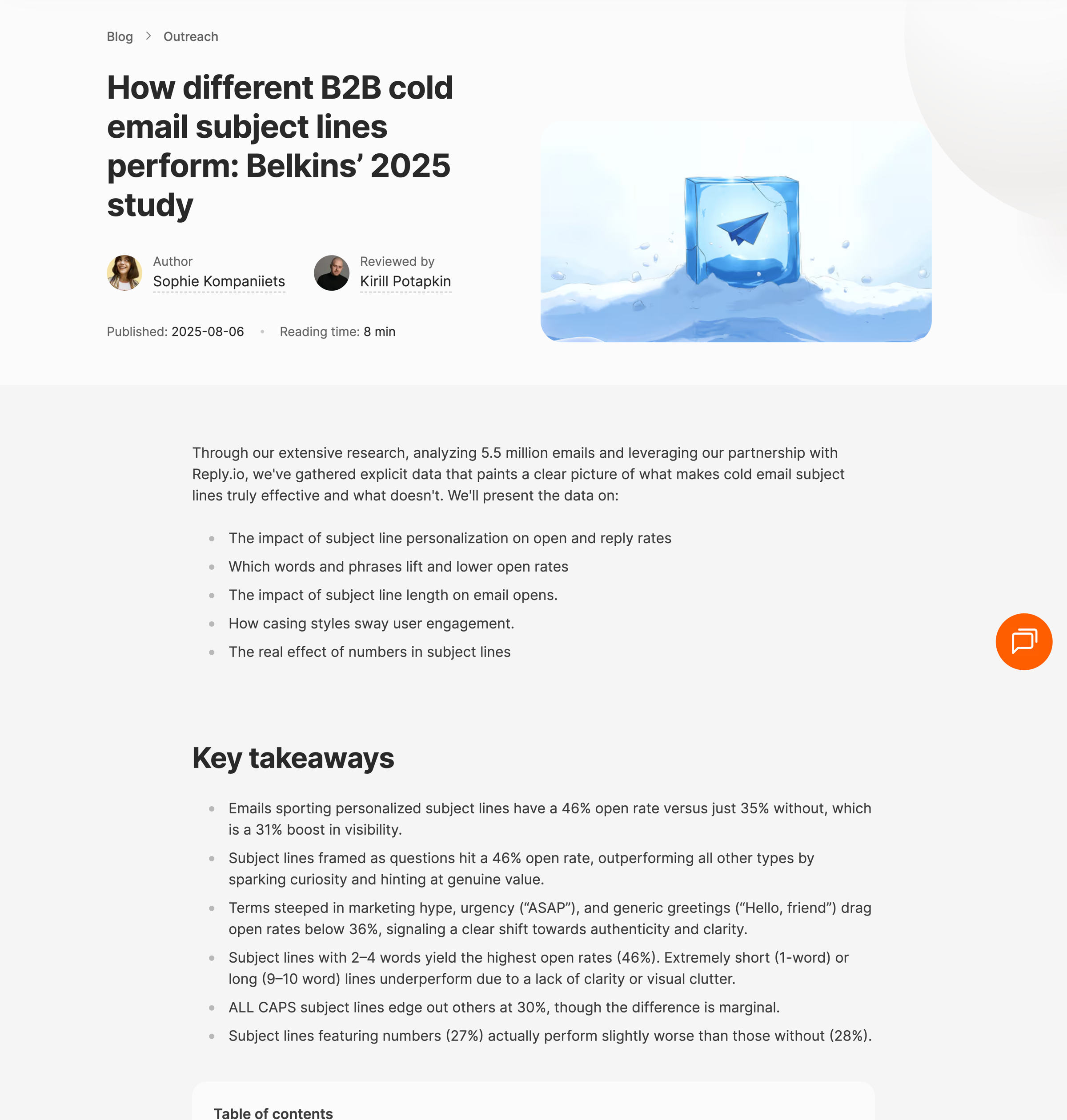
- 2-4 word subject lines hit 46% open rate — shorter than you think works
- Personalized subject lines boost opens by 31% and replies by 133% vs generic
- Question-based subject lines outperform every other type at 46% open rate
- The "internal camouflage" principle: write subject lines that look like colleague emails, not marketing
- Below: 50+ categorized templates + a free subject line scorer tool
Your cold email subject line is the entire pitch. Mike ran a marketing agency with 8 freelancers. He sent 500 cold emails per week with the subject line "Innovative Marketing Solution for Your Agency." Open rate: 11%. He changed it to "Quick question about [Agency Name]." Same email body, same list, same send time. Open rate jumped to 48%.
One cold email subject line change. That was the only difference.
This is not anecdotal. Belkins analyzed 5.5 million cold emails sent in 2024 and found question-framed subject lines pull a 46% open rate while marketing jargon and urgency phrasing push opens below 36%. Not your offer. Not your credentials. Not even your sender name (though that matters too). The subject line.
For Upwork agency owners building a direct outreach channel beyond the platform, this is the cheapest lever you can pull. You already know personalization works — you write custom cover letters every day. Cold email subject lines follow the exact same principle, and the data proves it at scale.
Here is the formula, the data, and 50+ templates you can steal today.
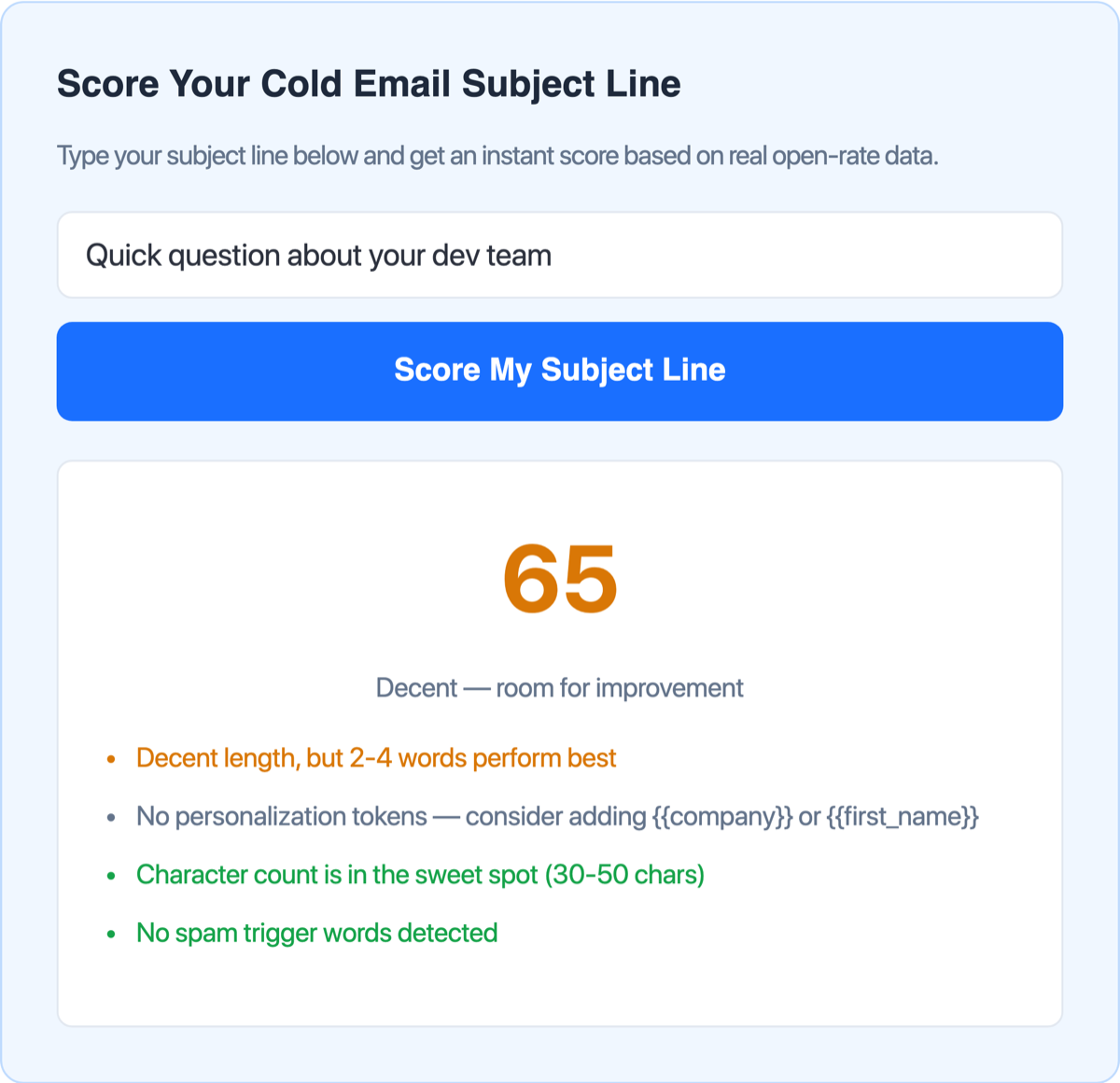
Free Subject Line Scorer Tool
Score Your Cold Email Subject Line
Type your subject line below and get an instant score based on real open-rate data.
The Data: What 10M+ Cold Emails Reveal About Subject Lines
I pulled data from Belkins' 2025 subject line study (5.5M emails sent in 2024) and Focus Digital's 2025 B2B cold email open-rate report. Here is what actually moves the needle:
Length, personalization and question-format figures: Belkins' 2025 subject line study (5.5M emails sent in 2024). B2B average open rate: Focus Digital, 2025.
The pattern is clear: shorter, personalized, question-driven subject lines win. Everything else — urgency tricks, clever wordplay, marketing jargon — underperforms.
Here is the breakdown by subject line type:
Key insight: "Marketing Jargon" sits at the bottom. Every time you write a subject line that sounds like it came from a marketing department, you are actively suppressing your open rates below the industry average.
The principle I call "internal camouflage" — making your cold email subject line look like something a colleague would send — is the single most reliable pattern in the data. No one ignores "quick question" from a peer. Everyone ignores "Exciting Partnership Opportunity!!!" from a stranger.
50+ Cold Email Subject Line Templates That Actually Book Meetings
These templates are organized by intent. Pick the category that matches your outreach context, swap in the personalization tokens, and test.
Category 1: Curiosity-Based (Best for first touch)
These work because they create a knowledge gap without being clickbait. The recipient thinks "what did they notice?" and opens. Best when you have zero relationship and need to earn that first click.
- Quick question about {{company}}
- Idea for {{company_name}}
- Noticed something about {{company}}'s [area]
- What {{company}} usually overlooks about [pain]
- {{first_name}}, this might help
- Before your next [initiative]
- Thought you'd find this useful
- Something's off with {{company}}'s [metric]
Category 2: Personalization + Relevance (31% higher opens)
These signal you did your homework. The personalization token in the subject line alone accounts for a 31% open rate lift vs generic (Belkins, 5.5M emails sent in 2024). They work best when you can reference something specific — a recent hire, a post, or a mutual contact.
- Hi {{first_name}} — 45.36% open rate (Focus Digital, 2025)
- {{first_name}}, made this for you — 42.71%
- {{first_name}} <> [Your Name] — 42.97%
- {{first_name}}, improving [pain point] at {{company}}? — 43.46%
- Saw {{company}} is hiring for [role]
- {{first_name}}, [mutual connection] referred me — 42.98%
- Re: {{company}}'s [recent initiative]
- Your post about [topic] — had to reach out
Category 3: Question-Based (Highest open rates — 46%)
Questions trigger a psychological need to answer. They also look conversational rather than promotional. The data from Belkins shows question-based subject lines outperform every other category at 46% average open rate.
- Are you the right person for this?
- {{first_name}}, can I get your feedback? — 43.45%
- Worth a conversation about [specific outcome]?
- Is [priority] still on your roadmap?
- How is {{company}} handling [challenge] right now?
- Would a [X]% improvement in [metric] matter?
- {{first_name}}, am I off here? — 42.96%
- Thoughts on [specific initiative]?
Category 4: Value-First / Social Proof
Lead with a result you achieved for someone similar. This works when your case studies are strong and the recipient will immediately recognize the relevance. Avoid vague claims — specificity is everything.
- How [similar company] booked 34% more meetings
- [Company] → 18% reply rate in 6 weeks
- 3 strategies that helped [similar client] win
- What companies like {{company}} are doing differently
- A faster way to [reach specific goal]
- [Number] [industry] teams are doing this now
- Helped {{competitor}} fix [problem] — you too?
- The approach that got [client] to [result]
Category 5: Short & Direct (Internal Camouflage)
These mimic the informal subject lines colleagues send each other. They look nothing like marketing. That is exactly why they work. The 2-4 word length sweet spot (46% open rate) falls here. Use these when your sender reputation is clean and your email body does the selling.
- quick question
- {{first_name}}?
- intro
- thoughts?
- 2 minutes?
- not sure if this fits
- trying to connect
- coffee?
Category 6: Follow-up / Breakup
Follow-up emails get opened at higher rates than first touches. The key is signaling finality without being passive-aggressive.
- Still relevant?
- Should I stop reaching out?
- Different angle on [topic]
- Closing the loop
- Last one from me
- Circling back — [one-line value]
- Next steps
- Did I miss something?
The A/B Testing Framework: Find YOUR Winning Subject Line
Templates are a starting point. Your audience, your industry, your sender domain — all of these affect performance. The only way to find your actual winning formula is to test systematically.
Here is the 7-step framework I use:
- Set one hypothesis. "Adding the company name to a curiosity subject line will increase opens by 15% vs. the generic version." One variable. One expected outcome. Write it down before you hit send.
- Choose one metric. For cold outreach, reply rate matters more than open rate. Opens mean nothing if no one responds. Track positive reply rate (replies that lead to a conversation) as your north star.
- Control variables. Same sender name, same audience segment, same send day and time, same email body. The only thing that changes is the subject line. If you change two things, you cannot attribute results.
- Minimum sample size. 100-200 sends per variant minimum. Anything less and your data is noise. If your list is small, run the test over multiple weeks with the same segments.
- Wait 72 hours. Do not declare a winner after 24 hours. Cold emails get opened on day 2 and 3. Replies often come 48-72 hours later. Patience pays here.
- Track beyond opens. Measure the full chain: open rate, reply rate, positive reply rate, meetings booked. A subject line that gets 50% opens but zero replies is a failure. A subject line with 30% opens and 8% reply rate is gold.
- Document and iterate. Keep a testing log (spreadsheet works fine). Re-test your winners quarterly — what works in January might fatigue by April. Patterns shift as templates get overused.
What to Test First
| Variable | Example A vs B | Expected Lift | Priority |
|---|---|---|---|
| Length | "Quick question about {{company}}" vs "question" | +10-20% opens | High |
| Personalization | "{{first_name}}, quick thought" vs "quick thought" | +31% opens | High |
| Question vs Statement | "Is this on your radar?" vs "Something for your radar" | +5-15% opens | Medium |
| Capitalization | "quick question" vs "Quick Question" | +3-8% opens | Medium |
| Specificity | "Your Q2 hiring plan" vs "Your hiring plan" | +5-10% opens | Low |
| Social proof | "How [competitor] fixed [X]" vs "Fix [X] faster" | +8-12% opens | Low |
Start with length and personalization — they deliver the biggest lift for the least effort. Once you have winners there, move down the priority stack.
7 Mistakes That Tank Your Cold Email Open Rates
I see these constantly in agency owner outreach campaigns. Each one is fixable in 5 minutes.
1. Writing subject lines that sound like marketing. "Exciting New Opportunity for Your Business!" screams sales. It triggers mental spam filters before it even hits the technical ones. If it sounds like something a marketing team wrote, rewrite it to sound like something a colleague typed in 3 seconds.
2. Going too long. Subject lines over 7 words drop from 46% to 39% open rate. That is a 15% relative performance hit just from adding extra words. Every word you add after 4 dilutes the open rate.
3. Using ALL CAPS or excessive punctuation. "DON'T MISS THIS!!!" — beyond looking unprofessional, all-caps triggers ESPs spam algorithms.
4. Including your value prop in the subject. "We Help Agencies 3x Revenue" — the moment you put your pitch in the subject line, you have killed curiosity. The subject line's job is to get the open. The body's job is to sell.
5. Using misleading "Re:" on first emails. It works once, then destroys trust and harms deliverability. ESP algorithms now flag fake "Re:" patterns, and recipients who feel tricked never reply. Short-term hack, long-term poison.
6. Not A/B testing. Sending the same subject line to your entire list means you are leaving 20%+ open rate improvement on the table. Even testing 2 variants per campaign compounds into massive performance gaps over 3-6 months.
7. Ignoring deliverability. The best subject line in the world means nothing if you land in spam. Warm your domain, authenticate with SPF/DKIM/DMARC, keep bounce rates under 3%, and never send more than 50 emails/day from a new domain in the first 2 weeks.
Already mastering personalization on Upwork? Scale it beyond the platform.
GigRadar's Business Manager model uses the same personalization principles that make cold email subject lines work — applied to Upwork proposals at scale. Track which approaches get replies. Double down on what works.
Book a Free DemoFrom Upwork Proposals to Cold Email — The Personalization Bridge
Why This Section Matters for Agency Owners
If you run an Upwork agency, you already have the hardest skill in cold email — writing personalized openers at speed. The jump from proposals to cold email is shorter than you think.
Here is the parallel most agency owners miss:
On Upwork, your cover letter opening line determines whether the client reads further. You already know that "Dear Hiring Manager, I am a skilled developer..." gets ignored, while "Noticed your job mentions migrating from Magento to Shopify — I did exactly this for [client] last quarter" gets interviews.
Cold email subject lines work on the same axis. The subject line IS your cover letter opener — just compressed into 2-4 words.
If you are using GigRadar's Business Manager model, you already see the data on which personalization approaches generate replies vs which get ignored. That same testing discipline — tracking reply rates by opener type, iterating on what works — is exactly the A/B testing framework above applied to email.
The natural diversification path for Upwork agencies:
- Phase 1: Master personalized proposals on Upwork (you are here)
- Phase 2: Identify your best clients by industry/size on the platform
- Phase 3: Build a cold email list of similar companies NOT on Upwork
- Phase 4: Apply the same personalization principles to subject lines and email bodies
- Phase 5: Use A/B testing data from both channels to compound your reply rates
The agencies I know doing $50K+ monthly in direct contracts all followed this exact path. Cold email was not a separate skill — it was an extension of what they already knew from writing 200 Upwork proposals a month.
For more on nailing the Upwork side of personalization, see our guides on Upwork cover letter templates and proposal optimization tactics.
Frequently Asked Questions
What is the ideal length for a cold email subject line?
2-4 words. Data from Belkins (n=5.5M emails) shows this length achieves 46% open rates — the highest of any length bracket. Once you go past 7 words, open rates drop to around 39%. Aim for something that looks like a quick internal note, not a headline.
Should I use the recipient's first name in the subject line?
Yes. Personalized subject lines (including first name, company name, or other tokens) achieve 46% open rates vs 35% without, a 31% relative improvement. They also boost reply rates by 133% (7% vs 3%). However, make sure your data is clean — a misspelled name is worse than no name at all.
Do question-based subject lines really work better?
The data says yes. Question-based subject lines hit 46% average open rate across large datasets, outperforming CTAs (44.6%), number-based (44%), and descriptive formats (39%). Questions trigger a psychological need to answer and look conversational rather than promotional.
How many subject line variants should I A/B test?
Start with 2 variants per campaign. You need 100-200 sends per variant to get statistically meaningful results. Testing more than 3 variants at once fragments your sample size and makes it impossible to draw conclusions. Once you find a winner, test it against a new challenger.
Is it okay to use "Re:" in a first cold email?
No. While fake "Re:" used to boost opens, ESP algorithms now flag this pattern. More importantly, recipients who feel tricked never convert to meetings. It trades short-term opens for long-term trust damage and deliverability risk. Build trust from the first touch instead.
What time should I send cold emails for the best open rates?
Tuesday through Thursday, 9-11 AM in the recipient's local timezone. Focus Digital's 2025 data puts Thursday 9-11 AM highest at 44% opens, with Tuesday and Wednesday mornings just behind. This varies by industry, so treat it as a starting point and test your own send windows.