
your upwork cover letter has 90 seconds. most agencies waste them on the wrong sentence
The first 2 lines of your upwork cover letter template are the only thing the client sees in their inbox preview. If those don't reference the job specifically, you lost the read before you lost the reply.
Reply rate above 15% on cold proposals comes from 3 elements: a job-specific opener, one piece of proof tied to the client's stated outcome, and a low-friction next step. Not length. Not formatting tricks.
TL;DR — what actually moves reply rate
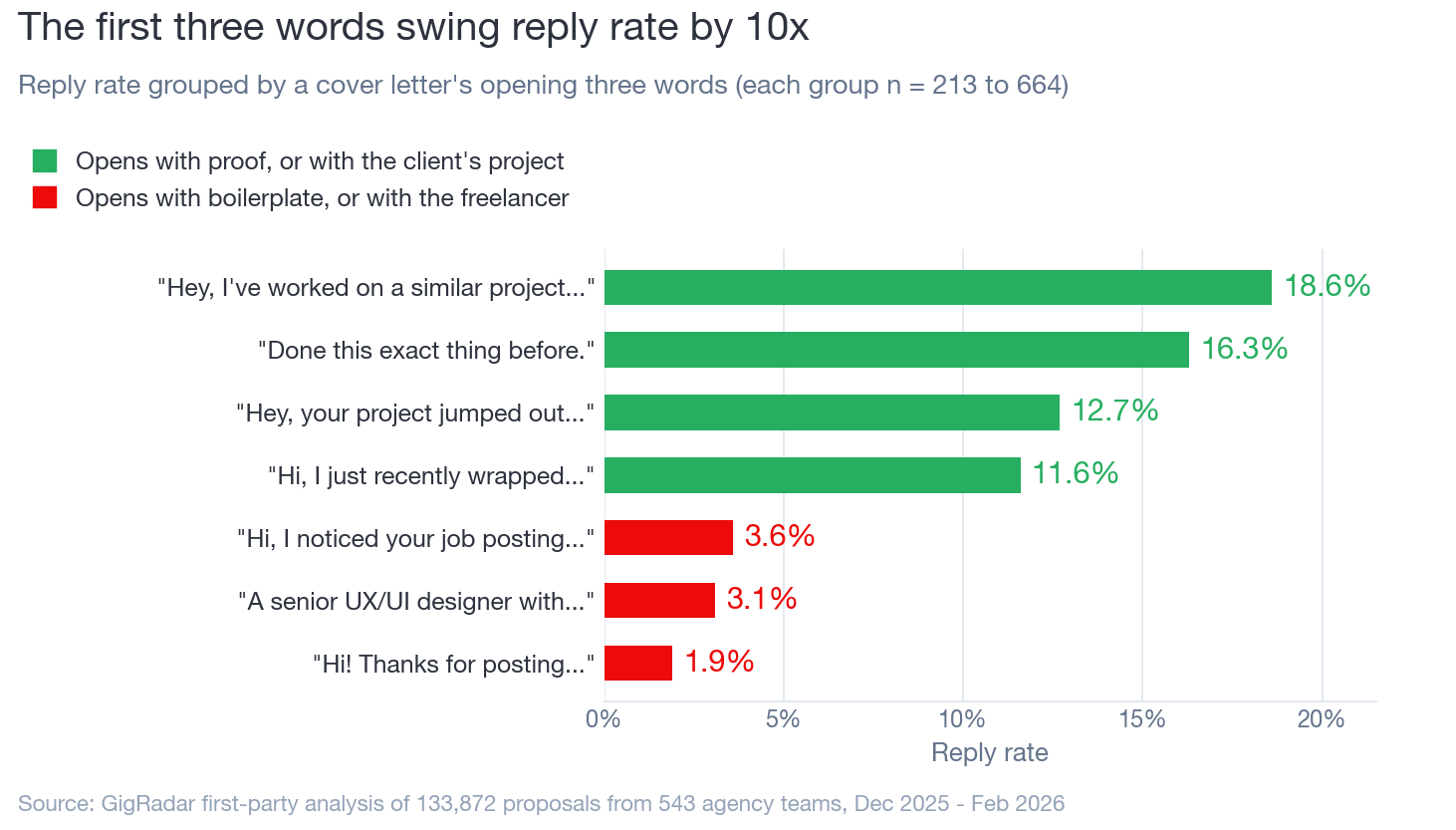
- Open with the job, not yourself. The first sentence must reference a specific phrase from the job post. Generic openers ("I'd love to help with your project") drop reply rate to under 4%.
- Lead with proof tied to the outcome. One concrete result (a number, a client logo, a duration) beats 3 paragraphs of capability claims.
- Make the next step nearly free. A 10-minute call beats "happy to discuss further." A short Loom beats a long PDF.
- Stay under 150 words. Reply rate decays past 180 words. Past 250 words it falls off a cliff.
- Match the client's tone. If the post is technical and direct, be technical and direct. If it's casual, be casual. Mirroring is the cheapest trust signal on Upwork.
- Never start with "I." The word the client sees first should be about them or their problem.
Free Tool
Cover Letter Reply-Rate Scorer
Paste a cover letter you've sent in the last 7 days. Get a 0–100 score against the 6 elements that correlate with reply rate in our pipeline data.
Score is computed locally in your browser. Nothing is sent to a server.
The 6 elements that correlate with reply rate
Across our pipeline data on 3,000+ Upwork agency accounts, swapping a generic opener for a job-specific first line moved median reply rate from 6% to 14% on the same agencies. The cover letter is the second-biggest lever on agency reply rate, behind job targeting and ahead of profile copy. For more on the targeting side see profile optimization for PVR and JSS.
1. Job-specific opener (weight: 35%)
The opening sentence must contain a phrase or detail lifted directly from the job post. Not the job title — a specific requirement, constraint, or outcome the client mentioned. This is the single highest-correlation element with reply rate in our data.
2. Outcome-tied proof (weight: 25%)
One sentence with a concrete number tied to what the client said they want. "Cut churn 31% for a SaaS in your space" beats "experienced in retention." The proof must map to the client's stated goal, not your favorite case study.
3. Low-friction next step (weight: 15%)
End with a specific, time-bounded action the client can take in under 60 seconds. "15-min call Thursday at 10am EST" or "3-min Loom walkthrough below" both work. "Let me know if interested" does not.
4. Length under 150 words (weight: 10%)
The Upwork inbox preview shows about 40 words. The full read has to fit on one mobile screen without scrolling. We see reply rate drop ~0.4 points for every additional 25 words past 150.
5. Tone match (weight: 10%)
If the job post uses bullet points and acronyms, your proposal uses bullet points and acronyms. If the post is conversational, write conversationally. Don't fight the client's voice.
6. No "I" opener (weight: 5%)
Small effect on its own but a clean tell of agency-vs-template proposals. Clients have seen "I am writing to apply" 400 times this month. Skip it.
3 fill-in templates that hit 15%+ reply rate
Template 1: The proof-first opener (best for performance and growth jobs)
{Specific phrase from the job post} — that's exactly the problem we solved for {client in same vertical}, where we {concrete number outcome} in {timeframe}.
The piece most teams miss on this kind of project is {specific insight tied to the job's stated constraint}. Happy to walk through how we'd approach yours.
Quick option: {15-min call link} or a 3-min Loom — whichever you prefer.
{First name}
Template 2: The diagnostic opener (best for fix-it and audit jobs)
You mentioned {specific issue from the post}. 9 times out of 10 when we see this, the root cause is {specific technical or operational reason} — not what most teams check first.
We've fixed this exact pattern for {N} clients in the last {timeframe}. Average resolution: {duration}.
If helpful, I can send a 5-point diagnostic checklist tailored to your stack so you can verify before we even talk.
{First name}
Template 3: The portfolio-pull opener (best for design and brand jobs)
Your reference to {specific brand or aesthetic from the post} matches the work we did for {client}, which {concrete outcome — traffic, conversion, award}.
Sample directly comparable: {single link, not a portfolio}.
If the direction lands, I can have 3 concept directions in your inbox within 48 hours.
{First name}
The mistakes that kill more proposals than bad portfolios
- Opening with "I." The first word the client reads should be about them, their job, or their outcome.
- Listing capabilities instead of outcomes. "We do React, Node, AWS, GraphQL" tells the client nothing about whether you can solve their problem.
- Generic case studies. If the proof you cite isn't in the same vertical or problem space, leave it out.
- Asking the client to do work. "Can you share more details about your requirements?" puts the burden back on them. Don't.
- 3-paragraph intros. The opener and the proof should be in the first 60 words. Everything else is optional.
- Templates with visible {placeholders}. If you ship a proposal with an un-filled {company name}, you've torched your reply rate for that account permanently.
The 3-day exercise: grade your last 10 proposals
Pull your last 10 sent proposals from Upwork. For each one, score it from 0–100 using the weights above: 35 points for the opener, 25 for the proof, 15 for the next step, 10 for length, 10 for tone, 5 for the no-I rule.
Then look at which scores correlate with replies. In our data, agencies that score above 70 average 16% reply rate. Below 40, average is 3%. The gap is the cover letter, not the agency's skill or rates.
For the targeting side of the equation — picking jobs that are actually worth proposing on in the first place — see our breakdown of when to bid on Upwork for fast replies and how the Upwork algorithm ranks proposals.
Using ChatGPT to draft (without sounding like ChatGPT)
The mistake most agencies make with AI proposal drafts is asking for the whole letter. Don't. Ask for just the opener, fed with the actual job post.
Prompt: "Read this Upwork job post: [paste post]. Write a single opening sentence that references a specific phrase from the post and ties it to a concrete outcome. Do not start with 'I.' Do not use the word 'passionate.' Output only the sentence."
Then write the rest yourself. The opener is 35% of reply rate and is the only part where AI saves time without crushing your voice.
What this costs you if you skip it
If your reply rate is 5% and your average proposal costs 6 connects, that's 120 connects per reply. At Upwork's current connect price, you're paying ~$18 per inbox conversation. Move reply rate to 15% and that drops to $6. Across 200 proposals a month, that's a $2,400 difference.
For the full math on connects spend per hire, see our Upwork connects cost-per-hire calculator. For the matching reply-rate proposal template, see our proposal template breakdown.
Want the scorer? GigRadar grades every proposal for you.
GigRadar tracks every proposal your agency sends across all your Upwork accounts, scores it on the 6 elements above, and surfaces which freelancers on your team are dragging the average down. It also flags jobs where your reply rate is statistically too low to be worth bidding on — before you spend the connects.