
🎬 Retainer Pricing: The Margin Math Most Agencies Get Wrong — the five pricing models, 2026 benchmarks, and the utilization-and-margin math that decides whether a retainer is profitable. Watch on YouTube
The Short Version
- A retainer is only recurring revenue if it is recurring profit. Most agencies price a retainer once, never re-check utilization, and let scope creep quietly erase the margin.
- There are five retainer pricing models. Pick the model before you pick the number, because a $5k access retainer and a $5k deliverable retainer are different products.
- 2026 benchmarks: small clients $1,000–5,000/mo, mid-market $5,000–15,000, enterprise $15,000–50,000+. SEO, PPC, content and design each have their own bands.
- The only price that holds is one built on the math: effective hours (including a scope-creep buffer) ÷ a target delivery margin of 55–60%+.
- Use the calculator below to see the gap between what you'd charge for scoped hours and what you actually need to charge to hold your margin.
Fast-growing agencies serve fewer retainer clients than average, not more. The 2025 benchmark from Predictable Profits (300+ seven- and eight-figure agencies) found the fastest growers completed 24% more projects while running 16% fewer retainers.
That is not an argument against retainers. It is an argument against the way most agencies do retainer pricing: pick a round number in the first sales call, lock it for a year, and never look at it again while the scope quietly doubles.
I have watched dozens of agency owners discover that their "stable" $4,000/month retainer was actually their lowest-margin account by the time they bothered to measure it. The retainer was recurring. The profit wasn't.
Free Tool
Retainer Pricing & Margin Calculator
Plug in the real numbers. See what the retainer should cost, what margin it actually leaves once scope creep hits, and which tier you're in.
Parakeeto recommends 55–60%+ on your P&L.
A retainer is only recurring revenue if it's recurring profit
The pitch for retainers is predictability. Recurring monthly revenue, smoother cash flow, less time selling. All true, and all beside the point if the number is wrong.
Retainers are now the dominant engagement type. Promethean Research's 2025 Digital Agency Industry Report found 95% of agencies offer project work, 91% offer retainers, and 88% offer both. A 2026 survey reported by Digital Agency Network put retainers as the primary model for 78% of agencies, up from 64% in 2023.
Here is the part nobody puts on the sales page. A retainer locks a fixed price against a variable scope. Every other engagement type re-prices when the work changes. A retainer doesn't, unless you build the re-pricing in.
So the question is not "should I do retainers." It is "is this specific retainer still profitable this month." If you can't answer that in under a minute, the price is running you, not the other way around.
The five retainer pricing models, and what each one actually sells
Most agencies blur these together and then wonder why clients argue about deliverables. Pick the model first. The number comes after, and it means different things in each one.
1. Pay-for-work (deliverable-based)
The client pays a fixed monthly fee for a defined set of deliverables: four blog posts, two ad creatives, one report. Easiest to sell because the client sees exactly what they buy. The trap, per Consulting Success, is that you are still trading time for money. Over-deliver once and that becomes the new baseline.
2. Pay-for-access (availability)
The client pays to have you on call, not for a specific output. Strategy, priority response, a standing seat in their planning. This decouples your fee from hours, which is why experienced shops prefer it. It only works once you have the reputation to charge for judgment instead of deliverables.
3. Hourly bucket (block of hours)
A pre-purchased block, say 30 hours, drawn down through the month. Transparent and easy to defend, but it caps your upside at your hourly rate and invites the client to audit every minute.
4. Value-based
The fee tracks an outcome instead of an input. A common structure: a base fee plus a percentage of new revenue above a baseline, so driving $50k in incremental monthly revenue at 20% earns you $10k.
It is the highest-upside model and the hardest to attribute cleanly. You and the client will argue over what counts as "incremental."
5. Hybrid
A smaller retainer for ongoing work plus separate project fees for discrete initiatives like a rebrand or launch. The most common real-world structure, because it gives you a stable base and still captures upside on big one-off work.
| Model | What the client buys | Best for | Main risk |
|---|---|---|---|
| Pay-for-work | Defined deliverables | Newer agencies, clear outputs | Scope creep on "small extras" |
| Pay-for-access | Availability + judgment | Senior, trusted advisors | Client questions "what am I paying for" |
| Hourly bucket | A block of hours | Variable, support-style work | Upside capped at hourly rate |
| Value-based | A share of the outcome | Measurable revenue impact | Attribution disputes |
| Hybrid | Base + project fees | Most agencies | Two scopes to manage |
Retainer pricing benchmarks for 2026: what to actually charge
Benchmarks are a sanity check, not a price. They tell you whether your number is in the right postal code. Across the industry, monthly retainers land in three broad bands by client size.
Inside those bands, each discipline has its own gravity. The table below collects 2026 ranges reported across agency-pricing guides for the four most common retainer services.
| Service | Floor | Typical | Premium |
|---|---|---|---|
| SEO | $1.5k–2.5k | $4k–8k | $12k–25k+ |
| PPC | $1.5k | $2k–4k (or 10–20% of ad spend) | $10k+ |
| Content | $1k–2.5k | $5k–15k (B2B full-service) | $15k+ |
| Design | $2k–4k | $6k–15k | $15k+ |
Ranges compiled from 2026 agency-pricing guides including Swydo, Column Five, and NEWMEDIA. PPC frequently uses a percentage-of-ad-spend model; content for mid-market B2B clusters at $5k–15k.
These are channel-agnostic methodology ranges. If you sell retainers through Upwork specifically, the channel mechanics (Connects, contract types, payment protection) change the math. We cover that in the Upwork agency pricing playbook and in turning SEO projects into Upwork retainers.
The profitability math: utilization × billable rate × scope discipline
A benchmark tells you what others charge. The math tells you what you can charge and still keep the lights on. Three numbers decide whether a retainer is profitable.
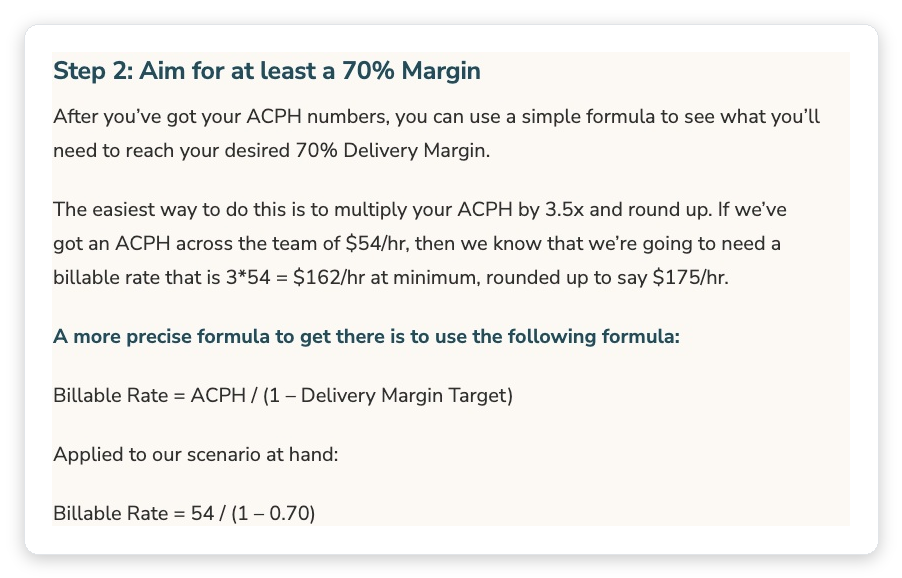
Parakeeto puts healthy agency-wide net utilization at 50–60% (up to 70%), with individual delivery staff at 65–85%. If you priced a retainer assuming someone is billable 100% of the time, you priced a fantasy.
Parakeeto's rule of thumb: your average billable rate should be roughly 3× your average cost per hour, or a 60%+ margin on that rate. Aim for a 70% delivery margin on the target rate so there is cushion for time off and overhead.
The first two are math. This one is behavior, and it is where most margin dies. A retainer priced at a 60% margin can fall below 50% on quiet out-of-scope requests nobody logged.
The targets that tie it together, from Toggl's and Parakeeto's benchmarks: aim for a 25% net margin on the P&L. With overhead around 30% of revenue, that requires a delivery (gross) margin of at least 55%. Parakeeto pushes for 70%+ on individual projects and retainers so the blended number survives reality.
Scope creep is where retainer margin quietly dies
You will almost never lose a retainer's margin in one dramatic event. You lose it 20 minutes at a time, to requests too small to invoice and too frequent to absorb.
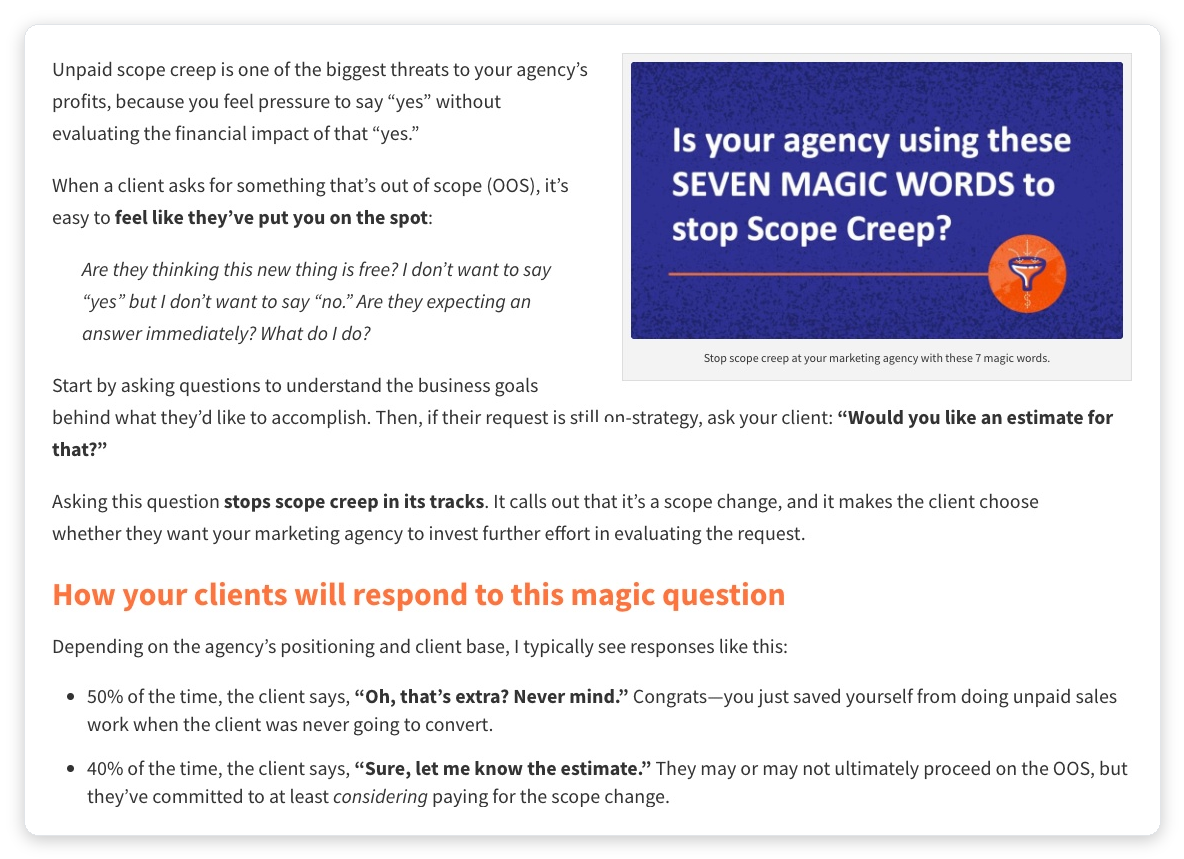
Agency consultant Karl Sakas calls scope creep the single biggest profit leak in fixed-fee work, and estimates unmanaged out-of-scope delivery costs agencies five, six, even seven figures a year. His fix is one question.
"Would you like an estimate for that?"
Karl Sakas, on stopping scope creep at agencies (Sakas & Company)
It works because it reframes a "quick favor" as a billable decision the client now has to make. The request either becomes real scope (paid) or quietly disappears. Either outcome protects your margin.
Sakas pairs it with the Iron Triangle: budget, timeline, scope. You can flex two, never all three. The classic version is "good, fast, cheap: pick two." Write the third constraint into the agreement as an explicit exclusions list, so the line is on paper before the first "can you just..." arrives.
The same logic applies when a one-off project wants to become ongoing care. Rather than absorb it, convert it into a small maintenance retainer with clear weekly hours. One of the instructors in GigRadar's Agency Success course walks through exactly this move in a price negotiation:
🎥 From GigRadar's Agency Success Course. Win price talks: flipping fixed-price into hourly and proposing a maintenance retainer.
The most expensive retainer is the one you never re-measure. A 60%-margin account in January is routinely a 45%-margin account by June, because the scope grew and the price didn't.
Free for Upwork agencies
Stop discounting retainers out of desperation
Underpricing is a pipeline problem in disguise. When you have a steady flow of new clients, you hold your price. GigRadar runs a real Upwork Business Manager that your agency invites through Upwork's official flow, then submits proposals on your behalf under our team's review. Your own account is never touched, and your calendar fills with qualified conversations to convert into retainers.
Get Your Free Agency Audit →How to structure and defend the price
Once the model and the math are set, four structural moves keep the price from eroding. None require a renegotiation. They get written in once.
Start from the formula, then adjust
The baseline both Consulting Success and contract guides like Docually use: hourly rate × expected hours/month × 0.85–0.90 (a 10–15% discount for the commitment). At $200/hr for 20 hours, that is $4,000, discounted to roughly $3,400–3,600.
Use that discount as a reward for guaranteed volume, not a default giveaway. If the client won't commit to a minimum term, they don't get the commitment price.
Anchor with three tiers
Present good / better / best, not a single number. Three options move the conversation from "yes or no" to "which one," and the middle tier becomes the obvious choice. Make any tier one you are genuinely happy to deliver.
Set a rollover policy and a minimum term
The balanced rollover, per Docually: 50% of unused hours, expiring after 60 days. The client gets flexibility for quiet months; you avoid an unsustainable backlog of owed work. Pair it with a 3 to 6 month minimum term so onboarding cost has time to amortize. (For the clause-by-clause version, see our guide to agency retainer contracts.)
Build in an annual review
Add a mandatory annual review clause so rate, scope, and structure can adjust without anyone having to terminate. A retainer priced right in January is usually mispriced by December, in one direction or the other.
Take-home: the retainer pricing checklist
Where retainer pricing actually starts: a pipeline you control
Notice what every move above assumes: that you can afford to hold your price, present three tiers, and walk from a bad-fit client. You can only do that when the next client is already in view.
The agencies that underprice retainers are rarely bad at math. They are short on pipeline, so the deal in front of them feels like the last one. Fix the pipeline and the pricing discipline follows. That is the same logic behind converting projects into retainers and building a repeatable client-acquisition motion instead of relying on referrals you can't schedule.
Price the retainer for the margin. Defend the scope every month. And keep enough demand in the room that you never have to discount out of fear.