
Marketing Consultant Freelance: Solo or Agency? Free Calculator (2026). Two-minute walkthrough of the three-path framework. Watch on YouTube
The Short Version
- Most solo marketing consultants who try to "build an agency" earn less per founder hour at $500K revenue than they did solo. The math doesn't break even until $2M+.
- There are three paths, not two: stay premium solo, go productized solo, or commit to a real agency build. The middle path is what almost nobody talks about and what almost everyone should do.
- Productized solo plays like DesignJoy ($1M+/year, one person) and ColdLytics ($300K) prove the ceiling is much higher than "I'll just raise my hourly rate."
- On Upwork specifically, Sales & Marketing has a 10.26% reply rate (second-highest category) but the optimal rate band is under $15/hr. Upwork is a lead funnel, not where the ceiling lives.
- If you do scale, four traps kill 70% of new agencies in year one: selling everything to everyone, 14-hour solo work weeks, feast-or-famine pipeline, and obsessing over per-proposal reply rate.
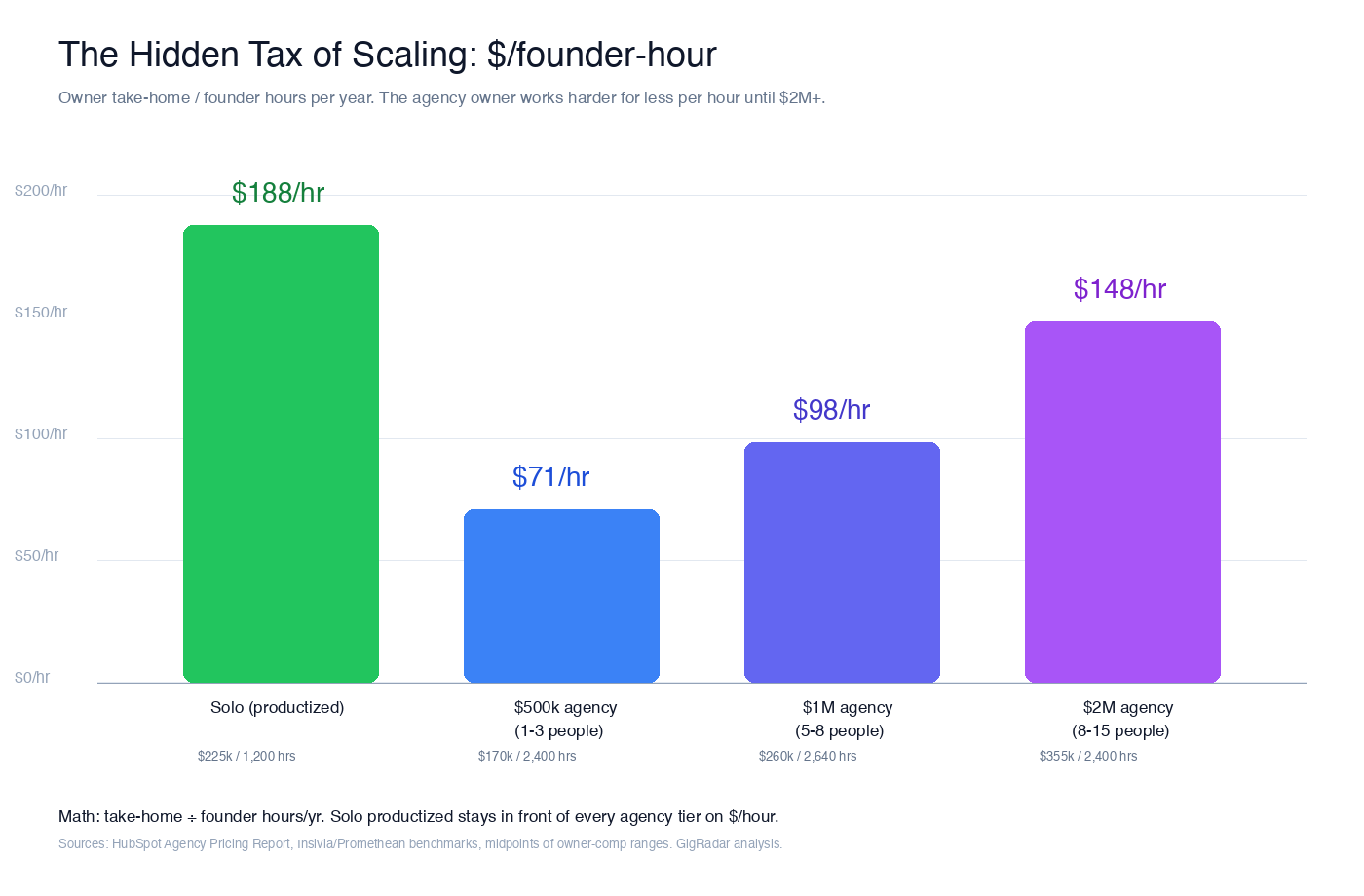
A solo marketing consultant making $200K takes home roughly $188 per founder hour. A $500K agency owner with two contractors takes home roughly $71 per founder hour.
Same person, more revenue, less money per hour they actually work.
That's not a typo. It's the hidden tax of scaling from solo marketing consultant to agency, and it's why most consultants who "go agency" end up exhausted, slightly poorer per hour, and quietly nostalgic for the days they were just billing clients directly.
You probably came here looking for whether to scale. The honest answer is: you have three paths, you've only been pitched two, and the right one for you depends on numbers most consultants never run.
So let's run them.
Interactive Calculator
Solo vs. Agency Take-Home Calculator
Plug in your target revenue and headcount. We compute owner take-home, founder hours per year, and effective $/founder-hour.
The third number is the one that matters.
Margin assumptions: 30% net at <$300K rev (low utilisation), 34% at $300–800K, 26% at $800K–$1.5M (first hires), 20% at $1.5–2.5M (manager layer), 17% at $2.5M+ (corporate overhead). Based on HubSpot Agency Pricing Report and Promethean 2026 State of Digital Services.
Adjust mentally if your model is unusually lean or fat.
The three paths most consultants get pitched as two
Every "should I build an agency?" article on the internet gives you a binary: stay freelance, or scale into an agency. That framing has cost a generation of consultants tens of thousands of dollars in needlessly hired contractors, blown retainers, and 60-hour weeks.
The honest framing is three paths, each with a different ceiling and a different operating model:
Premium solo
Raise rates, niche down, drop low-margin work; bill 20–30 hours per week at $200–$400/hr. Ceiling: ~$300K/yr.
Productized solo
One repeatable deliverable, fixed price, 1–2 contractors doing execution; you stay the only seller. Ceiling: ~$1M/yr (DesignJoy proves it).
Full agency
5+ people, account managers, real sales process, equity story; founder mostly sells and recruits. Ceiling: $5M–$10M+/yr.
Most consultants who "go agency" don't actually pick Path 3. They drift into a malformed version of it.
Three contractors, no manager layer, no sales hire, still doing the delivery themselves. And call it scaling.
That's not Path 3, and the math doesn't work.
Path 1: Premium solo (and the Upwork data nobody wants to face)
The first move every consultant tries is the same: raise rates, work fewer hours, keep the difference. It works up to a point, and the marketing-agency lead generation playbook around niche positioning works the same way solo.
That point is roughly $200–$300K in annual revenue if you're disciplined about what you take on and ruthless about what you don't.
The math is simple: sustainable billable load for a solo professional caps around 25 hours per week. The rest of your week is sales, admin, marketing yourself, and the unbillable client-management overhead nobody talks about.
At $250/hr × 25 hrs × 48 weeks, you land at $300K. To go higher, you either raise the rate (which the market will eventually push back on) or pick a different model.
Rochelle Moulton, who has been advising solo consultants for 20 years, puts it bluntly on her podcast:
"I have clients who easily hit 300,000, 500,000, even a million without a single employee. If you want to stay solo, commit yourself to scaling the easy way."
Source: Rochelle Moulton, The Soloist Podcast
The Upwork-specific wrinkle for marketing consultants
If Upwork is your primary lead channel, the premium-solo playbook collides with a counterintuitive data finding. We analysed 25,058 Sales & Marketing-category proposals in GigRadar's pipeline data over Dec 2025–Feb 2026, and the optimal hourly rate band on the platform for S&M is under $15/hr (14.84% reply rate).
The same skill set bid at $35/hr replies at 9.0%.
Upwork is not where a premium marketing consultant's ceiling lives. It's a lead funnel.
Win the call with a low Upwork rate, then convert the relationship to an off-platform retainer at your real rate. Anyone who tells you they're charging $300/hr on Upwork is either a Top Rated Plus with a 5-year client base on the platform, or making it up.
The S&M-specific reply data goes deeper. The highest-reply opener on Upwork is "Hey!
I'm confident I can help" at 20.8% reply rate. The lowest-reply opener is the one every consultant defaults to: "Hi, with over X years of experience…" at 4.0%.
The words "ROI" (-2.58pp), "Klaviyo" (-3.32pp), and "retention" (-3.88pp) all drag your reply rate down because every consultant uses them.
If you want the full playbook on what to write in your Upwork cover letters as a marketing consultant, our team built it from this data. Read cover letter Upwork for the patterns and Upwork proposal template for the three formats that hit 15%+ reply rate.
Path 2: Productized solo (the middle path nobody pitches you)
This is the path that almost nobody writes about and almost everyone should consider. You stay solo.
You don't add a sales team. You don't hire account managers.
You take one thing you do well, package it as a fixed-price recurring product, and use 1–2 contractors for execution leverage.
The proof points are real and named:
$1M+/year, solo. Unlimited-design subscription at a fixed monthly rate.
Brett spoke to The Futur about hiring designers, hating it, and going productized instead.
All productized, all featured in ManyRequests' productized service case studies. None of them ever pitched themselves as "an agency."
Fractional CMOs bill $3,000–$21,000/month per client at 5–15 hours/week each. Three clients at $7K/month = $252K/yr at ~30 hrs/week of work.
The productized solo path has one structural advantage agencies don't: it scales without scaling you. You add a contractor, not an employee.
You productize one deliverable, not five. You sell the same package to every client, not custom-scope each one.
You stay the only seller, which means you don't need a $150K sales hire whose commission destroys your margin.
Path 3: Build the agency (and the four traps that kill 70% of them in year one)
If you've genuinely decided on Path 3 (five-plus people, real account managers, eventual exit), the math eventually works. But the year-one failure rate is brutal: BLS-based small-business survival data shows 1 in 5 small businesses fails in year one and ~50% are gone by year five.
The professional-services sector tracks close to that average, and marketing agencies cluster around the same survival curve.
The four agency-specific failure patterns we see at GigRadar are consistent across hundreds of conversations with new agency owners. The Agency Success course covers them in detail (lesson embedded below); here is the compressed version:
From GigRadar's Agency Success Course. Fatal Traps for Solo Freelancers (the lesson on what kills newly-formed agencies).
Trap 1: Selling everything to everyone
The most common failure pattern. Web design, SEO, content, social, paid.
All of it, because "we have to take what comes in." The Upwork algorithm gets confused, your profile reads as a generalist, and your reply rate craters.
The course's Tony case study makes this concrete: he was Top 5% in CRO, then added AI consulting and Shopify tweaks, and watched his ranking collapse as the algorithm lost track of what to send him.
Trap 2: 14-hour days with no delegation
You started the agency to escape the freelancer time-trade. Now you're coding, invoicing, bidding, jumping on calls, and sleeping in your office.
You're afraid to hire because hiring is risk. So you stay the bottleneck and the agency can't grow strategically because you don't have the hours.
Trap 3: Feast-or-famine pipeline
You land good clients. You stop sending proposals because the team is busy.
Two of those clients churn at the same time. Your pipeline is empty.
Now your team is on the bench for six weeks while you rebuild, and that cash gap is what kills most early agencies. You bid the hardest when you're least desperate.
Trap 4: Obsessing over per-proposal reply rate
"I sent 4 manual proposals and got 2 replies. Now I send 100 automated and only get 10 replies.
That's worse, right?" No. The first is a 50% reply rate at the cost of your entire week.
The second is 10 conversations at zero of your attention. Reply rate falls when you scale; reply volume goes up.
Conversations are what pay the bills, not percentages.
The honest math on which path pays the founder more
The dirty secret of agency economics: at $2M in revenue with 12 people, the owner's take-home is roughly the same as a top-tier solo consultant. The difference is you have 12 people's payroll, 12 sets of expectations, and a calendar full of 1:1s.
| Configuration | Revenue | Owner take-home | $/founder-hr |
|---|---|---|---|
| Solo, hourly billing | $180K | $140K | $117 |
| Solo, productized | $300K | $225K | $188 |
| $500K agency, 1–3 ppl | $500K | $170K | $71 |
| $1M agency, 5–8 ppl | $1M | $260K | $98 |
| $2M agency, 8–15 ppl | $2M | $355K | $148 |
Two things jump out. First, productized solo at $300K beats the $500K agency configuration on every meaningful metric: more take-home, fewer hours, no payroll.
Second, the $2M agency doesn't pay you meaningfully more per hour than a productized solo at $300K. You're scaling for non-monetary reasons at that point.
Equity, a real exit, building something beyond yourself.
If you're choosing the agency path purely to make more money, the math says you're wrong unless you commit to crossing $3M+ revenue. Below that, productized solo wins every time.
For solo consultants and small agencies on Upwork
Pick your path. We'll keep the Upwork pipeline running either way.
GigRadar operates a real Upwork Business Manager that submits proposals on your agency's behalf under our team's supervision. Your account is never touched.
Whether you're solo, productized, or building a 10-person shop, the pipeline is the same boring asset that should never be feast-or-famine.
Book a free agency audit →The 5-question decision framework
If you're still genuinely unsure which path is right, run yourself through these. The pattern of your answers tells you which path the math wants you on.
Honest answer determines whether Path 3 even works for you. Tolerating it eventually shows up in your team's eyes.
If yes. Path 2 (productized) is on the table.
If your work is fundamentally bespoke each time, you're stuck choosing between Path 1 and Path 3.
If yes, demand exists. If no, hiring won't solve your problem.
Sales will. Hire your way out of a delivery bottleneck, not a sales one.
Take-home: Path 1 or 2. Exit: Path 3, and commit to crossing $3M revenue.
Anything below doesn't sell for meaningful multiples.
If no, don't hire full-time; use contractors (Path 2 model) until you can. 29% of failed small businesses cite "ran out of cash" as a primary cause, and most over-hired before the pipeline was stable.
Most of those over-hired before the pipeline was stable.
If you've already decided you want to scale into an agency, we have the full playbook at freelancer to agency, scaling an Upwork agency, and how to start a freelance agency on Upwork. This article was about whether you should.
Those are about how.
FAQ
Is being a freelance marketing consultant viable in 2026?
Yes, and the data is unusually strong. Upwork's 2026 freelancer earnings research puts the average US freelancer at $99K/yr, with top specialists at $275K.
Sales & Marketing on Upwork is the second-largest category by proposal volume and the second-highest reply rate (10.26%). The viability question isn't whether you can earn, it's whether you can defend a niche.
How much does a freelance marketing consultant actually make per year?
Median sits around $90–120K based on PayScale's 2026 marketing consultant data and Glassdoor's freelance-marketer benchmarks. Top quartile clears $130–200K.
Hard solo ceiling without productization sits at $225–300K. Beyond that you either productize or hire.
When should I switch from solo consulting to running an agency?
Three conditions need to be true at once: you're turning down 30%+ of inbound work, your delivery is bespoke enough that productizing won't work, and you genuinely want to manage people. If any of those are false, Path 2 (productized solo) beats Path 3 on take-home per hour.
Don't scale because everyone says to. Scale because the math and the work-style fit both demand it.
Do solo marketing consultants on Upwork really succeed at premium rates?
Yes, but rarely at premium rates on Upwork itself. GigRadar's pipeline data on 25,058 Sales & Marketing proposals shows the highest reply rate band is under $15/hr.
Upwork's algorithm and client base reward affordability in this category. The premium-solo move is to win the call cheap on Upwork, then convert the relationship to an off-platform retainer at your real rate.
The platform is a lead funnel, not your ceiling.
What's a productized service, and how is it different from an agency?
A productized service sells one specific deliverable at a fixed price, usually on subscription. DesignJoy sells "unlimited graphic design" for $5K/month.
MixBloom sells social content packs. ColdLytics sells qualified lead lists.
The customer buys a known thing for a known price. No scoping, no proposals, no custom statement of work.
Agencies sell capacity (people's time) and custom work. Productized sells outcomes (a deliverable).
The model scales without scaling you, which is why solos can hit $1M before they hit "agency."
How many billable hours can a solo marketing consultant realistically work per week?
The honest answer is 20–30 billable hours per week, with industry data on billable utilisation showing even firm-supported lawyers cap around 35–39 billable hours/week. As a solo, you're also your own sales, marketing, finance, and admin, which consumes 35–45% of your working hours.
That consumes 35–45% of your working hours. Anyone telling you they bill 40+ hours/week sustainably is either lying, burning out, or about to quit.
Plan for 25 hours/week of billable as your steady state.
What's the failure rate for new marketing agencies?
There's no marketing-agency-specific dataset, but BLS-based small-business survival numbers are the closest proxy. About 20–24% of small businesses fail in year one, and roughly 50% are gone by year five.
The most-cited failure cause is "no market need" (42%), followed by "ran out of cash" (29%). Both map directly to the agency-specific traps: undifferentiated positioning and feast-or-famine pipeline cause the majority of early-agency deaths.