
2-minute video walkthrough. When to convert, and the 5 traps that kill new agencies.

Most freelancers convert to an agency 8 to 14 months too late. They wait until the calendar is on fire.

By then they have already bled $30K to $80K of lost capacity, and they are bringing every bad habit from solo into a structure that punishes bad habits 10x.

The other half convert a year too early. They register an agency on Upwork before they have repeatable inbound, hire two juniors, run out of cash in four months, and then sit on a cold agency profile that drags down their JSS for the next two years.

Both failures are avoidable if you understand exactly what the agency conversion changes on Upwork, what it does not, and the narrow window where it compounds instead of leaks.

This article walks through when to flip it on, when to wait, the five traps that kill new agencies inside 90 days, and the three GigRadar customers who got this right so you can copy what worked.

Upwork's agency landing page showing Microsoft, Airbnb, Automattic, Bissell, and Cloudflare as Trusted by clients with Development, Design, and Sales & Marketing as top in-demand agency categories

Upwork itself routes the enterprise buyers it parades (Microsoft, Airbnb, Automattic) toward agencies, not solo freelancers. Match where the money goes.

The five signals that you should have already converted

I pulled the agency-conversion timing data across 600+ GigRadar customers who made the jump in the last 18 months. The same five triggers show up every time.

If three or more of these are true right now, you are behind schedule.

Signal Threshold that triggers it What it costs you to ignore
Capacity ceiling Turning away $4K+/month of qualified work for 2+ months $50K+/year of lost revenue, zero optionality
Invite overflow 3+ invites per day you cannot respond to within 24 hours JSS drag, invite rate decay, cherry-pick regret
One skill, multiple buyers The same service is being bought by 5+ clients/quarter Your personal brand is the bottleneck, not the demand
Retainer ratio 60%+ of revenue is recurring (retainer, ongoing, milestone-2+) You already run an agency, just without the structure
Enterprise ICP Your best clients are hiring teams, not individuals You lose to agency proposals you never see in the feed

The signal that gets ignored most is capacity ceiling. Solo freelancers get used to declining work the same way smokers get used to coughing.

It becomes background noise, and the dollars never show up on a ledger so they feel invisible.

This is what it looks like on the ground. A career coach posting in r/Upwork last quarter described the exact shape of the miss:

Reddit thread titled I get too much work. Would an agency solve my problem. A $125/hour career coaching freelancer with 99% recommend rate says he declines 4 to 5 invites per day and asks whether an agency would let him route work to partners without hurting his JSS

4 to 5 invites a day, declined. This is the capacity signal in the wild, and it is the exact moment to open an agency account, not the moment to hire juniors.

The math on this specific case is brutal. At $125/hour, declining 4 invites/day at even a 20% close rate at 10 hours/contract costs roughly $25,000 in missed revenue per month.

The cost of converting to an agency and routing the overflow to a vetted partner is closer to $0 out-of-pocket if you do it right.

The four signals that mean you should NOT convert yet

Converting too early is worse than too late. A cold agency profile with zero hours logged drags on every proposal you send from your freelancer account for months, and you cannot undo it cleanly.

Don't convert if any of these are true
  1. You do not have 3+ months of pipeline without you personally bidding. If every contract still requires you writing the proposal, you are not ready to delegate the production side. You are ready to delegate the bidding side (GigRadar) but not to take on the payroll of an agency.
  2. Your JSS is under 90 or your last 12 months have 2+ below-3-star reviews. Agency profiles start with zero reputation. If your solo profile is not a clean launchpad, converting dilutes it without compensating with agency-level signal.
  3. You do not have a specific niche that agencies are being hired for in your category. Some Upwork categories (voice-over, proofreading, niche translation) are actively biased toward individuals. Check the "top hired" section in your category before you convert.
  4. You cannot float 4 months of runway without a single contract. Agency onboarding on Upwork takes 90 days of ramp-up minimum. If cashflow is tight, the pressure to close bad contracts compounds the JSS risk.

Vadym walks through the three fatal traps solo freelancers hit when they convert too early (niche dilution, the "case study of one" problem, and the feast-or-famine loop) in the GigRadar course:

🎥 From GigRadar's Agency Success Course: Fatal Traps for Solo Freelancers. The three mistakes that kill conversions before the first agency contract

Score your own readiness in 2 minutes

Free Tool: Readiness Scorer

Should you convert to an agency on Upwork right now?

Answer 7 questions about your current Upwork operation. The scorer returns a Go / Wait / Don't verdict plus the specific thing to fix next.

What actually changes when you turn on an agency profile

Most conversion advice online is 6 years out of date. The agency mechanic on Upwork was rewritten twice since 2022.

The biggest misconception is that the agency replaces your freelancer profile. It doesn't (it runs in parallel).

Here is what actually shifts the day you flip it on, based on what GigRadar customers have measured on both sides of the switch:

What gets better
  • Visibility on enterprise jobs. Jobs tagged "prefer agency" or "need a team" only show agency proposals in the top tier.
  • Multi-contractor contracts. You can bill 3 contractors against one client without it looking like a middleman arrangement.
  • Trust signal on first-time contact. "Agency with 12 hires and $80K earned" lands harder than "freelancer with 12 hires and $80K earned" on the same dollar volume.
  • Category match. In dev, design, B2B marketing and PPC, the top 10% of budgets go disproportionately to agencies.
What gets harder
  • JSS resets to zero on the agency. Your solo score does not transfer. Budget 6 to 12 weeks of unranked proposals before the agency JSS stabilizes.
  • Connects are shared. If three team members bid, one shared pool burns 3x faster.
  • Double 10% fee exposure. You pay Upwork's fee plus whatever you skim off the contractor's rate. Poor margin math kills new agencies.
  • Profile mixing gets you suspended. See the next section.

The crucial point most freelancers miss: keeping both profiles active simultaneously is not just allowed, it is the optimal configuration for the first 9 to 12 months.

Do not migrate your solo reputation. Let the two profiles co-exist and specialize into different buyer segments.

How not to die like Julia (the profile bridge rule)

This is the single most expensive mistake I watch GigRadar customers make, and it is a full account suspension, not a slap. A Top Rated Plus freelancer with $200K+ earned posted in r/Upwork last month describing exactly what happens:

Reddit thread from u/julia_konon3103 in r/Upwork describing how Upwork suspended her $200K+ Top Rated Plus account because contracts accidentally landed under her freelancer profile instead of her agency profile

The failure mode I see at least twice a month: a $200K+ Top Rated freelancer runs an agency AND a solo profile, a contract slips onto the wrong one, and Upwork calls it misrepresentation.

The rule Upwork enforces invisibly: once you register an agency, every contract you sign must match the profile that sent the proposal.

If the proposal went out from your agency, the contract and hours must live under the agency. If it went out from your solo profile, it stays solo.

Sounds easy. Here is what goes wrong in practice:

Trap A: The client switches mid-negotiation

You bid from the agency, but the client messages you on the solo profile (they found your older work first) and you reply from solo. Three weeks later the contract is signed on solo while the original proposal lives under the agency, and Upwork's ML calls this misrepresentation.

Trap B: The team member uses the wrong profile

One of your contractors logs hours under your solo contract because Upwork's Team app opened to it by default, so weeks of hours accrue under the wrong profile. This is the #1 way agency owners get flagged.

Trap C: Identical portfolios on both profiles

Your solo profile lists "10 years doing B2B SaaS dev" and your agency profile lists the same 10 years, same stack, same case studies. Upwork flags this as two accounts representing one person (a Terms violation), so differentiate the agency positioning from day one.

The working configuration is to separate by offer, not by identity.

Solo profile = your specific high-ticket service (strategy, audit, consulting). Agency profile = productized delivery with multiple contractors (implementation, monthly retainer, ongoing maintenance).

Vadym runs through the exact profile-bridge architecture (including how to handle repeat clients that want to move from solo to agency) in the course:

🎥 From GigRadar's Agency Success Course: Rookie Traps for New Agencies. The profile bridge, fee math, and the 90-day ramp

The five traps that kill new agencies in the first 90 days

I have watched about 400 freelancers convert to agencies on Upwork inside the GigRadar customer pool. The pattern of the ones that die in the first quarter is surprisingly uniform.

It is almost always the same five things, often 2 or 3 of them at once.

1
Hiring juniors before revenue justifies it

The instinct after opening the agency is to post on LinkedIn "we're hiring." Resist. The profitable path is to start with 1 or 2 contractors you have already worked with, keep them on a revenue-share until the agency has 3 months of recurring income, and only then start thinking about employees (premature hiring is the top killer).

2
Bidding in your solo niche without differentiation

If your solo profile wins "Webflow developer" gigs, your agency profile cannot just say "agency that does Webflow." It needs a productized angle the solo cannot support (e.g., "Webflow audits + rebuilds for Shopify brands doing $1M+"), so the agency has to sell a job the solo cannot do alone.

3
Year-of-zero panic after the JSS reset

Agency profile JSS starts at zero and is unranked for the first 1 to 3 months, so most freelancers panic at 8 weeks because the agency has landed 1 contract while the solo profile would have landed 4. Budget 90 to 120 days of slow agency growth before you judge it: CodeIT.pro (a GigRadar customer that now does $6M+ lifetime Upwork revenue) had their first year of near-zero before the trust compounded.

4
Running one Connects pool for the whole team

Agency Connects are shared across all members, so without a per-seat bid cap the bid team burns through 200 Connects in a week and the agency owner is left with no budget for high-value jobs. Cap each seat at a specific weekly allowance (GigRadar enforces this at the scanner level; without a tool, enforce it in a shared doc with the daily burn rate).

5
Ignoring the fee double-dip

Upwork charges the agency 10%, then you pay a contractor some portion of what's left: a freelancer clearing $80/hour solo who bills $80/hour as an agency while paying a contractor $50/hour is actually clearing ($80 × 0.9) − $50 = $22/hour of margin. Too many agencies run at a loss for 6 months because the math was never done, so model margin on a per-contract basis before every bid.

The three agencies that got this right (and what copied)

Vague advice is slop. Here is what actually happened to three specific GigRadar customers who made the jump in the last 18 months, what they did in the first 90 days, and what their numbers looked like on the other side.

Case 1: Grandz

Solo dev to 8-person agency, 250% revenue growth in 18 months

Grandz converted from a solo full-stack profile with 4 years of Top Rated history, and did not migrate the solo contracts. They kept the solo profile live for high-ticket strategy work and used the agency for productized SaaS MVP builds, with first-year agency revenue up 180% and solo revenue also growing 40% in the same window.

+$21K
new monthly revenue
250%
growth in 18 months
8
team members
Case 2: CodeIT.pro

Near-zero year one, $6M lifetime Upwork revenue by year four

CodeIT's founder warned me explicitly about this: the first 12 months of the agency profile were "demoralizingly quiet," with the new agency landing 1 small contract a month while the Top Rated solo profile kept humming. They stayed the course, focused on winning one lighthouse enterprise client, and by year 4 they had crossed $6M in total Upwork earnings as an agency.

The lesson: if you bail on the agency after 4 months because it is not performing like the solo, you never get to the compounding phase.

$6M
lifetime Upwork revenue
12 mo
of quiet ramp before compounding
4 yr
to breakout scale
Case 3: EagleRocket

Close rate doubled after moving bid ops off the solo owner's shoulders

EagleRocket was a solo profile that had plateaued: the owner was bidding personally, closing ~12% of sales calls, and running out of hours. The conversion was driven by hiring a dedicated bidder/SDR who specialized in Upwork, shifting bid volume under the agency profile, and keeping the solo profile active for personal-network leads.

Close rate doubled to ~24% in the first 6 months because the bidder did the one job full-time instead of the owner squeezing it into margins. This is the "buy time back" conversion, not the "add capacity" one.

2x
close rate increase
6 mo
to stabilize new structure
1
dedicated bidder hire

The through-line across all three: keep the solo profile alive, pick a productized agency offer that the solo cannot support, expect 90 to 120 days of slow growth, and move bid ops off the founder as early as you can.

The first 30 days runbook: what to do the day after you flip the switch

Most conversion guides dump 40 generic tips. Here is what actually happens day-by-day in the first month if you do it right, with every line as a specific action, not a principle.

D1
Register the agency, do NOT migrate any solo contract

Create the agency profile with a different positioning line than solo, do not move ongoing contracts, and keep the solo profile fully active. Clients who try to "move" an existing engagement to the agency should be told "agency is for new work, solo stays for our existing contract."

D3
Add 1 to 2 trusted contractors you've already worked with

Do not hire strangers in week one; invite past collaborators who have delivered for you before. Pay them revenue-share (typically 50 to 70% of billed hourly) until the agency has 3 months of stable revenue.

D5
Build ONE productized offer that the solo profile cannot support

Example: "3-week Shopify audit + migration" (requires 2 contractors), "Monthly PPC retainer with weekly optimization" (requires 24/7 coverage a solo can't provide). The offer must require agency structure to fulfill.

D7
Cap Connects per seat, not per agency

Set a per-seat weekly cap (e.g., 60 Connects per bidder per week). Without this, one aggressive team member burns the shared pool: see our Connects cost-per-hire guide for the math.

D14
Run the first agency scanner with clear ICP boundaries

Your agency scanner is NOT your solo scanner copied: it targets jobs that explicitly benefit from a team (larger budget, longer timeline, multi-role scope). See scanner filter framework for the filter set.

D21
Audit fee math on every signed agency contract

For every contract landed in the first 3 weeks, calculate: (client rate × 0.9) − contractor cost − your time on the account = true margin. If any contract is under 30% margin, that offer gets reworked before the next bid.

D30
Review profile-bridge compliance, then plan month 2

Audit every contract signed in month 1: did the proposal and the contract live under the same profile? If any mismatch, close the contract and re-issue from the correct profile (month 2 goal: 3 to 5 active agency contracts with healthy margin).

What about the "no agencies" jobs? (the hidden pool)

A real objection: roughly 15 to 20% of Upwork jobs explicitly say "no agencies, freelancers only." Does converting to agency-only lock you out of that pool?

Yes and no. Your agency profile is locked out of those jobs, but your solo profile (you kept it alive, right?) can and should bid on exactly those jobs.

The two profiles specialize into different buyer segments. Here is the client reality on enterprise/team jobs, from a client who posted in r/Upwork last year (the most upvoted thread of the quarter):
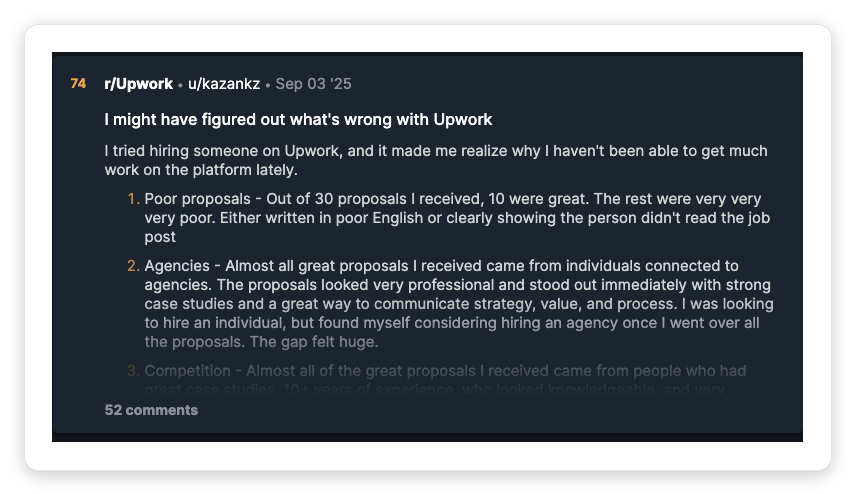
Reddit post from a client in r/Upwork explaining that almost all the great proposals they received came from individuals connected to agencies, not from solo freelancers

Read this one twice. A client doing real hiring on Upwork tells you which proposals actually stand out, and the answer is "people attached to agencies."

The solo-only jobs are smaller, faster-close, lower-margin; the agency-accepted jobs are larger, slower-close, higher-margin. Running both profiles means you capture both tiers instead of being forced to pick one.

Vadym covers the specific positioning tactic for bypassing "no agencies" restrictions when the client would actually benefit from team delivery in the course:

🎥 From GigRadar's Agency Success Course: Bypass "no agencies". How to position an agency proposal on a freelancer-only job without lying or getting flagged

The copy-paste pitch for your agency conversion announcement

Once you have landed the first 2 to 3 agency contracts, tell your existing solo clients about the agency (not to move their contract, but to open the door for overflow work and referrals). This is the message that works:

Hey [CLIENT NAME], Quick update: I've spun up an agency profile on Upwork for the bigger projects that needed more than just me. Our ongoing work stays exactly where it is (under my solo profile), nothing changes on your side. If anything comes up in the next few months that needs [SPECIFIC AGENCY OFFER, e.g., "a full rebuild instead of a single-person build" or "24/7 PPC coverage instead of weekly"], that's what the agency is built for. Here's the link: [AGENCY PROFILE URL]. And if you know anyone on your side looking for that exact kind of scope, I'd love the intro. Thanks as always, [YOUR NAME]

Three things this does: preserves the existing contract structure (profile-bridge safe), opens a new buyer conversation with the client, and creates a referral surface without asking for it directly. Agencies I've watched use this verbatim have landed 1 or 2 new contracts within 60 days from 20 client outreach messages.

Upwork alternatives if your conversion signals point to "wait"

If the scorer returned "wait" or "don't," the right move is not to sit and do nothing for 3 months. It is to diversify lead sources while you fix the specific conversion blocker.

We keep a running comparison of where Upwork agencies supplement pipeline while their main profile matures in the Upwork alternatives guide.

The short version: Contra and Toptal are the two most common second channels for agency-tier work, Fiverr Pro is better for productized $500 to $5K packages, and LinkedIn outbound is where most agencies eventually build a non-platform pipeline.

Do not treat any of them as a replacement for Upwork. Treat them as a hedge while you fix the specific readiness gap the scorer flagged.

GigRadar

Free 30-min conversion audit

Getting ready to convert? Let us stress-test your plan.

GigRadar has been the bid-ops layer for 3,000+ agencies on Upwork, including roughly 400 solo-to-agency conversions in the last 18 months. We know which traps kill which kinds of freelancers, and we'll tell you in plain English if your plan has a hole in it.

Book Your Free Conversion Audit →

The one-line decision rule

The decision, compressed

$4K+/month of qualified work turned away for 8+ weeks AND JSS 90+ = open the agency this week.

Either is false? Do not convert yet.

If either condition is false, do not convert yet. The rest of this article is commentary on the same rule.

Run the scorer above if you are unsure, and write down the date and the score. In 60 days, run it again and compare: the delta tells you whether you are getting closer or staying stuck.