
The SEO Agency for SaaS Playbook: Pick One Vertical, Charge Three Times More
SEO Agency for SaaS: Pricing & How to Win Clients — the 2-minute walkthrough on niching into SaaS SEO, what to charge, and the positioning mistake that kills reply rates. Watch on YouTube
TL;DR
- In GigRadar's pipeline of 133,872 Upwork proposals, "Shopify specialist" lifts reply rate +1.23pp while "full-stack developer" drags it -2.88pp. Vertical positioning beats horizontal. SaaS is the vertical with the most posted SEO retainers.
- The trap: bragging the bare word "SaaS" in a proposal actually lowers reply rate (-1.77pp), because 14% of all freelancers already do it. Positioning is not name-dropping. It is proving you understand product-led growth.
- SaaS SEO is a different job from local or ecommerce SEO: the conversion is a free trial, not a sale, so bottom-of-funnel comparison, alternative, and integration pages carry 40-60% of organic conversions.
- 2026 retainers: $3-8k/mo for early-stage SaaS, $8-15k/mo at growth stage, fractional operators $2.5-6k/mo. Use the free calculator below to size your offer.
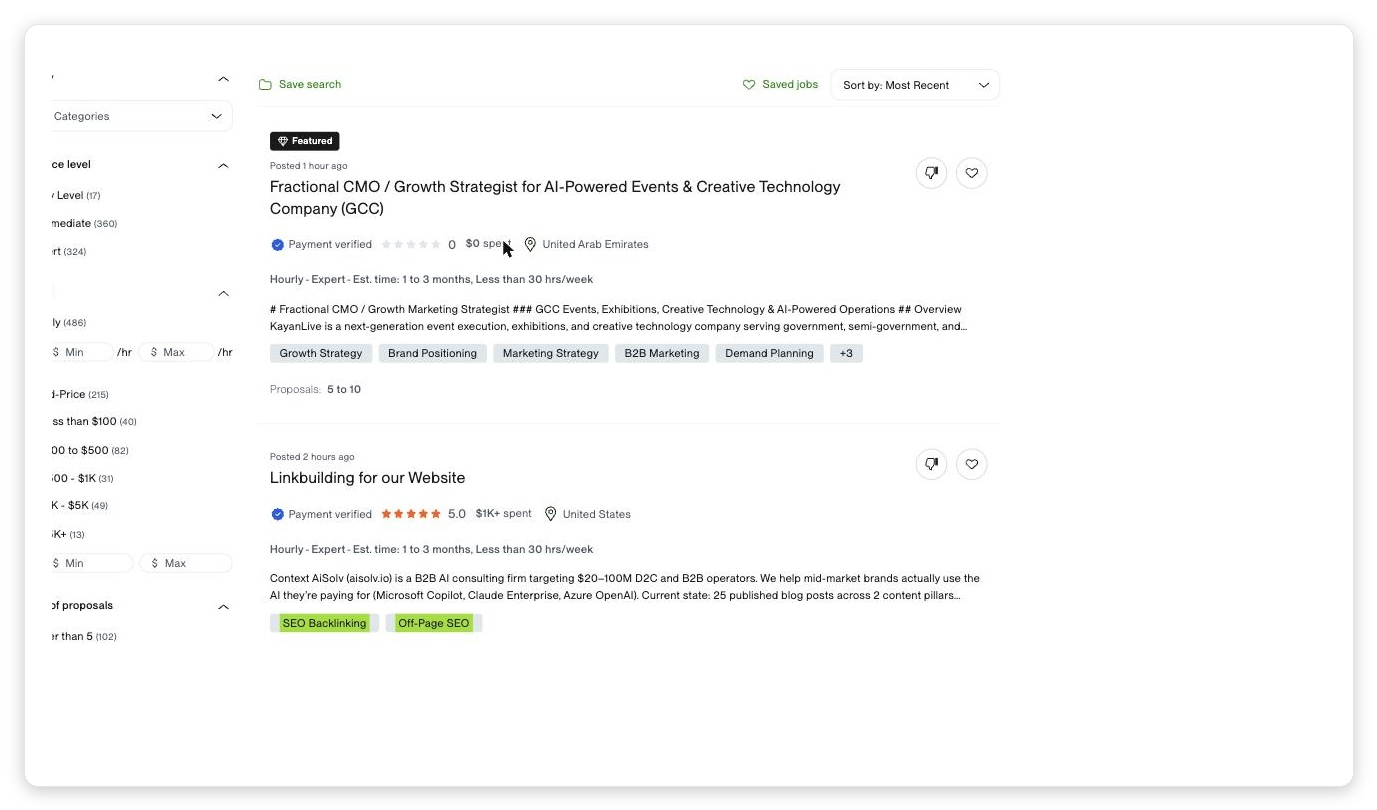
- SaaS founders post these contracts on Upwork constantly. GigRadar finds and bids them through an invited Business Manager, so your own account is never touched.
A "full-stack developer" on Upwork gets a 4.66% reply rate. A "Shopify specialist" gets 8.67%.
Same platform, same proposal volume, nearly double the replies. The only difference is that one of them picked a lane.
That gap comes from GigRadar's analysis of 133,872 outbound proposals across our pipeline (December 2025 to February 2026). It is the clearest argument I know of for niching your agency, and right now the most underpriced lane on Upwork is SEO for SaaS companies.
Not because SaaS is trendy. Because SaaS SEO is a genuinely different craft that most generalist agencies execute badly, the contracts are recurring retainers instead of one-off projects, and the buyers (VP Marketing, Head of Growth, technical founders) pay a premium for someone who already speaks product-led growth.
This playbook covers what makes SaaS SEO structurally different, what to charge in 2026, how to position your Upwork profile and proposals so you actually win these jobs, and the one positioning mistake that quietly kills reply rates.
Why an SEO agency for SaaS beats a generalist shop
Generalists compete on price; specialists compete on outcomes. The data backs this hard.
Across the full 133,872-proposal sample, the specialization claims that lift reply rate are all vertical (a business model or platform), and the ones that tank it are all horizontal (a technical layer).
The logic is simple. A "Shopify specialist" signals you understand ecommerce economics, while a "full-stack developer" signals you write code, same as the other 4,036 people who used that phrase.
SaaS is the strongest version of this move for an SEO agency because the work is recurring, the budgets are real, and the buyers are sophisticated enough to value expertise over the lowest bid. It pairs naturally with the broader positioning work in our SaaS marketing agency guide and the rate math in SEO agency Upwork retainers.
What makes SaaS SEO different from regular SEO
If you run a local-business or ecommerce SEO playbook on a SaaS account, you will lose the contract in 90 days. The whole funnel inverts.
In most SEO, the conversion is a purchase. In SaaS, the conversion is a free trial or a demo, and that single visitor can become a $10,000-a-year subscription (W3era, EmberTribe).
The stakes per visitor are far higher, so conversion tracking is baked in from day one, not bolted on later.
- Starts with a keyword tool
- Top-of-funnel "what is X" blog posts
- Measures rankings and traffic
- Conversion = a sale
- One-off projects
- Starts with the product's data
- Bottom-of-funnel comparison and integration pages
- Measures trials, signups, pipeline
- Conversion = a free trial or demo
- Recurring retainers
The biggest structural shift is build order. Generalist SEO builds top-of-funnel first and hopes readers eventually discover the product.
SaaS SEO builds bottom-of-funnel first: comparison pages ("Notion vs Confluence"), alternative pages ("best Salesforce alternatives"), pricing pages, and integration pages.
Those pages are unglamorous but they convert. Comparison and alternative pages convert at roughly 7.5% to as high as 10-20%, versus around 0.19% for generic informational content, and bottom-of-funnel formats drive 40-60% of SaaS organic conversions despite a smaller share of traffic (Ottawa SEO, DesignRevision, GrowthOS).
When you pitch a SaaS founder, lead with their three highest-intent missing pages: a "[their product] vs [top competitor]" page, a "[big competitor] alternatives" page, and an integrations hub. Naming the actual pages in your proposal proves you have done this before.
The five-service SaaS SEO stack you actually sell
A SaaS SEO retainer is not "blog posts plus links." It is a stack of five services, and naming them explicitly is how you justify a premium over a generalist.
Page speed, indexation, and schema on the pages that lead to a trial. Broken trial flow kills more revenue than any ranking ever earns.
Template-driven pages built from the product's own data: integration pages, use-case-by-industry pages, comparison pages at scale (Dango).
Every integration the product ships is a backlink from that partner's directory. This is link acquisition a local SEO never thinks about.
First-touch attribution in GA4 plus a product analytics tool, then LTV by entry page so spend moves to the highest-LTV pages (Ottawa SEO).
Reporting on signups and pipeline instead of vanity rankings, plus GEO/AEO so the product gets cited in ChatGPT, Perplexity, and AI Overviews. In 2026 buyers treat AI-search capability as a primary screening criterion (DerivateX).
Build this stack into your proposal and you stop sounding like the 40 other SEO freelancers who pasted "increased organic traffic by X%." You sound like someone who has run a SaaS program before.
SaaS SEO retainer calculator: size your offer
The single biggest mistake new SaaS SEO agencies make is pricing like a generalist. Use the calculator to anchor your retainer to the client's ARR stage and the scope they actually need.
Free Tool
SaaS SEO Retainer Calculator
Pick the client's stage and the scope you will deliver. Get a 2026 monthly retainer range, annual contract value, and the page mix to propose.
Ranges synthesise 2026 SaaS SEO pricing benchmarks. Your floor depends on proof and case studies, not ambition.
What SaaS SEO costs in 2026
Retainers are the dominant model. The Ahrefs 2026 survey found 78.2% of SEO providers charge a monthly fee, with freelancers averaging $1,348/mo and agencies $3,209/mo across all of SEO (OuterBox).
SaaS specifically pays above those averages, because the buyer is funding recurring revenue, not a one-time project.
| Client stage | ARR | Monthly retainer | What's included |
|---|---|---|---|
| Startup | $2M-$10M | $3k-$8k | Technical audit, keyword architecture, 4-8 pieces/mo, basic links |
| Growth | $10M-$50M | $8k-$15k | Dedicated strategist, 8-12 pieces/mo, programmatic, editorial links, pipeline reporting, GEO |
| Enterprise | $50M+ | $15k-$25k+ | Programmatic at scale, multi-product strategy, international AEO, custom dashboards |
| Fractional operator | Any stage | $2.5k-$6k | One accountable operator, strategy plus hands-on execution on the highest-leverage layer |
Under $2k/mo, a SaaS retainer can only fund one thing: content OR links OR technical, never an integrated program (DerivateX). If a client wants everything for $1,500, scope to one honest deliverable or walk.
Specialists also convert better, and that is your whole pitch. SaaS companies that hire specialised partners report 30-35% higher organic conversion than those using generalists (AboveApex).
That number is what justifies your premium, so put it in the proposal.
How SaaS buyers actually choose an SEO agency
You are not being judged on rankings. A VP of Marketing or a technical founder screens SaaS SEO agencies on a short, specific checklist (SEO GrowUp, AboveApex).
- Case studies at their ARR stage, not generic "SaaS clients." A Series A founder does not care about your enterprise logo.
- Revenue and pipeline reporting, not traffic charts. "Walk me through how you connect organic sessions to closed revenue" is the screening question.
- GTM fit: do you understand product-led growth versus sales-led motion? Most agencies cannot tell the difference.
- Realistic 6-12 month timelines. Anyone promising page-one in 30 days is a red flag to them.
- Short, month-to-month contracts as a quality signal. Confident specialists do not need 12-month lock-ins.
- AI-search capability. "Show me a client you got cited in an AI answer for a buying-intent query" is now a standard test.
The fastest way to pass this screen on Upwork is to answer two of these in the first three lines of your proposal, before they ever click your profile.
The positioning mistake that quietly kills your reply rate
Here is the counterintuitive part, and it is the reason most "SaaS SEO" freelancers underperform. Bragging the word "SaaS" in your cover letter lowers your reply rate.
The word "SaaS" is not magic. When 14% of all freelancers say it, it stops meaning "I have SaaS experience" and starts meaning "I know the word SaaS." Clients filter past it.
But look closer and the resolution appears. Inside the Sales & Marketing category specifically (the second-largest category on Upwork at 19% of proposals and a 10.26% reply rate), the picture flips based on the language around it.
So the rule is not "never mention SaaS." The rule is: do not use "SaaS" as a brag. Use it as context around the specific, fresh language of product-led growth: pipeline, scale, trials, the actual page types you build.
This is the same positioning logic the starting an SEO agency guide teaches, applied to one vertical. Most freelancers think they have an Upwork problem when they actually have a positioning problem.
🎥 From GigRadar's Agency Success Course, the Nail Your Upwork Profile lesson on positioning over breadth.
Your SaaS SEO positioning template
Steal this. It puts the vertical, the buyer's outcome, and a fresh-vocabulary proof point in the first three lines, which is the entire reply-rate game.
It names real page types (not the word "SaaS" as a brag), offers a Loom teardown (Loom mentions lift reply rate +2.70pp in this category), and reports on pipeline. For more on openers, see our guide to landing SEO clients.
Free for Upwork agencies
SaaS founders post SEO retainers daily. Be first to bid.
GigRadar scans every new Upwork SaaS-SEO job and submits your positioned proposal through our invited Business Manager, so your own account is never touched and you reply before the feed fills up.
Get Your Free Agency Audit →How GigRadar fits a SaaS SEO agency
Positioning gets you the reply; volume gets you the pipeline. The hard part of niching is that a narrow vertical means you have to see every relevant job the moment it posts, because the good SaaS retainers get 20 proposals within the hour.
That is the job GigRadar does. Our scanners watch Upwork for the exact SaaS-SEO jobs you have positioned for, then submit your proposal through GigRadar's own Upwork Business Manager.
Your agency invites our BM through Upwork's official invitation flow, the same role you would use to onboard a hired bidder.
Proposals submit from our BM under our team's supervision. Your freelancer account is never touched, and if Upwork ever reviews a submission, the review lands on our BM profile, not yours.
You can read the full mechanics in our comparison of bidding approaches, and pricing is on the pricing page.
A sharp SaaS-SEO position plus first-to-reply speed is the whole flywheel. The position lifts your reply rate, the speed lifts your share of the good jobs, and the recurring retainers turn one good month into a book of business.
Where to start this week
You do not need to rebuild everything. You need to pick the lane and prove it once.
- Rewrite your profile headline around one outcome: "I build the bottom-of-funnel pages that turn organic search into SaaS trials."
- Build one proof asset: a teardown of a real SaaS company's three highest-intent missing pages. This becomes your portfolio piece and your proposal hook.
- Set your floor with the calculator above and refuse the sub-$2k "do everything" requests.
- Submit 20 targeted proposals using the template, then read your view, reply, and interview rates and refine.
Niching feels risky because it narrows your market. The data says the opposite is true: the narrow, vertical position is exactly what doubles your reply rate.
SaaS SEO is the lane with the most recurring money and the fewest people who do it properly. Pick it.