
🎬 Service Productization: Why $750 Beats $5K on Upwork: the fixed-price reply data, the 5-step framework, and the first-$500 wedge, in 2 minutes. Watch on YouTube
TL;DR
- On Upwork, service productization is a reply-rate move before it is a margin move. A fixed-scope, fixed-price package is the only proposal shape a buyer can judge in the eight seconds they spend scanning your bid.
- Our pipeline data is blunt about the price band: fixed-price bids in the $250–999 zone pull the best replies (Mobile Dev at $250–499 hits 26%), while fixed bids above $2,500 collapse to 1–3%.
- Productize the first $500 of the relationship as an acquisition wedge. Let custom scope return as the upsell after you are hired and off the open marketplace.
- The 5-step framework: narrow the menu → narrow the ICP → name one core outcome → fix the scope → ship before the SOPs are perfect.
- Use the calculator below to price a package to your delivery capacity and check it against the Upwork reply sweet spot.
A custom $5,000 SEO audit and a productized $750 one can describe the exact same work. On Upwork, the $750 version gets the reply and the $5,000 version gets skimmed past. That gap is the whole argument for productizing, and almost nobody frames it the way it actually pays off on a marketplace.
Most productization advice sells you on margins and predictable revenue. Those are real, but they are the second prize.
The first prize is that a packaged offer is legible. When a client is comparing thirty proposals, "Brand sprint, fixed scope, delivered in 5 days, $850" wins the click over "Let's hop on a call to scope your project" every single time.
I run GigRadar, which handles Upwork lead-gen for agencies, so I see the proposal-to-reply data on tens of thousands of bids a month. The pattern is consistent enough that I will plant a flag: if you sell on Upwork and your offer is not packaged, you are leaving replies on the table before margin even enters the conversation.
Free Tool
Productized Package Price Finder
Price a package to your delivery capacity, then check it against the Upwork fixed-price reply sweet spot.
Sweet-spot bands derived from GigRadar pipeline data on 10,113 fixed-price bids (Dec 2025–Feb 2026). Floor = target revenue ÷ capacity.
What productizing actually means (and the fake version that quietly kills margins)
A productized service is a service that behaves like a product: one narrow problem, one defined deliverable, one fixed scope, one fixed price, one repeatable process. "Logo design, 3 concepts, 2 revision rounds, delivered in 4 business days, $450" is productized, and "Branding services" is not.
The distinction that matters is not the price tag. It is whether the scope is fixed, and that is exactly where most agencies fake it.
You slap a flat price on what is still bespoke, custom-scoped work. The price is fixed but the effort is not, so margin variance comes straight back in through the side door. Every "small extra request" eats the margin the flat price was supposed to protect.
Real productization fixes the scope first and lets the price follow. Fake productization fixes the price and leaves the scope open.
The first scales. The second is just discounting with extra steps.
It helps to see productized work next to the two models agencies usually run instead.
| Dimension | Project work | Retainer | Productized service |
|---|---|---|---|
| Scope | Custom per client | Loosely defined, "hours" | Fixed and identical every time |
| Pricing | Estimate, often revised | Monthly for capacity | One flat published price |
| Margin behaviour | Volatile (scope creep) | Stable if scope held | Stable and improves with reps |
| Sales cycle | Long, proposal-heavy | Medium, trust-based | Short, the offer sells itself |
| Upwork fit | Weak (illegible in a scan) | Weak (needs a relationship first) | Strong (clear scope + price) |
None of these are wrong. The point is that on the open marketplace, only the productized column is legible to a stranger comparing bids, because the other two need a conversation you have not earned yet.
If you want the mechanics of holding scope once you are in a contract, our guide on milestones that prevent scope creep covers the clause language.
Why fixed-price packaging wins replies on Upwork (the data)
Here is the part the generic productization blogs cannot give you, because they do not sit on marketplace proposal data. We looked at fixed-price bids across subcategories and tracked which price bands actually got a reply.
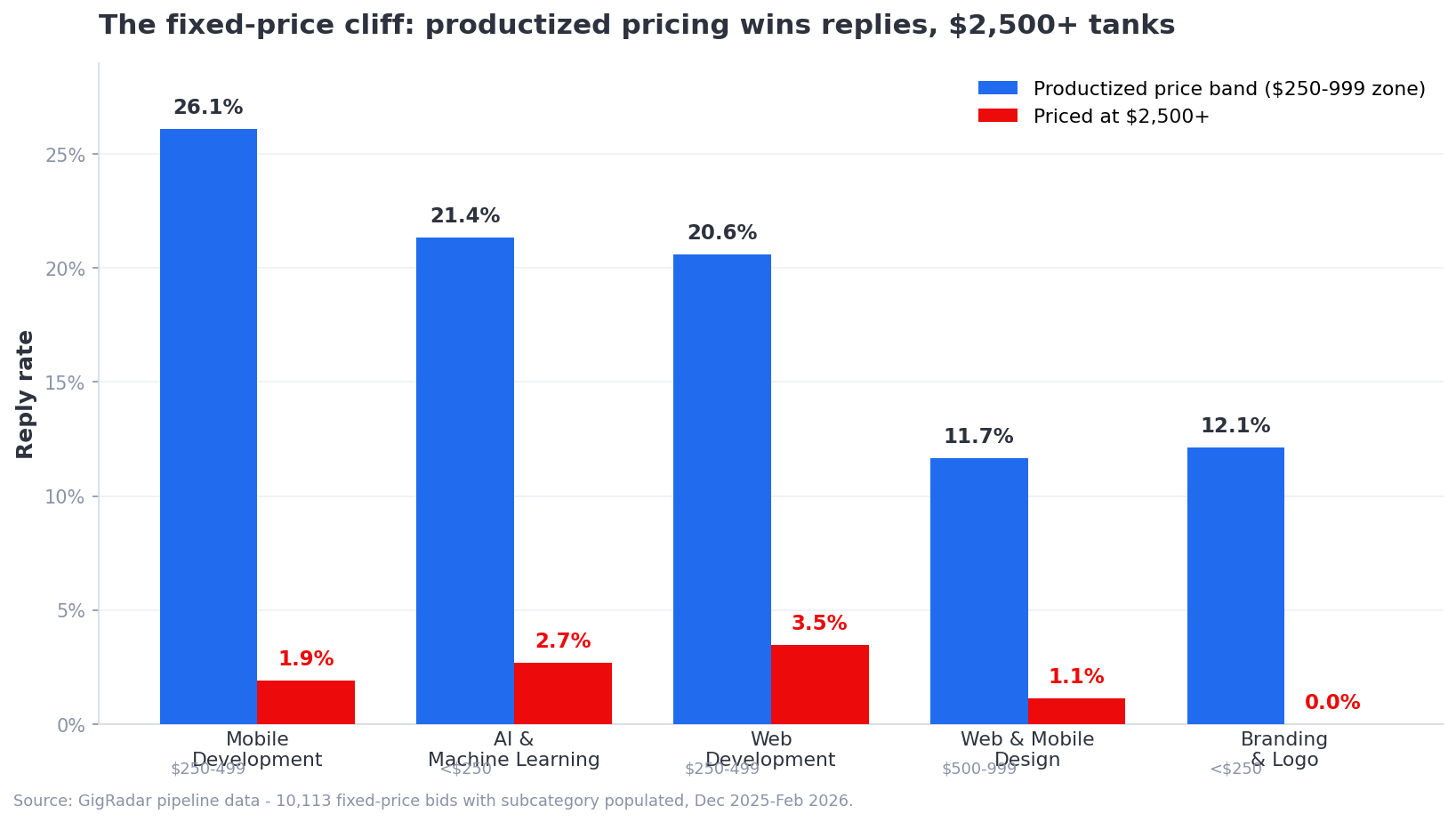
The shape is the same in nearly every subcategory. Fixed bids in the $250–999 zone reply 5 to 15 times better than the same work quoted at $2,500 and up.
In Web Development the gap is 20.6% versus 3.45%, and in Mobile Development it is 26.1% versus 1.9%. Branding bids above $2,500 replied at zero.
Why? Clients posting fixed-price jobs carry a mental budget, usually a few hundred to a couple thousand dollars.
A package priced inside that range reads as "fairly priced specialist." A $4,000 fixed bid on a job they imagined at $600 reads as "did not read the brief."
Productizing in the sweet-spot band is not leaving money on the table. It is matching the number to the buyer's expectation so you get into the conversation at all.
The deeper mechanics of pricing proposals on Upwork back this up across bid types.
The 5-step framework to productize a custom service
Productizing is not publishing a price on your site. It is an operational redesign that happens in a deliberate order, the same sequence operators like Brian Casel teach over at Productize & Scale.
Skip a step and you end up fake-productized.
Productization starts with subtraction. Pick the one or two engagements you already deliver repeatedly and commit to making them the center of the business, not a side experiment. Decide out loud what you will stop saying yes to.
A package only stays fixed if the clients are similar. "SEO audit for B2B SaaS doing $2–10M ARR" lets you assume the tech stack, the sales cycle, the vocabulary. The narrower the buyer, the more standardized the deliverable can be. Our breakdown of Upwork filters by niche is a fast way to find where your repeat work clusters.
Productized offers are built around a result the buyer can picture: "major SEO issues diagnosed and prioritized in 24 hours," not "SEO consulting." Map your usual process, keep the 70–80% of steps that repeat across good projects, and give the package a product-like name.
Write down exactly what is in, what is out, how many revisions, and the turnaround. Everything outside that line is a clearly priced add-on, never a free "quick favor." Price the in-scope work for the band where buyers reply, then let Upwork’s fixed-price milestones protect you on delivery.
The instinct is to document every workflow first. That is three months in Notion and zero contracts. On a marketplace the leverage is in how the offer reads, not how flawlessly it runs on day one. Post the packaged offer as your proposal template this week and let real contracts force the SOPs into existence.
Step 4 is where most of the money is made or lost, because the fixed-price-versus-hourly conversation is where clients try to pry the scope back open. Fixed-price contracts also carry a quiet advantage: under Upwork’s milestone rules, an unreviewed deliverable auto-releases to you after 14 days.
This lesson from our Agency Success course walks through how to hold the line and when to flip a contract between models:
🎥 From GigRadar’s Agency Success Course, the “Win price talks” lesson on fixed-price vs hourly contracts.
Real productized services and what they actually charge
The model is not theoretical. Some of the most profitable solo and small agencies running today are pure productized plays, and they publish their prices.
| Productized service | The package | Price | What it proves |
|---|---|---|---|
| DesignJoy Brett Williams, solo |
Unlimited design requests, one active at a time, ~48-hour turnaround, pause anytime | $4,995–$7,995/mo | One person cleared roughly $145K/month in recurring revenue with zero employees |
| Design Pickle 100+ team |
Tiered subscriptions, dedicated designer per client, graphics through motion | ~$499–$1,695/mo | The same fixed-scope model scales with headcount, each tier a defined output |
| O8 agency |
24-hour SEO baseline audit with prioritized fixes | $750 flat | A repackaged $5,000 custom audit, productized into a fast fixed-price entry offer |
Pricing per each provider’s published plans; DesignJoy figures via founder interviews (designjoy.co).
Two patterns to steal. First, every one of these named a single outcome ("design requests," "SEO baseline in 24 hours") instead of a service category.
Second, the pricing was set to delivery capacity, not to a market rate. Brett Williams priced DesignJoy to how many active requests one person can hold, which is why a solo operator can defend a near-$5,000 monthly price.
Productize the first $500, not the whole engagement
Here is the objection every agency owner raises, and they are half right: "productized offers attract cheap clients, and real work always drifts back to custom scope." True.
The wrong conclusion is to abandon productizing. The right one is to scope what gets productized.
Use the packaged offer as the entry point. Its job is to win the reply and the first contract on the open marketplace, where price-and-scope clarity is the only thing a stranger can evaluate.
Once you are hired and working off-platform, the relationship expands into custom retainer work on your terms. The custom drift everyone complains about is not a bug: it is the upsell, and it belongs after the wedge, not instead of it.
A $250–999 fixed-scope package is a customer-acquisition tool, not your whole business model. It buys you a paying relationship cheaply. What you do with that relationship is where the margins live. Our client retention playbook covers turning that first contract into recurring revenue.
This is also exactly where a lead-gen engine earns its keep. GigRadar runs Upwork outreach for agencies through a real Business Manager account: your agency invites our BM through Upwork’s official invitation flow, and proposals submit from our BM under our team’s supervision, never from your own account.
Put a packaged offer priced in the reply sweet spot behind that, and you are sending the most legible proposal shape there is, at volume, to the buyers most likely to reply.
Free for Upwork agencies
Get your packaged offer in front of the right Upwork buyers
We send fixed-scope proposals from a supervised Business Manager account, at volume, to the jobs your productized package actually fits. You stay focused on delivery.
Get Your Free Agency Audit →The pricing band that filters tire-kickers for you
The fear of cheap clients pushes owners to productize at $99–$199 to look competitive. That is the exact move that attracts the bargain hunters they are afraid of.
The data says the floor that works is higher than instinct suggests.
The $250–999 band does two jobs at once: it sits in the highest-reply zone and it screens out the clients who only respond to basement pricing.
Going below it does not make you more competitive. It self-selects you into the worst client segment while costing you reply rate, and going far above it, past $2,500, drops you off the reply cliff entirely.
Set the floor by capacity, not by the market. Decide how many packages you can deliver per month without missing a turnaround, divide your target monthly revenue across them, and that is your floor per package.
A solo operator wanting $15,000 a month across five clients has a $3,000 floor. The calculator above runs that math and checks the result against the reply band, so you are not guessing.
When a client tries to negotiate you below it, our negotiation scripts for agencies give you the language to hold.
Steal this: the productized offer one-liner
If you copy one thing from this article, copy the format that makes a package legible in a proposal scan. Fill in the blanks and paste it as the first line of your bid.
[OUTCOME] for [NARROW ICP]. Fixed scope, delivered in [TIMEFRAME], [FLAT PRICE].
Includes: [3 concrete deliverables]. Out of scope: [1 clear exclusion].
Example: "Conversion-ready landing page for B2B SaaS. Fixed scope, delivered in 5 days, $850. Includes copy, design, and Webflow build. Out of scope: ongoing A/B testing."
Productizing your service will not fix a weak deliverable. What it will do, immediately, is make a strong deliverable legible to a buyer who is scanning fast and deciding faster.
On Upwork, that legibility is the difference between a reply and a skip, long before it ever becomes a margin story. If you are still setting your agency up, start with how to create an agency on Upwork and package the first offer from day one.