the upwork algorithm doesn't reward your best proposal. it rewards your best pattern
Watch the 2-minute walkthrough: the three-layer ranking system, proposal timing, and the JSS signals most agencies miss. Watch on YouTube
- Upwork says its matching considers keywords, skills, location and work history when ranking proposals. It has never published the weights, so anyone quoting exact percentages is guessing
- Speed is the timing lever, and the cliff is at five minutes, not sixty. Across 59,339 GigRadar proposals, bids sent 3 to 4 minutes after posting replied at 11.86%; bids sent at 5 to 6 minutes replied at 6.91%
- Boosting buys one of four slots pinned above the organic list, and you hold it only until the client interacts, opens your proposal three times, or sees it five times
- Private feedback below 7 out of 10 drags your Job Success Score down even when the public review is five stars
- Upwork's own JSS guidance: 90% and up is the top band, the 80s signal room for improvement, 79 and below signal trouble. 91 versus 93 is noise
- Category crowding beats cover-letter quality. When 11 or more GigRadar teams bid the same job, reply rate falls from 9.44% to 2.11%
the three-layer ranking system agencies need to map
Most agency owners think of "the algorithm" as a single black box. It's actually three separate ranking decisions happening at different moments, each with different inputs.
Source for all three: Upwork's own Intro to Upwork and How to boost your proposal help pages.
There is no official percentage breakdown of the ranking factors. If a guide tells you invite matching is "40% keywords, 30% performance, 20% availability", that number was invented, and we are not going to hand you one either.
Everything below is either quoted from Upwork's help pages or measured in GigRadar's own proposal pipeline, with the sample size attached.
Agencies typically focus all their energy on Layer 3 (boosting proposals). The higher-impact intervention is Layer 2: the factors Upwork names out loud, which are all profile and history, not proposal prose.
the proposal ranking diagnostic: score your agency
the five-minute cliff that most agencies bid straight past
The "apply within the first hour" advice is not just soft, it is pointed at the wrong number. We measured the gap between job posted and proposal sent on 59,339 GigRadar proposals with a full timestamp chain, and the reply rate falls off a cliff at five minutes.
Bids sent at 3 to 4 minutes replied at 11.86%. One to two minutes later, at 5 to 6 minutes, that is 6.91%.
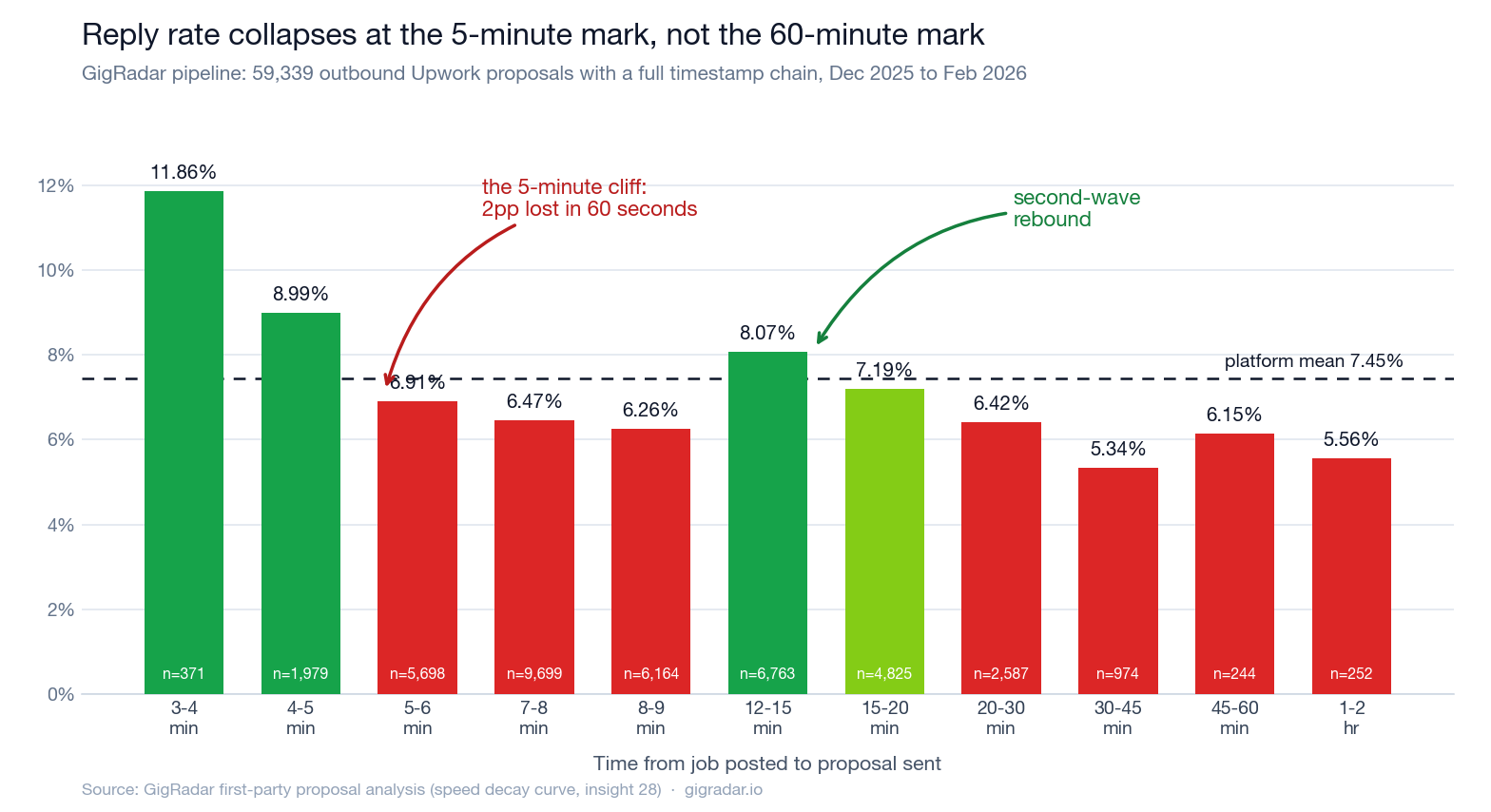
There is a second-wave rebound at 12 to 15 minutes (8.07%), which fits the pattern of a client opening the inbox once on posting and again a quarter of an hour later.
The dead zone is 30 to 45 minutes, at 5.34%. That is the band the "apply within the hour" rule quietly points you at.
The speed premium is not uniform. In IT and Networking, sub-5-minute bids reply at 13.75% against 6.49% at 5 to 10 minutes, a 7.26pp gap; in Web, Mobile and Software Development the same split is 7.38% against 5.28%.
A three-times-a-day “bid sprint” cannot hit a five-minute window. If a human has to notice the job first, you are structurally in the 8-minute band or later.
The only fix is detection and drafting that runs continuously. GigRadar’s scanner watches postings by budget, category, and client history, and the proposal submits from an invited Business Manager account rather than waiting for someone to open a tab.
why your category choice is a bigger algorithm lever than your proposal text
Most agencies spread proposals across 5 to 8 categories to "maximize opportunities". Upwork lists work history among its matching factors, so a scattered history gives its knowledge graph nothing sharp to match on.
The measurable cost of that spread shows up long before any ranking effect does, in which subcategory you are bidding into.
GigRadar pipeline data across 133,872 proposals from 500+ agency teams (December 2025 to February 2026) puts numbers on that gap. Web Development, the most saturated subcategory in the window at 37,099 proposals, replied at 5.80%, while thinner subcategories like Lead Generation and Telemarketing (14.38%) and Sales and Marketing Copywriting (14.24%) replied at roughly double the 7.5% platform mean.
The algorithm learns where you convert. That's where it shows you.
There is a second effect underneath the category number that almost nobody prices in: how many other automated bidders are pointed at the same job. Across 59,339 proposals covering 30,964 distinct Upwork jobs, reply rate falls from 9.44% when one GigRadar team bids a job to 2.11% when 11 or more do.
67% of GigRadar proposals land on a job at least one other GigRadar customer also bid. A "hot" job that matches everyone's scanner is, by that fact, a worse job.
| Category Type | Typical Proposal Count | Expected Reply Rate (focused agency) | Algorithm Signal |
|---|---|---|---|
| UI/UX & Product Design | 15–30 | 25–40% | Strong |
| Web Dev (Shopify/React/Next) | 20–40 | 20–35% | Strong |
| SEO & Content | 25–50 | 20–35% | Medium |
| Data / AI & Analytics | 20–40 | 15–28% | Medium |
| Generic "Writing" or "Admin" | 50–100+ | 5–12% | Negative |
Source: GigRadar Proposal Benchmarks 2026 and GigRadar Agency Metrics Benchmarks
the private feedback trap that no agency talks about
When a contract ends, Upwork asks the client for private feedback you never see, and that feedback feeds your Job Success Score alongside the public review. Upwork no longer publishes the wording of that question, so ignore the 0 to 10 "how likely are you to recommend" script that older guides still quote as if it were current.
Upwork's JSS help page now says only that the score "takes into consideration a number of different factors including client feedback, contract-ending history, and long-term customer relationships". It no longer names private feedback at all.
What our own account managers work with, from lesson 28 of the GigRadar Agency Success course: a private score below 7 out of 10 pulls your JSS down even when the public rating is five stars, and in JSS Insights it shows up as an exclamation mark or an X rather than a checkmark.
Lesson 29 puts a size on it. A single bad private score can move a JSS by up to 11 percentage points.
A client can hand you a public 5-star review and still file lukewarm private feedback. You never see the gap, and the private answer is the one your Job Success Score is built from.
Agencies see the 5-star and assume everything is fine. The private score is the one that matters for visibility.
The fix is operational, not cosmetic. Before closing any contract, do a quick 5-minute voice/video check-in to confirm the deliverable fully met expectations.
Ask directly: "Is there anything you wish had gone differently?" Catching that answer before the contract closes is the only way to intercept the signal, because once the private feedback is filed you cannot see it or appeal it.
Then tell the client exactly what to click. The course's closing script is three specific asks: rate the private feedback a 10, choose "Project completed successfully" as the reason for ending the contract, and mark English proficiency as Fluent.
A refund removes public feedback. It does not remove the private score, which is the one that was moving your JSS in the first place.
when boosted proposals help (and when they actively hurt you)
You will find a "10x return on ad spend" figure attributed to Upwork all over the freelancing web. We went looking for it on Upwork's own ads page and in the help centre and could not find Upwork saying it anywhere, so we are not going to repeat it.
Here is what Upwork does say, on How to boost your proposal: eligibility to boost "is determined based on how strong of a match you are for the job", the top four bidders get the slots, and the auction closes after seven days or the first hire.
And here is what our own data says, which is more useful than either. Boost is a substitute for speed, not a multiplier of it.
| Time from posting to bid | Boosted reply rate | Unboosted reply rate | What boost bought you |
|---|---|---|---|
| Under 5 minutes | 9.32% | 9.55% | −0.23pp, wasted |
| 5–15 minutes | 7.54% | 6.71% | +0.83pp |
| 15–60 minutes | 7.93% | 6.22% | +1.71pp, peak |
| Over 60 minutes | 5.82% | 6.60% | −0.78pp, boost cannot save a late bid |
GigRadar pipeline, 59,339 proposals with both boost and full timestamp data, December 2025 to February 2026.
If you bid first, boosting adds nothing: you are already at the top of the inbox and the spend is dead. If you bid more than an hour late, boosting is worse than not boosting, because the connects go to clients who have already moved on.
Boost is the make-up tool for the middle band, not a default setting.
Bid size matters as much as timing. Across the same sample, 16 to 20 connects of boost lifted reply rate by 1.61pp at about $1.94 per extra reply, while the 21 to 30 connect band reply rate came in below the no-boost baseline.
Boosting a fixed-price bid returned roughly twice the lift of boosting an hourly one (+1.63pp versus +0.81pp).
The correct use of boosted proposals: reserve them for jobs where (1) you've already converted in that exact category recently, (2) the client is payment-verified with hiring history, and (3) you could not get the bid out inside five minutes. Boost 3 strong-fit jobs instead of 15 medium-fit ones.
Does your agency have 2+ completed contracts in this exact sub-category? If not, don't boost.
Submit organic and let the proposal earn its position.
Payment-verified, previous hire history, reasonable budget for the scope. Boosting a job post with no client history is spending Connects on someone who may never hire.
Check the visible bid range and bid at least one Connect above the fourth-place position. A boost that loses the auction refunds your Connects, but costs you time.
Upwork's own guidance is to check the "My stats" page to see whether boosting is actually winning you more jobs. If it isn't, your targeting is off, not your bid size.
the agency-specific dynamics most guides ignore
The dynamic that actually separates agency accounts from solo profiles is not a hidden search penalty. It is arithmetic, and Upwork states it plainly: "An agency's JSS is an aggregated score of all the agency's jobs."
One member's bad contract moves the number every client sees on every proposal the whole team sends.
Upwork's JSS page also draws the bands for you, and they are wider than the ones agency owners obsess over.
Upwork is explicit that "small differences between scores, say 91% versus 93%, are less important than large differences". Chasing 95% because a blog post named it a threshold is chasing a number Upwork does not treat as a threshold.
The break points that do matter are 90 and 80.
There is one agency-specific mechanic worth knowing, covered in lesson 29 of the Agency Success course: exclusive agency members inherit the agency's JSS, non-exclusive members do not.
If your agency score is healthy, exclusivity pulls a weak individual up. If one member tanks the agency score, every exclusive member wears it, and switching to non-exclusive is the lever that isolates the damage.
what an Upwork-algorithm-aware proposal actually looks like
Upwork has never published anything about detecting or suppressing copy-paste proposals, and we are not going to invent a threshold for you. What we can measure is what the client does when a generic proposal lands.
Across 59,339 proposals tagged by the algorithm that produced them, hand-crafted templates replied at 8.13% against 6.95% for our own GPT-4o auto-bidder. A tight human template out-replies a large language model with full job context by 17% relative.
The structure that works is deliberate keyword mirroring: reflecting the client's specific vocabulary back at them in your own framing, not copying their text verbatim.
A client who posts "need a Shopify developer who understands conversion rate optimization" signals their actual vocabulary. Your proposal opening should reference Shopify + CRO in the first two sentences, using their exact terms.
Stop guessing which proposals the algorithm sees
GigRadar tracks your proposal-to-interview ratio by category, flags low-converting bid patterns, and surfaces only payment-verified jobs that match your highest-performing profile segments.
Get Your Free Agency Audit →building algorithm trust over 90 days: the only timeline that works
There is no published "90-day algorithm window", and the reason 90 days is still the right planning horizon has nothing to do with a ranking model. It is two separate, measurable lags.
The first is JSS. Upwork calculates it over 6, 12 and 24-month windows and displays whichever is best for you, so a contract you close today does not move the number the client sees for months, and long-term contracts only count as successful outcomes once they pass 90 days.
The second lag is in your own reporting, and it is the one that makes agencies quit too early. Reply rates in our pipeline do not finish maturing for 75 to 90 days after send.
Proposals aged 45 to 60 days show a 4.45% reply rate. The same cohort at 75 to 90 days shows 9.56%.
Judge a two-week experiment on two-week data and you are reading a number that understates by roughly half.
Audit and cut your active categories to your top 2 converting ones. Measure your current median gap from job posted to proposal sent before you change anything.
No boost spending this phase. Boost cannot fix a detection problem.
Target: get the median under 5 minutes, which almost always means automating detection and drafting rather than scheduling humans. Category concentration above 70%.
Track view rate and reply rate separately, by category. A low view rate is a profile and targeting problem; a healthy view rate with a weak reply rate is a cover-letter problem.
Remember the curing lag: a cohort sent this fortnight will read roughly half its eventual reply rate.
Target: beat the 7.45% pipeline baseline in your primary category. Add repeat-client follow-ups on every closed contract.
This is the point where the cohorts you sent in phase one have cured and the numbers are worth reading. Selective boosting makes sense now, on high-fit jobs you could not reach inside five minutes.
Target: repeat client percentage climbing toward 20%, JSS holding in Upwork's 90%+ band, boost spend concentrated at 16 to 20 connects rather than sprayed.
the metric to track that almost nobody tracks
Proposal view rate (PVR) is the single most diagnostic metric for algorithm health. It measures what percentage of your submitted proposals the client actually opens.
There is no published industry benchmark for it, and any article quoting you one has made it up. What exists is a range our account managers read every week.
In the accounts we look at, a view rate in the low-to-mid twenties paired with a double-digit reply rate is a healthy account, not a suppressed one. Around 24% viewed and 12% replied is a good pair.
The number in isolation tells you almost nothing. The pair is the diagnostic, which is what the next section is for.
separate view rate from reply rate: they diagnose different problems
Most agencies conflate "the algorithm hates me" with "my copy doesn't work." They're almost never the same problem. View rate measures whether the algorithm surfaces you. Reply rate measures whether the cover letter closes the open.
| View rate | Reply rate | What it actually means |
|---|---|---|
| 24% | 12% | Healthy. Keep shipping. Watch Connects spend. |
| 30% | 5% | Algorithm is showing you. Opens are fine, conversion fails. Rewrite the opener: short, personal, one clear ask. |
| 21% | 5% | Same pattern as above. Letter is weak, not your positioning. |
| 10% | 7% | Letter works, exposure doesn't. Fix the profile first line and tighten category targeting. |
| 10% | 5% | Few see you, half of those reply. Profile, first line, or targeting is the problem, not the letter. |
| Low | Low | You're bidding on fake or dead jobs. Change your job filters before touching copy or profile. |
A worked example from the course: an agency ran 81 bids and got 5 replies. A 6% reply rate looks terrible until you split it.
If the view rate on those 81 bids was healthy, the letter is the problem. If it was near-zero, the proposals were never surfaced and the letter is irrelevant.
In that particular case it was neither. 25 of the jobs closed with no interview and 6 were filled or withdrawn, so most of the bids went to postings nobody was ever going to hire from.
Go to Stats and Trends in your profile menu. Review three ratios: Proposals Sent vs. Viewed (your PVR), Interviews vs. Proposals (your interview conversion), and Hires vs. Interviews (your close rate).
Each ratio maps to a different problem. Your view rate diagnoses Layer 2, the matching factors Upwork names: profile, keywords, work history. Interview conversion diagnoses the cover letter. Close rate diagnoses price and call skill, not the algorithm at all.
read these next
Understanding the algorithm is only useful if you're sending proposals worth ranking. These five GigRadar resources build directly on what's covered above.
GigRadar: Upwork agency automation for serious operators. gigradar.io