
🎥 Video walkthrough: Why proofreading is the contrarian Upwork bet for 2026
TL;DR
- Editing & Proofreading Services on Upwork posted 1,488 jobs in April 2026, up 12.6% from February. Content Writing fell 14.1% in the same window. AI is shifting the work, not killing it.
- Median fixed-price proofreading budget is $75 (p25 $25, p75 $250). Median hourly band is $10-$20/hr. Specialists in academic, legal, medical, and SaaS docs charge $35-$60/hr and up.
- 85.4% of clients posting proofreader jobs have payment-verified accounts and historic hire rate is 50.9%. The category has cleaner clients than most.
- Matching the posted budget is the worst bidding move on Upwork (8.8% reply rate across 59,339 fixed-price proposals). Undercut by 50%+ or premium-bid 2-5× over.
- The Connect math kills generalists: a $15 job with 31 Connects costs $4.65 to bid on, leaving $8.10 after Upwork's fee. Filter ruthlessly or you'll subsidize bad clients with your bidding budget.
Everyone says AI killed Upwork proofreading. The pipeline data says the opposite. Editing & Proofreading Services posted 1,322 jobs in February 2026, 1,399 in March, and 1,488 in April. Content Writing went the other way: 2,848 to 2,447 in the same 90 days.
The mechanism is obvious if you've ever read an AI-drafted blog post. The model writes faster than ever. The output is also sloppier than ever. Somebody has to clean it up before it ships to a client. The "somebody" is a human proofreader who can spot when GPT-5 confidently invented a stat.
This is a vertical playbook for agency owners who run two-to-twenty proofreaders on Upwork. The angle is operator-first: bidding math, niche selection, repeat-client mechanics, and the agency model that compounds. No theory.
Interactive Tool
Proofreader Cost-Per-Reply Calculator
How much you actually spend to land one reply, after Connects and Upwork's fee. Type your numbers. The math updates live.
Math: each Connect costs $0.15 per Upwork's calculator. Reply rate assumes one reply ≠ one win. Divide your reply-to-win ratio further if you want a true cost-per-hire.
AI is Generating the Slop. Proofreaders Are Cleaning It Up.
The graph below comes from GigRadar's pipeline crawl of Upwork's metajob index. Same parent Writing category, two subcategories, three consecutive months.
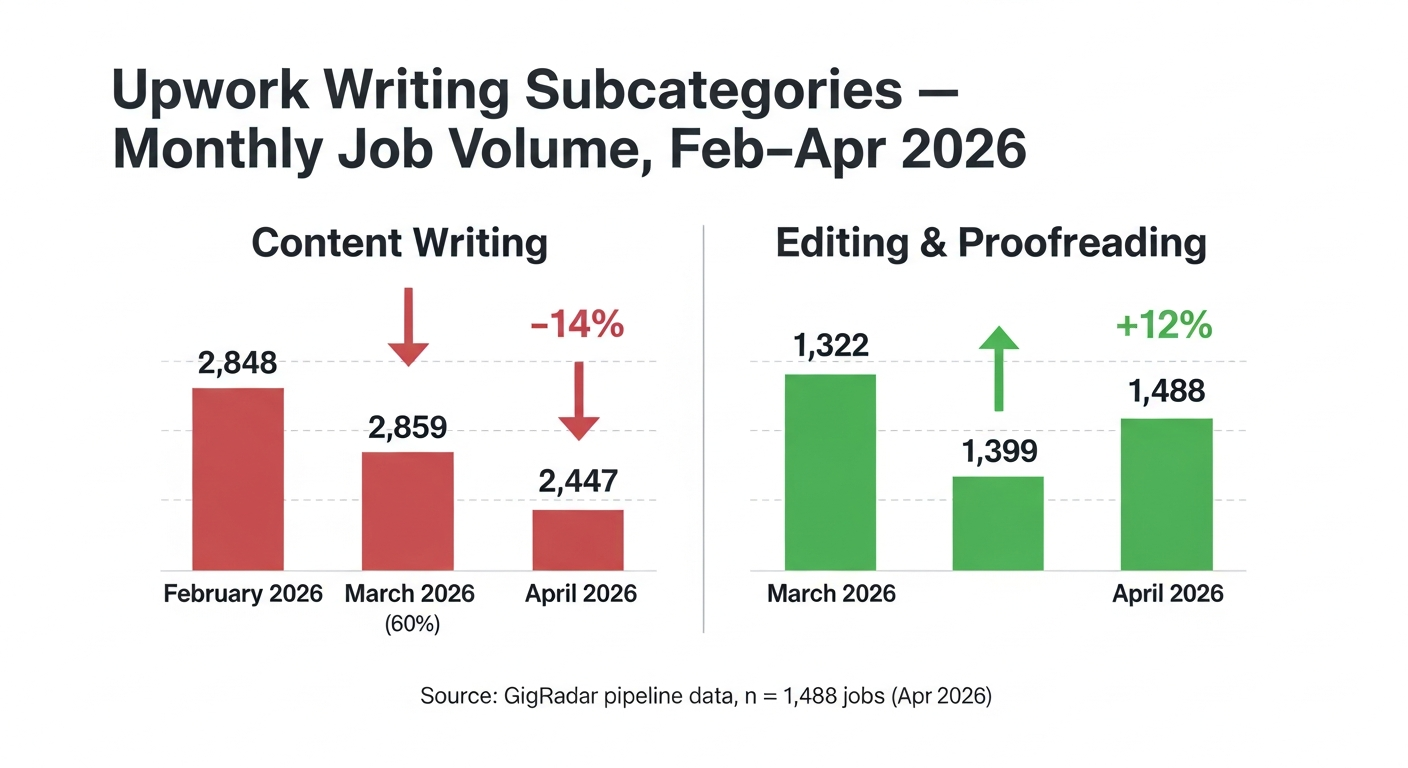
Content Writing is what AI does well: first-draft prose, listicles, generic blog filler. That market is consolidating into ChatGPT, Claude, and Gemini. Editing & Proofreading is what AI does badly: catching factual errors, holding the voice steady across 8,000 words, fixing the comma splice that ChatGPT inserts in every fourth paragraph.
The clients haven't changed their mind about whether good writing matters. They've changed their mind about where the time goes. Two years ago, a SaaS founder paid a writer $0.40/word to draft a help-center article from scratch. In 2026, the same founder generates the draft in 90 seconds and pays a proofreader to make it not embarrassing.
Payment verification matters because it's the cleanest filter Upwork gives you. Verified clients have hire intent. They're also more likely to be repeat hirers: the average client total-spent across the same sample was $140,300. These aren't "I just signed up to test a tool" accounts.
One Upwork client recently wrote up their experience hiring proofreaders, with the full thread sitting at the top of r/Upwork for proofreading queries this year:
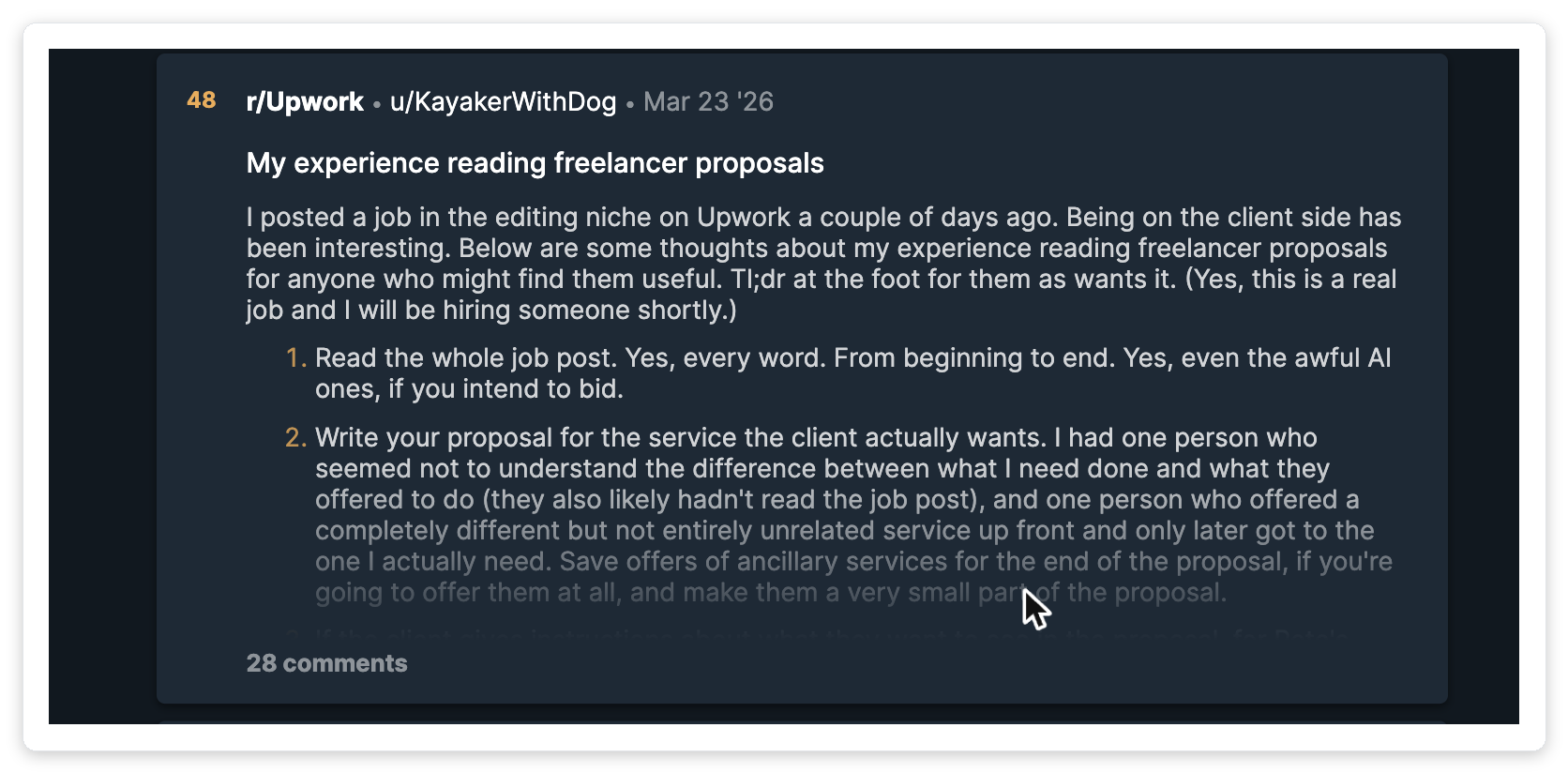
The client's top complaint isn't quality. It's that proofreaders pitch the wrong service. One bidder offered substantive rewrites when the post asked for light copyediting. Another led with ancillary services. The client describes both as auto-deletes.
This is the operator lesson: the client knows exactly what scope they want before they post. The agency that wins isn't the one with the best portfolio. It's the one whose first line matches the scope.
The 4 Niches That Get Proofreaders to $50/hr
Upwork's own rate page lists $18-$35/hr for generalist proofreaders, median $25. Generalist is a trap. The four niches below have a higher ceiling because the cost of an error is higher than the cost of the editor.
Academic & Dissertation
$35-$60/hr
Theses, journal submissions, grant applications. Clients are non-native PhDs and journal editors. Pricing benchmark from the Editorial Freelancers Association: $20-$50 per 1,000 words. Style guide literacy required: APA, Chicago, Vancouver, MLA. Multi-month engagements common (thesis chapters arrive every two weeks for six months).
Legal & Compliance
$50-$90/hr
Contracts, policies, regulatory filings, NDA-heavy work. Errors carry real liability so clients screen hard for credentials. JD or paralegal background expected. Lower volume than academic but stickier. Once a law firm trusts you on one matter, they route everything.
Medical & Scientific
$45-$80/hr
Clinical-trial reports, patient materials, journal manuscripts, pharma marketing. Subject-matter literacy is non-negotiable. AMWA certification helps. Clients are hospitals, biotech, and academic medical centers, large total-spend accounts.
SaaS & Technical Docs
$40-$70/hr
API docs, release notes, in-product copy, knowledge bases. Clients are product, DevRel, and tech-writing leads. You'll need Markdown, Git, basic familiarity with the product, and the discipline to test docs against actual UI. Retainer-friendly.
When the work is "fix typos in a 1,200-word blog post," the client compares you to ChatGPT, Grammarly, and a $7/hr proofreader in a low-cost country. You will lose on price. When the work is "edit a 12,000-word PhD chapter in econometrics," the client compares you to other econometrics-literate editors. That is a much smaller pool.
The Bidding Math No Proofreader Wants to Hear
Upwork makes more money the more proposals get sent. You make more money the more you don't send. These two facts are in tension and the Connect calculator is where it shows up.
Each Connect costs $0.15 (Upwork's own pricing). Most proofreading job posts charge 8-16 Connects to bid. A handful go pathological: there is a documented academic proofreading post on Upwork charging 31 Connects for a $15 fixed-price job. That's $4.65 in Connects to bid on a job that nets $12.75 after Upwork's 15% fee. Math says no.
The most expensive bidding mistake isn't picking the wrong number. It's picking the obvious one. GigRadar's analysis of 59,339 fixed-price Upwork proposals found that 88% of bids match the posted budget and those bids reply at 8.8%. Bids 50%+ below the posted budget reply at 20.6%. Bids 2-5× over the posted budget reply at 16.4%. The U-shape is real.
For proofreading, the cleanest application is to re-scope the job rather than re-quote it. Client posts $100 for a 10,000-word manuscript? Bid $250 for "a tight copyedit of the first 4,000 words plus a sample of the heavier prose," with the rest as an optional extension. That's a 2.5× premium bid and a clear scope. It clears the 16.4% bucket.
Some clients post intentional lowballs to filter out professionals. Others are first-timers who genuinely don't know what proofreading costs. The Connect cost is identical for both, but the lifetime value isn't. Always check payment verification, total spent, and number of past hires before you bid.
The Fixed-Price Budget Reality
Here's the actual distribution of fixed-price proofreading budgets in April 2026, pulled straight from Upwork's job posts:
| Percentile | Fixed budget posted | What that's actually buying |
|---|---|---|
| 25th percentile | $25 | 1,000-word blog post, light proofread |
| 50th (median) | $75 | 2,500-3,500 word article, basic copyedit |
| 75th percentile | $250 | Manuscript chapter or technical document |
| Top 10% (estimated) | $500+ | Full thesis, book manuscript, multi-deliverable |
If you want to live in the top 25% of jobs by margin, you need to stop bidding on the bottom 50%. The reason is not snobbery, it's per-Connect-economics. A $25 budget at 12 Connects = $1.80 in Connects for a $22.50 net job. Your time isn't free, and the win rate on these jobs is statistically capped because every proofreader in Bangladesh, the Philippines, and a Bali coworking space is also bidding on them.
Free for Upwork agencies
Stop sending 40 proposals to win 2 jobs
GigRadar operates an Upwork Business Manager that scans Editing & Proofreading job feeds and submits proposals on your team's behalf. Your freelancer accounts stay untouched. Most agencies see 5-10× more replies per bid week. Free audit. No card required.
Get Your Free Agency Audit →The Repeat-Client Mechanics That Compound
Upwork's Top Rated Plus status requires $10,000+ in earnings over the past 12 months and at least one large contract. A team of five proofreaders billing $40/hr at 25 hours/week clears that threshold per account in roughly 10 weeks, but only if they hold the same clients across the period. Churn through 30 different one-shot clients and you stay at "Rising Talent" forever.
The math on this is brutally simple. Acquiring a new Upwork proofreading client costs 6-10 Connects per proposal × 5-12 proposals to a win = $4.50 to $18 in Connect spend, plus 30-90 minutes of pitch and onboarding labor per client. Selling a second job to an existing client costs zero Connects and 5 minutes of pitching. The breakeven from "do another one" vs "find a new one" is roughly the third project.
Deliver early. Send the file with two-line notes flagging the ambiguous calls you made. Ask one specific question about their next project before they ask you. The first job's profit margin matters less than whether they remember your name when their next chapter is ready.
Once a client has paid you three times, propose a monthly fixed block. "Twenty hours of editorial coverage per month at $40/hr, locked rate, priority queue." A non-trivial fraction of clients say yes the first time they hear this. The ones who say no still hire you ad-hoc. The offer doesn't cost you anything.
A $75 job with a 4× repeat rate is worth $300 over six months. A $400 one-off is worth $400 and then zero. Most agencies optimize for the wrong number because the one-off is more visible. Build a simple spreadsheet that tracks per-client total billing on a 90-day rolling window. Every Friday afternoon, your top three clients should be repeat accounts.
"I posted a job in the editing niche on Upwork a couple of days ago. Being on the client side has been interesting... Read the whole job post. Yes, every word. From beginning to end."
u/KayakerWithDog, r/Upwork, March 2026The 3-Person Proofreading Agency Operating Model
You can run a profitable Upwork proofreading agency with three roles. The structure breaks down at one person (no QA layer), and it gets expensive at five+ before you've built the repeat-client base to feed everyone.
Owns the Upwork dashboard, runs job-feed filters, writes proposals. Spends roughly 60% of week-one time studying jobs, 40% writing proposals. The expensive part isn't the writing. It's the discipline to not bid on the 31-Connect $15 jobs.
Handles client comms post-win. Reviews every deliverable before it goes back to the client. The "before it goes back" part is the agency's reason to exist. A solo freelancer cannot QA their own work.
Owns the first pass on each deliverable. Subject-matter literacy in the agency's chosen niche is the only hard requirement; speed comes with reps. Pay $15-$25/hr internally, bill client at $35-$55/hr, the spread covers the bidder, QA, and your margin.
What the Spreadsheet Actually Looks Like
Numbers for a real three-person team running on academic + SaaS-docs niches at a mid-sized scale. Round numbers for clarity:
| Line item | Monthly | Notes |
|---|---|---|
| Gross revenue (24 contracts × $400 avg) | $9,600 | ~6 active retainers + 18 ad-hoc |
| Upwork fee (10% blended) | −$960 | Lower on long-term clients (5%), higher on new (10-15%) |
| Connects budget | −$140 | ~10 Connects × 90 proposals/month |
| Junior proofreader labor (2 × $1,800) | −$3,600 | ~80 hrs each at $22.50/hr internal |
| Senior proofreader / QA | −$2,500 | ~50 hrs at $50/hr |
| Tools (Grammarly, project mgmt) | −$80 | |
| Net to bidder/owner | $2,320 | Pre-tax. Tax handling is your problem. |
$2,320 isn't life-changing as a monthly take-home from a single Upwork account. The leverage comes from running 3-5 BM-invited accounts in parallel through GigRadar's agency vertical playbook, where the bidder time is amortized and the QA stack is reused. At that point the bidder/owner is netting $7-12k/month and the operation is fundable.
Where GigRadar Fits
The honest answer: GigRadar isn't a tool for one proofreader. It's infrastructure for an Upwork proofreading agency that already has 3+ accounts to feed.
The way it works is that your agency invites a GigRadar Business Manager through Upwork's official BM invitation flow. Our BM is a real, human-staffed Upwork identity. The BM scans your target subcategories (Editing & Proofreading, Content Writing if you do hybrid work) using filters you configure, drafts proposals informed by GigRadar's reply-rate data on 133,872 proposals, and submits from the BM account under our team's supervision. Your freelancer accounts are never touched.
If Upwork ever reviews a submission, the review lands on our BM profile, not your team. The same architecture is used by hundreds of agencies running on the platform. See our comparison of the agency-automation landscape for the longer breakdown of why BM-model and filter-and-draft are categorically different.
The reply-rate-by-category data we track shows that proofreading agencies that combine speed (first 60 minutes after a job post) with niche-specific opener phrasing land replies at roughly 2× the cross-Upwork average. The combination is hard for a human bidder to maintain manually for 8 hours straight, every day, across multiple BM-invited accounts. That's where the automation pays for itself.
If you're a solo proofreader still building your first three clients, skip GigRadar and read our piece on winning proposals for content work; same craft principles apply to proofreading. If you already run 3+ proofreader accounts, book a free audit and we'll walk through your current bid-to-reply ratio on a real session.
The Take-Home
Editing & Proofreading on Upwork is growing while the rest of the writing world contracts. The math favors agencies that pick a niche, filter Connects aggressively, and build for repeat clients instead of one-off churn. The agencies that go broke are the ones who keep bidding on $25 jobs at the median because that's "where the volume is."
The volume is also where the margin isn't.