
Value Proposition Canvas: Win Upwork Clients (Free Tool). How Upwork agencies fill the canvas right-side first and turn it into proposals that reply 3x better. Watch on YouTube
TL;DR
- The value proposition canvas has two halves: the Customer Profile (the client's jobs, pains, gains) and the Value Map (your products, pain relievers, gain creators). Most agencies fill in their own half and never touch the client's.
- The framework is meant to be filled right side first. Start with the client's world, then build the Value Map to match it. Starting with your services is the single most common mistake Strategyzer documents.
- On Upwork, "fit" is not abstract. It shows up in the first two lines of your proposal, and we can measure it: openers that name concrete proof ("We have worked with Coca-Cola, Pepsi...") reply at 15.22% versus roughly 5% for bare positioning claims like "we are a leading agency."
- Build your own canvas with the free tool below. It scores your fit and turns the six boxes into a paste-ready Upwork proposal opener.
A value proposition canvas an agency owner fills out in a conference room is worthless on Upwork, and here is the tell: the left side (your services) is crammed with sticky notes, and the right side (the client) has three vague bullets someone added at the end.
That is backwards. Alexander Osterwalder built the canvas to be filled in the opposite order, and on Upwork the cost of getting the order wrong is a reply rate that sits in the single digits while a competitor who mapped the client's world correctly takes the job.
I have watched 50-plus agencies run this exercise. The ones who win new business on Upwork treat the canvas as a translation tool: client language in, proposal language out.
This guide rebuilds the value proposition canvas for that job, with a tool that turns your six boxes into an opener you can actually paste into a bid.
Free Interactive Tool
Value Proposition Canvas Builder
Fill the client's side (right) first, then your side (left), one item per line. It scores your fit and drafts an Upwork proposal opener from your inputs.
① Customer Profile (the client)
② Value Map (your agency)
③ Proof for your opener
The value proposition canvas has two sides, and you are starting on the wrong one
The value proposition canvas is a one-page tool Osterwalder and the team at Strategyzer built to zoom into the two blocks of the Business Model Canvas that decide whether a business survives: who you serve, and what you offer them.
It is split down the middle. On the right sits a circle, the Customer Profile; on the left sits a square, the Value Map.
They only earn their keep when they connect.
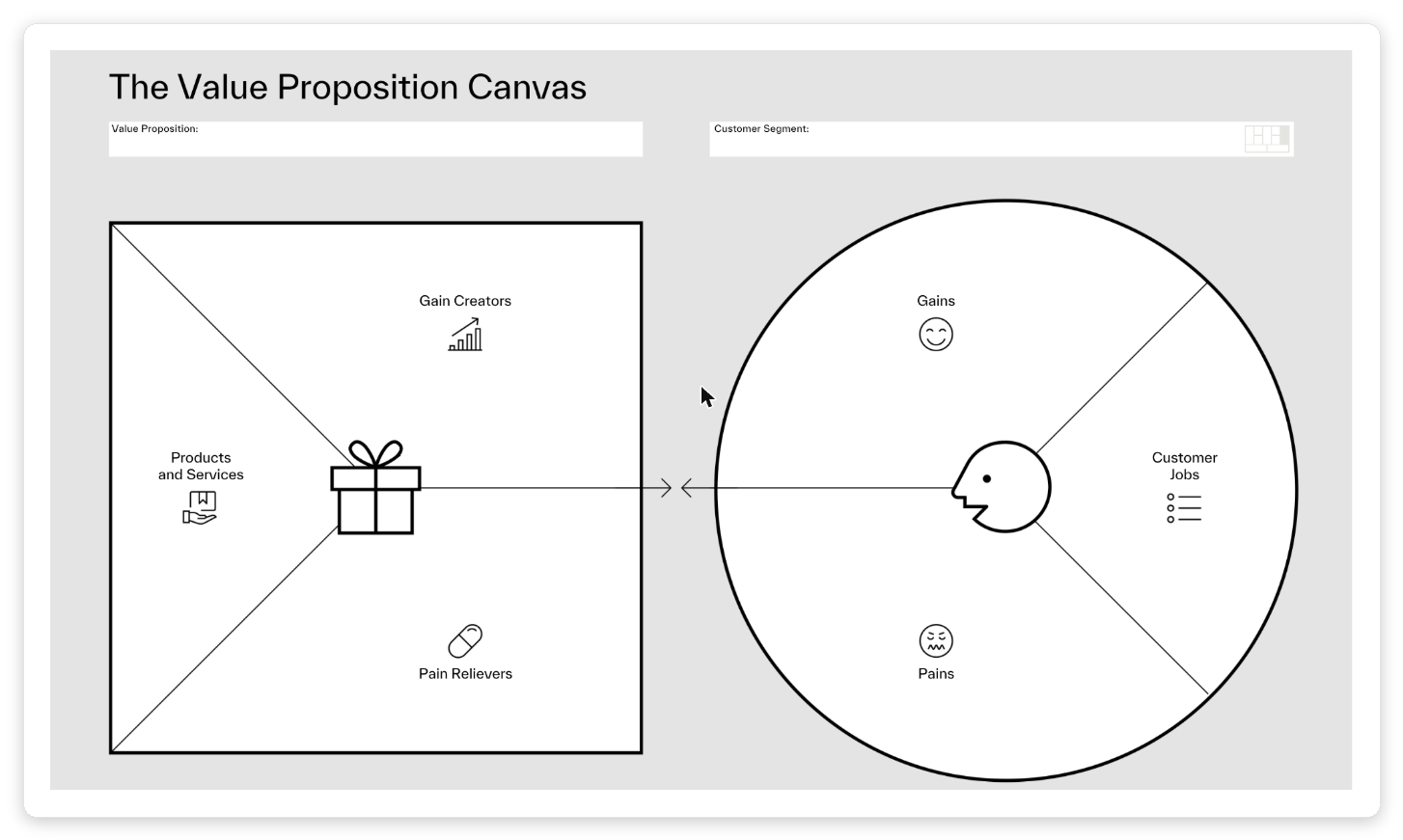
The right side draws on jobs-to-be-done thinking: value is defined by what the customer is trying to accomplish, not by the features you happen to build.
The right circle has three wedges. Customer jobs are what the client is trying to get done in their own words, pains are the bad outcomes and frustrations around those jobs, and gains are the concrete results they want.
The left square mirrors it. Products and services are what you deliver, pain relievers describe how those services kill specific pains, and gain creators describe how they produce specific gains.
The six building blocks, and the order to fill them
② Value Map (fill second)
Products & services - what you deliver
Pain relievers - how you kill each pain
Gain creators - how you produce each gain
① Customer Profile (fill FIRST)
Jobs - what they're getting done
Pains - risks and frustrations
Gains - the outcomes they want
Fit happens when each pain reliever points at a real pain and each gain creator points at a real gain. Build the right side from evidence, then build the left to match.
Osterwalder is blunt about the sequence in Value Proposition Design. You model the customer's world first, validate it, and only then design the offer against it.
Business Models Inc. teaches it with a literal trick: cover the left half, show your team only the circle, and force them to describe the customer before anyone is allowed to pitch a feature.
Agencies skip this because their services feel like the known quantity. That instinct is exactly why so many bids read like a capabilities deck nobody asked for.
What an Upwork client's jobs, pains, and gains actually look like
The Customer Profile only works if you fill it with the client's language, not your category labels. On Upwork you have an unfair advantage here: the client already wrote half of it for you, in the job post.
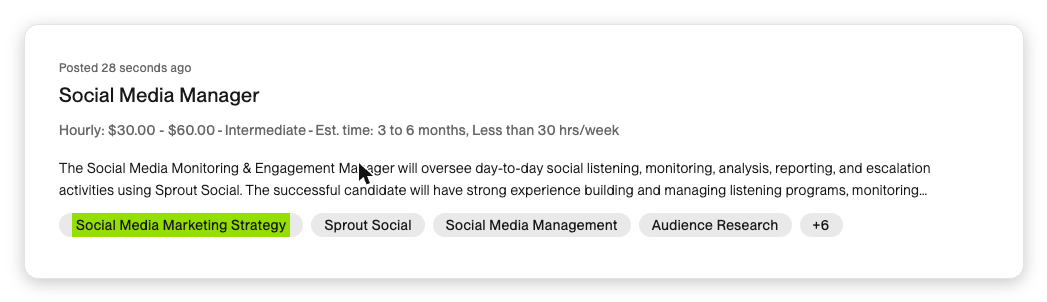
Read a posting like a researcher. The "job" is buried in the deliverable, the "pains" hide in the disqualifiers ("must be reliable, last freelancer disappeared"), and the "gains" are in the success criteria and the budget logic.
Here is the same client translated into the three wedges, the way it should land on your canvas.
| What the job post says | Canvas wedge | How it should read on your canvas |
|---|---|---|
| "Need our Klaviyo flows rebuilt before Q4" | Job | Capture more revenue from email before the peak season |
| "Last agency went silent for 3 weeks" | Pain | Fear of being ghosted again and losing the Q4 window |
| "Must be senior, no juniors" | Pain | Burned by junior execution, no time to manage it |
| "Goal: email at 25%+ of revenue" | Gain | A measurable revenue line they can defend internally |
Notice what is missing from the right side: your services. Not one wedge mentions "email marketing agency," and that restraint is the whole discipline.
The moment "we do Klaviyo" sneaks into the client profile, you have stopped researching and started pitching.
Separate functional, social, and emotional jobs: a client hiring on Upwork has a functional job (rebuild the flows), a social job (look competent to their boss for the hire), and an emotional job (stop dreading the Q4 forecast). The cover letter that names the emotional job reads as written by a human who gets it.
Your value map: turn services into pain relievers, not a feature list
Once the right side is real, the left side gets easy and ruthless. Every item in your Value Map has to earn its place by pointing at something on the client's side, and if a service does not relieve a listed pain or create a listed gain, it does not belong in this bid.
This is where agencies leak credibility. "We offer end-to-end email marketing" is a product line, not a pain reliever: the pain reliever is the sentence that connects it to the client's fear.
Same service, two ways to write it
✗ Feature list (no fit)
"We provide Klaviyo setup, flow building, segmentation, A/B testing, and monthly reporting."
✓ Pain reliever (fit)
"You were ghosted last time, so we ship the first three flows in week one and send a Loom every Friday. No silence, no Q4 risk."
For service businesses this is the documented adaptation. Service Design Tools and guides on consulting value-proposition design treat intangible work (workshops, audits, managed delivery) as the "products," then translate each into how it reduces risk and cognitive load.
The agency version of "gain creator" is almost always a number you have hit before.
That last point matters more on Upwork than anywhere else, and it is measurable. Vague gain creators do not just feel weak, they cost replies.
On Upwork, fit is proven in the first two lines of your proposal
The canvas calls the connection between offer and customer "fit." Strategyzer keeps it conceptual because they are teaching product teams. On Upwork, fit collapses into something brutally concrete: the first two sentences of your bid, where a gain creator either carries proof or it does not.
We can measure the gap. GigRadar analysed 133,872 outbound proposals from its pipeline (December 2025 to February 2026) and scored how the opening phrase correlated with reply rate, and the pattern is stark.
The winner, at 15.22% reply across 716 proposals, is "We have worked with" followed by specific named clients. That is a gain creator with evidence attached.
The loser, around 5%, is "we are a leading agency," which is a positioning claim with nothing behind it.
This is the translation the canvas is built for. Your gain creators become the proof in line one, and your pain relievers become the bridge in line two.
The openers that consistently get replies are not clever, they are just canvases that were filled right-side-first and then carried real evidence, the same pattern you see across reply and win-rate benchmarks.
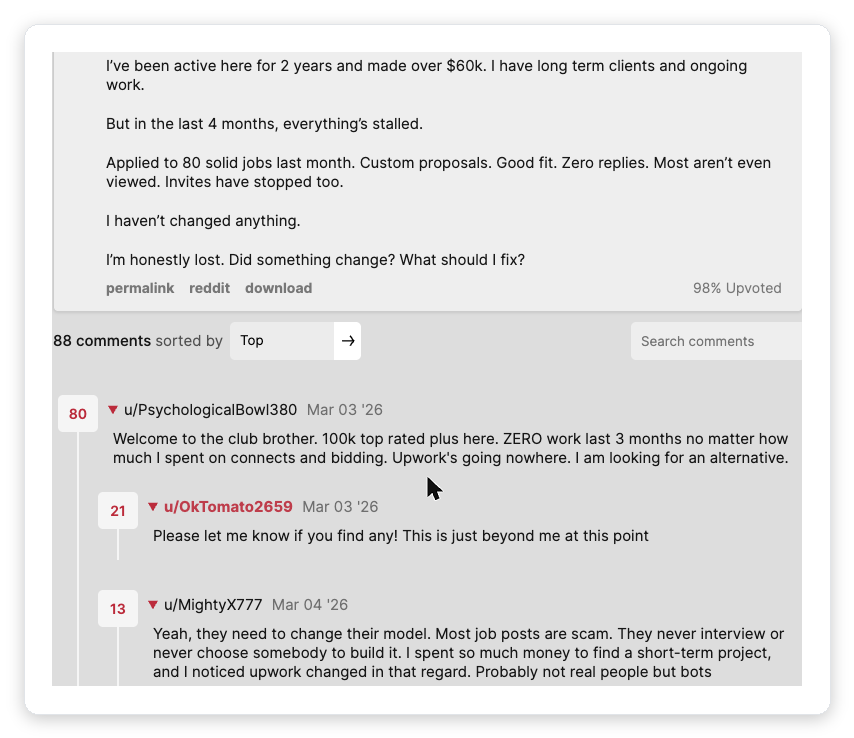
"Stopped opening with 'we're a full-service agency.' Switched to naming the two brands in their exact niche we'd worked with. Replies went from rare to normal almost overnight."
- paraphrased from r/Upwork agency-owner threads
Free for Upwork agencies
A perfect canvas still needs the right jobs to bid on
GigRadar surfaces the Upwork jobs that match your real value map, then submits tailored proposals from our managed Business Manager so your fit reaches the client first. Battle-tested across thousands of agencies.
Get Your Free Agency Audit →Five ways agencies butcher the value proposition canvas
Strategyzer documents five recurring mistakes. Each one shows up in a different way when you are bidding for agency work, so here they are translated to the Upwork context.
Starting with services projects your assumptions onto the client. Cover the left half until the right half is real.
A SaaS founder, an ecommerce ops lead, and a marketing director have different jobs. One canvas per client type, or you average them into a bid that fits nobody.
You wrote "build the flows" and stopped. You missed "look good to my boss for this hire" and "stop dreading the forecast." Social and emotional jobs are where differentiated proposals live.
"Faster" and "better" are not pains, so quantify and rank them. A few high-intensity pains drive most of the hiring decision, so address those first.
The canvas is a set of hypotheses, not a finished slide, and every won or lost bid is evidence. Update the wedges as you learn which pains actually convert.
Where the value proposition canvas stops, and what to pair it with
The canvas is a lens, not the whole picture, and pretending otherwise is its own failure mode. Critics note it can underweight emotional and brand-driven value and oversimplify complex B2B buying, where several stakeholders each carry their own jobs and pains.
It also does not price your work. The canvas tells you why a client should care; it stays silent on what to charge.
That is a separate exercise in value-based pricing, and on Upwork it connects directly to your agency rate card and anchors.
And it sits inside the Business Model Canvas, which maps the other seven blocks (channels, revenue, costs, key partners). The value proposition canvas zooms into two of those nine; use it to design the offer, then zoom back out to check the offer actually pays.
A pristine canvas that never reaches a client is a hobby. The constraint for most agencies is not insight, it is getting the fit in front of enough right-fit buyers fast, which is the client-acquisition problem the canvas alone does not solve.
Value proposition canvas: common questions
What is the difference between the value proposition canvas and the business model canvas?
The business model canvas maps nine blocks of how a whole business runs. The value proposition canvas zooms into just two of them (customer segments and value propositions) and breaks each into three parts, so you can design the offer in detail before checking it against the rest of the model.
Which side of the canvas do you fill in first?
The Customer Profile (the right circle) first, always. Map the client's jobs, pains, and gains from evidence, then build the Value Map (the left square) to relieve those specific pains and create those specific gains.
Can a service business or agency use the value proposition canvas?
Yes. Treat intangible work (audits, workshops, managed delivery) as your "products and services," then translate each into how it reduces a client's risk and cognitive load (pain relievers) and the measurable outcomes it produces (gain creators).
What does "fit" mean on the canvas?
Fit is when your pain relievers and gain creators line up with the pains and gains the customer actually cares most about. On Upwork, you prove fit in the first two lines of a proposal by attaching named evidence to your strongest gain creator.
Is the value proposition canvas free to use?
Yes. The official template is a free download from Strategyzer, and the interactive builder near the top of this article is free as well, scoring your fit and drafting a proposal opener from your six boxes with no signup.
Fill the right side first, and make every left-side item point at a real client pain or gain. Then carry the proof into the only two lines a client actually reads.
That is the whole game, and the tool above gets you to a paste-ready version in about five minutes.