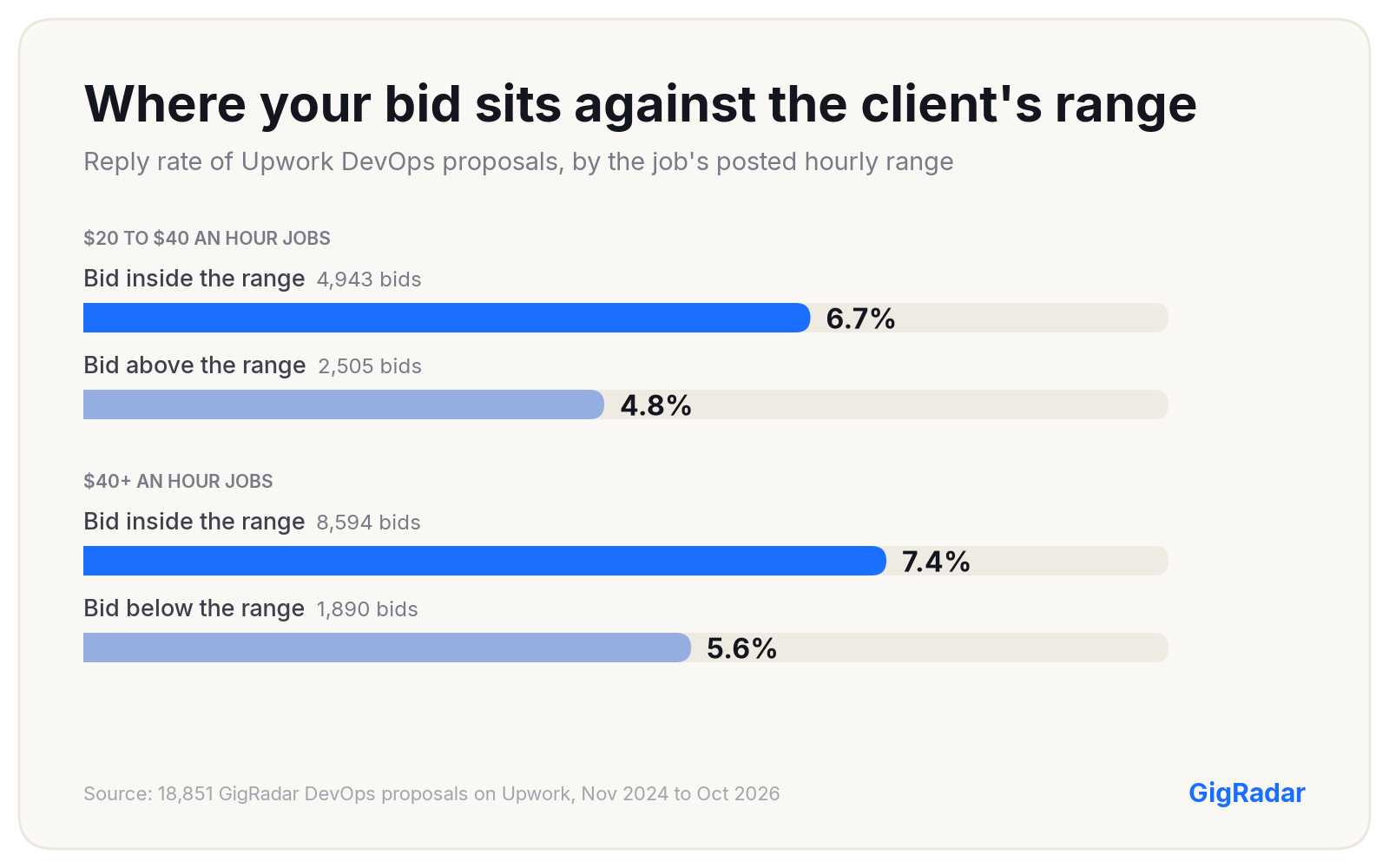
A DevOps cover letter that gets a reply looks almost the same on a $25 job and on a $60 job. In 18,851 Upwork DevOps proposals, the difference that held up in both bands was the rate: on $20-40 jobs, bids above the client's range got 4.8% replies against 6.7% inside it, and on $40+ jobs, bids below the range got 5.6% against 7.4%.
Abhishek, a member of my Skool community, asked what separates the DevOps letters that get replies in these two price bands. I expected the letters themselves to change with the budget, and they barely do.
How does a DevOps cover letter that gets replies differ by budget?
Among letters that got a reply, length and opening line are close across the two bands. Links and the bid are where they split.
| Letters that got a reply | $20-40 jobs | $40+ jobs |
|---|---|---|
| Replies in the sample | 457 | 817 |
| Median length | 686 characters | 776 characters |
| First line shows past work | 17.9% | 18.5% |
| First line is about the bidder ("I'm a DevOps engineer with...") | 22.5% | 19.0% |
| Has a link | 46.0% | 38.3% |
| Median bid | $40/hr | $50/hr |
| Share that bid above the client's range | 26.0% | 8.7% |
| Share that bid below the client's range | 1.1% | 12.9% |
Job band = the middle of the client's posted hourly range. Shares are of letters that got a reply in that band.
Replies on $40+ jobs came on letters about 90 characters longer, which is one or two extra lines. In both bands the shortest letters still got the most replies.
Why do bids above the range hurt on $20-40 DevOps jobs?
A third of the bids on $20-40 jobs (2,505 of 7,530) went above the client's top rate. Those got 4.8% replies, and bids inside the range got 6.7%.
The gap held in 2025 (2.6 points) and in 2026 (1.4 points). Inside the same agency it was 1.7 points, so it isn't only a few agencies bidding high.
Going over the range costs replies, by any margin. Bids up to 25% above the top of the range got 4.3% (1,483 bids).
Bids further above did a bit better at 5.4% (1,022 bids), and that still trails the 6.7% inside the range.
Upwork's own page on DevOps engineer rates says DevOps engineers on Upwork cost $40 to $100 an hour, and entry-level ones typically charge $40 to $60. So a client posting $20-40 is asking for entry-level rates or less.
Upwork suggests what people typically charge while the client posts, and its job post tool suggests a range based on similar projects. So the range is a real budget signal.
Why do bids below the range hurt on $40+ DevOps jobs?
On $40+ jobs, bids under the bottom of the client's range lost: 5.6% replies on 1,890 bids, against 7.4% inside the range on 8,594 bids.
| $40+ DevOps jobs | Proposals | Replies | Reply rate |
|---|---|---|---|
| Bid inside the range | 8,594 | 637 | 7.4% |
| Up to 25% under the bottom | 1,057 | 65 | 6.1% |
| More than 25% under the bottom | 833 | 40 | 4.8% |
| Bid above the range | 816 | 71 | 8.7% |
Above-the-range bids look fine here, but inside the same agency they got 2.2 points fewer replies than bids inside the range, so this row is no reason to bid high.
The further under, the fewer replies. The gap held in 2025 (2.0 points) and was smaller in 2026 (0.7 points), and inside the same agency it was 1.4 points.
These clients mostly post Expert-level work: 79% of proposals on $40+ jobs went to Expert-level posts, against 40% on $20-40 jobs. A study of hiring on a large online labor market found that when employers state how much they will pay for experience, freelancers tailor their wage bids to it.
Upwork's hourly rate guide says that if your rate is far below the market range for your skill, "clients may assume lower quality." Its page on US DevOps engineers puts their typical rate at $50 to $79 an hour.
In another experiment on an online labor market, firms made to pay a higher minimum hourly wage hired more productive workers. That fits $40+ clients buying skill over price.
"Novice callback rates increase by 54 percent from a baseline of 3.41 percentage points."
Ahmed, Tirmazee and Wu (2026), field experiment where new freelancers bid 80% of the budget on fixed-price data entry jobs
Undercutting worked there, for new freelancers on cheap fixed-price work. On $40+ DevOps jobs we saw the opposite, so I wouldn't carry that tactic over.
Which opening line works in a DevOps proposal?
By first line after the greeting, the order is the same in both bands: past work first, a question or the client's need next, and the bio last (tied with risk warnings on $40+ jobs).
| First line | $20-40: proposals | $20-40: reply rate | $40+: proposals | $40+: reply rate |
|---|---|---|---|---|
| Past work or a result ("Migrated a client's CI/CD to GitHub Actions last month") | 1,004 | 8.2% | 1,538 | 9.8% |
| Question to the client | 315 | 7.3% | 486 | 8.0% |
| The client's need ("You need your EKS cluster stable before launch") | 2,066 | 6.6% | 3,270 | 7.9% |
| A warning about the risk ("Where these migrations go wrong is...") | 561 | 5.3% | 741 | 5.1% |
| About the bidder ("I'm a certified DevOps engineer with 10 years...") | 2,304 | 4.5% | 3,016 | 5.1% |
Letters whose first line fit none of these types, or a rare type, are left out of the table. Examples in quotes show the type and are not real letters.
Agencies opened with a bio in 31.1% of the $20-40 letters that got no reply, more than any other first line on those jobs. On $40+ jobs it was 27.2%.
Inside the same agency the gap between past-work and bio openers shrinks to 1.6 to 2.7 points, so part of it comes from which agencies write them.
More first-line examples are in our list of 25 Upwork proposal openers that get replies.
Does a shorter DevOps proposal get more replies?
In the raw numbers, yes. Letters under 500 characters got the most replies in both bands, and the longest letters were near the bottom.
| Letter length | $20-40: proposals | $20-40: reply rate | $40+: proposals | $40+: reply rate |
|---|---|---|---|---|
| Under 500 characters | 1,681 | 7.8% | 2,110 | 9.8% |
| 500-999 | 3,654 | 6.0% | 5,369 | 6.5% |
| 1,000-1,499 | 1,123 | 5.8% | 2,035 | 7.3% |
| 1,500-1,999 | 761 | 3.8% | 1,296 | 6.6% |
| 2,000+ | 311 | 4.5% | 511 | 5.3% |
Inside the same agency, letters under 500 characters did no better than longer ones. So the short-letter edge mostly comes from the agencies that write short, and cutting words alone won't move your number.
Links helped on cheaper jobs only. On $20-40 jobs, letters with a link got 7.4% against 5.3% without one, and the gap held inside the same agency (2.2 points).
On $40+ jobs it was 7.7% against 7.0%, and inside the same agency the gap was 0.1 points.
What didn't help in either band?
Naming the tools from the job post didn't help. Letters that named at least half of them got 5.9% on $20-40 jobs and 7.1% on $40+ jobs, about the same as letters that named fewer.
| Letter habit | $20-40 jobs | $40+ jobs |
|---|---|---|
| Names half or more of the job's tools (AWS, Terraform, Kubernetes...) | 5.9% vs 5.8% | 7.1% vs 7.4% |
| Asks a question anywhere in the letter (raw) | 6.7% vs 4.9% | 7.6% vs 6.4% |
| Asks a question, inside the same agency | 1.3 points lower | 0.5 points lower |
"vs" compares letters with the habit against letters without it. The tool row counts only jobs whose post named at least one common DevOps tool.
Questions anywhere in the letter look good in the raw numbers and did slightly worse inside the same agency. A question as the first line is a different measure, and the opener table above doesn't control for agency.
What to change in your next DevOps proposal
If your floor is above their top rate, skip the job.
Bids more than 25% under it got 4.8% replies against 7.4% inside.
Past-work openers got 8.2% and 9.8%; bio openers got 4.5% and 5.1%.
It was worth 2.2 points inside the same agency on $20-40 jobs.
Here is an opening built on the past-work pattern. Fill the brackets from a real project.
Fixed-price jobs follow a different pattern, covered in how bids against a posted fixed budget did. To set your own hourly number, use our Upwork hourly rate calculator.
See where your DevOps bids sit against each client's range
Book an agency audit and we'll check your reply rate by job budget and by bid position for your own proposals.
Get your free agency auditHow did we measure this?
We took every proposal sent through GigRadar from 1 November 2024 to 31 October 2026 on Upwork jobs in the DevOps & Solution Architecture subcategory. We kept hourly jobs with a posted hourly range and left out invitations to interview, fixed-price jobs and hourly jobs with no range.
That left 19,555 proposals, and 18,851 of them sat in the two bands Abhishek asked about. They came from 443 agencies and 728 bidding profiles.
Freelancer and agency profiles can't be compared, because nearly every bid here went out from an agency setup. Top Rated and Job Success Score were only on file for 59% of bids, and only as of November 2026, not as of the bid.
Greeting the client by name (14 letters) and GitHub links (under 1% of letters) were too rare to measure. For more reply data, see the Upwork proposal response rate guide and our reply rate benchmarks by category.
Sources
- GigRadar proposal data, 1 Nov 2024 to 31 Oct 2026: 19,555 non-invite hourly proposals with a posted range in Upwork's DevOps & Solution Architecture subcategory; 18,851 in the $20-40 and $40+ bands. Reply = client opened a chat.
- Upwork: DevOps Engineer Hourly Rates, cost to hire. upwork.com/hire/devops-engineers/cost
- Upwork: Upwork Hourly Rates, average rates by skill and experience in 2026. upwork.com/resources/upwork-hourly-rates
- Upwork Help: How to post a job. support.upwork.com
- Upwork Help: Post a job (Enterprise), budget section. support.upwork.com
- Upwork: Best DevOps Engineers in the United States, typical US rates. upwork.com/hire/devops-engineers/us
- Horton, J., Johari, R. and Kircher, P. (2021). Cheap Talk Messages for Market Design: Theory and Evidence from a Labor Market with Directed Search. john-joseph-horton.com
- Ahmed, H., Tirmazee, Z. and Wu, R. (2026). Beliefs, Reputation, and Barriers to Entry in Online Labor Markets. rebeccawu96.github.io
- Horton, J. (2018). Price Floors and Employer Preferences: Evidence from a Minimum Wage Experiment. john-joseph-horton.com