If you're sending 40 proposals a week and hearing back from one or two, you do not have an algorithm problem. You have a funnel problem. The average reply rate on Upwork in 2025 is 15%. Top agencies sit at 22–30% in the same categories. The delta is not luck. It is eight decisions you are quietly making wrong.
What "2–4% reply rate" actually means
Most agencies report reply rate as one number: replies ÷ proposals. That number is useless. It hides the two things that actually move.
A 2–4% reply rate can come from two completely different funnels. The fix for each is opposite.
- High view rate, low reply rate: clients open your bid and walk away. Your letter is the problem.
- Low view rate, decent reply rate: clients never open your bid. Your profile, title, or first line is the problem.
From the GigRadar course, here are three real agency data points I diagnose every week:
| View rate | Reply rate | Diagnosis |
|---|---|---|
| 24% | 12% | Healthy. Keep shipping. |
| 21% | 5% | Letter is weak. Clients open, then bail. |
| 10% | 7% | Exposure is weak. Profile or first line filters you out. |
If your agency is under 5% reply rate and you have not split the funnel into view and reply, you are flying blind. Fix that first.
Sources: Upwork Insights 2025, aggregated marketplace analytics from 2025 Upwork category reports, and GigRadar pipeline data across 280+ agencies.
Reply rate by category. the real benchmarks
Industry averages are misleading when your category is twice as competitive as the platform mean. Here is what actually happens by niche, based on 2025 Upwork category benchmarks and our own pipeline data across 280+ agencies.
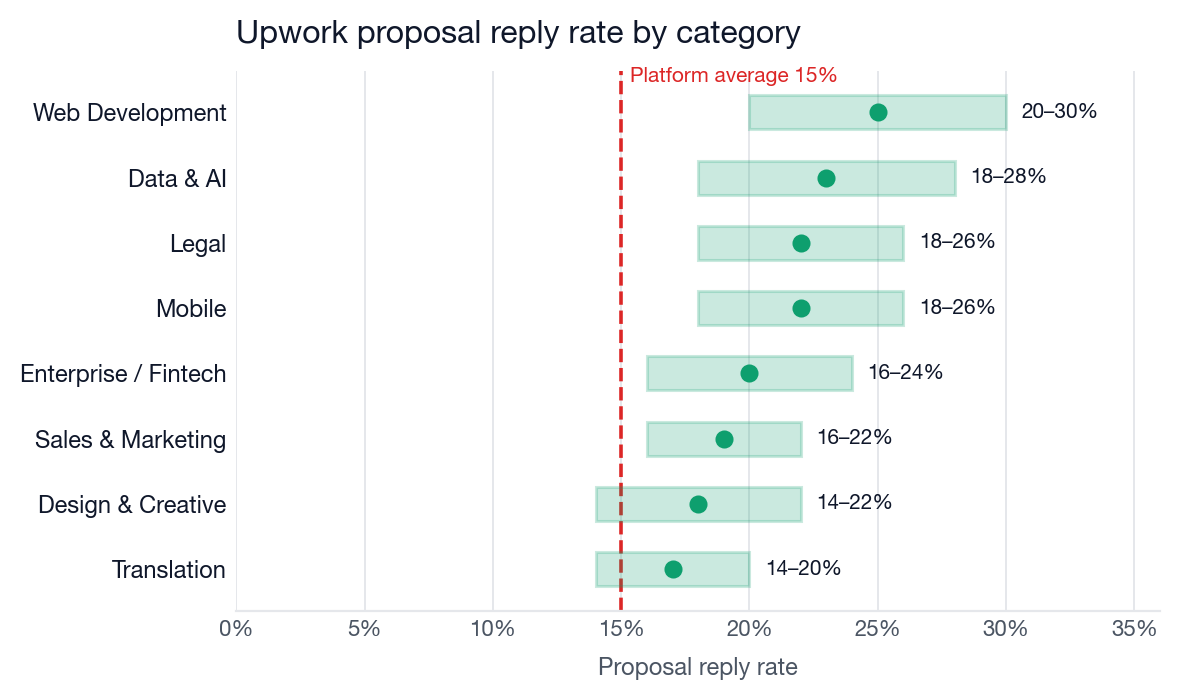
Three things jump out of the data.
First, Legal and Translation sit 40–60% above the platform average. Low competition, high intent. If you are a legal-adjacent freelancer (contract drafting, IP, compliance) and your reply rate is under 18%, your profile is the problem, not the category.
Second, Development stays the most responsive category for invites. Only 12.5% of dev invites went unanswered in 2025, nearly unchanged from 2023. Translation: if you can earn a Top Rated badge in development, the platform starts feeding you warm leads instead of asking you to chase cold ones.
Third, Enterprise and Fintech reply rates are the lowest (16–24%) but convert at the highest rate. One reply in fintech is often worth five in local services. Track win rate, not reply rate, when your ACV is above $15k.
The diagnostic: where is your funnel broken?
Plot your view rate and reply rate on this matrix. The quadrant tells you what to fix first.
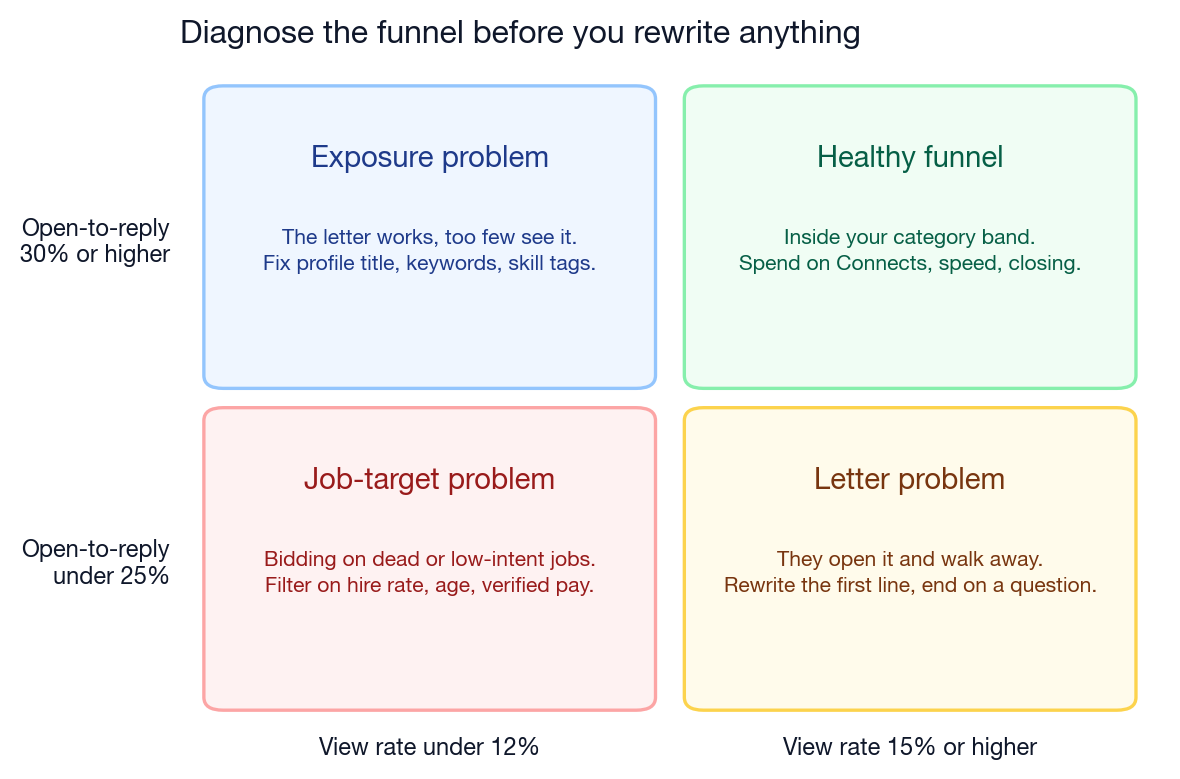
The most common failure pattern I see in agencies: they open their proposal analytics, see 6% reply rate, and start rewriting the cover letter. Then view rate drops below 10% and they blame Upwork.
That was the wrong fix. With a 10% view rate and a 6% reply rate, the letter is fine. Your first line or profile is filtering you out before anyone reads the pitch.
Calculate your real reply rate (and what to fix)
Response Rate Diagnostic. free tool
Pull your last 30 days from Upwork's Proposals tab. Enter below.
Profile beats proposal volume, 3 to 1
Most agencies try to fix reply rate by sending more bids. That is a treadmill. The math of the platform says profile quality compounds the return on every single Connect you spend.
Two profile metrics carry most of the weight:
- Job Success Score (JSS). Above 90% unlocks Top Rated. Above 95% gets you recommended to enterprise buyers.
- Proposal View Rate (PVR). Driven by your profile title, first line of the letter, and how closely your 15 skill tags match the job's search terms.
A 10-point jump in PVR is worth more than a 2x increase in proposals sent. One doubles your clients opening the letter. The other doubles your Connect spend without changing outcomes.
Watch: Nail your Upwork profile (5 min)
The 3-part title formula
Your title has 70 characters. Most freelancers burn them on things like "Experienced Full-Stack Developer." That title blends into 200 identical ones.
The formula that converts:
- Pattern disruptor. "Exceptional," "Detail-Obsessed," "Ass-Kicking." Stops the scroll.
- Main keywords. Pulled directly from job posts your target clients have already paid for. Not what you think clients search for. What they actually pay for.
- Audience niche. "for US SMBs," "for Tech Startups," "for Coaches." Clients feel seen.
Result: "Exceptional Klaviyo Email Marketing for US Startups." Three moves, one line, instant filtering.
The cover letter: first 200 characters decide everything
Here is what Upwork does the moment a client clicks your proposal: it shows about a line and a half before the "read more" fold. Roughly 200 characters. That is the entire budget for your hook.
Generic opener: "Hello, I'm John, I'm a ReactJS developer with 10 years of experience.". client scrolls past.
Investigated opener: "Hey Eric, I see you already have WordPress and Shopify stores, and even built a dropshipping site before. Is this new project related to that?". client reads the rest.
The investigation takes 90 seconds. Check the client's past jobs (green titles show what platforms they use), scan their feedback history (especially what they wrote about freelancers. it tells you how they behave), and look for a website link.
Watch: Personalize cover letters (6 min)
Where to find the "screaming name"
Every proposal needs one personal anchor. a name, company, competitor, or product they built. In sales, we call it the screaming name. It is the thing that makes the client feel you are writing to them, not the whole platform.
- Client feedback history. Freelancers routinely address clients by first name in written reviews.
- Past jobs. Names often appear in the earliest posts, before the client learned to strip PII.
- Company website "About" or "Team" pages. A 10-second Google search from the job post URL.
- GDPR / privacy pages on European sites. These legally require a named data protection officer. often the founder.
If none of those work, the fallback is the country or the niche. "I saw you're hiring for a Laravel developer in Germany. do you need this built from scratch or added to an ongoing project?" Still better than "Hi, I'm John."
Make them reply: mirroring + open questions
The second-most common reason clients open a proposal and walk: the letter ends with something they can ignore. "Let's hop on a call." "Happy to discuss." "Looking forward to hearing from you."
Every one of those lines lets the client think "yeah, sure" and close the tab. None of them force a reply.
Switch to open questions. They cannot be answered with yes or no.
- Instead of "Can you share documentation?" → "What does success look like for this project?"
- Instead of "Should we jump on a call?" → "Where do you expect the biggest challenges?"
- Instead of "Does this fit what you need?" → "How do you see this solution fitting into your business?"
What, where, how, when. Those four words, placed at the end of your letter, are the difference between a 5% and a 12% reply rate in agencies I work with every week.
Watch: Make them reply (7 min)
Speed wins: under 30 minutes or don't bother
Upwork's own data shows clients read 6–10 of the first proposals and decide. The first 5 proposals get 3–5x more views than anything submitted after the first hour. Early applicants see a 15–25% reply rate against a ~5% platform average for late bids.
From our pipeline data across 280 agencies, the gradient is sharper than most freelancers realize:
And the trap most agencies fall into: bidding in the first 10 minutes, then taking 24 hours to respond when the client finally replies. That kills the momentum faster than showing up late in the first place. The client's brain registers "fast pitch, slow follow-up" and assumes the proposal was automated.
Set one rule for your team: reply to any client message inside 30 minutes during business hours, even if the reply is just "tied up now, back in 2 hours with a proper answer." Presence beats polish.
Watch: Win in 5 minutes (6 min)
Kill the fake jobs before they kill your reply rate
Here is the single-most-missed cause of a 2–4% reply rate: the jobs you are bidding on were never going to hire anyone.
A real batch from one of our agencies: 81 bids → 5 replies. Reply rate: 6%. The team was mid-rewriting the cover letter when we pulled the list. Over half the jobs had closed as "no longer available" or "no interview" within 48 hours. Most had zero hires across the client's entire history. Rewriting the letter would have changed nothing.
Four filters that keep your Connect spend honest:
- Client hire rate. Under 40% hired-from-past-jobs means half the jobs they post get abandoned. Skip or heavily discount.
- Payment verified. Not optional. Every unverified job is ~3x more likely to close without a hire.
- Post age. Within 48 hours of posting. Two-week-old jobs have already hired someone or lost interest.
- Competition signal. "20–50+ proposals already submitted" = you are fighting for the 6–10 slots the client will actually read. Unless your profile is in the top 3% for the keyword, skip.
The less-obvious move: narrow your job targets. Retargeting. chasing clients you already pitched and lost. works in 2% of cases on Upwork. What works is cutting your target list by 50% and doubling down on the 50% where your profile is actually in the top of the stack. Agencies that narrow from "any JavaScript job" to "Next.js + Supabase + $3k+ budget" routinely see reply rate climb from 5% to 14% in six weeks.
The path from 4% to 15%: 21-day plan
Here is the sequence that consistently moves reply rate in agencies I work with. It is ordered by leverage, not effort.
| Week | Focus | Target lift |
|---|---|---|
| Week 1 | Split funnel: measure view rate, reply rate, open-to-reply separately. Filter out fake jobs. | Baseline clarity + 1–2 pts from job-target cleanup |
| Week 2 | Rebuild profile title (3-part formula), audit 15 skill tags against top-earner profiles. | +3–5 pts view rate |
| Week 3 | Rewrite opening line. investigate every client for 90s before writing. Switch closers from "let's discuss" to open questions. | +4–7 pts reply rate |
At the end of three weeks, most agencies sit in the 10–14% band. Legal and development agencies often clear 18%. After that, the levers are marginal. speed (under 30 min), boost usage on high-ACV jobs only, and call closing once you land the reply.
Frequently asked questions
What is a "good" reply rate on Upwork in 2025?
Platform average is 15%. "Good" means 18–22% for most categories, 22–30% for Legal, Translation, or Development with a Top Rated badge. Below 10% signals either a profile problem, a job-targeting problem, or both.
Why is my reply rate 2% when I send 50 proposals a week?
The most common causes, in order: (1) bidding on fake or dead jobs, (2) profile title does not match what clients search for, (3) cover letter opens with a generic intro instead of an investigated first line. Fix (1) first. it costs nothing and often doubles reply rate alone.
Does Boosted Proposal actually work?
Yes, but not the way most agencies use it. Boost delivers an 80% view rate on average. 2–3x the unboosted baseline. But it cannot fix a weak letter or a bad profile. Use Boost on jobs with ACV over $3k, strong client hire rate, and where your profile is already keyword-matched. Boosting to "get views" on low-intent jobs just burns Connects faster.
How long should an Upwork cover letter be?
Under 500 characters by default. Mirror the client: long job post = slightly longer letter. Short job post = short letter. Every sentence past 500 characters dilutes the hook and lowers your Upwork AI match score.
Does Job Success Score (JSS) affect reply rate?
Yes, heavily. JSS above 90% unlocks Top Rated and measurably increases PVR. A single bad private-feedback score can move JSS by up to 11%. If your JSS dropped recently, check JSS Insights for exclamation marks or X's. those flag hidden private feedback under 7/10 that pulled the number down regardless of public star rating.
How fast should I reply after a client responds?
Under 30 minutes during business hours. Our pipeline data shows replies under 5 minutes are 100x more likely to convert to a Zoom call than replies over 24 hours. Even a quick "Thanks. tied up for 2 hours, will send a proper answer after my meeting" keeps the thread alive.
Is the "2-Question Method" better than long-form proposals?
For most categories, yes. Short, investigated, two-question letters see 24–28% reply rates against 8–12% for long-form. Exceptions: enterprise or $20k+ projects, where detailed proposals with a custom Loom video still outperform. Rule of thumb: under $10k, go short; over $20k, go long.
Stop sending proposals into the void
GigRadar tracks view rate, reply rate, and open-to-reply ratio on every proposal your agency sends. so you know which of the four problems to fix before you send the next 100 bids.
See the dashboard. book a demo