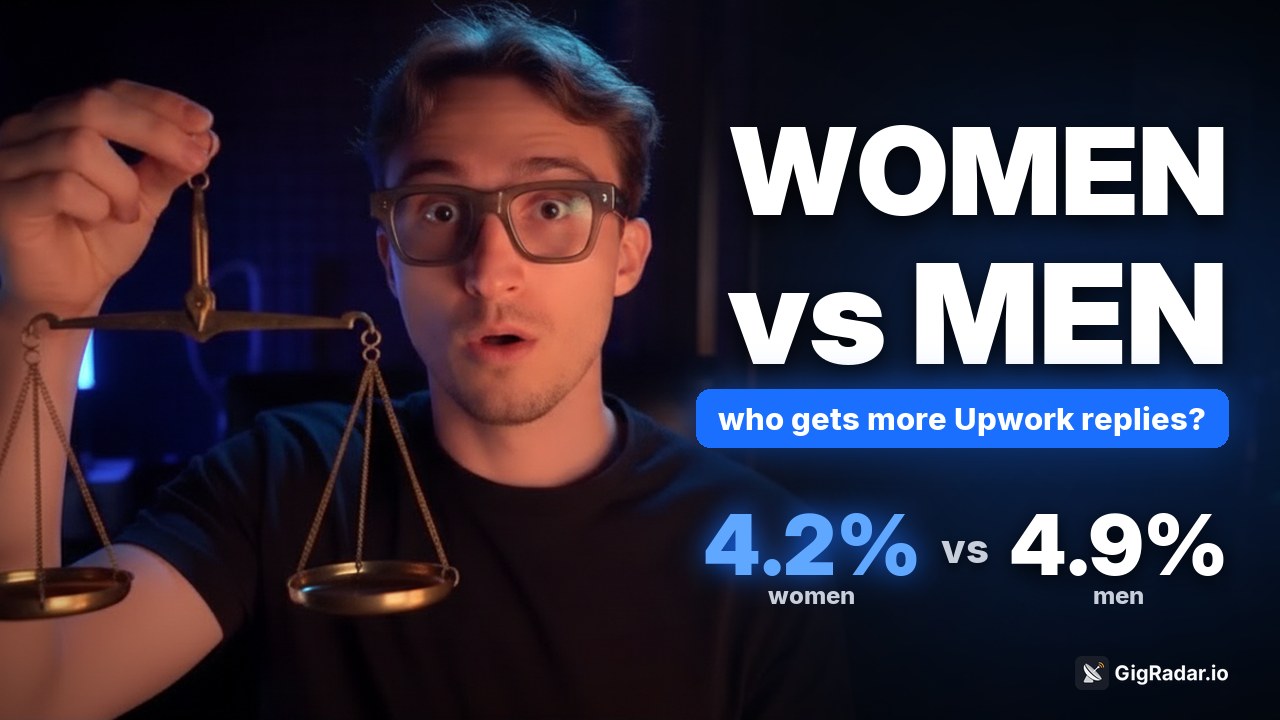
Women's profiles got replies to 4.2% of their proposals, and men's got 4.9%. That is the raw Upwork gender gap in 273,348 proposals sent through GigRadar between May and October 2026, and inside the same agency and category it falls under half a point.
Tamara, a member of my Skool community, asked me about this, and I expected a bigger number. The same-agency gap could even be zero.
How big is the Upwork gender gap in replies?
Across all categories, men are about 0.6 points ahead. When we resample freelancer profiles to see how much that moves, it ranges from 1.7 points in favor of men to 0.8 points in favor of women.
So the raw gap is too noisy to call. Which profiles happen to be in the sample can swing it either way.
| Group | Proposals | Replies | Reply rate |
|---|---|---|---|
| Women | 58,580 | 2,469 | 4.2% |
| Men | 214,768 | 10,425 | 4.9% |
| Difference | 0.6 points* |
*Gaps in this article use unrounded rates, so they can differ by 0.1 from the rounded rates shown.
Does the gap hold inside the same agency?
Women's profiles are spread across agencies differently from men's, and agencies differ in niche and pricing. So we compared men's and women's profiles only inside the same agency and the same job category.
That covers 91,090 proposals, and the gap there is under half a point. It drops from about 0.6, so comparing within one agency and category removes about a third of the raw gap.
Likely range, same agency and category: from 0.8 points fewer replies for women to 0.1 points more. Zero sits inside that range.
Which Upwork categories show a gender gap?
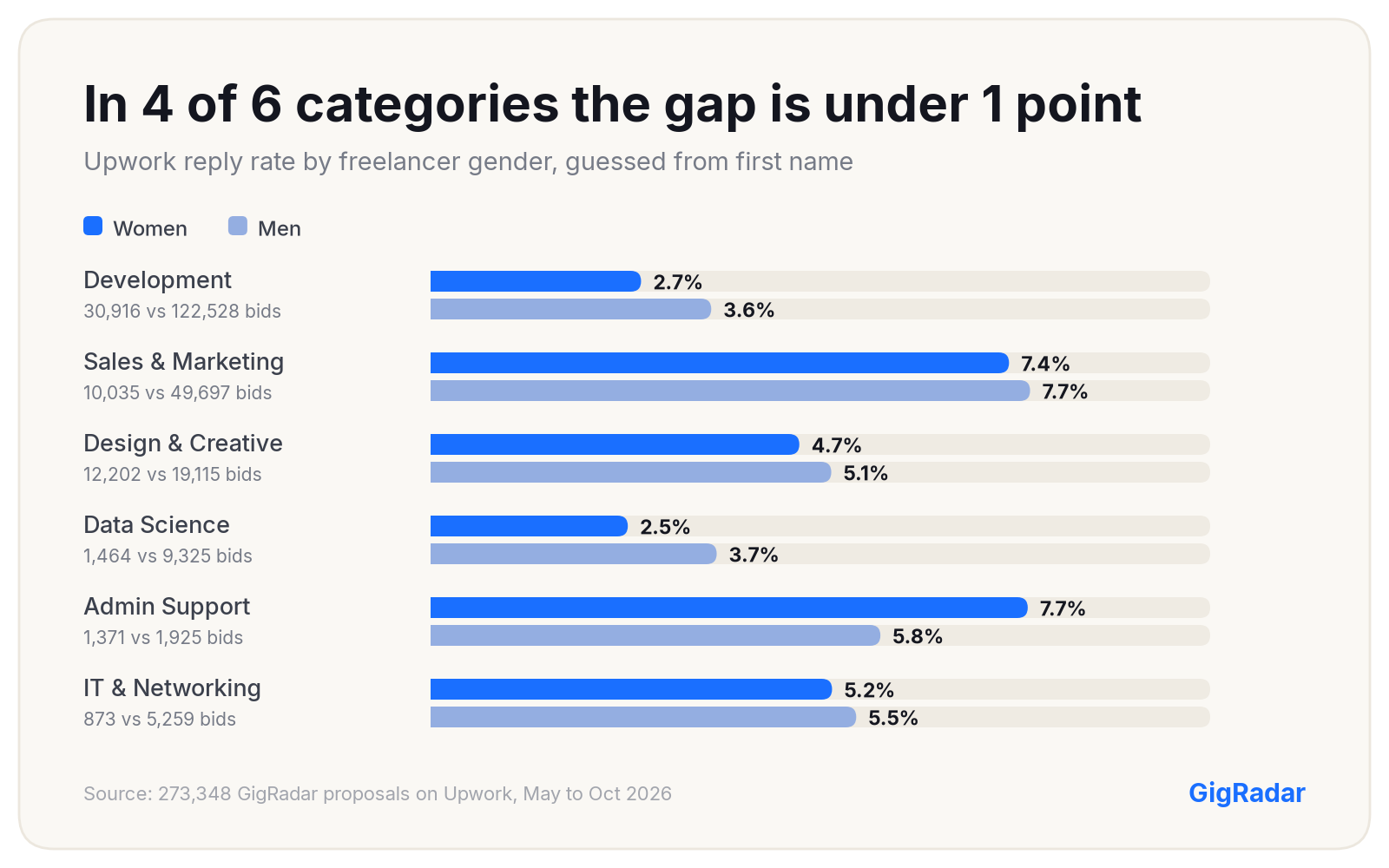
In four of the six categories with the most bids from women, men and women are less than one point apart. Data Science shows a 1.1-point gap for men on only 1,464 women's bids, and Admin Support goes the other way: 7.7% for women and 5.8% for men.
| Category | Women: proposals | Women: reply rate | Men: proposals | Men: reply rate | Gap (points)* |
|---|---|---|---|---|---|
| Development | 30,916 | 2.7% | 122,528 | 3.6% | 0.9 for men |
| Design & Creative | 12,202 | 4.7% | 19,115 | 5.1% | 0.4 for men |
| Sales & Marketing | 10,035 | 7.4% | 49,697 | 7.7% | 0.3 for men |
| Data Science | 1,464 | 2.5% | 9,325 | 3.7% | 1.1 for men |
| Admin Support | 1,371 | 7.7% | 1,925 | 5.8% | 1.9 for women |
| IT & Networking | 873 | 5.2% | 5,259 | 5.5% | 0.3 for men |
| Engineering & Architecture | 590 | 8.6% | 2,017 | 7.6% | 1.1 for women |
| Accounting & Consulting | 499 | 6.2% | 3,454 | 6.9% | 0.7 for men |
| Customer Service | 266 | 11.3% | 473 | 6.1% | 5.1 for women |
Engineering, Accounting and Customer Service have too few women's bids to trust, so I would not plan around them. Writing, Legal and Translation are left out because women's profiles there got 10 replies or fewer.
Development shows the clearest raw gap
In Development, women got 2.7% replies on 30,916 proposals and men got 3.6% on 122,528. Of the nine categories we resampled, it is the only one where the raw gap stays clear of zero.
Inside the same agency it drops to about half a point, and that range also includes zero.
Half a point in Development is about 1 extra reply per 200 bids.
Why does the profile matter more than the gender?
We took every profile with at least 200 proposals in the period. The middle profile gets 4.4% replies for men and 4.3% for women.
The spread inside each group is far wider than the gap between them. Among women, the top quarter gets more than three times the replies of the bottom quarter (7.0% against 1.9%), and among men it is about two and a half times (6.7% against 2.7%).
Part of that spread is category mix, so I checked Development alone. There the top quarter of men's profiles gets 4.8% or more and the bottom quarter 1.9% or less, while women's run from 1.3% or less to 4.5% or more on a small set of profiles.
| Profiles with 200+ proposals (all categories) | Women | Men |
|---|---|---|
| Bottom quarter (at or below) | 1.9% | 2.7% |
| Middle profile | 4.3% | 4.4% |
| Top quarter (at or above) | 7.0% | 6.7% |
| Top 10% (at or above) | 11.3% | 10.1% |
The women's top 10% rests on a small number of profiles, so treat that row as a rough guide.
What does other research say about gender on freelance platforms?
Jason Chan and Jing Wang studied hiring on a large online labor platform and found a hiring bias in favor of women. They link it to clients trusting women more when they can't meet the freelancer.
They also saw that bias shrink as clients hire more on the platform. On price, a 2018 Northwestern study of 48,019 US Upwork workers found that women asked for $35 an hour and men $46.
"The researchers discover that the median woman on Upwork billed 74 percent of what the median man did."
Northwestern Institute for Policy Research, summary of Foong et al., CSCW 2018
A follow-up survey of 392 US Upwork freelancers found no gender difference in pricing strategies that was significantly tied to bill rate. Full-time freelancer status and self-esteem may explain more of the rate gap.
Our data measures an earlier step: whether the client answers the proposal at all. On that step, the difference we see is small.
What should an agency do with this?
Upwork asks for a profile photo that is a close-up of your head and shoulders, clearly showing your face, so clients see who is bidding. Upwork's rules also say clients may not unlawfully discriminate when selecting freelancers or writing job posts.
With a gap this small, picking who bids by gender would not help.
Use at least 200 bids per profile in that category so one lucky week doesn't decide it.
The spread between profiles of the same gender runs to several points.
Our guide to optimizing your Upwork profile covers the title, proof and portfolio.
If you want to see where your own profiles land, our reply rate benchmarks by category give you the baseline.
Find out which of your profiles wins each category
Book an agency audit and we'll look at reply rates per profile and category for your bids.
Get your free agency auditHow did we measure this?
We took every proposal sent through GigRadar from 1 May to 31 October 2026 that had a job category, leaving out invitations to interview. That is 337,754 proposals.
We guessed each freelancer's gender from the first name on the profile that sent the bid, using the open-source gender-guesser name list. Names it marked clearly male or clearly female stayed in (273,348 proposals, 81%), and "mostly", unisex and unknown names were left out.
A name is not a gender, so a few profiles land in the wrong group. Upwork also shows the client a photo, which we did not use.
For more on what gets replies, see what 166,000 real proposals say gets replies, why proposals get seen but not shortlisted and the Upwork proposal response rate guide.
Sources
- GigRadar proposal data, 1 May to 31 Oct 2026: 337,754 non-invite proposals with a category; 273,348 with a clearly male or female first name. Reply = client opened a chat.
- Chan, J. and Wang, J. (2018). Hiring Preferences in Online Labor Markets: Evidence of a Female Hiring Bias. Management Science 64(7). pubsonline.informs.org/doi/10.1287/mnsc.2017.2756
- INFORMS Management Science Review summary of Chan and Wang. informs.org
- Foong, E., Vincent, N., Hecht, B. and Gerber, E. (2018). Women (Still) Ask For Less: Gender Differences in Hourly Rate in an Online Labor Marketplace. CSCW. doi.org/10.1145/3274322
- Northwestern Institute for Policy Research (2019), summary of Foong et al. ipr.northwestern.edu
- Foong, E. and Gerber, E. (2021). Understanding Gender Differences in Pricing Strategies in Online Labor Marketplaces. CHI. doi.org/10.1145/3411764.3445636
- Upwork Help: How to choose a good profile picture. support.upwork.com
- Upwork Help: Upwork's commitment to nondiscrimination, inclusion, and respect. support.upwork.com
- gender-guesser (open-source first-name gender list). github.com/lead-ratings/gender-guesser