
Walkthrough: a 2-minute breakdown of what to type in the field, when an LLC actually pays off, and why the "$600 1099-K" panic is dead. Watch on YouTube
TL;DR
- If you have no registered company, the Upwork legal name of business is your own full legal name. Not your brand. Not "Acme Digital."
- A single-member LLC is a "disregarded entity." It is taxed exactly like a sole proprietor, so forming one buys you zero tax savings on day one.
- The "$600 1099-K threshold coming in 2026" was repealed in July 2025. Upwork's real trigger for 2025 reverted to $20,000 and 200 transactions (some states are lower).
- An S-corp election only starts beating the compliance cost once your net profit is consistently around $60k to $80k. Run the calculator below before you file anything.
- Your freelancer and agency accounts share one combined 1099-K as long as the name and TIN match.
There is a single text box in Upwork's tax setup that has made more freelancers panic than any Connects balance ever has. It is labeled "Legal name (or business name if filing as a company)," and people stare at it like it is a trick question.
It is not. If you have never registered a company, the correct answer for your Upwork legal name of business is your own full legal name, tied to your Social Security Number.
That is it.
The reason that answer feels wrong is that the field sits next to a "Federal tax classification" dropdown, and that pairing turns a 10-second form into a decision people think they need a lawyer for. They don't.
But there is a real decision hiding underneath it, and getting it wrong quietly splits your income reporting or drains a few thousand dollars a year you didn't need to spend.
You can watch the spiral happen in real time on r/Upwork. Someone at $3,000 a month sees one YouTube video and starts second-guessing whether they need an LLC, an S-corp, and a payroll setup before their next proposal.
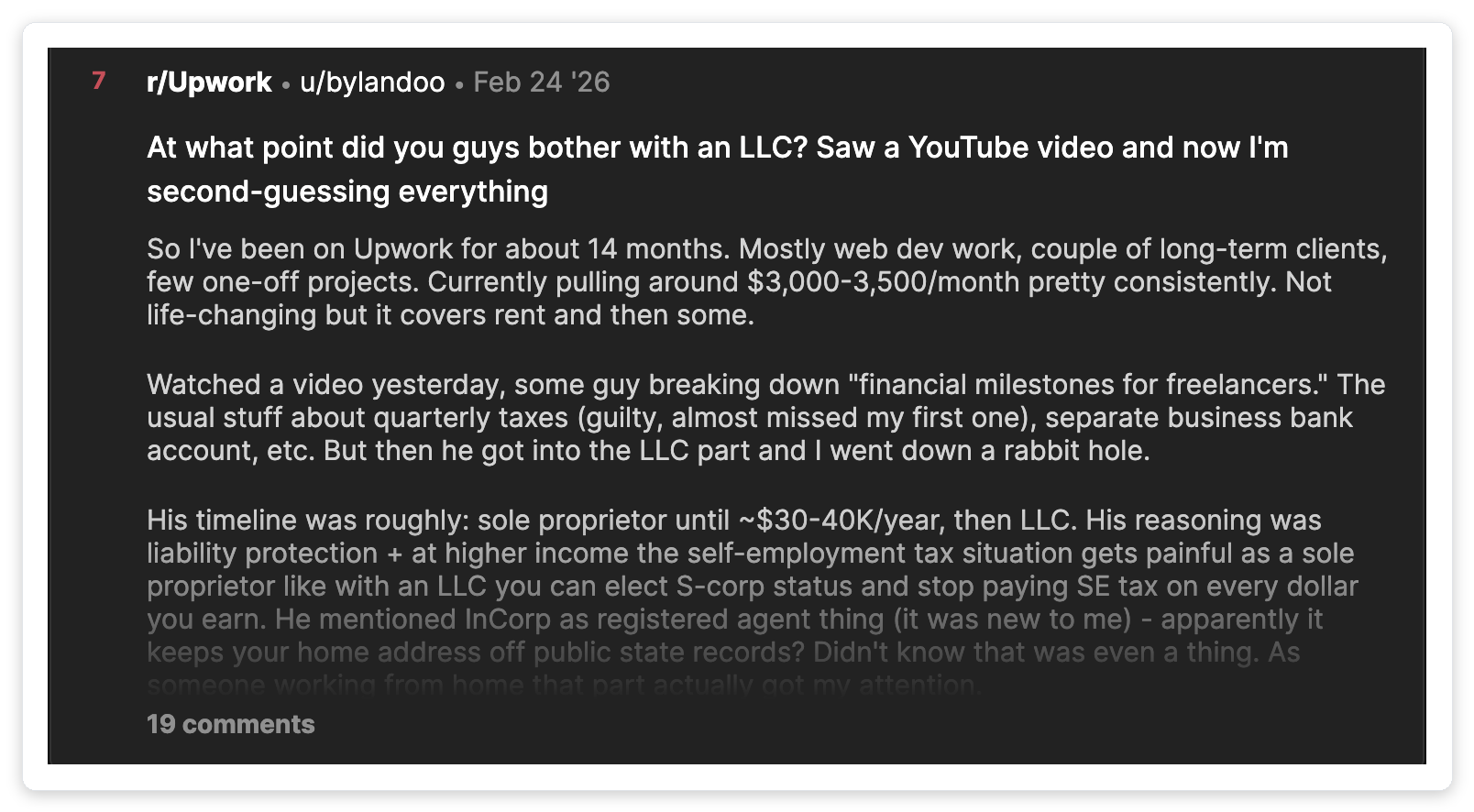
I run an Upwork automation company, not a CPA firm. This is how the mechanics work and where the numbers land.
Before you file an entity election, confirm your specifics with an accountant who knows your state.
What to type in Upwork's legal name of business field
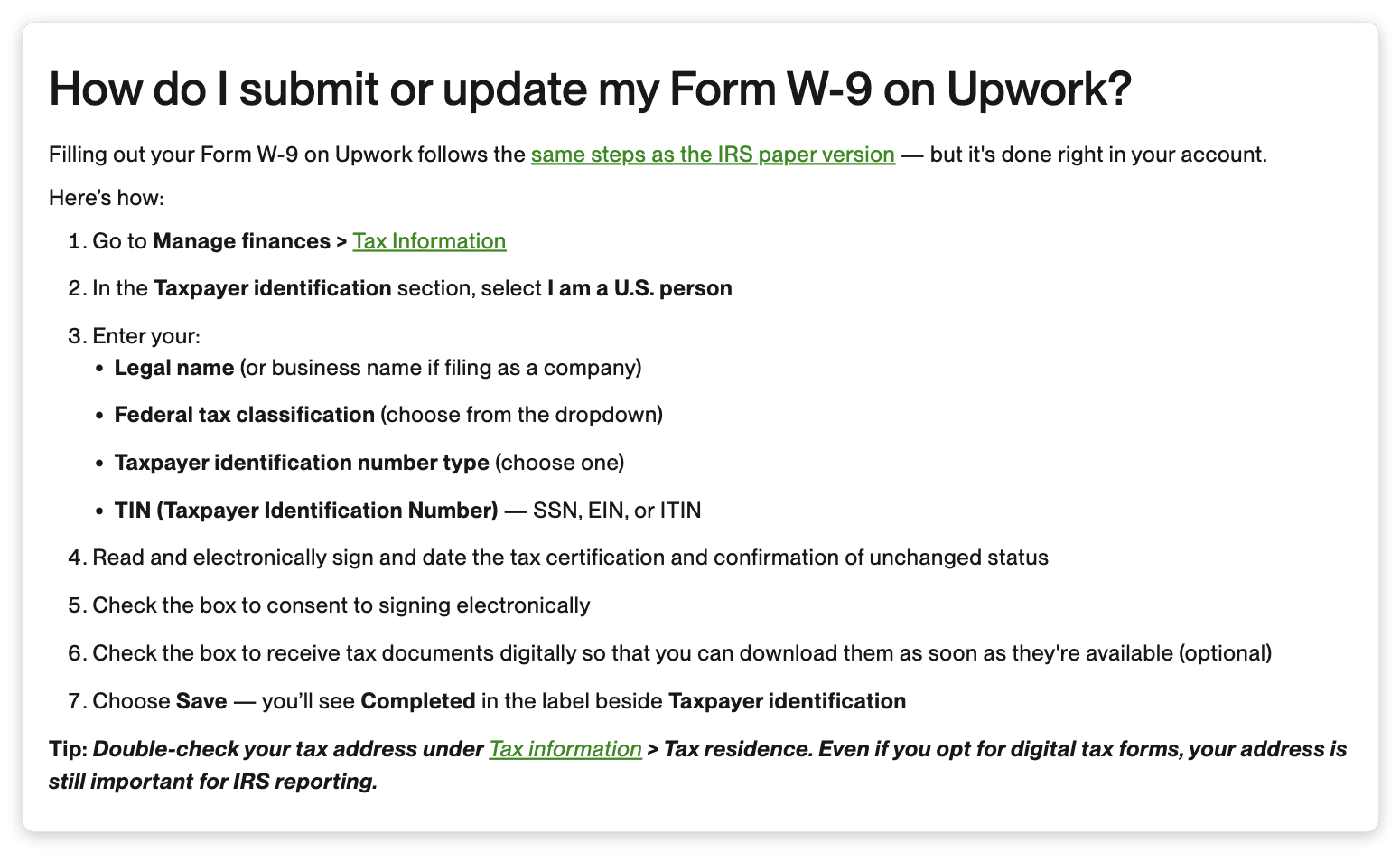
Upwork's own W-9 instructions tell US freelancers to enter their "Legal name (or business name if filing as a company)" plus a "Federal tax classification" from a dropdown. That phrasing maps one-to-one onto the IRS Form W-9 you would otherwise fill out on paper.
On the W-9, Line 1 is "Name of entity/individual" and Line 2 is "Business name/disregarded entity name." The IRS instruction is blunt: a sole proprietor enters their own name on Line 1, and the business or DBA name goes on Line 2.
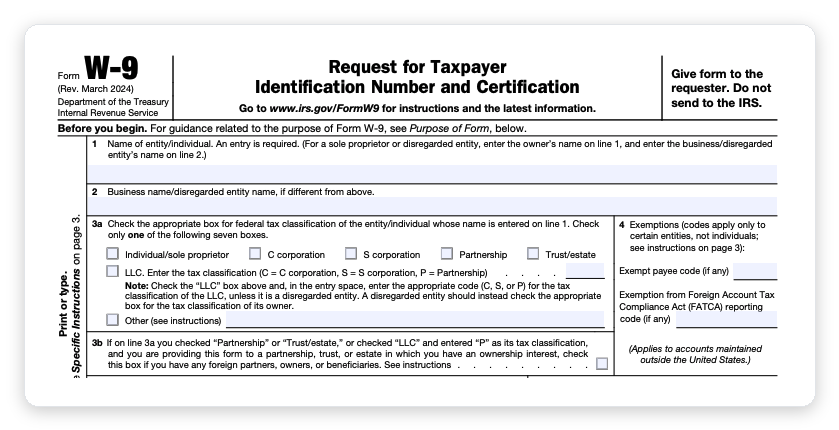
So the rule splits cleanly by what you have actually registered with a government:
You are a sole proprietor by default the moment you earn a dollar.
Legal name = your full legal name, tax classification = Individual/sole proprietor, TIN = your SSN.
Legal name of business = the exact name on your Articles of Organization or Incorporation, including the "LLC" or "Inc." suffix.
Tax classification matches how the IRS taxes that entity, and your TIN is your EIN.
Your legal name still goes in the legal-name field. The brand ("Acme Digital") is a DBA that lives on Line 2 and in your Upwork profile title, never in the legal-name box on its own.
One more thing that trips people up: your Upwork profile display name and your verified legal name are two different fields. Upwork says your account name is your "nickname," while your verified name must match your tax and identity documents and shows on contracts and invoices.
Here is the exact text to drop into each field if you are an unregistered US sole proprietor. Copy it, adjust the obvious parts, move on with your day.
Sole proprietor or S-corp? Run your own numbers first
The entity question is not philosophical. It is arithmetic.
The only thing that decides whether a sole proprietor should restructure is whether the self-employment tax saved beats the cost of running a more complex entity.
Plug your real Upwork net profit in below. The calculator compares the 15.3% self-employment tax a sole proprietor pays against the payroll tax an S-corp owner pays on salary only, then nets out a typical S-corp compliance cost.
Free Tool
Sole Prop vs S-Corp Tax Calculator
2026 numbers: 15.3% SE tax, Social Security wage base $184,500.
The IRS requires a defensible salary. For a solo service business, comparable W-2 wages usually land at 30 to 60% of profit.
Net savings assumes roughly $2,000/year in added S-corp compliance (payroll service, Form 1120-S return, bookkeeping).
Estimate only, not tax advice. State franchise taxes vary.
Notice what the calculator does at $50k versus $150k. The savings are not linear.
Below roughly $60k of profit, the self-employment tax you save is eaten by payroll processing, the Form 1120-S return, and bookkeeping. Above $80k, the gap widens fast.
Why most Upwork freelancers form an LLC two years too early
The advice "just form an LLC" is repeated so often that people do it before they have a reason. Then they discover the LLC did nothing they were hoping for.
A single-member LLC is what the IRS calls a "disregarded entity." For federal income tax it is invisible: you report the same Schedule C, pay the same 15.3% self-employment tax, and check the same box you would as a sole proprietor.
The LLC saved you no tax at all.
The other reason people form early is liability protection. That instinct is right, but the protection is narrower than they assume for a solo service provider.
An LLC shields your personal assets from the business's debts. What it does not shield is your own professional work.
If a client sues over a missed deadline or a bug you shipped, that is your personal service, and an LLC alone does not wall it off. Courts also pierce the veil on single-member LLCs that commingle personal and business money, which a lot of freelancers quietly do.
The realistic protection for a freelancer's biggest risk is errors-and-omissions insurance, not a registration certificate. The LLC matters more once you have real assets, a co-owner, employees, or profit high enough to justify an S-corp election.
That last trigger is the one worth planning around.
The "$600 1099-K" panic is dead, and Upwork's real rule is simpler
For three years, freelancing forums treated the $600 1099-K threshold like an incoming asteroid. Half the entity-formation panic I see traces back to it.
The asteroid missed.
The American Rescue Plan Act dropped the reporting threshold to $600, the IRS delayed it repeatedly, then in July 2025 the One Big Beautiful Bill reverted the threshold to the old $20,000 and 200 transactions. The $600 number people braced for never took effect.
Upwork follows the same rule. Its support docs say a US person gets a 1099-K for 2025 when they earn $20,000 or more before fees and clear 200 transactions.
Some states force a lower threshold, so check yours.
If you live in Arkansas, Illinois, Maryland, Massachusetts, Mississippi, Missouri, Montana, New Jersey, Vermont, Virginia, or Washington D.C., Upwork issues a 1099-K at a lower state threshold even if you never hit the federal one.
Here is the part nobody says out loud. The 1099-K threshold was never the tax threshold.
You legally owed tax on dollar one the entire time, form or no form.
"I didn't get a 1099 from Upwork so I figured I was under the limit and didn't report it. Now I'm sorting out two years of back taxes."
Paraphrased from r/Upwork tax threads
So treat the 1099-K as a copy of what Upwork already told the IRS, not as the moment your income becomes real. If you build a clean transaction export from Reports inside Upwork, you can reconcile it against the form when it arrives in January.
When an S-corp election actually starts paying for itself
The S-corp is the only structure on the list that touches your self-employment tax.
It does not erase the 15.3%. It redirects it.
As a sole proprietor, all of your profit is hit with self-employment tax. With an S-corp, you split profit into a salary that gets payroll tax and distributions that do not.
The savings come entirely from the distribution slice.
The IRS guards this with one rule: the salary has to be "reasonable." Pay yourself $20k on $150k of profit and the IRS reclassifies the distributions as wages, with penalties.
For a solo service business, a defensible salary usually sits between 30 and 60% of profit.
There are two more catches worth knowing before you file. The election is not casual.
File Form 2553 on time
To make the election count for the current tax year, the IRS wants Form 2553 within two months and 15 days of the start of that year. Miss it and you wait until next year.
Run real payroll
You become your own employer. That means a payroll service, quarterly filings, and a W-2 to yourself.
This is the recurring cost the calculator nets out.
Know it locks in
If a slow year drops your profit below the break-even, you cannot pause the election. Revoking it triggers a five-year wait before you can elect again.
Elect only when income is stable.
The entity ladder, in order of revenue
Most agency owners climb these rungs in sequence as profit grows. You do not skip to the top because a forum told you to.
The default. Your name in the legal-name field.
Right answer for almost everyone under $60k profit.
Add when you have personal assets to protect, a brand to hold, or you are about to step up to an S-corp.
The self-employment tax play. Worth it once net profit is reliably $80k+ and you can defend a salary.
Only when you add partners, raise money, or hit a size where the C-corp tax structure pays off. Rare for Upwork agencies.
Free for Upwork agencies
Get the entity sorted. We will handle the pipeline.
Once your tax setup is done, GigRadar fills the top of your funnel: a filtered job feed, scored leads, and AI-drafted proposals submitted from our own supervised Upwork Business Manager. Your agency account is never touched.
Get Your Free Agency Audit →What changes when you switch to an Upwork agency account
An Upwork Agency account is not a separate company in Upwork's eyes. The Upwork legal terms describe it as "a special kind of Freelancer account," so the tax identity behind it is still you or your registered entity.
That answers the most common agency question: do you get two 1099-Ks? No.
Upwork says that as long as your freelancer and agency profiles share the same name and TIN, you get one combined 1099-K.
If you set up the agency under a registered entity and the freelancer side under your SSN, the names diverge and your reporting fragments.
This is also where the question of "who actually submits the proposal" intersects with your legal setup. If you bring on outside help to bid for you, Upwork's clean path is its invitation system, not handing over your password.
That is the exact model GigRadar's automation runs on. We operate a real Upwork Business Manager account as a company, and your agency invites our BM in through Upwork's official flow, the same role you would use to onboard a hired bidder.
Proposals submit from our supervised BM, your own account is never touched, and if Upwork ever reviews a submission, the review lands on our BM profile.
The mechanics are the same whether you are a sole proprietor or an LLC, because the entity behind the account does not change who Upwork sees pressing submit.
If you want the full breakdown, we cover it in our guide to what the Upwork API can and cannot do and our compliance playbook for agencies.
Your three-minute decision
Stop treating the legal-name field like a test you can fail. For most readers the whole thing resolves in one sitting.
The checklist
- No registered company? Enter your full legal name, pick Individual/sole proprietor, use your SSN. Done.
- Have a brand but no entity? Still your legal name in the field. Brand goes in your profile and on the DBA line.
- Net profit under $60k? An LLC or S-corp is almost never worth it yet. Revisit at year-end.
- Net profit reliably over $80k? Run the calculator, then book a CPA call about the S-corp election.
- Running an agency account? Keep the name and TIN identical to your freelancer side for one clean 1099-K.
If you are still in the "should I even bother with an agency" phase, the entity decision is downstream of revenue, and the revenue is downstream of pipeline. Our guides on going from freelancer to agency and scaling an Upwork agency cover the part that actually moves your profit.
The entity is just the paperwork that follows it.
For the wider money picture, including how the fees factor in before you ever calculate net profit, see our breakdown of what Upwork actually costs and what agency owners really take home.