the exclusive vs non-exclusive freelancer mistake that kills most upwork agencies
TL;DR
- Default every new agency member to non-exclusive. Flip them to exclusive only after 3 months and 20+ guaranteed hours per week.
- Exclusive members can't bid solo and can't join other agencies. If you can't keep them busy, they churn and your JSS bleeds with them.
- The 0% to 15% Upwork service fee is identical for both types. The "savings" from going exclusive don't exist at the platform level.
- Private feedback on agency contracts hits both the agency JSS and the member's solo JSS, even after they leave. This is the contagion most owners don't price in.
- Multi-agency setups (one main + one parallel) are how mature operators hedge against suspension and JSS swings.
most owners get this wrong on hire #1
You finally find someone good. They've done two contracts under your agency as a non-exclusive, the work was clean, and you want commitment.
You flip them to exclusive on month one because you're afraid they'll take work elsewhere.
Two months later you can't give them 30 hours a week. They get restless and they quit.
Your agency JSS takes a private-feedback hit you didn't see coming because contracts ended awkwardly. Your Top Rated Plus badge wobbles because their hours rolled off.
I've watched this play out on at least 40 GigRadar customer accounts. The pattern is identical every time.
Founders confuse exclusivity with loyalty, and they pay the team-management bill three months later.
This article is the math, the mechanics, and the decision tree for when exclusive is actually correct (rare) and when non-exclusive is the right answer (almost always, especially for your first 3 to 5 hires).
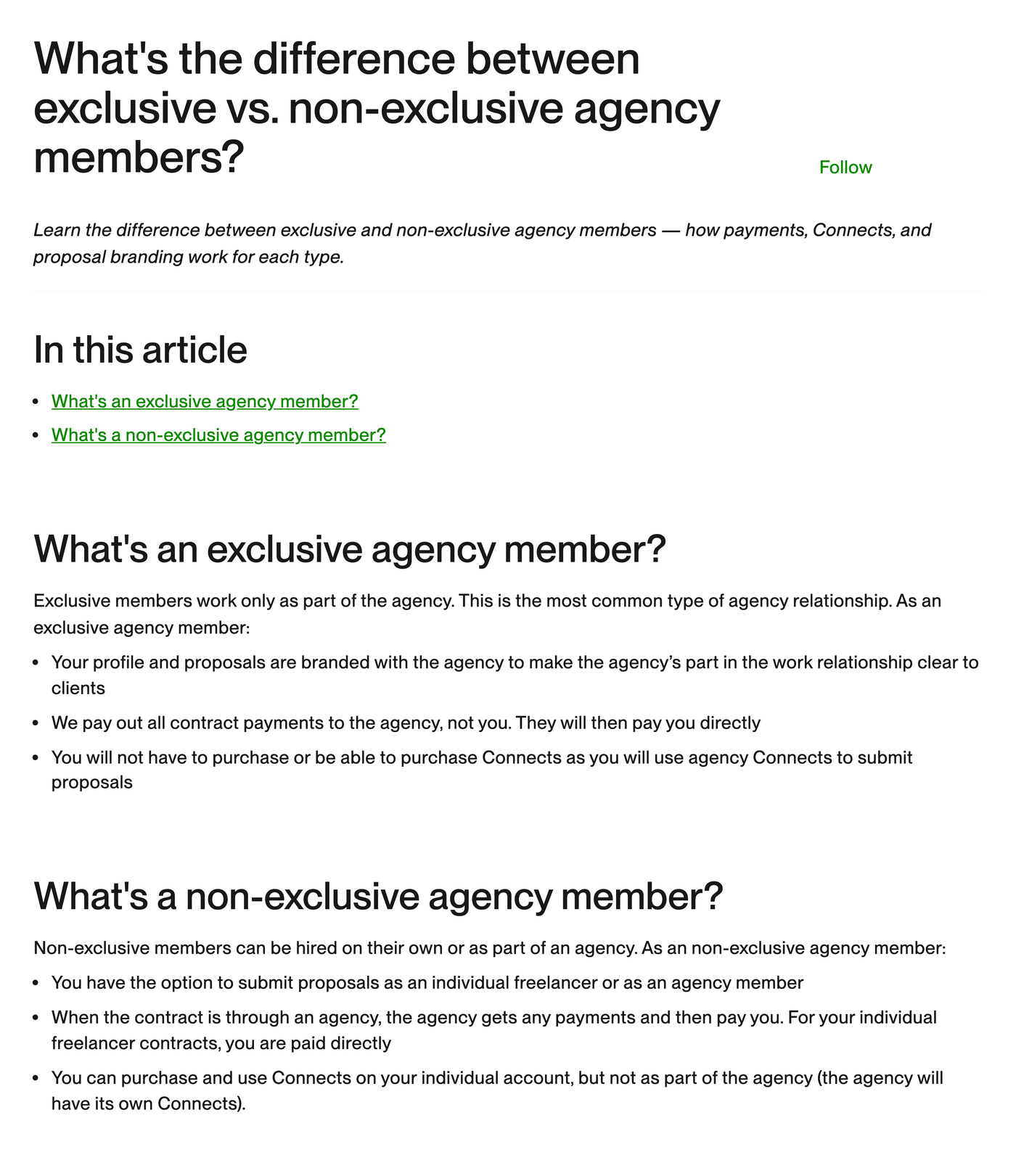
Source: Upwork Help Center, "What's the difference between exclusive vs. non-exclusive agency members?", captured August 2026.
what upwork actually means by exclusive vs non-exclusive
Upwork lets agency members choose how they show up on the platform. Per the official Upwork help page on agency membership, there are exactly two flavors.
Locked to your agency
- All proposals submitted as the agency
- All payments routed to the agency account
- Cannot bid solo or join another agency
- Profile branded with your agency
Solo profile + agency role
- Per-proposal choice: bid as agency or solo
- Agency contracts pay the agency; solo contracts pay them
- Can join multiple agencies on Upwork
- Keeps their own JSS, badges, and reviews
There is no fee difference between the two. The Upwork freelancer service fee, variable 0% to 15% per contract since May 2025, applies identically to agency and solo contracts.
The "savings" you think you're capturing by going exclusive don't exist at the platform level.
What you're actually capturing is control, not money. And control without the operational capacity to back it up is the trap.
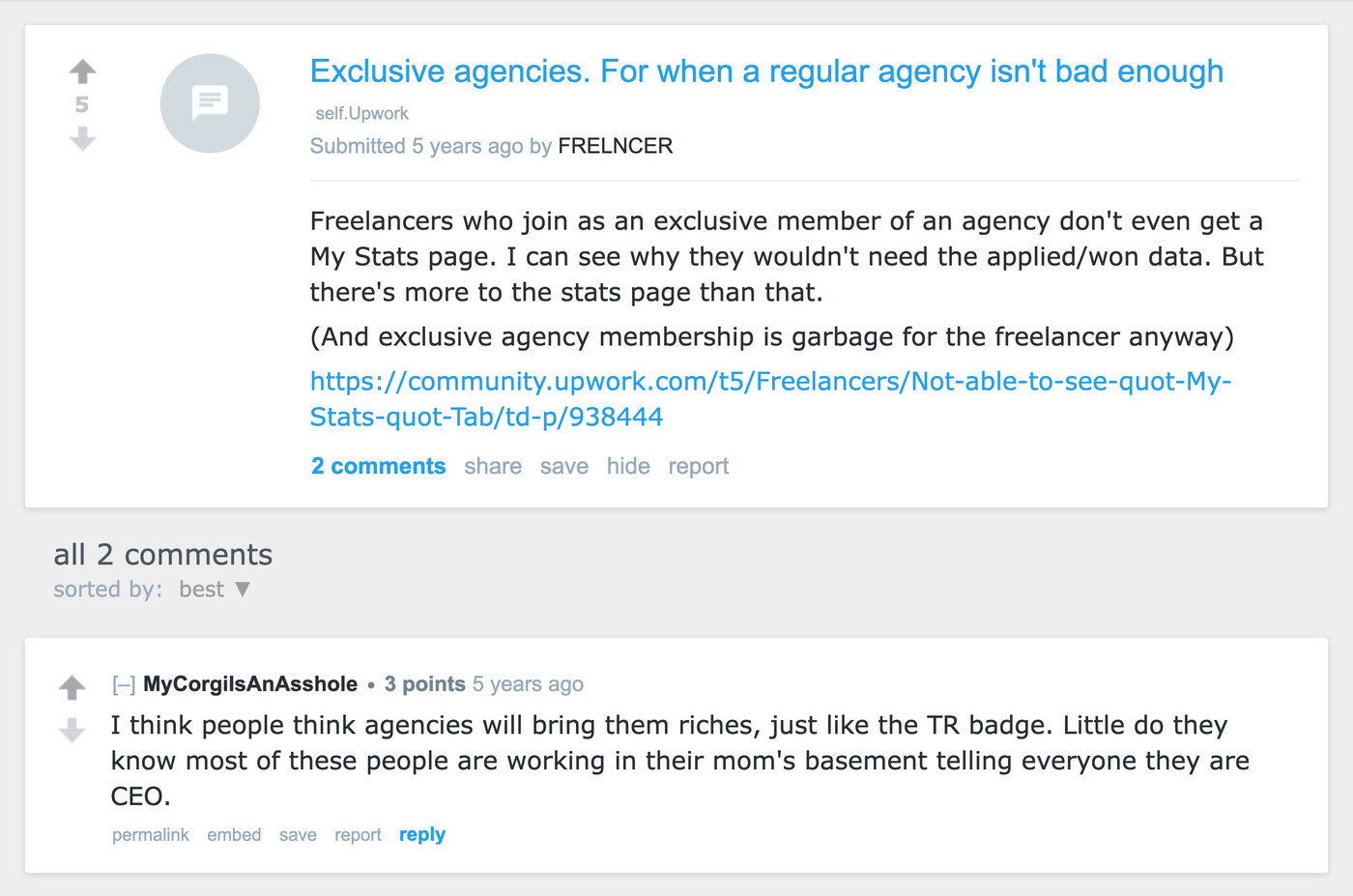
FROM REDDIT
"Exclusive agencies. For when a regular agency isn't bad enough."
The post itself: exclusive members lose access to the My Stats page and the per-contract analytics they can see as a solo. Whoever signs that contract loses operational visibility into their own work.
Source: r/Upwork, July 2021
the real cost of going exclusive too early
The Upwork mechanics make exclusivity feel like a small admin choice. The downstream consequences are not small.
1. The hours-starvation churn
You promised the freelancer steady work. They closed their solo profile.
Now your sales pipeline drops one bad week and you have a junior bidder under contract with nothing to do.
Either you pay them out of agency reserve to keep them on the bench, or you tell them to wait, or they leave.
The math is brutal. A senior dev in Eastern Europe expects $25 to $40 per hour of agency work.
At 30 hours per week, that's $3,000 to $4,800 per month per head. Three benched exclusive members for a single slow month costs you $9k to $14k of cash you didn't budget for.
Most early agencies don't have that runway.
2. JSS contagion that follows them after they leave
Every agency contract leaves private feedback attached to two profiles: the agency, and the agency member who actually performed the work.
Even private feedback below 7/10 drags both scores. When that exclusive member eventually leaves your agency, they take the JSS damage with them.
So do you.
I've seen agencies and freelancers part on perfectly good terms, then both get blindsided by a private-feedback contagion six weeks later when a contract closed quietly with a 6/10. Tamara Levit at Levit.tips documented this pattern in detail, including the specific badge-loss mechanic when an exclusive freelancer was riding the agency's Top Rated Plus halo.
3. The badge halo evaporates the day they leave
If your agency is Top Rated Plus and the exclusive member's solo profile was unranked, they were borrowing your badge for client-facing visibility.
The day they leave, that disappears. So does any client trust they built around it.
Restoring an individual Top Rated badge takes about three months of qualifying work after the split. That's three months of price-suppressed bidding for them, and three months without that headcount for you.
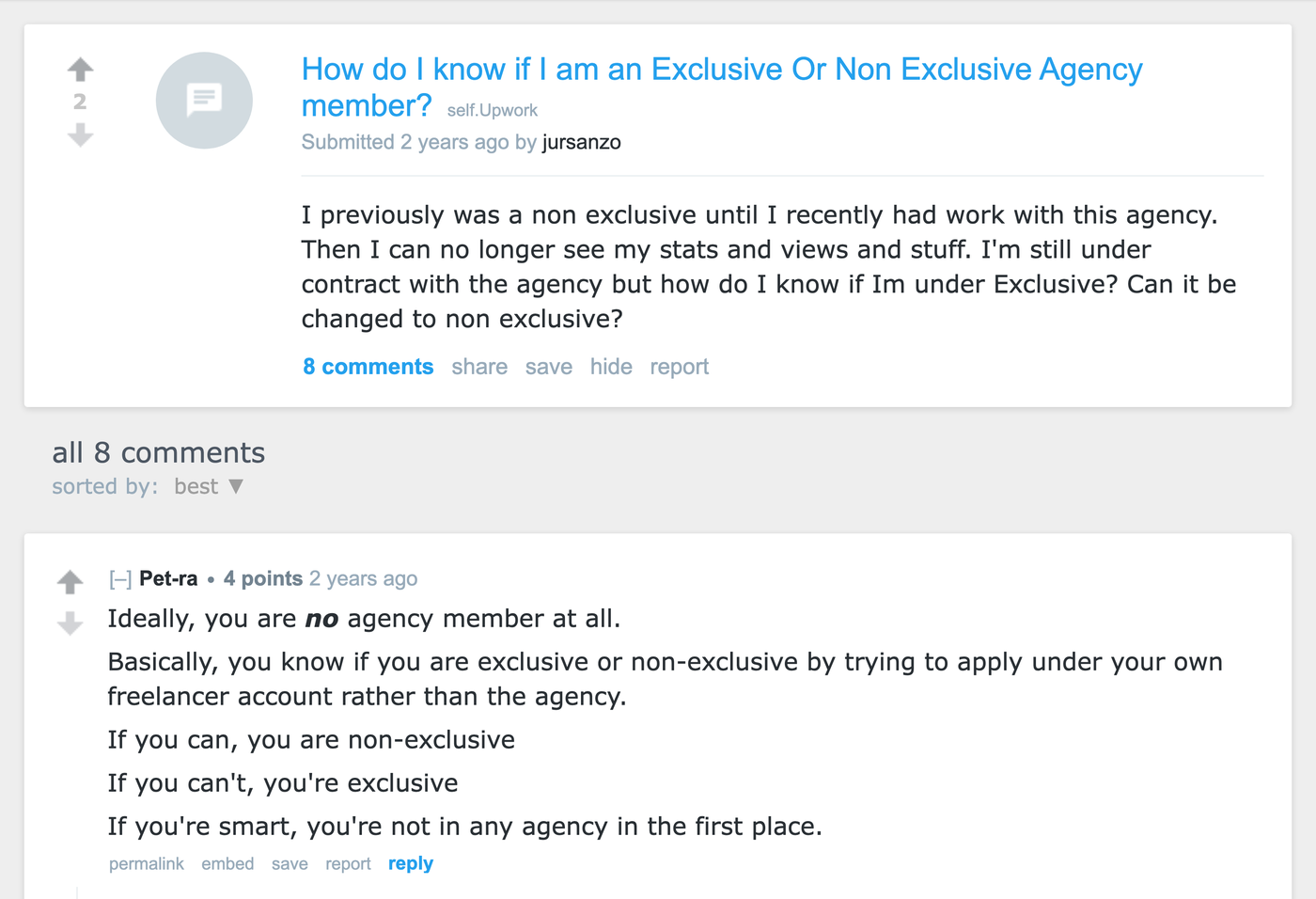
r/Upwork, January 2024: even active members get confused about which membership tier they signed up for. Diagnostic from u/Pet-ra: if you can apply under your own account, you're non-exclusive.
the decision framework: a calculator, not a vibe check
Here's the rule we tell every GigRadar customer who asks. Flip a non-exclusive member to exclusive only when all three are true at the same time:
Should I flip this freelancer to exclusive?
Answer four questions. The score tells you GO, NOT YET, or NEVER.
How the score is built
Each input maps to a weighted score. The thresholds come from the operational pattern across 500+ GigRadar customer agencies, not theory.
| Input | Threshold for GO | Why |
|---|---|---|
| Hours/week you can guarantee | 20+ consistent | Below 20, the member resents the bench |
| Months working together | 3+ | Below 3, you don't know their failure modes |
| Active contracts under them | 2+ | Single-contract members have no buffer if it ends |
| Their current solo earnings | $0 last 30 days | If they're earning solo, exclusivity is taking money out of their pocket |
If you score GO on three of four, run a 60-day exclusive trial with a written exit clause. If you score below that, keep them non-exclusive and revisit quarterly.
the payroll burden problem (the part nobody warns you about)
Once a member is exclusive, every dollar they earn lands in your agency Upwork account, not theirs. You then pay them outside Upwork.
This sentence sounds boring on a help page. In practice it is the single biggest tax and admin headache that hits new agencies.
You now have a payroll obligation. In the US, paying a recurring contractor more than $600 per year requires 1099-NEC reporting.
If you're paying weekly and the relationship resembles employment (set hours, set tools, set workflow), the IRS may classify them as an employee, which triggers W-2 reporting and payroll tax withholding.
Most early agency owners get this wrong because they're operating from "I'm just paying my contractor."
Outside the US, you're on the hook for the equivalent local rules. In the UK, IR35 still bites.
In the EU, the misclassification framework is tightening fast.
The operational chain looks like this for an exclusive setup:
A non-exclusive member running their own contracts inverts this. Their solo work pays them directly.
Upwork handles the freelancer-side fees, the freelancer handles their own filings, and you stay out of the chain entirely for that revenue.
You only inherit payroll responsibility for the work that flowed under your agency contract.
This is why a 5-person agency with all non-exclusive members runs leaner administratively than a 3-person agency with all exclusive ones. People don't price the admin tax until they're paying it.
when exclusive is actually the right call
The case for exclusive isn't dead. It's just narrow.
You have steady $40k+ per month in Upwork contract pipeline. Below that, you can't reliably keep 3 to 4 exclusive heads busy without bench drag.
The member is a delivery role, not a sales role. Project managers and senior developers who don't bid don't need a solo profile to compete elsewhere. Their value is execution under your contracts.
The member's solo profile is weaker than your agency profile. A junior dev with a 3-month-old solo account riding your Top Rated Plus badge is genuinely better off branded as agency.
You're hiring a dedicated bidder/business manager. This role has to act under the agency banner anyway, and exclusivity removes ambiguity about which proposals are theirs vs the agency's. Most agencies that hire a bidding VA make them exclusive from day one.
In every other case, default non-exclusive.
For agencies scaling past 5 heads
Stop letting bench drag eat your team's hours
GigRadar runs a real Upwork Business Manager invited into your agency. Your team stays focused on delivery while we keep your pipeline full enough to actually justify exclusive hires.
Get Your Free Agency Audit →the double-agency hedge
Once you cross 8 to 10 members, the exclusivity question stops being binary. Mature agency operators run two agencies in parallel for safety and niche flexibility.
The structure that works in practice:
Primary agency (exclusive-heavy) holds your senior delivery team and your most stable client base. Tight branding, focused niche, Top Rated Plus.
Secondary agency (non-exclusive-heavy) runs as a pipeline overflow plus insurance policy. New hires land here on probation. Members with side ambitions live here permanently. If your primary agency catches a suspension review, the secondary keeps cash flow alive.
This pattern shows up across the larger Upwork agencies in the GigRadar customer base. It's not a tax dodge or a workaround.
It's risk management. Upwork explicitly permits multiple agency accounts as long as identity, payment, and ToS lines stay clean.
how to actually move someone between exclusive and non-exclusive
The mechanic is simple. The timing is everything.
Most disputes I've watched explode in agency Slacks were avoidable with a 1-page doc up front.
the credentials trap (auto-ban risk)
A separate failure mode worth flagging: do not, under any circumstance, ask a member for their Upwork password.
It happens constantly with new agencies trying to "help" their bidders work faster. The agency owner gets the freelancer's login to "just edit the profile" or "submit a proposal while you sleep."
Upwork's IP and device tracking catches the cross-login. Both accounts get flagged.
Permanent suspension is the documented outcome.
The compliant route is to invite the bidder as a non-exclusive agency member and give them Business Manager permissions. They keep their own credentials.
You give them the access they need. Same operational outcome, zero ban risk.
If the work is hourly, run it on the agency contract under a member who actually performs the work. Hourly contracts logged on a profile that didn't perform the hours is misrepresentation.
Upwork has been enforcing this aggressively since 2024.
what this means for your next hire
The default rule is simple. Bring every new agency member on as non-exclusive with a written 90-day evaluation.
Run two contracts under them. Watch the private feedback come back.
Watch how they handle a slow week.
If at month four they've done 60+ hours per week consistently across 2+ contracts, and they've stopped touching their solo profile entirely on their own, that's the signal.
Flip them to exclusive with a signed contractor agreement and a documented hourly minimum.
If at month four they're still doing solo work on the side, that's also a signal. Just the opposite one.
Either you're not giving them enough volume (your problem) or they're hedging because they're not sure about you (their problem). Either way, exclusive is the wrong move that month.
The agencies that scale past $50k/month in Upwork revenue without imploding are the ones that resist the urge to lock people down early. Loyalty is built by giving people a reason to stay, not by closing the door behind them.
related reading
If this article was useful, the GigRadar blog has deeper coverage on the surrounding mechanics:
- Upwork Agency Account Guide 2026: the full structure of agency accounts, including the readiness calculator
- How to create an agency on Upwork: step-by-step setup walkthrough
- How to add a freelancer to your Upwork agency: the invitation flow and permissions
- Interviewing and onboarding Upwork bidders: the hire-and-evaluate playbook
- Upwork Fees 2026: The real agency tax is 22-34%: the full cost stack on agency contracts
- Freelancer to agency transition: when the math actually flips
Vadym Ovcharenko is the CEO of GigRadar. GigRadar operates a real Upwork Business Manager invited into customer agencies through Upwork's official invitation system, automating proposal generation and submission under our team's supervision.