
TL;DR
- An account plan template is for one client you want to grow, not your whole book. It is a different document from a sales plan (that covers your whole pipeline).
- The 12-section enterprise template is built for a $2M account with a 9-month sales cycle. At 6 people you need one page and five boxes.
- The whitespace box (what is this client paying someone else to do that you could do?) is the only section with real ROI. Everything else documents what you already know.
- Every action needs an owner name and a date, or it is a diary entry. "Explore expansion in Q3" is not a plan.
- Use the free Account Plan Builder below to generate a copy-ready one-page plan for a single client in about 10 minutes.
A six-person agency copying a Fortune-500 account plan template is the fastest way to produce a 12-tab spreadsheet that nobody opens after week two.
Roughly 73% of B2B revenue comes from existing customers through renewals, upsells, and expansions. Yet most agencies spend almost all of their planning energy chasing the next cold lead, and almost none deciding how a client they already have gets to double.
The account plan is the document that fixes that imbalance. Done at the right size, it is the highest-leverage hour you will spend all quarter.
Done at enterprise size, it is theater. This guide gives you the small-agency version, a live builder, and the five boxes that actually matter.
Free Interactive Tool
The Account Plan Builder
Fill the five boxes below and get a copy-ready one-page account plan, plus a single-thread risk flag, in about 10 minutes. Nothing is stored or sent anywhere.
Monthly retainer × 12, plus known project work.
What this account could realistically be worth.
List everyone with budget or veto power. One line = single-thread risk.
This is the box that pays rent. Be specific and put a number on it.
No owner and no date means it is not an action.
An account plan is not a sales plan, and confusing them costs you
The two words get used interchangeably, and that is the first mistake. A sales plan looks at your whole book: total revenue targets, which segments to chase, how many proposals a week, quota by person.
An account plan zooms all the way in to one client. It asks a different question: not "how do we hit the number this quarter" but "how does this specific relationship go from $72k to $150k over the next year without us winning a single new logo?"
They are also different from the two documents agencies most often mix them up with. Here is the clean version.
| Document | Scope | Core question | Horizon |
|---|---|---|---|
| Account plan | One key client | How does this client grow? | 6–24 months |
| Sales plan | Whole pipeline / team | How do we hit the number? | Quarter / year |
| Territory plan | A segment or geography | Where do we hunt? | Year |
| Customer success plan | One client, post-sale | How do they get value and stay? | Onboarding onward |
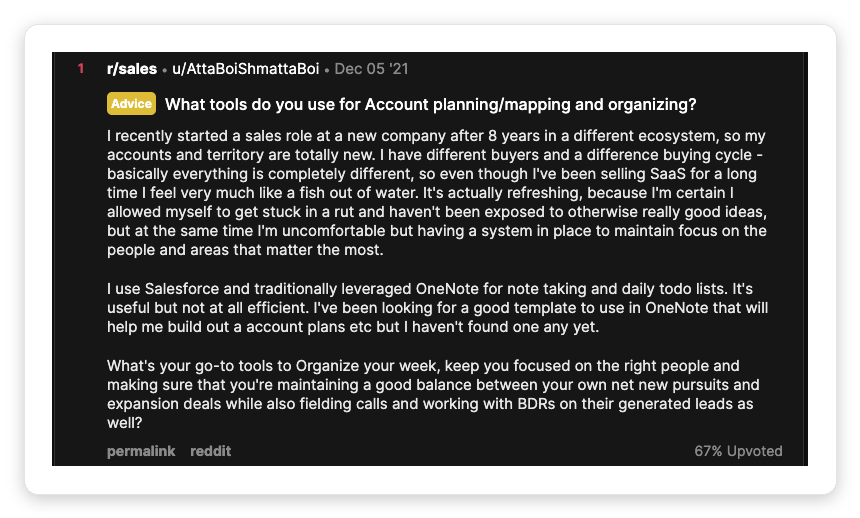
The account plan sits on top: a good one absorbs the retention goals of a success plan and feeds the numbers back up into your sales plan. It is the only one of the four written for a named human on the client side.
You do not write an account plan for every client, only for the top three or four accounts where expansion is both possible and worth your time. For everyone else, a line in your sales pipeline is enough.
Why most account plan templates are enterprise cosplay
Open any "strategic account plan template" and you will find twelve sections: account overview, relationship history, org chart, stakeholder power map, SWOT, competitive landscape, whitespace, revenue goals, value roadmap, risk register, action plan, governance cadence.
That template was built for a Salesforce rep managing a $2M account with a nine-month cycle and a team of solutions engineers behind them. You have one client paying $8k a month and a shared Slack channel.
The template industry sells complexity because complexity is what justifies the software license, not because it moves retention. Every hour you spend color-coding a dotted-line reporting chart is an hour you are not shipping visibly good work or asking the client what they need next quarter.
Most account plan templates are enterprise cosplay: for a six-person agency, eleven of the twelve sections are procrastination dressed up as strategy. The whitespace map is the only box that pays rent.
The principle underneath is simple: planning effort should scale with the depth of the relationship and the size of your team. Building a three-year revenue projection and a QBR deck for a client you met through one Upwork contract is planning a wedding after the first date.
The five boxes a small agency's account plan actually needs
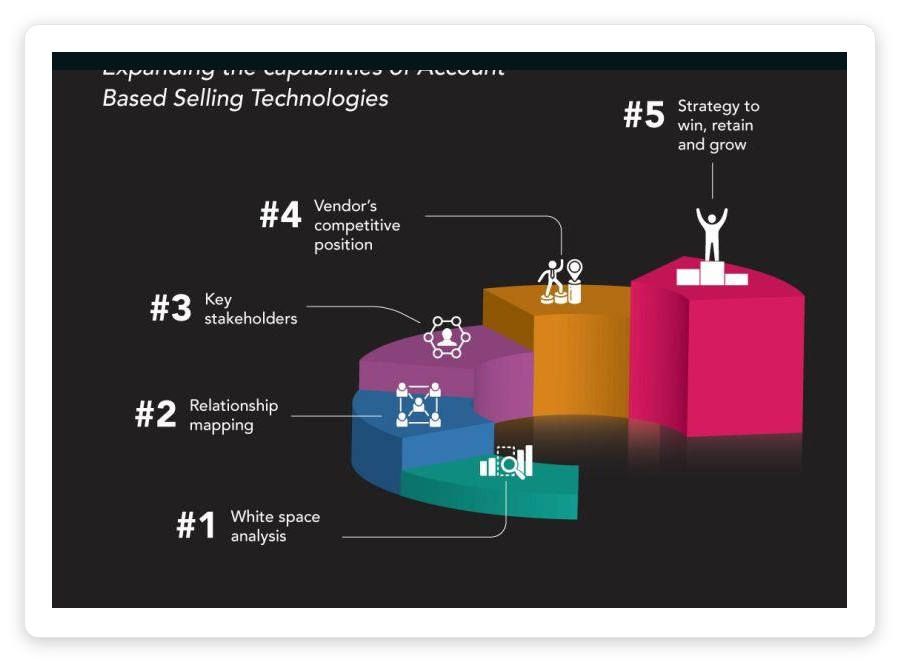
Strip the enterprise template down to what survives contact with a real week, and five boxes remain. That is the entire structure, and if it does not fit on one page you are overthinking it.
Not an org chart. Two to four names, each with a role and a one-word status (champion, neutral, or blocker), is your relationship map compressed to what you will actually use.
The one question that generates money: what is this client paying a different contractor to do, adjacent to your work, that you could take over? Put a dollar figure on it.
Not a full risk register, just the single most likely reason this client is gone in six months: a champion job-hunting, a budget freeze, a results dip. Name it so you can watch it.
"Explore expansion opportunities in Q3" is a diary entry; "Vadym asks Sarah about the analytics gap on Thursday's call" is an action. If a line cannot survive "who does what, by when," delete it.
The section every template buries and every agency skips. A plan you never reopen is a dead plan, so pick the date now.
DemandFarm warns that once you pass eight to ten scoring criteria, the extra data points cause analysis paralysis. Five boxes is not laziness, it is the point past which a template stops being used.
Whitespace is the only box with real ROI
Everything else in the plan documents what you already know. The whitespace box is the only part that generates new revenue, and it is the one the enterprise templates bury on page four.
The mechanic is a simple grid. Down one side are the services you sell; across the top, whether this client buys each from you, from someone else, or not yet.
You — $6k/mo ✓
Rival contractor — $3k/mo
Nobody owns it yet
You — included ✓
In-house junior
Nobody owns it yet
Green = you own it, red = a competitor owns it, amber = open whitespace. The red and amber cells are your expansion roadmap.
Every red cell is a competitor you can displace. Every amber cell is a service the client already needs but has not bought.
A single line ("they pay a separate contractor $3k/mo for the thing next to our work") is worth more than the other four boxes combined.
This is also why account planning correlates with performance at all. RAIN Group's research finds that teams with a consistent planning habit out-grow those improvising, and it is almost entirely the whitespace discipline doing the work.
Feed the number you find here into your sales forecast so the expansion is planned, not hoped for.
Single-threading is how you lose a $6k retainer in one message
The enterprise orthodoxy says multi-thread everything: build relationships with four or five stakeholders so you survive a champion leaving. That is correct advice for a company with a dedicated account team.
At a three-person agency it is often wrong. Forcing a junior freelancer to "build a relationship" with a finance director who does not know them just annoys the client and dilutes the one relationship that is actually working.
So single-threading on your champion is the rational default at your scale. But it is a real, named risk, and the honest mitigation is not "add more threads you cannot maintain," it is two things you control:
Enough cash runway that losing this one client is survivable, not fatal. That buffer is what turns a single-thread from a gun to your head into a calculated bet.
If your champion ghosts you, the replacement revenue is already in motion. A full sales pipeline is a better hedge than five shallow relationships you do not have time to feed.
The one exception: when a client crosses into anchor territory (a real share of your revenue), the maths flips. At that point a second thread is worth the effort, because losing that account would genuinely take you down.
Add the thread when the account earns it, not before.
The Upwork twist: earn the right to a real account plan
Enterprise key-account management assumes the relationship is real: a signed master agreement, procurement, switching costs. On Upwork, most of your early "accounts" are one contract deep with a client who can close the contract and disappear with two clicks and no explanation.
Pouring hours into a QBR deck for a client at that stage is falling in love with a relationship that does not exist yet. The plan should scale with proof, not precede it.
| Relationship depth | What you write | Effort |
|---|---|---|
| One project, first contract | A single note: deliver, over-communicate, log the whitespace you spot | 10 min |
| Repeat work or a retainer | The five-box one-pager (the builder above) | 30 min |
| Anchor account, off-platform | Five boxes plus a second thread, a quarterly review, and a value roadmap | 2 hrs / quarter |
This is also where lead flow and account growth connect. GigRadar keeps the top of your funnel full so that expanding one client is a choice, not a desperation move.
We book qualified Upwork intro calls for your agency by submitting proposals through our own Upwork Business Manager account. Your agency invites our BM through Upwork's official invitation flow, the same role you would use to onboard a hired bidder.
Proposals go out under our team's supervision, and your own Upwork account is never touched.
Free for Upwork agencies
Never expand a client out of desperation
When your pipeline is full, growing an account becomes a strategic bet instead of a survival tactic. GigRadar fills the top of the funnel so your account plans have room to breathe.
Get Your Free Agency Audit →The review cadence that keeps a plan alive
Gartner's most-cited account-planning pitfall is the static, once-a-year document that gets written and filed. The fix is a cadence.
Top sales teams run three loops: weekly signal reviews, monthly health checks, and quarterly business reviews. Shrink each to agency size.
Did anything change: a new contact, a delivery slip, an offhand comment about budget? Note it in a 60-second glance at the one-pager, not a meeting.
Is the account growing, flat, or slipping, and is the next action done? If the same action has rolled over three months it was never real, so rewrite it.
Only for anchor accounts: show results, ask what is changing on their side, and pitch one whitespace cell. This is where retainers grow.
Increasing retention by just five points can lift profit anywhere from 25% to 95%, because expansion revenue carries almost none of the acquisition cost. The cadence is what converts a plan from a document into that compounding.
Where agencies actually get account plans wrong
The failure modes are predictable, and none of them are "the template was not detailed enough." They are the opposite.
| Mistake | Why it kills the plan | The fix |
|---|---|---|
| Write once, never reopen | The client changes; the plan does not | Box 5: a review date, set now |
| All about your revenue | Reads as pushy; erodes trust | Anchor every expansion to a client problem |
| No owner or date on actions | Nothing moves; it becomes a diary | "Who does what, by when" on every line |
| Twelve sections at 6 people | Never finished, never used | Five boxes, one page, done |
Notice the pattern: small agencies rarely fail from too little planning. They fail from a template so heavy it never gets filled in, or so passive it never gets reopened.
Account plan template: frequently asked questions
What is an account plan template?
A reusable structure for planning how you will grow and retain a single key client: who can approve spend, where the expansion revenue is (whitespace), the biggest risk, the next action, and when you will review it. It is not a plan for your whole book, that is a sales plan.
What should an account plan include?
For a small agency, five boxes: the people who can say yes or no, the whitespace (what they buy from someone else), the one risk that could end the account, the next action with an owner and a date, and a review date. Enterprise teams add SWOT, org charts, and value roadmaps, but those add friction below about 50 people.
How is an account plan different from a sales plan?
A sales plan covers your entire pipeline and team over a quarter or year and answers "how do we hit the number." An account plan zooms into one client and answers "how does this relationship grow," so you keep one sales plan but a handful of account plans for your top clients.
How often should you update an account plan?
Run a 60-second signal check weekly, a health read monthly, and a client-facing review quarterly for anchor accounts. Also update it on any triggering event (a new stakeholder, a budget change, a results dip), because a plan reviewed less than monthly is functionally dead.
Do I need an account plan for every client?
No. Write one only for the top three or four accounts where expansion is realistic and worth your time, and for a client one project deep a single note is enough until the relationship earns more.
Which section of an account plan matters most?
The whitespace box, the only section that generates new revenue rather than documenting what you already know. If you fill in one box, make it the list of what this client pays other people to do.
An account plan is not paperwork. It is the difference between a client who stays one project and a client who quietly becomes a third of your revenue.
Keep it to one page, put an owner and a date on every action, and reopen it before it goes stale.