
Customer Success Plan Template: 8 Sections to Stop Churn. A 2-minute walkthrough of the 8-section plan, the retention math, and the free builder. Watch on YouTube
The short version
- Winning a customer costs 5 to 25 times more than keeping one, so retention is the cheaper growth engine. Most teams still run it on a CSM's memory instead of a documented plan.
- A customer success plan is a shared, written roadmap that turns the customer's business goal into measurable outcomes, milestones, and a review cadence.
- Eight sections make a plan complete: goals, success metrics, stakeholder map, onboarding milestones, health score, risks, communication cadence, and expansion path.
- The payoff is measurable. Behaviour-based onboarding can lift retention by up to 50%, and cutting annual churn from 5% to 3.5% raises customer lifetime value by roughly 43%.
- Use the builder below to generate a plan for one account in two minutes, then copy or download it.
Acquiring a new customer costs anywhere from 5 to 25 times more than keeping one you already have. That single fact, documented by Harvard Business Review, is why net revenue retention is now the number investors watch first.
And yet most customer success runs on vibes. The CSM knows the account "is doing fine" until a renewal email bounces because the champion left three months ago and nobody wrote it down.
A customer success plan template fixes that by forcing the relationship into a shared, written artifact. This is the exact 8-section template we would hand a new CSM, plus a builder that generates a plan for one account in two minutes and the 2026 retention benchmarks that prove it is worth the effort.
Free Template
Customer Success Plan Builder
Fill in one account. The builder assembles a formatted success plan with all eight sections, ready to copy into your CRM or download.
Everything runs in your browser. Nothing is stored or sent.
Why a customer success plan template beats a great CSM's memory
The best CSMs carry a mental model of every account. That model is invisible, non-transferable, and gone the day they take PTO or leave.
A documented plan turns that private knowledge into a shared asset. It also forces a shift most teams struggle with: from reacting to whatever ticket is loudest to managing toward a defined outcome.
ChurnZero puts reactive-over-proactive at the top of its CSM mistake list: a day spent answering tickets and complaints is a day pulled away from the plan. The fix is to ask what is likely to happen next, and act before it does.
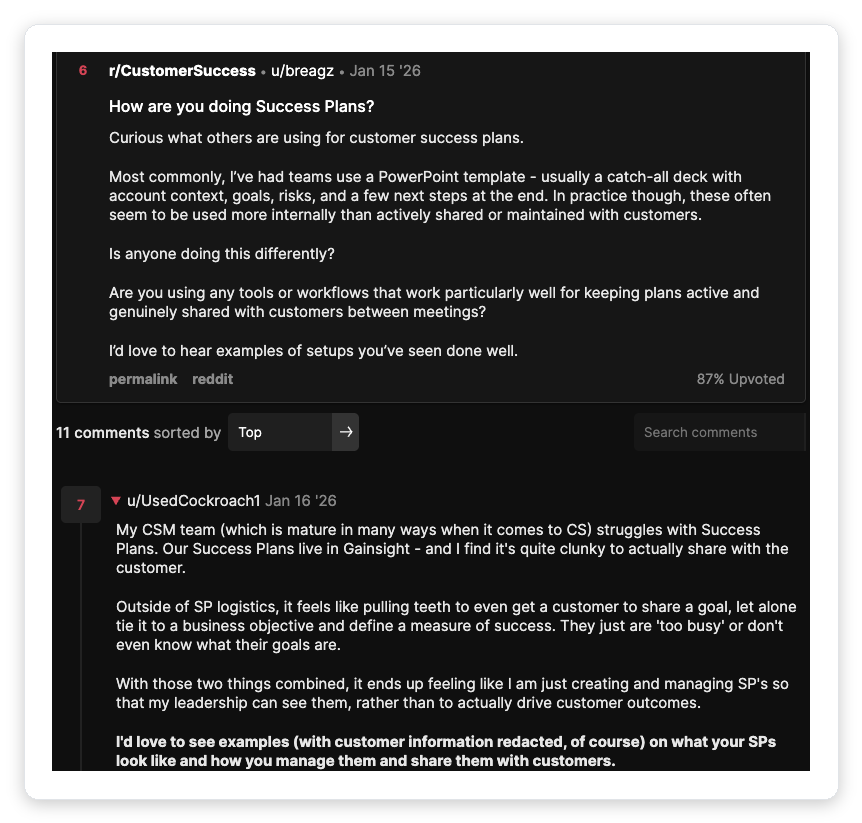
This is not a niche complaint. Ask any customer success community and the same theme surfaces: teams scaling past a handful of accounts without a written plan lose the thread.
The plan is also what makes customer success measurable at the org level. When every account shares the same skeleton, leadership can spot which plan attributes correlate with renewals, and AI health tooling can flag missing fields automatically.
The 8 sections every customer success plan template needs
Section labels differ across vendors, but the content converges. A plan that is missing any of these eight has a blind spot that shows up later as a surprise churn. This is the order they belong in.
The customer's business objective in their language, not yours. Capture the current-state baseline and the future-state target so success is arguable later, not vibes.
The quantitative version of the goal. Time to first value, adoption rate, expansion ARR. Scope it lighter for SMB, deeper for enterprise.
Champion, executive sponsor, end users, technical owners. Champion turnover is the single most under-tracked churn risk, so the map has to stay current.
Time-bound checkpoints from kickoff to first value. This is the highest-leverage section: behaviour-based onboarding can lift retention by up to 50% (Userlens).
Churn rarely arrives without warning. Reduced activity, poor NPS, a champion going dark, and repeated discount requests are the tells (Vitally). Each risk gets an owner.
Check-in frequency, next review date, and the QBR agenda. The cadence is what keeps value visible between renewals, not just at them.
The next seat, use case, or service, tied to a health threshold. Expansion is what pushes net revenue retention above 100%, so it belongs in the plan, not as an afterthought.
The retention math that makes this template worth building
A success plan is not a documentation chore. It is a lever on the two numbers that decide whether a subscription business survives: churn and net revenue retention.
That 3.5% is a monthly blended figure. Measured annually, B2B SaaS churn averages closer to 4.9% (Vena Solutions), and it runs higher for SMB-heavy books than enterprise ones.
Net revenue retention is the share of last year's recurring revenue you keep from the same customers, including their upgrades. SaaS Capital's benchmark puts median NRR near 102% for private SaaS in the $25-50k ACV band. Above 100% means the base grows even before you add a single new logo.
Gross revenue retention strips out the upgrades and can never exceed 100%. Healthy enterprise GRR sits in the mid-to-high 90s (Benchmarkit). The gap between your GRR and NRR is exactly what the expansion section of the plan is built to grow.
The clearest way to see the plan's value is the customer lifetime value formula, where churn sits in the denominator.
Because churn is the divisor, small drops compound. Move annual churn from 5% to 3.5%, which is squarely within reach of behaviour-based onboarding, and lifetime value rises by about 43% with nothing else changing.
Customer success plan vs journey map vs QBR
These three get used interchangeably and they should not. Confusing them is why some teams think they "have a plan" when they only have a meeting.
| Artifact | What it is | Scope |
|---|---|---|
| Customer success plan | A shared roadmap tying one account's goals to metrics, milestones, and cadence | Per account, full lifecycle |
| Customer journey map | A generalised model of the stages any customer passes through | All customers, strategic |
| QBR | A recurring meeting to review progress against the plan | One event inside the plan |
The relationship is nested. The journey map informs the plan, and the QBR is one governance beat inside it. The plan is the only one of the three that is specific, per-account, and continuously updated.
For Upwork agencies: protect the revenue GigRadar helps you win
Agencies live the acquisition-versus-retention math in a sharper form than most SaaS teams. A client win on Upwork is expensive, and the real profit sits in the second and third retainer, not the first.
GigRadar exists to make the acquisition side cheap and predictable. We operate a real Upwork Business Manager account that your agency invites through Upwork's official invitation flow, the same role you would use to onboard a hired bidder, and proposals submit from our BM under our team's supervision. That fills the top of your funnel.
But a full pipeline only matters if the clients stay. Run the same 8-section plan on each retainer client, swapping software milestones for campaign milestones and ARR for retainer value, and you convert one-off project wins into the compounding revenue that net revenue retention rewards.
Free for Upwork agencies
Fill the pipeline. Then keep it.
GigRadar automates your Upwork proposal flow so you win more clients to run these success plans on. See your real reply rate and cost per hire in one audit.
Get Your Free Agency Audit →Run the template on one account this week
A template only pays off when it is used. Do not roll it out across the whole book at once. Prove it on a single at-risk account first.
High enough stakes to matter, enough runway to change the outcome.
Co-creating the plan is half the value. It surfaces goal misalignment fast.
Decide the number now, while nothing is on fire.
An unscheduled review is a review that never happens.
The question is never "did we meet?" It is "did the metric move?"
Build the plan, get retention working, and pair it with a predictable front end. Feed it with a full pipeline from clean pipeline stages, benchmark acquisition cost with a CAC calculator, borrow the discipline of a sales plan template for the acquisition side, and track the compounding result with an ARR calculator. Retention is the cheaper half of growth. This template is how you actually run it.