
Fractional SDR for Agencies: The $7K/mo Margin Math (2026). Full walkthrough of the pricing tiers, the 11% vs 53% margin trap, and the 60-day playbook to launch this service from an existing agency. Watch on YouTube
TL;DR
- A fractional SDR is a 15–25 hour-per-week outsourced rep priced at $3,000–$8,000/mo per client. Mid-market sits at $4–8K; entry tier at $2–4K dilutes quality fast.
- For agencies SELLING fractional SDR services, gross margin swings from 11% (underpriced) to 53% (priced correctly). The killer is forgetting to bill for SDR manager / strategy time.
- Cost-per-meeting for a competent fractional engagement runs $300–600 versus $800–1,150 for fully-loaded in-house SDRs. Same outcome, half the burn.
- Only ~7% of outsourced SDR engagements are reported by buyers as having "really worked." Reason isn't talent. it's contracts without qualified-meeting definitions and SLAs that reward volume over fit.
- The shortest path for an Upwork agency to ship this service: niche it down to ONE vertical you already serve, price at $5–7K mid-market, and write SLAs around meeting QUALITY, not count.
A fractional SDR engagement at $7,000/month can leave you with $4,200 in gross profit or $800 in panic, depending entirely on how you priced the SDR manager's time.
That's the spread agencies miss before launching. Most read "fractional SDR services charge $4–8K/month" on a competitor's pricing page, multiply it by three clients, and assume an extra $20K MRR is one good week of selling away.
Then they sign the first contract, realize the rep needs supervision, the campaign needs weekly iteration, the client wants Friday standups, and the math collapses.
This article walks through what fractional SDR services actually are in 2026, what they cost, how the unit economics work for agencies that sell them, and where the model breaks. I'll use GigRadar pipeline patterns and public benchmarks from real providers like SalesHive, SalesRoads, CIENCE, and Martal.
Calculator: your fractional SDR retainer margins
Punch in the retainer price you're considering, the hours per week your rep will work, and your real internal costs. The calculator returns gross margin and breakeven sensitivity. Numbers are pulled live from your inputs.
Free Tool: Fractional SDR Margin Calculator
Margin includes 15% overhead allocation. Adjust the retainer or shave manager hours to hit the 35%+ benchmark.
What a fractional SDR actually is in 2026
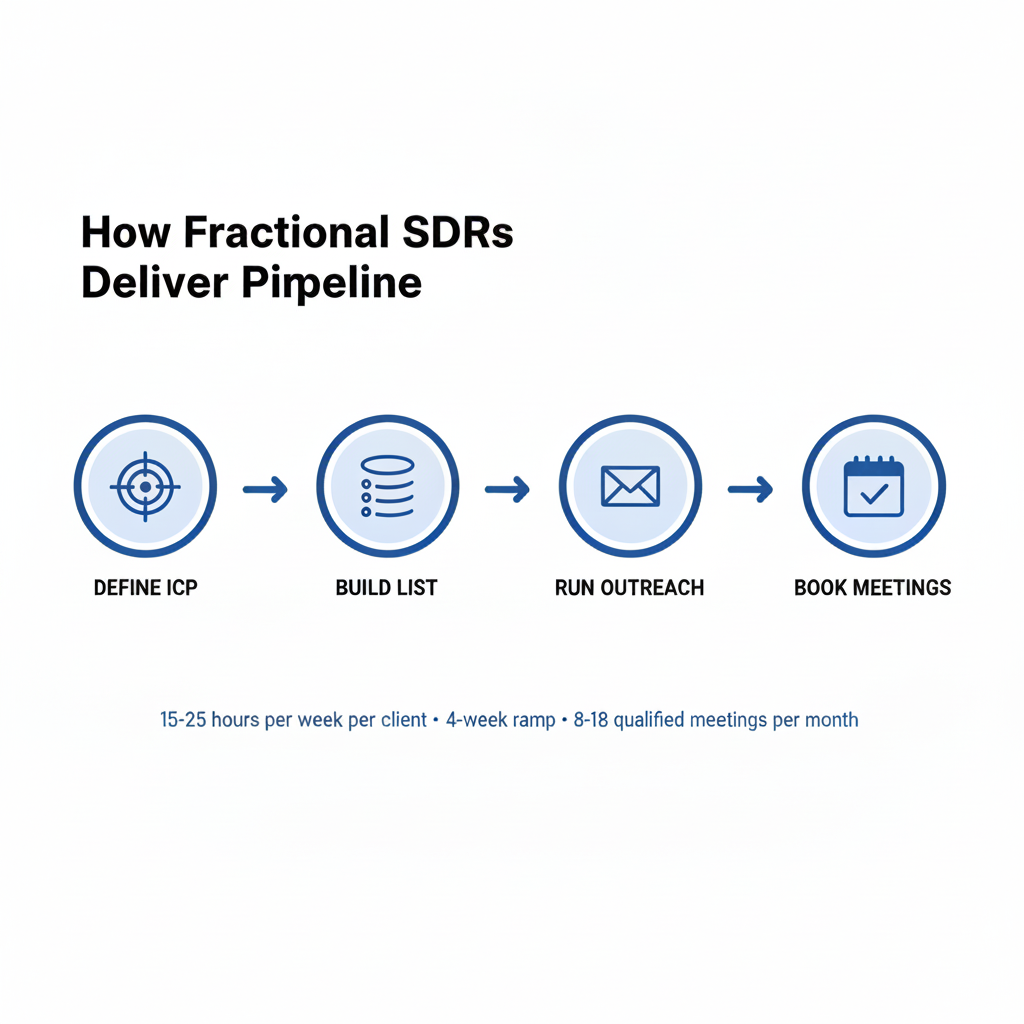
A fractional SDR is a sales development rep who works 10–25 hours per week per client, splits time across two-to-five accounts simultaneously, and bills as a contractor or shared agency resource. Not a full-time hire. Not a commission-only Upwork lead-scraper either.
The boundary that matters: a fractional SDR is supposed to arrive pre-ramped. They show up with sequences, deliverability infrastructure, and CRM hygiene already figured out. The client pays for output speed, not training time.
That's the difference between "fractional SDR" and "outsourced SDR agency." Outsourced typically means a dedicated full-time rep working only your account, priced at $6,000–$15,000/month with 6–12 month commitments. Fractional is part-time and flexible, usually $3,000–$8,000/month with 90-day minimums or month-to-month after the first quarter (UpliftGTM, 2026).
BDR versus SDR mostly doesn't matter at this scale. Most fractional engagements blend both, and the title is determined by what the client already calls the seat. Worry about it only if a buyer specifically asks for inbound MQL qualification (SDR proper) versus pure outbound cold lists (BDR territory).
The market math that makes this a real opportunity
Two structural shifts pulled fractional SDR from edge case to standard B2B GTM line item between 2023 and 2026.
The first is in-house economics. Fully-loaded SDR cost in the US now sits at $110,000–$150,000/year once you add benefits, payroll tax, tooling ($1,200–$2,200/mo for the stack), management time, and a 5–6 month ramp where the rep books almost nothing (DemandDrive, 2026; Martal Salary Guide, 2025).
The second is the fractional pattern hitting other GTM functions first. Fractional CMO and CRO retainers have normalized in the $8K–$22K/month range for 2–3 days a week of work (Fractionus, 2026). Once a SaaS finance leader signs off on a part-time CMO, signing off on a part-time SDR is a formality.
The downstream effect: the outsourced SDR market hit $4.4B in 2026 and is forecast to grow to $6.98B by 2032, roughly 7.9% CAGR (Prospeo Outsourcing Report, 2026). And 70%+ of B2B companies surveyed plan to expand outsourced SDR investment through 2026 to grow pipeline without growing headcount.
If you already coordinate 5–20 freelance designers or developers, you have the operational muscle to add fractional SDRs as a service. Most agencies struggling with this aren't missing capability. they're missing the right pricing model.
Pricing benchmarks: what fractional SDR actually costs in 2026
The published price bands cluster tightly across credible providers. There's room to differentiate on niche, talent seniority, and channel mix, but not on price band. go too low and quality assumptions collapse; go too high and you need an enterprise sales motion.
| Tier | Monthly retainer | Hours / week | Meetings / mo (target) | Talent profile |
|---|---|---|---|---|
| Entry | $2,000–$4,000 | 10–15 | 4–8 | Junior or offshore, templated outreach, shared across 3+ clients |
| Mid-market | $4,000–$8,000 | 15–25 | 8–15 | Experienced rep, custom sequences, dedicated to 2–3 clients |
| Premium | $8,000–$15,000 | 20–30 | 12–25 | Senior SDR + GTM advisor pod, multi-channel, vertical specialist |
Sources: DevCommX 2026 Comparison, UpliftGTM Comparison, Prospeo SDR Agency Index.
Public pricing from named providers maps onto this grid:
- SalesHive. Starter $4K/mo, Growth $8K/mo, Crush $12K/mo; one US-based phone SDR with 150+ touches/day is $7K/mo (source)
- Belkins. $3,000–$6,500/mo retainers for dedicated SDR capacity with email and LinkedIn
- SalesRoads. starts at $9,950 per four weeks for high-volume appointment setting (source)
- CIENCE. $499/mo platform license + SDR marketplace at $1,500–$5,500/mo pass-through (source)
- Martal Group. $3,000–$7,000/mo for fractional SDR engagements with focus on tech buyers (source)
- EBQ. $4,000–$7,000/mo, HubSpot-native RevOps-heavy delivery
- Callbox / MarketStar (enterprise pods). $8,000–$25,000/mo for dedicated multi-channel pods
Hybrid pricing is the second flavor. Most common pattern: $2,500–$3,500/mo base + $100–$200 per held qualified meeting. At target volumes, this normalizes to roughly the same monthly take as a flat retainer but de-risks the client. Pure pay-per-meeting falls in $175–$350 per qualified meeting for mid-market B2B and only economic for very low volumes or very high ACV (CMOvate, 2025).
$300–600
Cost-per-meeting for a competent fractional SDR engagement. In-house at fully-loaded cost runs $800–1,150. Same outcome, roughly half the cash burn.
The 53% margin trap (and why agencies underprice into break-even)
This is the single number that decides whether the service is worth shipping. The same $7,000/month retainer can yield 11% gross margin or 53% gross margin depending entirely on how you cost it.
Scenario A: the underpriced trap (11% margin)
Agency hires a senior fractional SDR at $50/hour and dedicates them 20 hours/week to one client. 80 monthly billable hours at $50/hr = $4,000 in SDR labor. Tools allocated to the client at $400/mo. SDR manager spends 5 hours/month at $150/hr coaching, reviewing sequences, joining the weekly client call = $750. Overhead at 15% of revenue = $1,050.
Total cost: $4,000 + $400 + $750 + $1,050 = $6,200. Gross profit: $800. Gross margin: 11.4%. One missed-meeting refund, one client requesting a Friday standup, one extra hour of strategy time, and the engagement is unprofitable.
SDR manager and strategist time gets accounted to "account management" instead of cost-of-goods on the SDR retainer. So the price looks generous, the math looks fine, and the trap closes when the rep needs supervision the agency didn't budget for.
Scenario B: the priced-right model (53% margin)
Same $7,000 retainer, repriced at $9,000/mo. Rep at $35/hr effective rate (mix of contractor + agency overhead), splitting 3 clients with 60 hours/mo per client = $2,100 SDR labor. Consolidated execution platform reduces tool allocation to $300/mo per client. Manager spends 4 hours per engagement at $120/hr = $480. Overhead at 15% = $1,350.
Total cost: $2,100 + $300 + $480 + $1,350 = $4,230. Gross profit: $4,770. Gross margin: 53%.
Scenario A. underpriced
Retainer: $7,000/mo
SDR labor: $4,000 (1 rep × 80 hrs × $50/hr)
Tools: $400
Manager: $750 (5 hrs × $150)
Overhead (15%): $1,050
Margin: 11.4%
Scenario B. priced right
Retainer: $9,000/mo
SDR labor: $2,100 (1 rep × 60 hrs × $35/hr × 3 clients)
Tools: $300
Manager: $480 (4 hrs × $120)
Overhead (15%): $1,350
Margin: 53%
The levers are three: charge above $5K/mo so the math has room to breathe, share senior reps across 2–3 clients (with caps on concurrent engagements per rep to protect quality), and use a consolidated execution platform instead of paying for five separate point tools.
Use the calculator at the top of this article to model your own retainer math before signing a contract.
Delivery: what "good" looks like in meetings, show rates, and SLAs
Selling fractional SDR services without realistic benchmarks is how engagements end on month four with an unrenewed contract and a bad reference.
Industry-wide outbound benchmarks for 2026 land here:
Sources: Reachoutly 2026 Reply Rate Data, Prospeo Conversion Rate Index, Prospeo SDR Performance Metrics.
Scaled to fractional load (15–25 hours/week), credible mid-market SDR engagements commit to 8–15 qualified, held meetings per month with the show rate and meeting-to-opportunity rates above. Anything beyond 20 meetings/month at $4–8K/mo is either a templated low-quality program or marketing copy that won't survive month two.
SLA design. the part that decides whether the contract survives
Almost every failed outsourced SDR engagement traces back to an SLA that measured "meetings booked" without defining "qualified." When the rep is comp'd on volume and the client experiences calls with no-fit prospects, trust collapses within 60 days. Only about 7% of buyers say outsourced SDR engagements "really worked". and the root cause is almost always SLA design, not talent.
Three SLA components that prevent the collapse:
Title, company size, geography, budget signal, use-case alignment. Anything that doesn't pass all five filters does not count toward the SLA. Both parties sign the definition before the contract starts.
If the client's AEs reject more than 30% of meetings as unfit, the SDR fails the SLA regardless of raw count. Skin-in-the-game protection against volume gaming.
20% no-show rate is normal. Refunding for no-shows incentivizes nothing useful. Replacing them with one extra booked meeting in the next 30 days does. keeps both sides aligned on the same pipeline target.
For agencies, the practical version: write SLAs that look more like "10–15 qualified, held meetings per month with at least 50% meeting-to-opportunity conversion in the first 90 days" rather than "15 meetings/month." The longer phrasing is the entire contract.
Free for Upwork agencies
Pipeline without the SDR overhead
If your agency wants the inbound pipeline benefit without building an SDR function, GigRadar's Business Manager submits proposals on your behalf across Upwork jobs that match your ICP. Real meetings, no rep to hire, no SLA to write.
Get Your Free Agency Audit →When fractional SDR services fail (and when not to offer them)
Three failure patterns kill more fractional SDR engagements than any other.
Failure 1: Selling fractional SDR to a client with no ICP defined. The SDR can't write a sequence without knowing who they're writing to. A two-week ICP workshop ahead of any outbound is non-negotiable. Skip it and the campaign returns 2% reply rates regardless of rep seniority.
Failure 2: Pure pay-per-meeting incentives. When the rep is comped only on meetings booked, the meetings get easier to book and harder to convert. DemandZen's failure analysis traces a majority of disengaged contracts to this exact misalignment.
Failure 3: Misaligned ramp expectations. Both the in-house and fractional SDR functions need 4–6 weeks to produce the first meaningful pipeline. Clients comparing fractional to "Adam, our SDR who started Monday" get frustrated when the fractional curve runs the same shape with the same waiting period.
If your product or service requires 6+ months of technical training before a rep can have a credible conversation (healthcare compliance, infrastructure security, complex DevOps tooling), fractional fails. The seniority arbitrage that makes the model work depends on the rep ramping in 3–4 weeks. Stay in-house.
Where fractional SDR works best for agencies to offer
Three niches consistently produce gross margins above 40% for the agency providing the service:
Validated product, missing internal SDR team, 4-week ramp window to prove pipeline before next fundraise. Highest budgeted-but-unspent demand in the market.
Decision-makers are CTOs and IT directors. Pain points are well-defined: cybersecurity, cloud migration, compliance. Conversations are predictable and a fractional rep with 1–2 prior MSP engagements ramps in weeks.
If your agency understands the agency pain point ("we need pipeline without growing headcount"), selling fractional SDR services to other agencies is a high-fit motion. Especially design and dev agencies that have decent inbound but need outbound consistency.
Wrong niches: consumer products, anything that closes in a single call under $1K ACV, anything where the buying committee is a single solo founder who wants to handle outreach personally.
The agency-owner playbook: launch this service in 60 days
For Upwork-native agencies. design, dev, marketing. already managing 5–20 freelancers, the fastest path to a fractional SDR service line is built on existing infrastructure: client ICP knowledge, retainer billing discipline, a CRM, and Slack channels you already run.
Pick the vertical you already serve best with your core service. If you build websites for HR-tech SaaS companies, your fractional SDR offer is "outbound for HR-tech SaaS". not generic B2B. The vertical narrows ICP work to two days instead of two weeks.
$25–$45/hour effective rate for a US-based senior SDR with 3+ years in your target vertical. Either Upwork direct or specialized fractional SDR talent platforms. Cap them at three concurrent clients to protect quality.
Shared CRM (HubSpot Starter, $20/seat), consolidated execution platform (Apollo / Smartlead / Outreach mid-tier, ~$150/seat), data via Apollo's free tier with verification via FullEnrich top-ups. Total per-client tool allocation: $300–$400.
90-day pilot, two SLA hard filters (qualified meeting + 50% AE acceptance), two-week ICP workshop included. Don't undersell to $3,000. the math breaks. Six pilot pitches in your network typically converts to two.
Week 4 is first reply spike. Week 6 is first qualified meeting. By the end of the pilot, you should be at 8–12 meetings/month per client. Document everything in case studies. the third client signs on case studies.
Three clients per SDR with 60 dedicated hours each puts you at the priced-right scenario. Add 4 hours/month of manager time per client into the price (don't absorb it). You should be at 50%+ gross margin from month three.
Pre-launch checklist before signing your first fractional SDR client
Should an agency buy fractional SDR or run outbound on Upwork?
If you're an agency reading this article because you want pipeline (not because you want to sell fractional SDR services), the build-vs-buy decision comes down to your ACV.
| Your situation | Best channel | Why |
|---|---|---|
| Avg deal size under $15K, fast close cycle | Upwork inbound (GigRadar BM submits proposals) | Cost-per-reply economics dominate at low ACV. Cold outbound costs more per qualified opportunity than well-targeted Upwork proposals. |
| Avg deal size $25K+, multi-stakeholder buying | Fractional SDR + Upwork in parallel | High-ACV buyers don't shop on Upwork; cold outbound (LinkedIn + email + phone) plus inbound from Upwork bidding covers both surfaces. |
| Avg deal size $50K+, named-account ABM | Premium fractional SDR pod ($8–12K/mo) | Need senior rep with technical fluency. Templated outreach won't get a CISO meeting. Upwork doesn't reach this buyer. |
| Early stage, no clear ICP yet | Founder-led outbound + Upwork inbound | No fractional SDR can compensate for a missing ICP. Use Upwork for fast hypothesis testing; do cold outbound yourself until you've closed 10 deals to the same persona. |
Most agencies eventually run both. Upwork gives the inbound surface most B2B agencies underweight. clients post jobs and write the brief themselves. Fractional SDR gives the outbound surface for accounts that wouldn't post a job. The two don't compete; they cover different parts of the same pipeline.
The tool stack: what fractional SDRs actually run on
Three categories make up the working stack. Skipping any one of them is what produces 1–2% reply rates that get blamed on the rep instead of the infrastructure.
HubSpot Starter or Salesforce + Apollo / Outreach / Smartlead. $100–$200/seat/mo.
Apollo free tier + FullEnrich verification ($69–$149/mo). Skip ZoomInfo until you need EU coverage.
Smartlead or Instantly inbox warmup ($94/mo). Optional parallel dialer (Nooks / Orum) for $200–$400/seat.
Total stack per dedicated SDR: $450–$700/month. Allocated across 2–3 clients on a shared platform, your per-client tool line drops to $200–$300. That's the lever that turns 30% margins into 50%.
For a deeper dive on data-tier choices, see our B2B data enrichment tool comparison. For the cold-email vs Upwork channel decision, see cost per lead by channel.
Fractional SDR FAQ
How is fractional SDR different from outsourced SDR-as-a-service?
Outsourced SDR-as-a-service typically means a full-time dedicated rep on your account at $6–15K/mo with 6–12 month commitments. Fractional means part-time (15–25 hours/week per client), a shared senior rep across 2–3 clients, and shorter terms (90-day pilots, month-to-month after). Same talent pool, different time commitment and pricing logic.
What's a realistic meeting volume for a fractional SDR working 20 hours/week?
8–15 qualified, held meetings per month is the credible target band for mid-market B2B at $4–8K/mo retainers. Anything beyond 20 meetings/month at this price tier is templated, junior, or measuring "booked" rather than "held qualified."
What gross margin should an agency expect on a $7K fractional SDR retainer?
40–55% if the SDR is shared across 2–3 clients with consolidated tooling and 4–5 hours/month of manager time is priced in. 10–20% if the SDR is dedicated 20+ hours/week to one client at senior US contractor rates and manager hours land in "overhead." See the calculator earlier in this article for your specific numbers.
Can a Upwork agency offer fractional SDR services without prior sales-team experience?
Yes. but pilot with one vertical you already serve. Niche-down beats credentials. An agency with 30 dev clients in HR-tech can sell "fractional SDR for HR-tech SaaS" credibly. Same agency can't sell "general fractional SDR" without prior sales infrastructure. The vertical knowledge collapses the ramp time the same way seniority does.
What's the failure rate of fractional SDR engagements?
By client self-report, only about 7% say outsourced SDR engagements "really worked" (RevenueGrowthAgent analysis). 25–50% fall short of expectations and 70% miss objectives. The dominant root cause is SLA design (rewarding volume not quality), followed by missing ICP definition before launch.
How quickly can a fractional SDR start producing pipeline?
First positive replies typically appear by week 3. First qualified meetings by week 4–5. Steady-state pipeline at 8–15 meetings/month by week 6–8. Anyone promising meetings in week 1 is either using stale lists or not qualifying.
What does the SDR manager actually do?
Reviews 10% of sent emails for quality, iterates sequence templates weekly based on reply data, joins one client check-in per month, coaches the rep on objection handling. Roughly 4–6 hours/month per client. Without this layer, sequences drift and reply rates collapse by month 3.