
Ecommerce Marketing Agency
Ecommerce Marketing Agency: Pricing, ROAS & Margins (2026) — the service stack, real ROAS benchmarks, and the client channel nobody uses, in two minutes. Watch on YouTube
TL;DR
- The "4x ROAS" your clients expect is a myth. The median ecommerce ROAS is closer to 2.0x, so any agency that competes on a ROAS promise is signing up to be fired the first slow month.
- Paid media is the offer everyone leads with, which is exactly why it pays the worst. Retention (email and SMS) runs 60-70% delivery margins versus paid media's ~50%.
- Retainer agencies churn at ~18% a year. Project-based agencies churn at ~42%. Your pricing model is your retention strategy.
- The cheapest client-acquisition channel almost no ecommerce marketing agency uses: Upwork inbound, where DTC brands post for paid-media buyers and Klaviyo specialists weekly. Marketing subcategories reply at nearly 2x the platform mean.
- Use the free calculator below to model your blended retainer and delivery margin before you take the next client.
The average DTC brand your ecommerce marketing agency is pitching does not get 4x return on ad spend. Across tens of thousands of stores the median sits between 2.0x and 2.1x, and roughly half of all brands are at or below breakeven once product margin and shipping come out (industry ROAS benchmarks, 2025-2026).
That single number decides whether your agency keeps a client or loses one. Build the whole engagement around a ROAS target and you have handed the client a stick to fire you with.
This is a build guide for the agency owner, not the brand. Here is the service stack DTC clients actually pay for, what to charge in 2026, the margin math behind each line, and the acquisition channel that is quietly filling other agencies' pipelines while everyone else burns money on cold email.
Interactive Tool
Ecommerce Agency Margin & Retainer Calculator
Pick the services you sell, set the ad spend you manage per client and how many clients you run. See your blended retainer, weighted delivery margin, and monthly revenue.
Services you offer (per client):
Fee and margin midpoints based on 2026 ecommerce agency pricing surveys. Estimates only, not a quote.
What DTC brands actually buy from an ecommerce marketing agency
An ecommerce marketing agency lives or dies on four service lines: paid media, performance creative, lifecycle (email and SMS), and conversion rate optimization. Everything else is an add-on.
The mistake new agencies make is treating these as equal. They are not. Each one has a different margin, a different churn profile, and a different level of control over the outcome.
Paid media is the entry point because it is the pain a founder feels first. When in-house buying stalls, creative fatigues, or post-iOS tracking breaks, they go looking for help (Meta's attribution and Conversions API guidance).
But the highest-leverage line is retention. The average DTC brand keeps only about 28% of first-time buyers, and as much as 85% of that churn is preventable with proper lifecycle flows (Klaviyo on retention economics).
Done well, email programs return 40-45x on spend, and brands using AI-driven personalization are markedly more likely to clear that bar (Litmus State of Email). It is the rare line where the result is yours to prove, not the auction's to dispute, and the math behind keeping customers has been settled for a decade (HBR on the value of retention).
The ROAS numbers your clients refuse to believe
Most ecommerce founders anchor on "good ROAS is 4x." That heuristic is years out of date and ignores margin, vertical, and channel mix.
Here is what the platforms actually return in 2025-2026, based on benchmark analysis across 15,000 advertisers (paid-channel benchmark data).
The reframe that keeps clients: stop quoting ROAS and start quoting contribution margin and new-customer payback. Tie the engagement to the metric the founder's bank account actually feels.
Meta removed its 7-day and 28-day view-through attribution windows in early 2026. If your reporting still shows last-year's inflated ROAS, you are setting a number you cannot defend at renewal.
Stop selling paid media as your lead offer
Everyone leads with Meta and Google because it is the easiest thing to pitch. That is exactly the trap.
Paid media is commoditizing toward ~50% delivery margins as the platforms automate targeting. The client judges you on a number iOS broke, and when it dips (it will, because you do not control the auction) they churn.
Retention is the opposite. You own the channel, the results are first-party and undeniable, and the margin is far better. Lead with email and SMS, attach paid media as the follow-on. Reverse the order most agencies use, and read our breakdown of building an email marketing agency for the playbook.
Creative is the other underpriced line. Analyses of Meta in 2026 attribute 50-70% of campaign performance variance to creative, not bid or audience tweaks, so a UGC and ad-creative retainer is one of the few ways to differentiate on a platform where "media buying" alone is a race to the bottom.
CRO compounds all of it. Onsite friction is brutal: cart abandonment averages around 70%, so even a modest lift in checkout completion can pay for the whole retainer (Baymard Institute cart-abandonment data).
The service stack ranked by delivery margin
If you are choosing what to build first, build in margin order, not in order of what is easiest to sell.
- Email & SMS / retention — 60-70% margin, lowest churn, you own the channel.
- CRO — ~62% margin, compounds the value of every other line.
- Creative & UGC — ~60% margin, the real lever on paid performance.
- Paid media — ~50% margin, necessary but commoditizing.
- SEO & content — variable, slow to prove, first cut in a budget squeeze.
How to price an ecommerce marketing agency retainer in 2026
Pricing for DTC services has settled into clear bands. Here are the 2026 monthly ranges for small-to-mid-market clients, drawn from agency cost surveys (Shopify's marketing budget guidance pairs well with these as a sanity check).
| Service | 2026 monthly range | Pricing driver |
|---|---|---|
| Paid media (Meta/Google/TikTok) | $8,000 - $25,000 | +10-20% of ad spend |
| Performance creative / UGC | $5,000 - $15,000 | asset volume |
| Email & SMS / retention | $3,000 - $10,000 | flows + campaign cadence |
| CRO (ecommerce) | $6,000 - $18,000 | test velocity |
| Amazon marketplace | $5,000 - $20,000 | catalog + DSP |
| TikTok Shop | $5,000 - $15,000 | sometimes + GMV commission |
| SEO (ecommerce) | $1,000 - $10,000 | scope + scale |
On model choice: percentage-of-spend rewards you for bloating budgets and punishes you for efficiency, which clients now see straight through. A flat retainer (optionally with a small performance kicker tied to profit, never to raw spend) ages far better. Our value-based pricing guide and retainer pricing breakdown go deeper on the mechanics.
The reason the model matters so much: retainer agencies churn at roughly 18% a year, while project-based shops churn at ~42%. The pricing structure is the retention strategy, and it is also why client retention belongs at the center of your operating plan, not as an afterthought.
Fire the brands under $30k a month in revenue
The demanding, low-margin, fast-churning ecommerce client that every agency owner complains about is usually self-inflicted. You took a brand that could not afford to be patient.
A small DTC brand has no margin cushion, so every ROAS wobble is existential. They panic, they micromanage, and then they leave. You cannot fix broken unit economics with better ad creative.
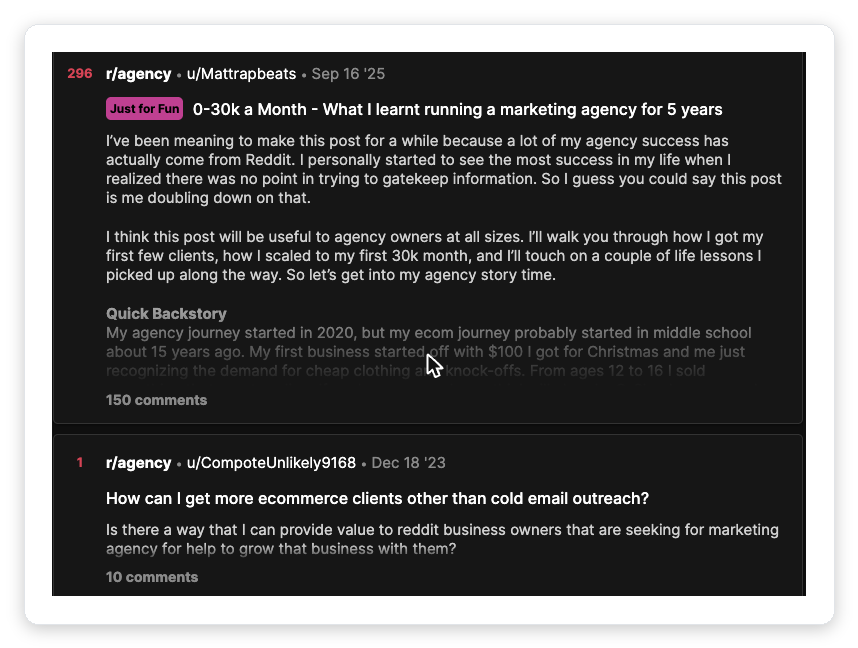
"How can I get more ecommerce clients other than cold email outreach?"
— recurring question across r/agency and r/PPC
Set a hard qualification floor (revenue, AOV, or gross margin) and disqualify below it. Saying no to the wrong brand is the highest-margin decision you will make this quarter.
Where ecommerce clients are actually hiring (and almost no agency looks)
Customer acquisition cost for agencies has climbed alongside everyone else's. Cold email to DTC founders is a bloodbath because every agency on earth is doing it.
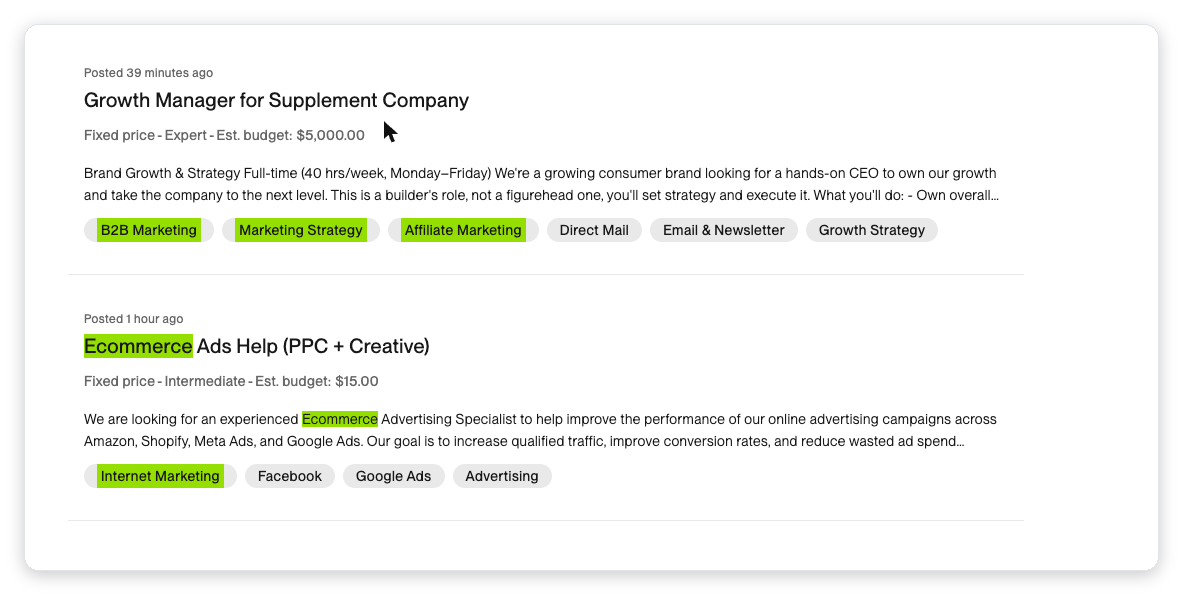
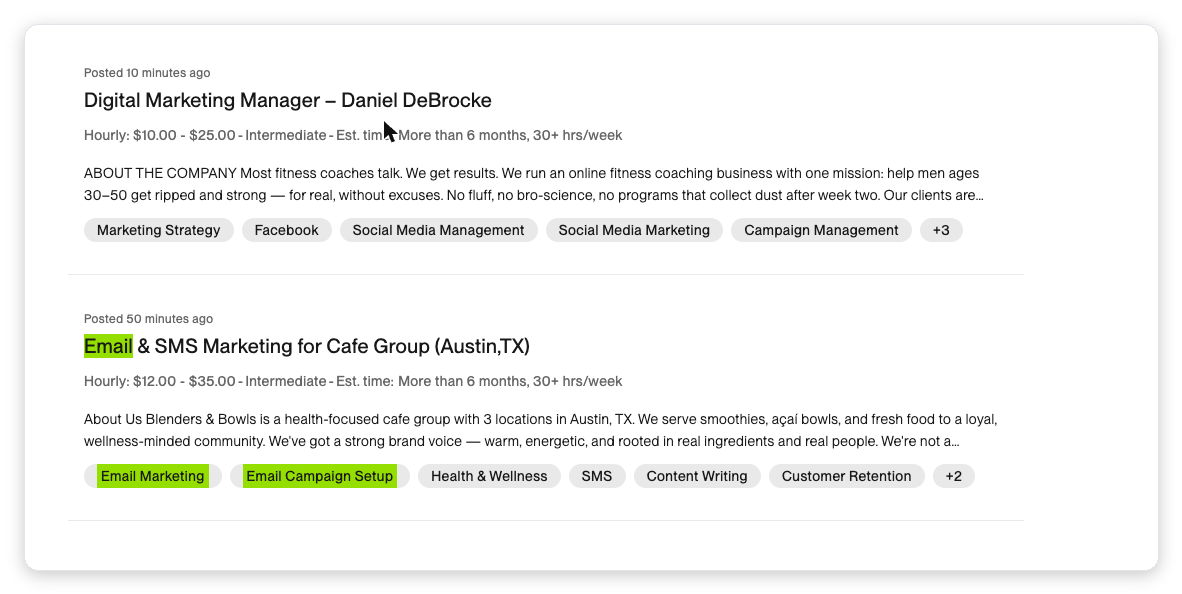
The channel hiding in plain sight is inbound intent. Ecommerce and DTC brands post on Upwork every week looking for paid-media buyers, Klaviyo and email specialists, CRO help, and Shopify work. A founder typing "Klaviyo expert" or "Shopify ads manager" into Upwork is pre-qualified and ready to buy.
Directories like Clutch and platform partner programs help, but they reward the agencies that are already big. Upwork is the one channel where a smaller shop can win on speed and fit instead of on reviews it has not earned yet, and where social-commerce demand (TikTok Shop alone is on track for ~20% of a $100B+ US market) keeps generating new briefs (TikTok for Business).
Here is the part the listicles miss. Marketing work on Upwork is not a saturated trap. In GigRadar's pipeline data (133,872 outbound proposals, Dec 2025 to Feb 2026), marketing-adjacent subcategories reply at nearly double the platform mean.
Source: GigRadar internal pipeline data, Dec 2025 - Feb 2026.
The catch is volume. Bidding on enough of those jobs by hand, fast enough to beat the queue, is a full-time job nobody on your team has time for. That is the gap GigRadar closes.
GigRadar operates a real Upwork Business Manager account. Your agency invites our BM through Upwork's official invitation flow, the same role you would use to onboard a hired bidder.
Proposals submit from our BM under our team's supervision, and your own Upwork account is never touched. If Upwork ever reviews a submission, the review lands on our BM profile, not yours.
It is the Business Manager model: not a browser extension, not a filter-and-draft tool.
That turns Upwork from a channel you dabble in into a predictable reply-rate machine, while your competitors keep burning budget on outreach nobody opens. See how full-service agencies run Upwork as a channel, and if you also serve B2B SaaS clients, the SaaS marketing agency playbook covers the parallel vertical.
Free for Upwork agencies
Fill your ecommerce pipeline from Upwork inbound
We auto-submit your proposals to DTC brands hiring on Upwork, through our managed Business Manager, so you get warm replies instead of cold-email silence.
Get Your Free Agency Audit →Why ecommerce brands fire their agency
Churn is rarely about a single bad month. It is about expectation gaps that were baked in at the start.
Run this pre-flight before you sign any DTC client. Tick every box and your retention problem mostly disappears.
Client-fit pre-flight checklist
Transparency, retention baked in, and an honest metric at kickoff are what separate the agencies that hold a client for five years from the ones replaced inside two quarters.
Build the margin-rich stack, price it on a retainer, qualify hard, and pull demand from where DTC brands already raise their hand. That is a defensible ecommerce marketing agency in 2026.