
Cost Per Lead by Channel: Why Upwork Wins on CPL (2026) — the 2-minute walkthrough of the $12 vs $408 math. Watch on YouTube
TL;DR
- Upwork costs roughly $12 per first reply at the platform-average 15% reply rate (12 connects × $0.15 ÷ 0.15). Cold email lands at $150–300, paid LinkedIn at $408, Google Ads Business Services at $103.54, outsourced cold calling at $357–500 per booked meeting.
- The Upwork number isn't cheaper because the platform is magic. It's cheaper because the buyer already raised their hand by posting a job. Every other channel pays to manufacture intent.
- The hidden line items on every "cheap" cold email setup (domain warmup, list enrichment, SDR salary, deliverability tooling) usually triple the headline CPL. Upwork has no warmup, no list, no domain risk.
- The CPL Comparison Calculator below blends your real Upwork volume with your real outbound spend so you can see your actual cost per qualified lead instead of the vendor brochure number.
- Cheap CPL doesn't always mean best ROI. The article ends with the three scenarios where Upwork is the wrong channel even at $12 per reply.
I just looked at an agency's outreach P&L. They were spending $14,200 a month on cold email infrastructure and a part-time SDR, and another $3,400 on LinkedIn Sales Navigator and Expandi. Total monthly outbound: $17,600 for 41 qualified replies.
Their Upwork connects bill that same month was $186. They got 84 first replies from Upwork in the same window. The math, when I ran it next to their LinkedIn Ads invoice, made the founder physically wince.
This is a cost-per-lead article that doesn't pretend each channel produces an identical lead. It does insist on naming the actual dollar a Upwork agency spends to get one human to respond, by channel, with sources you can audit.
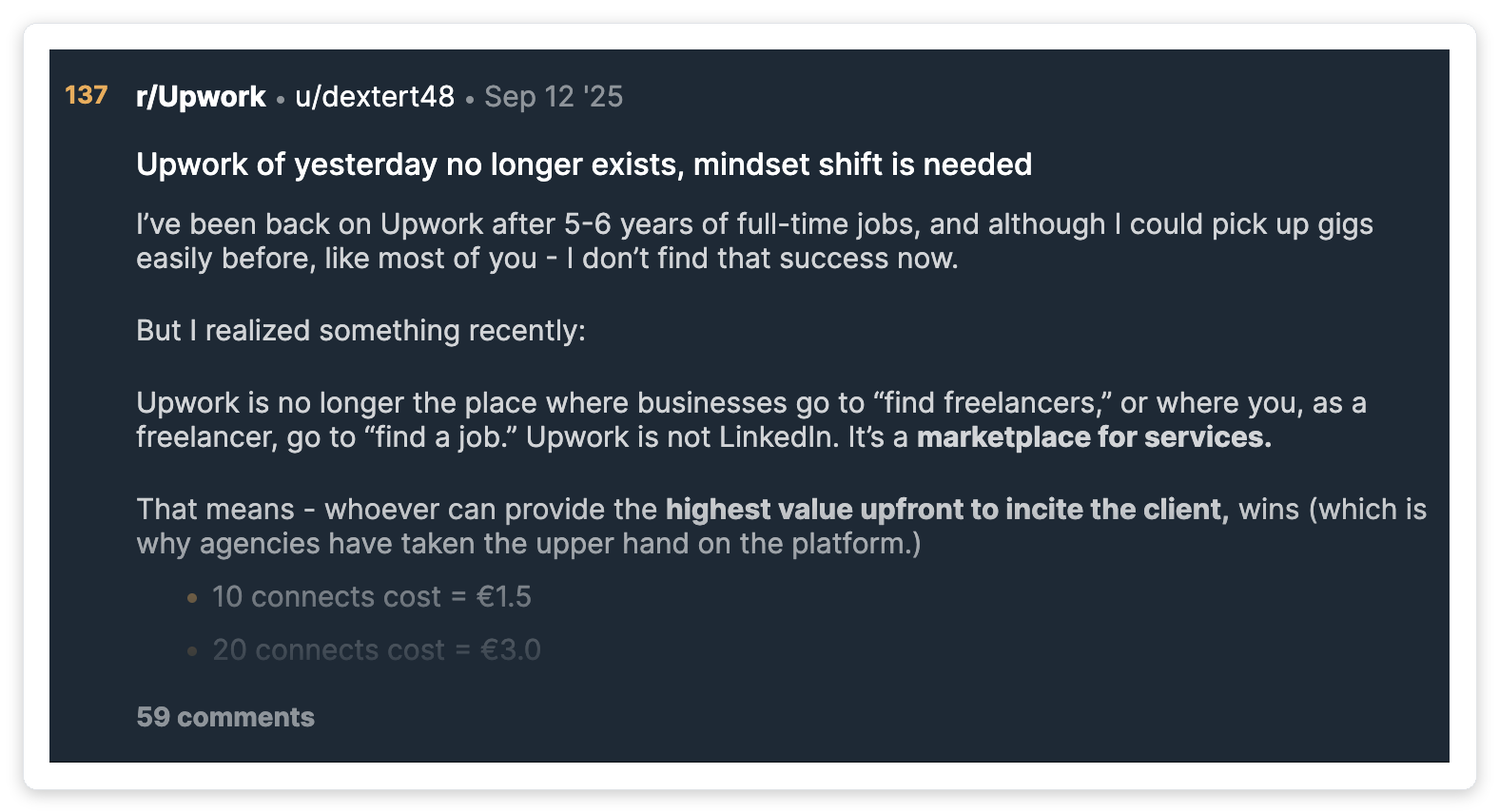
The CPL math your spreadsheet hasn't caught up with
Most agencies build their outbound cost model from vendor pricing pages. The vendor pricing page is the cheapest version of the channel that exists. The real CPL appears once you add domain warmup, list enrichment, SDR loaded cost, deliverability tooling, content production for nurture, and the percentage of replies that turn out to be "remove me."
Here is the table I now make every agency build before they decide which channel to scale. Numbers are 2025-2026 benchmarks from WordStream's 2025 search advertising benchmarks, Sopro's 2025 B2B CPL benchmarks, HubSpot's CPL benchmarks, and GigRadar's analysis of 133,872 outbound proposals.
| Channel | Avg CPL / per reply | Reply rate (avg) | Time to first lead |
|---|---|---|---|
| Upwork (automated bidding) | ~$12 per reply | 15% (top quartile 22–30%) | Same day |
| Google Ads (Business Services) | $103.54 per lead | 7.52% landing page CVR | Same day (after $5K+ ramp) |
| Cold email (B2B agency) | $150–300 per qualified lead | 1–5% (3.43% benchmark) | 2–4 weeks (warmup) |
| LinkedIn outreach (Sales Nav + tooling) | $200–400 per qualified lead | 11% DM reply average | 1–2 weeks |
| LinkedIn Ads (Lead Gen Forms) | $408 per lead (Sopro 2025) | Form submit, not reply | Same day |
| Cold calling (outsourced SDR) | $357–500 per booked meeting | 2.3–2.5% dial-to-meeting | 2–3 weeks |
| Cold calling (in-house SDR) | $821–1,150 per booked meeting | 2.3–2.5% dial-to-meeting | 2–3 weeks |
| Content / SEO | $206 per lead | Indirect | 6–12 months |
Upwork per-reply figure derived from $0.15 × 12 connects ÷ 15% reply rate. Reply rate from GigRadar's 133,872-proposal dataset. Other channels: WordStream, Sopro, HubSpot, SalesHive 2025.
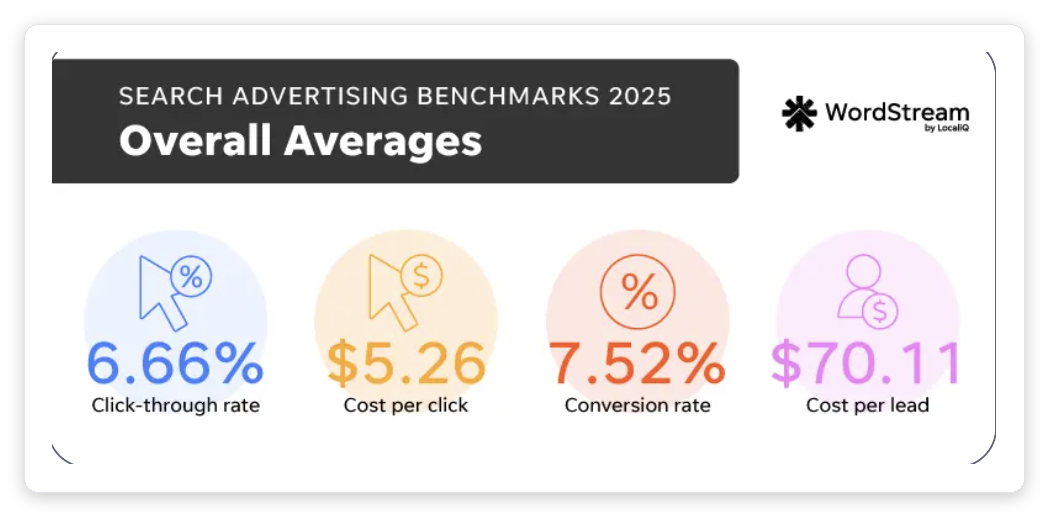
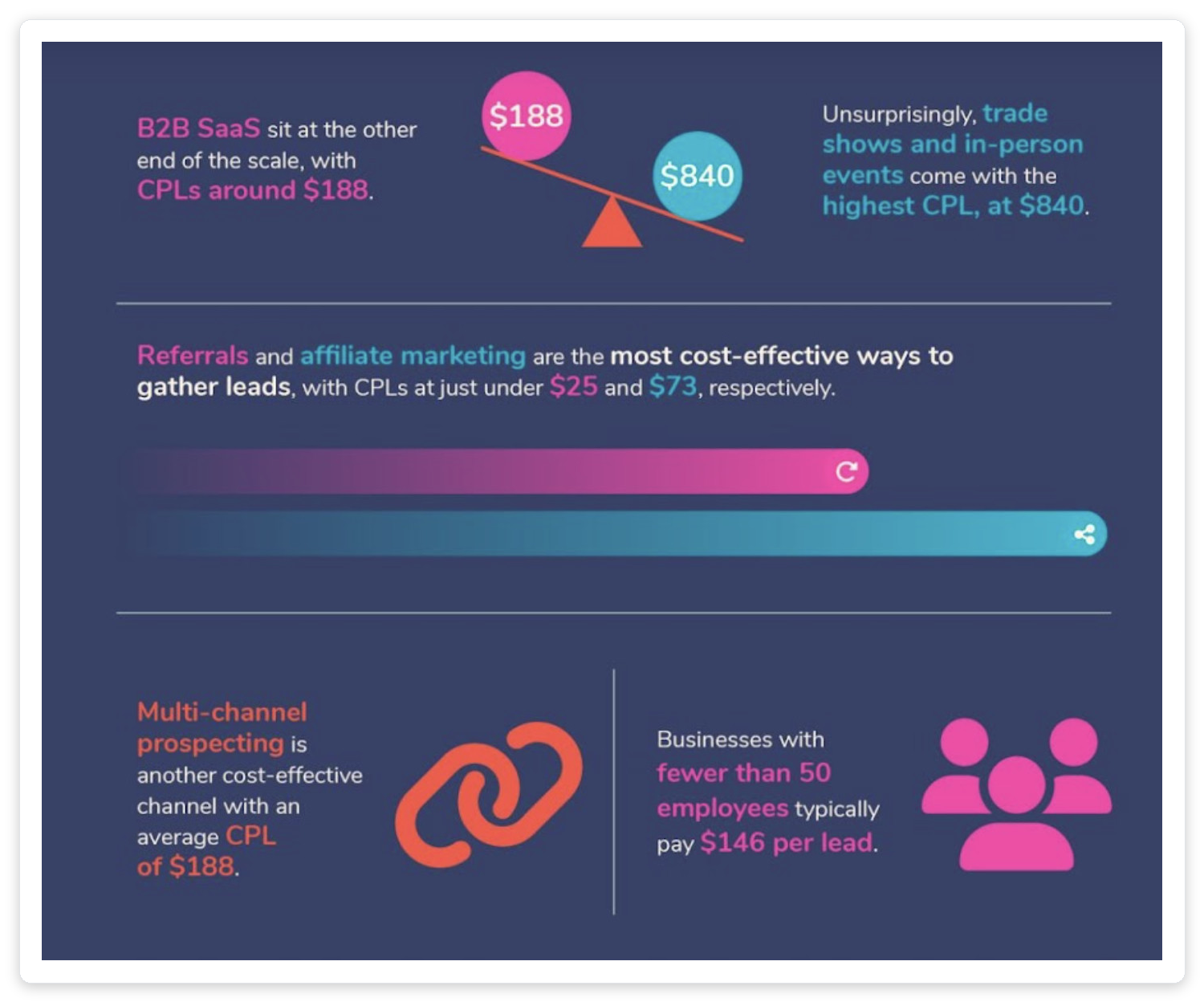
The most aggressive comparison is the gap between Upwork's per-reply cost and paid LinkedIn's per-lead cost. Roughly 34x. The most useful one is the gap between Upwork and outsourced cold calling, because that's the channel agencies actually try to scale when their cold email cools off. Roughly 30x to first qualified meeting.
Why $12 per Upwork reply is not a typo
Connects cost $0.15 each on Upwork. The average proposal consumes 12 connects. That's $1.80 per proposal sent.
From our analysis of 133,872 outbound proposals, the platform-average reply rate sits at 15%. Top categories like Legal, Web Development, and senior-tier Sales & Marketing push it to 22-30%. Bottom-tier categories drop to 5-7%.
Plug it into the formula: $1.80 ÷ 0.15 = $12.00 per first reply. At a 22% reply rate (a normal number for an agency that's run our job-bid scoring framework), it's $8.18. At 7%, it's $25.71. Even the worst-performing version of Upwork is cheaper per reply than the cheapest version of cold email.
Two clarifying notes on this number, since I get them every time:
First, "reply" here means a real human responded. Not a hire, not a contract, not a paid invoice. The conversion from reply → hire on Upwork runs roughly 25–35% for agencies that actually qualify the chat, which puts the cost per hired contract at $34–48. That's still 5–10x cheaper than every other channel's cost per booked meeting.
Second, this number assumes you're submitting fast. Reply rates on Upwork decay sharply with submission speed: 8.99% within 5 minutes of a job post, 6.47% at 7 minutes, 5.34% at 30 minutes. Speed matters more than copy quality on Upwork, which is why the cheapest version of this channel is automated submission rather than a human bidder.
The hidden line items on every "cheap" cold email setup
The pitch deck for every cold email tool says "$97/month and you're outbounding." The actual P&L for a B2B cold email setup that doesn't get its domain blacklisted in week three looks like this:
Apollo Professional sits at $79/user/mo. A 1,000-contact full-enrichment pull at overage credit pricing crosses $1,200 in credits on its own.
Each agency needs 3–6 secondary domains (~$15/year each) plus warmup tooling and 2–4 weeks of sending only to seed inboxes. That's a month of zero replies before the campaign starts.
Someone writes the sequences, monitors deliverability, drops the bouncing addresses, fields the "remove me" replies. A part-time VA can do this; that VA still costs money.
A meaningful share of cold email replies are "unsubscribe", "wrong person", or "we have a vendor." The headline reply rate isn't the qualified-lead rate.
Add it up against an agency-volume program (~10,000 sends/mo at a 3.43% gross reply rate per Built For B2B's 2025 benchmark): roughly $4,500–6,000/mo in fixed costs producing maybe 100–150 qualified replies. That's the $40–60 per qualified reply nobody puts on the brochure.
Upwork carries none of that overhead. No domain warmup. No bounce management. No "remove me" replies. No deliverability score to babysit. The connects bill is the entire cost.
If your agency's outbound program currently includes both Upwork and cold email and you're tempted to drop Upwork because "the connect bill is going up," check the per-reply math first. Connects-going-up-while-replies-go-up is the cheap version of scaling. Connects-going-up-while-replies-stay-flat is the signal that something else is broken (job filtering, response time, cover letter), not Upwork itself.
The CPL Comparison Calculator your spreadsheet won't run
Interactive Tool
Your real cost per qualified reply
Plug in your actual outbound spend and volume. The calculator returns your real $/reply by channel, then ranks them.
Upwork
Cold email
Cold calling
Upwork's secret weapon: every job post is a buy-signal
The reason Upwork's CPL is structurally lower has nothing to do with proposal templates or bidding strategy. It's because the buyer raised their hand before you spent any money on them.
On every other outbound channel, you're paying twice: once to manufacture intent (the "is this prospect actually shopping?" gamble), then again to convert it. On Upwork, intent is published by the buyer in plain text, with budget, scope, and a hire deadline. The job post is the intent signal, and it shows up before you've spent a single connect.
This is why benchmarks like the enterprise B2B intent platforms (6sense, Bombora) charging $25K–100K+/seat/year exist. Other channels pay enterprise software prices to guess at the buy-signal Upwork hands you in a public RSS feed.
Cost per qualified lead, simplified, is: (acquisition cost) + (intent-signal cost). Cold email pays both. LinkedIn ads pay both. Google Ads pays both. Upwork pays only the first one because the buyer publishes the second.
Saturation is the multiplier nobody is pricing in
Cold email reply rates have been dropping for three straight years. The 2025 average is 3.43% per Instantly's benchmark report. The 2022 average was 5–8%. The arithmetic is brutal: half the reply rate at the same cost means 2x the CPL.
LinkedIn DMs went from "novel touchpoint" to "every junior SDR's first channel" in about 18 months. The site's weekly connection-request cap of 100 exists because too many automated tools were running on the platform; tightening it raised the floor cost per accepted connection.
Upwork's connect price has gone up too (from $0.06 to $0.15 in 2023). But it sits at one channel's worth of inflation while every other outbound channel has experienced both rising costs and falling reply rates simultaneously. Net effect over five years: Upwork's per-reply cost is roughly stable. Cold email's has roughly doubled. LinkedIn's has tripled.
When the cheapest channel is the wrong choice
I've made the case for Upwork as the cheapest CPL channel. There are still three scenarios where it's the wrong call:
1. You sell a category Upwork doesn't host
Upwork is a project marketplace. If your service is "fractional CRO consulting at $25K/mo" or "private equity due diligence," there's no job category for that and the connects you spend will go to the wrong audience. Sell what Upwork hires for, or pick a different channel.
2. Your agency can't respond inside 30 minutes
The decay curve is steep. Reply rate at 30+ minutes is 5.34%, less than half the within-5-minutes number. If you can't be in the first 5 proposals on a job post (manually or through automation), Upwork's economics collapse to roughly cold email territory and the "every job is intent" advantage disappears.
3. You're optimizing for retention, not new logos
Upwork is a top-of-funnel channel. The economics work spectacularly for landing the first contract. They don't replace whatever you do to keep the client past month three. Retention math is a different article.
Outside those three scenarios, the CPL math points one way. Every other channel is structurally more expensive, structurally slower, and structurally exposed to declining reply rates that Upwork's intent-driven format is mostly insulated from.
Free for Upwork agencies
We submit Upwork proposals from our Business Manager so you hit the 5-minute window every time.
GigRadar runs Upwork bidding through our own invited Business Manager account. Your agency's profile and credentials are never touched. Speed is the variable that drops your $/reply from $25 to $8.
Get Your Free Agency Audit →The reallocation playbook
If your outbound P&L doesn't match the math above, the reallocation looks like this:
Pull last month's actual spend per channel and actual qualified replies. Don't use the vendor's marketing-page numbers.
The corrective is connects volume plus submission speed, not better proposal copy.
Lead Gen Forms produce form submissions, not replies. The qualified-reply number is usually 30–40% of the form-submit volume.
Enterprise targets, named accounts, specific verticals: those are the right cold email use cases. Don't replace cold outreach with Upwork; replace volume-spray with intent-driven.
The single common mistake: agencies treat Upwork and cold outbound as if they're the same channel ranked by aesthetic preference. They're not. Upwork is a paid intent feed at $0.15 per signal. Cold outbound is volume manufacturing. Different units. Different unit economics. The agency's job is to know which one they're scaling and price the alternative correctly.