
🎬 MEDDIC Sales for Upwork Agencies — a 2-minute walkthrough of how to qualify and disqualify Upwork deals before you spend a Connect. Watch on YouTube
TL;DR
- MEDDIC is a six-part qualification checklist (Metrics, Economic Buyer, Decision Criteria, Decision Process, Identify Pain, Champion) built to kill bad enterprise deals early. Its real power is disqualification, not closing.
- On a $1k to $15k Upwork project the buyer decides who to shortlist in the first 20 minutes, before any call. So your qualification has to happen in the proposal and at the lead-sourcing layer, not in a discovery meeting that may never get booked.
- Half your MEDDIC is pre-printed: the job post states the pain, the budget field frames the economics, the client's hire history and verified-payment badge score the buyer. Read those before you spend a Connect.
- On Upwork the Economic Buyer and the Champion are usually the same person, so stop running the six-stakeholder enterprise playbook on a solo founder.
- Score any opportunity in 30 seconds with the free MEDDIC scorecard below, then only write tailored proposals for the jobs that pass.
MEDDIC was invented to stop sellers from forecasting deals that were never going to close. It worked so well that the company that built it, PTC, grew from roughly $300 million to $1 billion in revenue in four years, on a run of 40 consecutive growth quarters, while running it as the qualification standard for every rep.
That origin matters for Upwork agencies, because the problem MEDDIC solves is the exact problem that quietly drains a 5-person agency: time spent chasing opportunities that were dead on arrival. Every tailored proposal costs you an hour and a fistful of Connects, and a no-budget tire-kicker costs exactly the same to pursue as a perfect-fit client.
The twist is that almost every guide teaches MEDDIC for six-month enterprise software cycles, but on Upwork the cycle is six minutes.
This guide rebuilds the framework for the way agency deals actually close: async, in chat, single decision-maker, decided before you ever get on a call.
Free Interactive Tool
The Upwork MEDDIC Scorecard
Score a job post and client against the six MEDDIC criteria before you spend a single Connect. Rate each one, then read your verdict.
Does the post name a measurable outcome you can move (leads, revenue, conversion, churn, launch date)?
Is the person posting the one who controls the budget (founder, owner, marketing lead), or a delegate who has to "check with the team"?
Do you know what they will judge proposals on (price, portfolio fit, niche experience, speed)?
Is there a clear next step (interview, trial milestone, hire date), or an open-ended "we'll see"?
Is there real, costly pain (something broken, stalled, or bleeding money), or just a nice-to-have?
Verified payment, real hire history and spend, and a person engaged enough to reply and advocate internally?
MEDDIC is six questions, not six boxes to tick
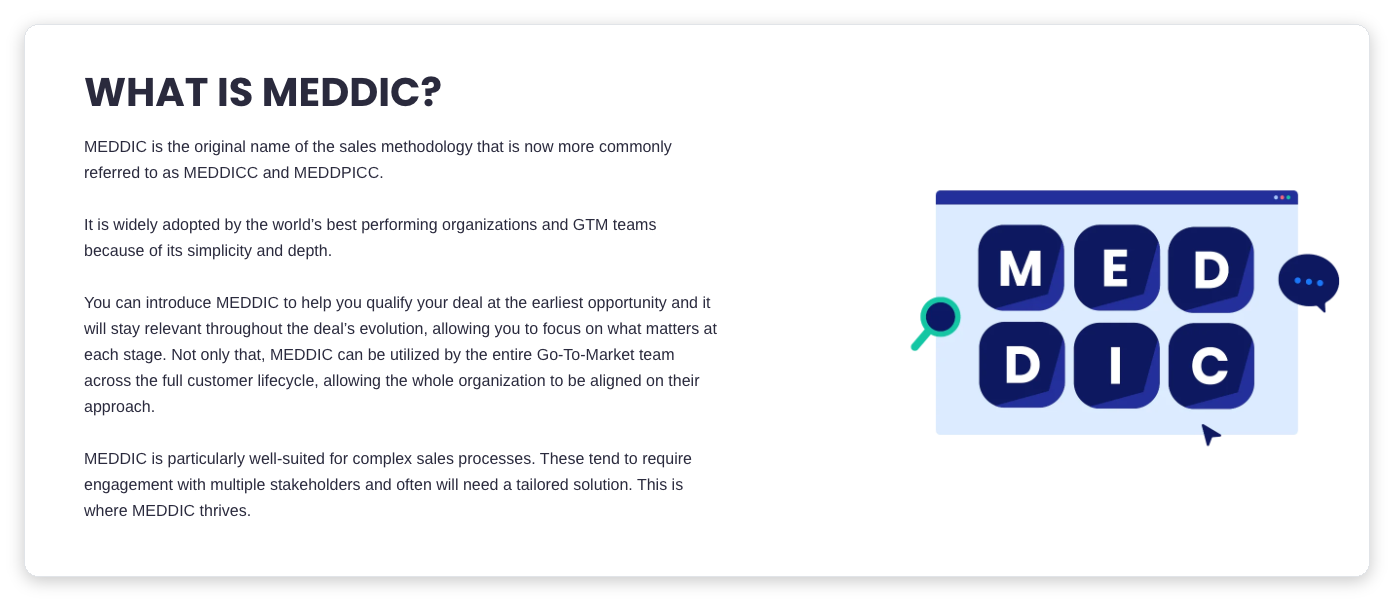
MEDDIC is an acronym for the six pieces of information you need before you believe a deal is real. It came out of PTC (Parametric Technology Corporation) in 1996, codified by reps including Dick Dunkel and Jack Napoli.
It is now common property: in April 2026 a U.S. federal court ruled that "MEDDPICC" is a generic term that belongs to the whole sales community, not a single trainer.
The trap is treating it as a form to fill in. Qualification is a judgment about whether to keep spending, not a quota of fields to complete.
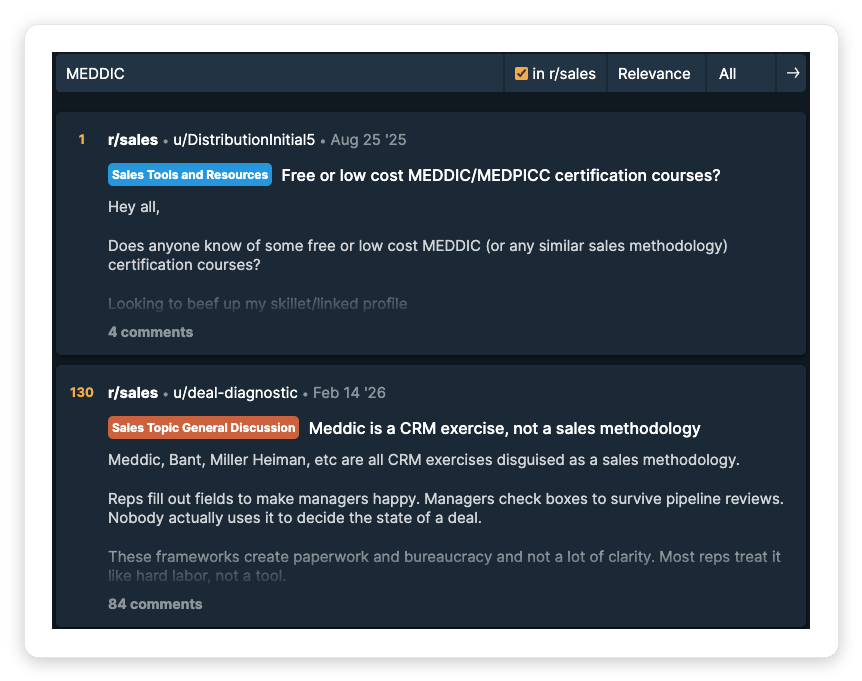
Real sellers argue about this constantly: search r/sales and you will find 100-plus-upvote threads insisting MEDDIC is "a CRM exercise, not a sales methodology."
Here is each letter, with the enterprise definition next to the version that actually fits an Upwork deal.
| Letter | Enterprise meaning | Upwork translation |
|---|---|---|
| Metrics | The quantified economic impact of solving the problem. | The number in the job post you can move: more leads, lower CPL, a launch date, a conversion lift. |
| Economic Buyer | The one person who can release the budget. | Usually the person who posted the job. On Upwork they often sign and pay themselves. |
| Decision Criteria | The formal scorecard the buying committee uses. | What they shortlist on: portfolio fit, niche proof, price, response speed, "no agencies." |
| Decision Process | Approvals, legal, procurement, sign-off chain. | Interview, then a trial milestone, then a contract. The whole thing can be one chat thread. |
| Identify Pain | The business problem and its cost if unsolved. | Already typed into the brief. Your edge is reading the pain they did not write. |
| Champion | An insider who sells for you when you are not in the room. | The person replying to you, plus the payment and hire-history signals that prove they actually buy. |
Two extensions show up in modern guides. MEDDICC adds a second C for Competition (on Upwork, the other 14 freelancers already in the client's inbox), and MEDDPICC adds a P for Paper Process (the contract and statement of work).
For services that paper process is real even on small jobs, which is why a clear statement of work shortens the back-and-forth before a client hires.
Why a $1B sales engine matters to a 5-person agency
MEDDIC exists because forecast accuracy and win rates are usually worse than reps admit. Sales teams that adopt the discipline and ruthlessly drop weak deals report meaningfully better numbers afterward.
Directional benchmarks compiled from MEDDICC case-study data; the lift comes mostly from discarding low-quality deals, not from working harder.
For an agency the math is even more brutal than for a salaried rep. The rep wastes salaried hours, while you waste billable hours plus Connects, and you only have so many of both.
That is why the framework is worth stealing even though it was built for deals 100 times your size.
If you want the broader picture of where qualification sits in your funnel, it lives right between sourcing and your first reply. We map that in the guide to sales pipeline stages, and it feeds directly into sales velocity, the math of how fast deals actually move.
On Upwork, the job post already wrote half your MEDDIC
Enterprise MEDDIC treats Pain and Metrics as things you extract through skilled questioning over weeks. On Upwork the client already typed their pain into the brief, the budget field already frames the economics, and the attached files often reveal more than a discovery call would.
So the highest-leverage qualification happens before you speak, by triaging which posts deserve a tailored reply at all. The real skill is not a question framework, it is lead selection.
A "$3,000 fixed, payment verified, hired 28 times, $90k spent, needs launch before Q3" post fills four MEDDIC letters in one glance. A "looking for a marketing ninja, budget flexible, no reviews, payment unverified" post fails three of them before you read the second sentence.
The signals Upwork hands you map almost one-to-one onto MEDDIC. Verified payment and total spend score the Economic Buyer, while hire count and reviews score the Champion.
The budget field is your Metrics anchor, and the brief itself is the Pain. Reading those fast is the entire game, which is why a sharper read of who you are up against changes which jobs you even open.
If a post is missing the budget AND the client has no verified payment AND no hire history, that is three MEDDIC fails on paper, so skip it. Spending a Connect there is the single most common way agencies leak money on Upwork.
Your Economic Buyer and your Champion are usually the same person
MEDDIC's Champion-versus-Economic-Buyer split exists because in enterprise the person who loves you cannot sign, and the person who signs has never met you. That gap is the whole reason you arm a champion with an internal business case.
On a $1k to $15k Upwork job, the person reading your proposal is usually the person paying. There is no procurement to navigate and no committee to convince.
Champion (loves you) ≠ Economic Buyer (signs) ≠ end users. Six stakeholders, three months, one business case per person.
Champion = Economic Buyer = the one founder in the chat. One person, one thread, one yes, so make that yes effortless.
Treating a solo founder like a six-person buying committee makes you slow and weird. They asked for a quote and you sent a stakeholder-alignment questionnaire.
Spend that energy instead on making the single decision-maker's yes effortless: a scoped price, a clear next step, and zero "let me loop in the team."
MEDDIC vs BANT: which one fits a 5-minute Upwork reply?
BANT (Budget, Authority, Need, Timing) originated at IBM and is the lightweight cousin of MEDDIC. It is faster and shallower, which sounds perfect for Upwork until you notice what it ignores: MEDDIC was built precisely because BANT misforecast at enterprise complexity.
| BANT | MEDDIC | |
|---|---|---|
| Built for | Fast lead triage | Complex, multi-step deals |
| Centers on | Can they buy? | Should we keep selling, and how do we win? |
| Misses | Decision criteria, the champion, competition | Can feel heavy on tiny deals |
| Best Upwork use | The 30-second "is this even real" filter | The qualified jobs you decide to fight for |
The right answer is both, in sequence. Use a BANT-style three-question filter to kill obvious non-starters in seconds, then run the fuller MEDDIC read on the survivors.
GigRadar's Agency Success course teaches exactly this fast filter, built around budget, authority and timeframe, as a 30-second qualifier you apply the moment a client replies.
🎥 From GigRadar's Agency Success Course: the "Win in 5 Minutes" lesson on speed and the budget-authority-timeframe filter.
The most valuable letter is the silent D: Disqualify before you bid
Reddit's r/sales is right that MEDDIC's real power is killing bad deals early. The catch is that enterprise reps disqualify after burning a discovery call, and an agency cannot afford even that.
"MEDDIC didn't make me close more. It made me stop wasting time on deals that were never going to close, so the pipeline got smaller and the forecast got real."
Paraphrased from a recurring sentiment in r/sales threads on MEDDIC
So move disqualification all the way upstream, to the lead-sourcing layer, before you write a single proposal. Filter for verified payment, hire history, spend and decision clarity first, then write only for the jobs that survive.
Set hard rules: payment verified, real hire history, a budget that fits your floor. Posts that fail never reach your proposal queue.
Run the MEDDIC scorecard above on what is left. Anything below a borderline score gets one clarifying question or a skip, not a tailored proposal.
Spend your real proposal effort on the jobs that pass. Better lead selection is the cycle-time win, because you stop spending hours on deals that fail MEDDIC on paper.
The agencies with the best close rates are not better at MEDDIC on calls, they simply never bid on the deals that fail MEDDIC on paper.
That is the entire connection between qualification and a shorter sales cycle: fewer, better-fit opportunities in, more closed deals out.
Free for Upwork agencies
Stop bidding on deals that fail MEDDIC on paper
GigRadar filters Upwork jobs by client spend, verified payment, hire history and fit, so your team only sees opportunities worth a proposal. Better leads in means a shorter sales cycle out.
Get Your Free Agency Audit →How to run MEDDIC on a $5k deal without a discovery call
The deal is usually decided before any call happens, so your proposal has to carry the qualification. Make the proposal itself prove you read the Metrics and Pain, name the next step (the Decision Process), and give the single buyer an easy yes.
When you do get to a call, the close is where MEDDIC pays off. Knowing the buyer's metric and pain lets you anchor a scoped offer and ladder it instead of guessing at price.
🎥 From GigRadar's Agency Success Course: the "Always Close the Deal" lesson on package laddering and the assumptive close.
A practical sequence for a qualified opportunity looks like this.
Mirror the metric. Open your reply by naming the exact outcome from the brief, not your résumé.
Name the unwritten pain. Show you understand the problem behind the problem, which is what a discovery call would have surfaced.
Propose the next step. A small first milestone is a low-risk decision process the buyer can say yes to today.
Close the single buyer. No committee to align: scoped price, clear deliverable, assumptive next step.
If your replies keep getting ignored, the problem is often upstream in the jobs you chose, not the words you used. Our breakdown of what actually moves reply rates on Upwork proposals pairs well with this, and the basics of how Upwork hiring works set the context for everything above.
The four ways agencies break MEDDIC on Upwork
Most MEDDIC failures on Upwork are not subtle. They are the same four mistakes, repeated.
Box-ticking. Filling all six letters with weak answers and bidding anyway, when a "maybe" in five fields is a disqualify, not a pass.
Over-qualifying tiny deals. Running a six-stakeholder process on a one-person buyer makes you slow and loses the job to a faster competitor.
Ignoring payment signals. A glowing brief from an unverified client with zero hire history fails the Economic Buyer test no matter how exciting the project sounds.
Disqualifying too late. If you only realize a deal is dead on the call you already lost the hour and the Connect, so move the kill decision before the bid.
Frequently asked questions
What does MEDDIC stand for in sales?
Metrics, Economic Buyer, Decision Criteria, Decision Process, Identify Pain, and Champion. The MEDDICC variant adds Competition and MEDDPICC adds Paper Process.
Is MEDDIC overkill for small Upwork projects?
The full enterprise version is. Use a light BANT-style filter first, then apply MEDDIC as a quick paper read on the jobs that survive, mostly to decide what to skip.
MEDDIC vs BANT, which should an agency use?
Both, in order. BANT answers "can they buy" in seconds; MEDDIC answers "should we fight for this and how do we win" on the qualified few.