
🎬 SOW Template: Clauses That Get Agencies Paid — the four clauses that turn a Statement of Work into a document that actually gets you paid, plus how your Upwork milestone split becomes your change order. Watch on YouTube
TL;DR
- The clause that decides whether you get paid is not "scope." It is the acceptance clause that defines when "done" happens, on a date, whether or not the client replies.
- Scope creep on agency projects is mostly self-inflicted. "Revisions until you are happy" and "a modern website" are sentences you wrote that hand the client an open-ended veto.
- Every strong SOW clause converts a feeling ("satisfied", "premium", "done") into a countable, dated trigger: 2 revision rounds, a 5-business-day review window, deemed acceptance.
- On Upwork, your funded milestone split is your change order. Work outside a funded milestone never starts. No "per our SOW" email required.
- Use the free builder below to generate a scope, revision cap, deemed-acceptance clause, and change-order clause you can paste straight into an Upwork contract.
A client withheld $6,000 on a finished website build because it "didn't feel premium enough." Nothing in the scope had been violated.
There was simply no sentence anywhere in the agreement that defined what "finished" meant. So the client got to decide, and they decided "not yet."
That is the whole game with a Statement of Work. Most agencies treat the SOW as a description of the work, and the top-ranking SOW templates online reinforce that: list the deliverables, the timeline, the fee, sign at the bottom.
That version is a liability with a logo on it. A description tells the client what they are buying, but says nothing about when they have to stop asking and pay.
This guide is the opposite. Every section below exists to make a single clause more enforceable, because an SOW's value is not how completely it describes the project, but whether it forces a decision on a date.
I have watched agencies lose months of margin to a beautiful 12-page SOW they were too afraid to invoke. I have also watched a one-page SOW with a deemed-acceptance timer close out a disputed project in five business days.
Free Tool
SOW Builder: generate the clauses that get you paid
Fill in five fields to get a scope, revision cap, deemed-acceptance clause, change-order clause, and payment terms you can paste into an Upwork contract or a Word doc. Nothing is stored.
Free Download
Or grab a ready-made SOW template (Word)
Prefer a document you can fill in? Download any of these three editable .docx templates. Every [placeholder] is marked in blue, the acceptance and change-order clauses are written to use as-is, and each one carries a "How to use" guide plus a GigRadar reference.
The lawyer-grade one: key-terms summary, definitions, 27 sections, and a pre-send checklist. Covers deemed acceptance, IP assignment on full payment, late-payment interest, kill fee, liability cap, indemnity, non-solicitation, and dispute resolution.
Download .docx ↓Built around funded milestones as your change order, with a deemed-acceptance window aligned to Upwork's review timer, IP-on-release, a liability cap, and an Upwork-terms-prevail clause. For fixed-price jobs.
Download .docx ↓The six load-bearing lines on a single page (deliverables, exclusions, revisions, acceptance, change orders, payment) plus a one-line "fine print" footer for IP, liability, and governing law. The version with teeth.
Download .docx ↓Templates are a starting structure, not legal advice. Have a lawyer review anything you reuse across clients.
An SOW is not a description. It is the document that decides if you get paid
In formal project-management practice, a Statement of Work is a narrative description of the products, services, or results a project will deliver. That is the PMI definition, and it is where most templates stop.
For a digital or marketing agency, that framing is incomplete in the one way that costs you money. The SOW is not just where you say what "launching a campaign" or "redesigning a website" means.
It is where you decide, in writing, when the client has to agree the job is done and release the money.
Contract-management practitioners describe the SOW as the primary tool for managing expectations and controlling what is and is not included. Scope-of-services guidance stresses that a real scope clause states the nature, extent, and limitations of the services.
The limitations are the part agencies skip. They are also the part that protects them.
What actually belongs in an agency SOW (and what is just filler)
A complete SOW has roughly a dozen sections, and they are not equally important. Four of them are load-bearing for getting paid.
The rest are context that a one-line reference to your MSA can often carry.
Here is the full anatomy, sorted by how much each section actually protects your margin.
| SOW section | What it does | Weight |
|---|---|---|
| Acceptance criteria + deemed acceptance | Defines "done" as an event on a date. Triggers payment. | Load-bearing |
| Deliverables (with counts & formats) | Turns "a website" into "5 templates, no migration." Kills assumptions. | Load-bearing |
| Revision cap | Converts "until you love it" into a countable number of rounds. | Load-bearing |
| Change-order process | Routes every "quick add" through a fee before work starts. | Load-bearing |
| Scope & exclusions | States inclusions and the explicit out-of-scope list. | High |
| Payment terms / model | Fixed, milestone, or T&M and the invoice schedule. | High |
| Assumptions & dependencies | What the client must provide (access, content) and by when. | Medium |
| Milestones & timeline | Checkpoints and dates, ideally tied to payment. | Medium |
| IP / ownership transfer | Work product transfers on full payment, not before. | Medium |
| Confidentiality & data access | Ad accounts, customer data, credentials handling. | Context |
| Term & termination | How either side exits and what gets paid on exit. | Context |
| Signatures / boilerplate | Governing law, the legal frame, sign-off. | Context |
If you only have an hour, spend 50 minutes on the four green rows and 10 minutes referencing a standard SOW template for the rest. The green rows are where projects actually go to die.
The biggest cause of scope creep is a sentence you wrote yourself
Across industries, the most consistently cited root cause of scope creep is ambiguous scope and vague deliverables. PMI lists it first in its top five causes of scope creep.
The uncomfortable part is that the ambiguity is usually sitting in your own document.
"Design a landing page" quietly becomes copywriting, three A/B variants, two email integrations, and a follow-up automation. Each request looks small, but together they double the build.
The danger is not difficult clients. It is that you defined the finish line as a feeling the client controls, so there is no exit.
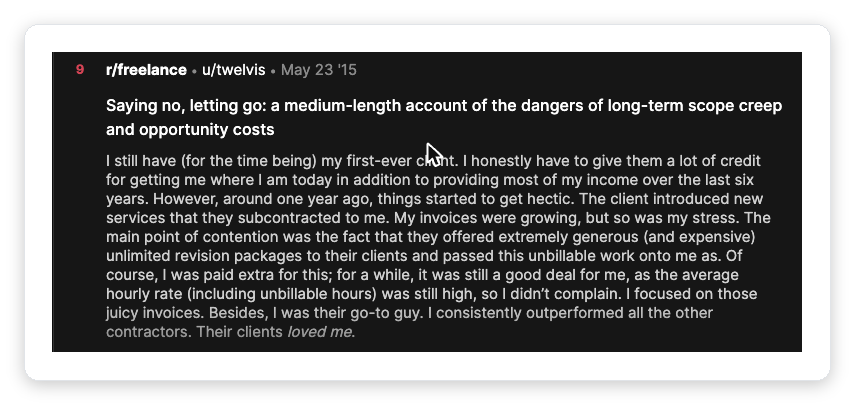
"Reasonable revisions" and "until the client is satisfied" are the two most expensive phrases in agency contracts. Clients read both as "unlimited." You meant "a couple." Only one of you wrote it down.
The fix is mechanical. Translate every qualitative promise into a concrete, countable one before it goes in the SOW.
The translation table that kills assumptions
| Vague phrase you wrote | What the client hears | Enforceable rewrite |
|---|---|---|
| "Manage SEO" | Audits, content, links, forever | "Technical audit of up to 30 pages + on-page fixes for 8 templates. Link building excluded." |
| "A brand video" | Every platform cut, unlimited edits | "One 60-second master cut + two 9:16 variants. 2 revision rounds." |
| "Social media management" | All platforms, weekend replies, paid ads | "12 posts/month on 2 named platforms. Community replies in business hours. Paid excluded." |
| "Ongoing support" | Free fixes indefinitely | "30 days of bug fixes on delivered features. New features via change order." |
For more on setting expectations before a contract even starts, this connects directly to how you scope work in a proposal. We cover that handoff in our guide to agency client acquisition.
"Done" is a date, not a feeling: the deemed-acceptance clause
If you take one clause from this article, take this one. Acceptance criteria matter more than scope, because "done" is exactly where the money gets withheld.
You can write a flawless scope and still lose three weeks to "it just doesn't feel premium enough." Nothing in the scope was violated. There was no definition of finished, so the client supplied their own, and theirs has no deadline.
The mechanism that fixes this is borrowed from Agile. A Definition of Done is a shared, testable checklist for "complete." Pair it with a deemed-acceptance window and you have a clause that closes itself.
That "deemed Accepted" sentence is the single most valuable line in a freelance SOW, and most agencies do not have it. It removes your dependence on the client clicking a button, so silence becomes acceptance instead of an indefinite hold.
Tie acceptance criteria to things a third party can verify: "matches the approved Figma at the listed breakpoints, passes Google's Mobile-Friendly test, loads under 3s on the five named pages." A platform mediator or a court can read that. They cannot read "looks premium."
Strong acceptance criteria are also your best evidence in a dispute. When a client claims work is incomplete, you point to the criteria they agreed to in advance, which reframes the argument from "we do not like this" to "does this meet the spec, yes or no."
Fixed-fee vs T&M vs milestones: which structure your SOW should use
Pricing structure is not just a money decision. It decides who carries the risk of scope expansion, which is the entire subject of this article.
| Model | Who carries scope risk | Client predictability | Best fit |
|---|---|---|---|
| Fixed-fee | Agency (high) | High | Templated, well-defined builds you have done before |
| Time & materials | Client (low for agency) | Low | Audits, discovery, evolving scope, sophisticated buyers |
| Milestone hybrid | Shared (medium) | Medium-high | Phased work and almost everything on Upwork |
Fixed-fee is profitable only when your scope, exclusions, and change-order clauses are airtight. Without them, every underestimate and every "small tweak" comes out of your margin, because you promised a price for a scope the client now reads more generously than you did.
For most agencies, especially on Upwork, the milestone hybrid wins. The total can be fixed, each milestone has its own price, and out-of-scope work is billed separately.
You get earlier payments and earlier detection of misalignment. This structure is also easier to staff against as you move from solo freelancing into a team model, which we get into in going from freelancer to agency.
On Upwork, your milestone split is your change order
Here is the part the 12-page templates miss. On a sub-$2,000 fixed-price Upwork job, your real SOW is not the attached PDF.
It is the milestone structure, because Upwork's escrow enforces it for you. This is one of the first operational habits worth building when you start a freelance agency on Upwork.
The honest reason agencies do not enforce their own SOW is not ignorance of the clause. It is relationship fear.
One Upwork client controls your JSS and a public review, so you eat the extra work rather than point to page 7.
Milestones remove the confrontation. Work outside a funded milestone simply does not start. There is no "per our SOW" email, just "happy to do that, I will add a milestone for it."
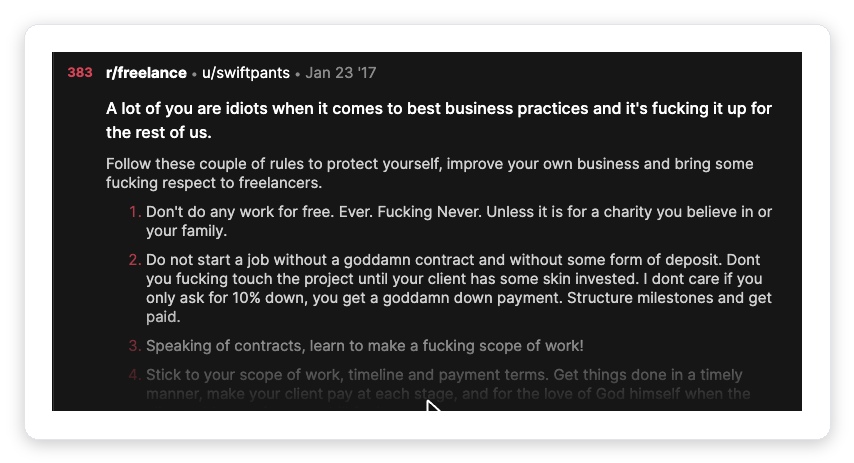
Implement it as a sequence, and document every scope change as a new milestone rather than a chat promise.
A $1,500 site becomes $400 wireframe, $700 build, $400 revisions and handoff. Each is funded before it starts.
Restate the deemed-acceptance window inside the milestone notes so it lines up with Upwork's own review timer.
"Add email templates" becomes a milestone titled "Email Templates: Added Scope" with its own fee. Work starts when it is funded.
Upwork mediation reads written records. A funded milestone plus a confirming message beats any verbal "we discussed it."
The change-order clause that turns "just one more tweak" into an invoice
Construction and government contracting have litigated scope changes for decades, and the lesson is consistent. Courts weigh whether the contract had a clear change procedure and whether the parties followed it, as change-order dispute analysis shows.
Informal changes are where the money and the goodwill leak out.
Your agency version does not need to be FAR-grade. It needs one paragraph that makes out-of-scope work a decision with a price, not a favor.
That last sentence is a non-waiver clause. It stops a few generous favors early in a project from being read as "scope is flexible" later, the exact pattern construction litigators flag when repeated informal changes get treated as having modified the contract.
You almost never have to quote the clause; you just say: "Love that idea, it is outside the current scope, so I will send a quick change order with the cost and timeline." That one line does the enforcement, warmly.
Free for Upwork agencies
A tight SOW protects the projects you win. We help you win better ones.
GigRadar runs your Upwork new-business pipeline through our own staffed Business Manager account, so your team submits to better-fit clients without ever touching your agency login. Fewer mismatched projects means fewer scope fights to begin with.
Get Your Free Agency Audit →SOW vs MSA vs proposal vs contract: how they actually stack
These four get used interchangeably, and the confusion causes real problems. They are different instruments doing different jobs.
A sales document. Persuasive, often non-binding. It wins the deal. It should not be the thing you deliver against.
The master legal frame: liability, IP, confidentiality, governing law. Negotiated once, reused across every project.
The execution blueprint under the MSA: scope, deliverables, acceptance, fees. This is where you get paid or do not.
The umbrella term. An MSA + SOW together are a contract. On a small job, a signed SOW can be the entire contract by itself.
The practical setup for an agency with repeat clients is one MSA plus a fresh SOW per project. You negotiate the heavy legal terms once, then spin up new work fast by executing a new SOW, which is exactly the modular structure contract counsel recommends.
For a first-time Upwork client on a single project, skip the MSA and let a one-page SOW be the whole contract.
The one-page SOW beats the 12-page one you will never enforce
A long SOW is theater if you cave the moment a client pushes back. The binding agreement was never the PDF: it was your willingness to invoke it, and on Upwork most agencies have none.
On a $500 fixed-price job, a 12-page SOW is net-negative. It costs you an hour to produce, signals "this person is hard to work with" to a first-time buyer, and you still will not enforce it.
So stop optimizing for completeness and optimize for teeth. Three tight paragraphs plus a real milestone split protects you more than a template that impresses nobody and gets ignored.
The one-page SOW checklist
If your SOW has these six lines, it has teeth:
- Deliverables with counts and formats (not adjectives)
- An explicit out-of-scope list
- A capped number of revision rounds, with "round" defined
- A deemed-acceptance window (5 business days is standard)
- A one-paragraph change-order clause with a non-waiver line
- A funded-milestone payment split
Generate all six in 30 seconds with the builder at the top of this article, then paste them into your next Upwork contract. The same discipline that protects delivery also protects the relationship, which is the real engine behind long-term client retention.
And when a project does close cleanly, that is the moment to ask the client for feedback while the goodwill is still fresh.
An SOW's value was never description. It is enforceability, and enforceability is just the habit of converting every "satisfied," "premium," and "done" into a trigger that fires on a date whether the client acts or not.