
OKR examples that survive a quarter — a 90-second walkthrough of real OKRs by team, why 52% of key results are fake, and the one metric a small agency should track instead. Watch on YouTube
TL;DR
- An OKR is one Objective plus 3 to 5 measurable Key Results. The test John Doerr borrowed from Google: it is not a Key Result unless it has a number.
- In a study of 7,857 real Key Results, 52% were tasks in disguise (“launch X,” “run Y”) rather than outcomes. That single mistake is why most OKRs quietly die.
- This page has 24 copy-ready OKR examples by team (company, sales, marketing, customer success, product, agency, and Upwork agency) plus a free Key Result checker that flags tasks-in-disguise.
- Grade aspirational OKRs 0.0 to 1.0 and treat 0.7 as a win. Committed OKRs are expected to hit 1.0.
- If you run a 2 to 20 person agency, you probably do not need a full OKR system. You need one weekly number that predicts revenue. The last section shows how.
Someone analyzed 7,857 Key Results pulled from real companies. 52% of them were not key results at all. They were tasks wearing a number, like “launch the new onboarding flow” instead of “move Day-7 activation from 34% to 52%.”
That is the whole game. The OKR examples you copy off a vendor’s landing page look tidy because they were reverse-engineered to look tidy, not because anyone ever hit them on a hard Monday.
So this is two things at once. A library of OKR examples you can actually steal, by team, and an honest take on when OKRs are the wrong tool for your size.
Interactive Tool
Key Result checker + OKR generator
Paste a draft Key Result to see if it is an outcome or a task in disguise. Then generate a ready-made OKR for your team.
What an OKR actually is (and the one-line test)
OKRs came out of Intel. Andy Grove turned Peter Drucker’s Management by Objectives into something faster, then John Doerr carried it to Google, where it became the operating system for goal-setting (full history here).
The structure never changed. One Objective answers “what do we want to achieve.” Three to five Key Results answer “how will we know we got there.”
Doerr’s formula fits on a sticky note: “I will [Objective] as measured by [Key Results].” The Objective is qualitative and a little inspiring. The Key Results are cold numbers (whatmatters.com).
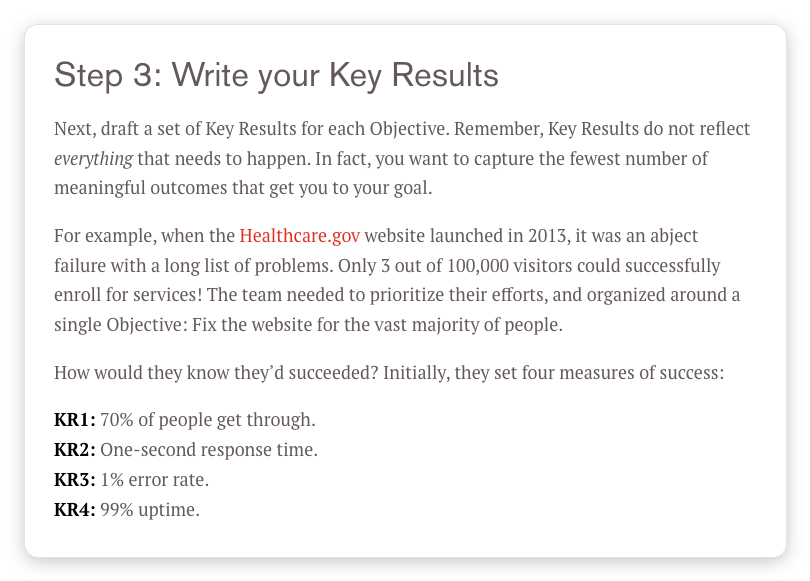
Here is the anatomy stripped to its parts, so you can sanity-check anything you write.
| Part | What it is | Good | Bad |
|---|---|---|---|
| Objective | Qualitative, memorable, a real priority for the quarter | “Make Upwork a predictable new-business channel” | “Improve marketing” |
| Key Result | A number that moves from a baseline to a target | “Reply rate 4% → 8%” | “Send more proposals” |
| Initiative | The work you do to move a KR (lives in your task list, not the OKR) | “Rewrite the first-line hook” | Putting this in the OKR itself |
Why most OKR examples online are useless
Most public OKR examples are written by companies selling OKR software. They are designed to screenshot well, not to survive a quarter.
That is how you end up with the most common failure in the framework. A team analyzed 7,857 Key Results and found 52% were tasks or KPIs in disguise (OKRs Tool). The pretty examples never had to answer the question every real KR faces: did the number move, or did we just stay busy?
If a Key Result starts with launch, build, run, ship, implement, write, hire, or set up, it is almost certainly a task. Outcomes start with a metric and a direction: increase, reduce, raise, cut, grow.
The fix is mechanical. Take every activity-based KR and ask “what is the intended outcome of doing this” until you hit a number a neutral observer could grade (Felipe Castro).
Task in disguise → real Key Result
| Task in disguise (bad) | Real Key Result (good) |
|---|---|
| Launch the new onboarding flow | Increase Day-7 activation from 34% to 52% |
| Send 300 Upwork proposals this month | Lift proposal reply rate from 4% to 8% |
| Run 3 webinars | Generate 120 SQLs from webinars (up from 40) |
| Hire 2 SDRs | Grow outbound-sourced pipeline from $200k to $350k |
| Implement the new CRM | Cut average lead response time from 9h to 1h |
| Write 10 blog posts | Grow organic ICP signups from 80 to 160 per month |
Outcome vs task, at a glance
- Has a baseline and a target
- Can fail even if all the work shipped
- Measures customer or revenue behavior
- Graded by a number, not an opinion
- Done = it happened, regardless of impact
- Starts with a verb like launch or build
- Counts effort, not effect
- Belongs in your to-do list
24 OKR examples by team (copy-ready)
These use realistic baselines and targets. Swap in your own numbers, keep the shape. Where the metric ranges lean on B2B SaaS funnel and engagement benchmarks, they are drawn from First Page Sage and Gainsight.
Company / leadership OKR examples
Objective: Achieve sustainable ARR growth while improving unit economics
- Increase new ARR booked per quarter from $1.2M to $1.6M
- Reduce CAC payback period from 20 months to 15 months
- Improve gross revenue retention from 88% to 92%
Objective: Make our core product indispensable for target customers
- Increase DAU/MAU ratio from 24% to 32% among paying customers
- Increase 7-day activation from 55% to 75%
- Grow weekly active users in our top 50 accounts by 50%
Sales OKR examples
Objective: Build a reliable outbound engine that delivers high-quality pipeline
- Increase outbound-sourced SQLs per month from 40 to 70
- Improve SQL-to-opportunity conversion from 25% to 40%
- Hold average opportunity value at or above $30,000
Objective: Win more of the right deals without sending more proposals
- Increase proposal-to-closed-won rate from 35% to 50%
- Cut unqualified proposals sent per month from 12 to 4
- Raise average deal size from $80k to $110k
Objective: Unlock expansion revenue from our happiest customers
- Increase expansion ARR from $400k to $700k this quarter
- Reach 30% add-on attach rate among customers with NPS ≥ 8
- Grow accounts using two or more products from 50 to 90
Marketing OKR examples
Objective: Establish a predictable inbound pipeline from our core ICP
- Increase visitor-to-lead conversion for ICP traffic from 0.8% to 1.6%
- Increase lead-to-MQL conversion from 20% to 30%
- Generate 60 inbound SQLs per month from ICP accounts (up from 35)
Objective: Become the go-to authority our buyers search for
- Grow organic traffic from ICP keywords from 10,000 to 18,000 monthly visits
- Generate 200 qualified leads per quarter from content (up from 90)
- Reach 25% MQL-to-SQL conversion on content-sourced leads (up from 15%)
Customer success OKR examples
Objective: Ensure new customers realize value within 30 days
- Increase 30-day activation from 60% to 85%
- Reduce time-to-first-value from 21 days to 10 days
- Increase 90-day logo retention from 92% to 97%
Objective: Turn delighted customers into a referral engine
- Grow active customer advocates from 35 to 80
- Generate 20 qualified referrals per quarter (up from 5)
- Raise NPS in our core segment from 28 to 45
Product OKR examples
Objective: Increase daily engagement with our core workflows
- Increase DAU/MAU ratio from 18% to 28% among paying customers
- Raise the share of users completing the core workflow twice a week from 35% to 55%
- Reduce accounts with zero activity in 14 days from 22% to 10%
Objective: Remove friction from onboarding to accelerate activation
- Increase onboarding-checklist completion within 3 days from 40% to 70%
- Reduce step 2 to step 3 drop-off from 55% to 20%
- Increase trial-to-paid conversion from 12% to 20%
Agency (services) OKR examples
Objective: Grow agency revenue with a healthier client mix and margins
- Increase recurring retainer revenue from $300k to $450k per month
- Reduce revenue dependent on the top 3 clients from 60% to 40%
- Improve retainer gross margin from 35% to 45%
Objective: Become the highest-rated agency in our niche
- Increase average client NPS from 32 to 55
- Earn at least 20 new 5-star public reviews this quarter
- Win 10 referral-sourced opportunities (up from 3)
OKR examples for an Upwork agency new-business engine
Generic templates assume a SaaS product that scales without headcount. An Upwork agency sells human hours, and its growth lives in one place most templates ignore: the proposal pipeline.
So the honest company-level OKR for an agency that runs on Upwork is not “grow MRR.” It is “make Upwork predictable.” Here is what that looks like with real levers.
Objective: Turn Upwork from a lottery into a predictable new-business channel
- Lift proposal reply rate from 4% to 8%
- Increase reply-to-call-booked rate from 30% to 45%
- Cut Connects spend per booked call by 40%
- Convert 6 Upwork wins into long-term retainers (up from 2)
Objective: Stop wasting Connects on the wrong jobs
- Increase the share of proposals sent to payment-verified clients from 60% to 90%
- Raise the median client past-spend on jobs you bid from $1k to $5k
- Reduce proposals to dead or low-fit jobs by 70%
Notice the pattern. Every Key Result is reply rate, conversion, cost, or retained revenue. None of them is “send more proposals,” because volume is the task, not the outcome.
This is also where the OKR exposes the real constraint. To move “reply rate 4% to 8%” you have to bid on better-fit jobs faster, and a 6-person agency cannot watch the feed 14 hours a day. That is the gap GigRadar fills, and it is worth being precise about how.
We operate a real Upwork Business Manager account. Your agency invites our BM through Upwork’s official invitation flow, the same role you would use to onboard a hired bidder. Proposals submit from our BM under our team’s supervision, with a human reviewing every one. Your own Upwork account is never touched, and if Upwork reviews a submission the review lands on our BM profile. The result for your OKR: more on-target proposals out the door, so reply rate and cost-per-call actually move.
For the targeting side, our own filters are built to push proposals toward payment-verified clients with real past spend, which is exactly the second OKR above. We wrote a full breakdown of cutting Connects waste in our guide to Connects strategy, and the proposal mechanics in these proposal templates.
Committed vs aspirational, and how to grade with the 0.7 rule
Doerr splits OKRs into two types, and mixing them up is how teams lose trust in the whole system (grading guide).
A promise. Uptime, a contractual delivery, a minimum quota. Anything below 1.0 is a miss.
A stretch. You expect to land near 0.7. Hitting 1.0 every time means you sandbagged.
Grade each Key Result from 0.0 to 1.0 at the end of the cycle, then average them for the Objective. Google’s rubric for aspirational OKRs is a simple traffic light.
Label each OKR committed or aspirational before the cycle starts. A stretch goal scored like a promise kills risk-taking. A promise scored like a stretch goal breeds complacency.
The 6 ways OKRs fail (ranked by how often they happen)
Around 60% of OKR implementations fail, and almost never because the framework is broken (Performspark). They fail for predictable, fixable reasons. Here they are in order of how often they show up (okrs.com).
The 52% problem. Fix: rewrite every “launch/run/build” KR into a metric that moves.
Diffuse ownership turns check-ins into group reporting. Fix: one human owns each KR before the cycle goes live.
Set-and-forget. Fix: a 15-minute weekly update on each KR’s number and confidence, inside a meeting you already run.
Fix: 1 to 3 Objectives per level, 2 to 4 KRs each. Align across teams, do not cascade to every individual.
When a miss hurts your bonus, you set safe targets. Fix: keep aspirational OKRs out of compensation math.
Revenue moves too slowly to steer by. Fix: pick leading KRs (reply rate, activation) you can act on this week.
And the human cost when it goes wrong is real. This thread from a 20-year manager is the failure mode in one breath: every OKR met, and the reviews still turned into setups.
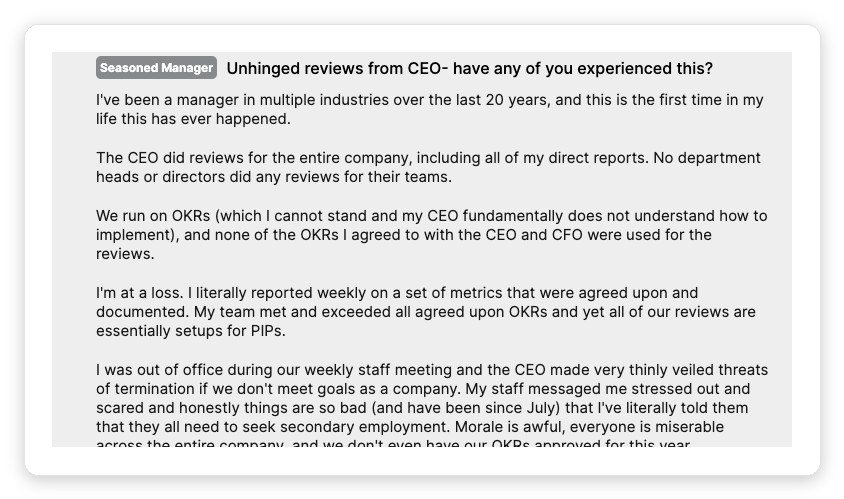
“My team met and exceeded all agreed upon OKRs and yet all of our reviews are essentially setups for PIPs.”
— r/managers, Seasoned Manager flair
Free for Upwork agencies
Set the OKR. We’ll move the reply rate.
If your quarterly goal is a predictable Upwork pipeline, GigRadar submits on-target proposals from our supervised Business Manager so your reply rate and cost-per-call actually change.
Get Your Free Agency Audit →If you run a small team, do this instead
Here is the unpopular part. A 2 to 20 person agency probably should not run a full OKR system. The ceremony (objectives, quarterly grading, 0.7 calibration) was invented for 500-person orgs where the CEO cannot see what anyone is doing.
You already have the alignment those systems are trying to manufacture. Everyone sits in the same Slack and sees the same pipeline. Your business also moves in weeks, not quarters: Connects, replies, calls booked, and cash all cycle in days.
So a quarterly Objective graded in month three tells you nothing you could not have caught in week two. Do this instead.
For most Upwork agencies that is reply rate or calls booked per week. One number, written on the wall.
Same cadence the big OKR systems credit for their wins, minus the paperwork.
When you outgrow one metric, that is when a light 2-OKR system starts to earn its keep.
Teams that run a real end-of-cycle retrospective complete 30 to 45% more of their goals the next cycle (OKRs Tool). The lesson is not “adopt OKRs.” It is “pick a number, review it weekly, and learn out loud.” That works at any size.
For more on choosing the right operating metrics, see our breakdowns of win rate, MRR, and how we structure sales pitches and case studies for agency growth.
OKR examples FAQ
What is a good OKR example?
One Objective plus measurable Key Results, like “Build a reliable outbound engine” measured by “increase outbound SQLs from 40 to 70” and “improve SQL-to-opportunity conversion from 25% to 40%.” Every Key Result has a baseline and a target.
How many Key Results should an OKR have?
Three to five. Fewer than three rarely captures success from enough angles, and more than five dilutes focus. Most guidance recommends 1 to 3 Objectives per level with 2 to 4 Key Results each.
What is the difference between an OKR and a KPI?
A KPI is a metric you monitor continuously. An OKR is a focused change you commit to for a cycle. A KPI can become a Key Result when you set a baseline, a target, and a deadline for moving it.
How do you grade OKRs?
Score each Key Result 0.0 to 1.0, then average for the Objective. For aspirational OKRs, 0.7 counts as success. Committed OKRs are expected to reach 1.0.
Do small agencies need OKRs?
Usually not the full system. A 2 to 20 person team is better served by one weekly number that predicts revenue (like reply rate or calls booked) reviewed every Monday, then graduating to a light OKR setup as it grows.