
The Best Sales Pitch Examples Do Not Pitch (and I Have the Reply-Rate Data to Prove It)
🎬 Sales Pitch Examples That Get Replies — the 2-minute walkthrough of the reply-rate data behind every example below. Watch on YouTube
The Short Version
- Gong analyzed 25 million cold emails: spending the body "pitching" your product cut reply rates by up to 57%. The winning move is to talk about the buyer's problem, not your résumé.
- We can prove this at a scale no sales blog can match. Across 133,872 outbound Upwork proposals in GigRadar's pipeline (Dec 2025 to Feb 2026), "I am writing to express" openers replied near 0%, while "I'd be happy to help get this done" replied at 20.4%.
- Below are 7 sales pitch examples you can copy, each tied to a measured reply-rate lever, plus a free Pitch Scorer that grades your draft against the patterns that actually convert.
- The opener is the whole pitch. Swapping your first three words moved reply rate from 3.6% to 11.6% in the same category.
Here is the most useful number I can give you about sales pitches: 57%. That is how much your reply rate drops when you spend the body of a cold message describing your product, platform, and ROI projections, according to Gong's analysis of 25 million cold emails.
Almost every "sales pitch example" you will find online does exactly that, leading with the seller. It opens with "I am writing to express my interest" and a wall of credentials.
I run GigRadar, where we watch what happens to real pitches at volume. An Upwork proposal is the purest A/B test of a sales pitch that exists: one buyer, one message, and a binary reply-or-ignore outcome.
We have the reply-rate data on 133,872 of them. It says the opposite of what most pitch guides teach.
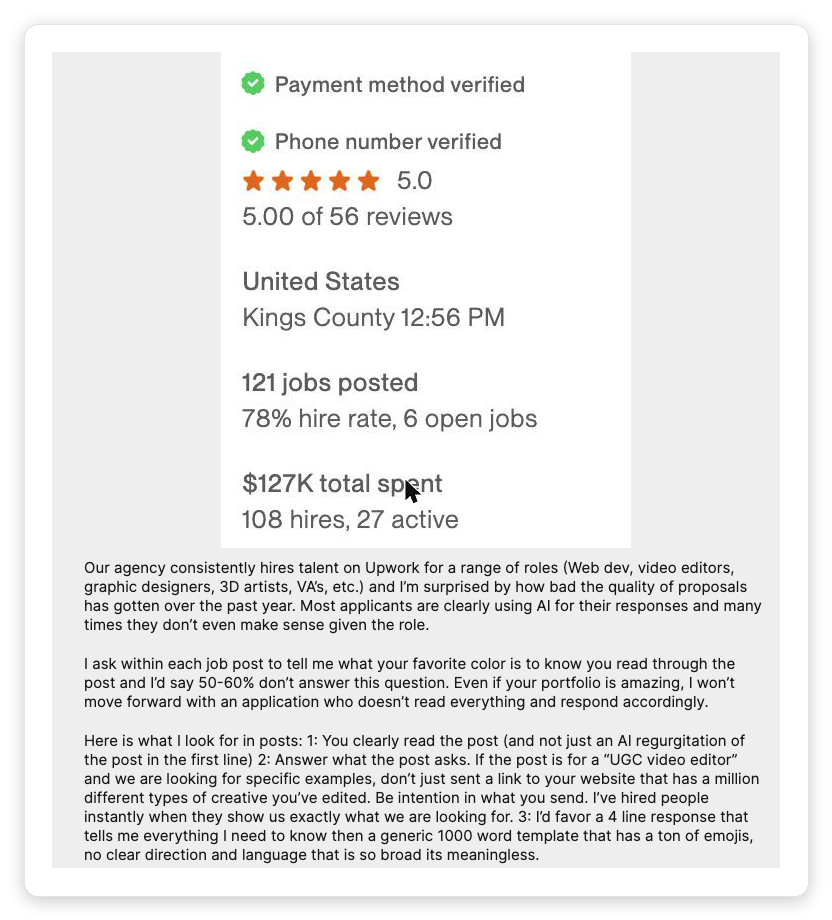
That client said the quiet part out loud: "I'd favor a 4-line response that tells me everything I need to know over a generic 1000-word template." Length is not the pitch. Relevance is.
Score Your Pitch Before You Send It
Before the examples, grade your current pitch. The seven checks below are the levers we found in the data, each one weighted by how much it actually moved reply rate.
Tick the ones your pitch already does. The scorer tells you which reply-rate tier it belongs in.
Interactive Tool
The Sales Pitch Scorer
Seven data-backed checks. Tick what your pitch does, then score it.
Why Most Sales Pitch Examples Fail the Moment You Copy Them
The generic pitch template is built for the seller's comfort, not the buyer's attention. It front-loads your story because that is what feels safe to write.
The data is brutal about it. We bucketed the first sentence of all 133,872 proposals into archetypes and measured reply rate for each.
The "formal open" ("I am writing to express my interest") replied at essentially 0%. Every one of those went straight to the bin.
| Opening line archetype | Reply rate |
|---|---|
| "I'd be happy to help get this done for you" (n=270) | 20.4% |
| Video offer: "Can I send a quick Loom with ideas?" | 14.9% |
| Specific proof: "I just wrapped a similar project for X" | 11.5% |
| Offer-help: "I can deliver / I can help with..." | 10.4% |
| Bare greeting: just "Hi there," | 7.3% |
| "Not a bot / non-ChatGPT proposal" disclaimer (n=390) | 5.9% |
| Formal open: "I am writing to express..." (n=29) | ~0% |
Source: GigRadar pipeline data, 133,872 outbound proposals, Dec 2025 to Feb 2026. Reply = the client opened a chat or assigned the proposal to a hiring room.
Look at the "not a bot" line: telling a client "this is not a ChatGPT proposal" replied at 5.9%, below the bare-greeting baseline. The disclaimer makes them assume you are a bot.
This is the same pattern Gong found in cold email and the same pattern that drags most sellers below quota (only about 24% exceed their target in a given year). The pitch fails because it is about the wrong person.
Independent cold-email research agrees on the shape. Belkins found messages of six to eight sentences and under 200 words reply best, while emails over 600 words fall to roughly 4%.
Even formal RFPs, the most effort-heavy pitch of all, win only about 39% of the time on average, per Loopio's benchmarks. Brevity and relevance beat volume everywhere.
The 4 Sales Pitch Types Every Agency Actually Uses
"Sales pitch" is not one thing. Agencies run four, each with a different job, and the best example for each looks different.
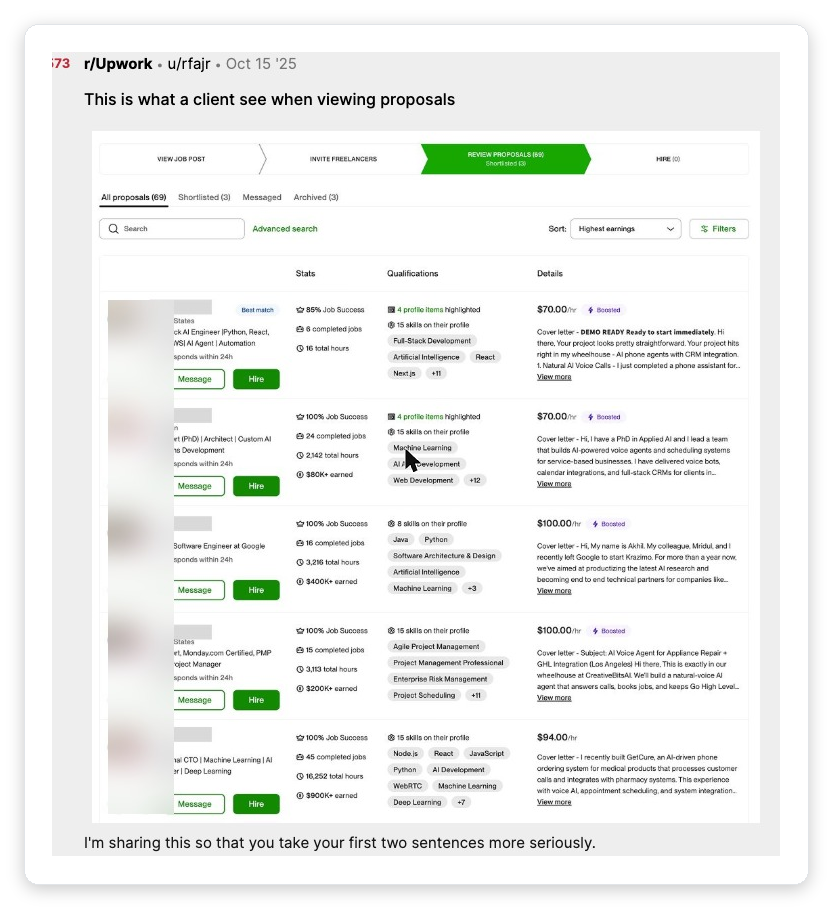
That screenshot is why the opener matters more than anything else. The buyer never reaches paragraph two of a pitch that wasted paragraph one.
7 Sales Pitch Examples That Get Replies (With the Data Behind Each)
Each example below is tied to a measured lever and is deliberately short. Copy any of them and swap in your specifics.
1. The problem-first opener (cold email or proposal)
This is the PAS framework (problem, agitate, solution) compressed into three lines. It opens on their pain, not your bio.
2. The video-offer opener (the highest-leverage move we found)
Offering a short Loom replied at roughly twice the platform median. It is low-friction for the buyer and proves effort.
3. The specific-proof one-liner
An 18 to 40 word pitch that names one concrete result outperforms a 400-word résumé. Confidence plus proof, nothing else.
4. The one-sentence positioning pitch
Your one-sentence pitch should make a stranger understand the value with zero context, per single-sentence pitch research. It is also the line you reuse when you outsource sales and need a rep to nail your positioning in one breath.
5. The 30-second elevator pitch (WOW, HOW, NOW)
Treat the elevator pitch as a movie trailer, not a biography. The WOW-HOW-NOW structure is built to spark a follow-up question.
6. The empathy plus soft-close message
"I understand the pain of..." lifted reply rate, and a soft "Any questions?" close beat a hard "Let's start tomorrow." Empathy opens, low pressure closes.
7. The backed confident-fit claim
"I'm a perfect fit" works only when proof follows in the same breath. A bare boast tanks; a backed one lifts.
The course lesson below breaks down why the opener does most of the work in any of these.
🎥 From GigRadar's Agency Success Course: Cover Letter Openers.
Winning vs Losing: The Same Pitch, Two Outcomes
The clearest way to see the pattern is to put a pitch that got a reply next to one that did not, from the same category and the same length band. Both are real, anonymized.
"Most projects fail not because of code, but because architecture is guessed instead of designed. I'll own the Drupal-to-React migration. Any EHR constraints for GraphQL? If you want something that survives real users, not just a sprint demo, let's talk."
"I'm skilled at leveraging AI tools to rapidly generate full multipage websites. My recent project, Notesight, is a prime example. It leverages artificial intelligence to provide smart suggestions, automate organization, and elevate the overall experience..."
The winner opens on the client's risk and asks a sharp question. The loser opens on its own portfolio and never mentions the client's project at all.
Hand-written pitches beat GPT-4o-generated ones by 17% on reply rate in our data, because the model writes fluent, generic, seller-centric copy. A human writes the one sentence that proves they read the brief.
The Opener Is the Whole Pitch (Your First Two Sentences)
If you change one thing this week, change your first sentence. The leverage there is enormous.
In the same category, swapping the first three words from "Hi, I noticed" to "Hi, I just" moved reply rate from 3.6% to 11.6%. Opening with a question, instead of a statement, was the single biggest behavioral gap between top-quartile and bottom-quartile senders (12.9% vs 3.8% reply).
This is why authority claims need backing. The phrase "top 1%" replied at 15.9% when the profile actually showed it, and 4.85% when it did not, because the buyer checks.
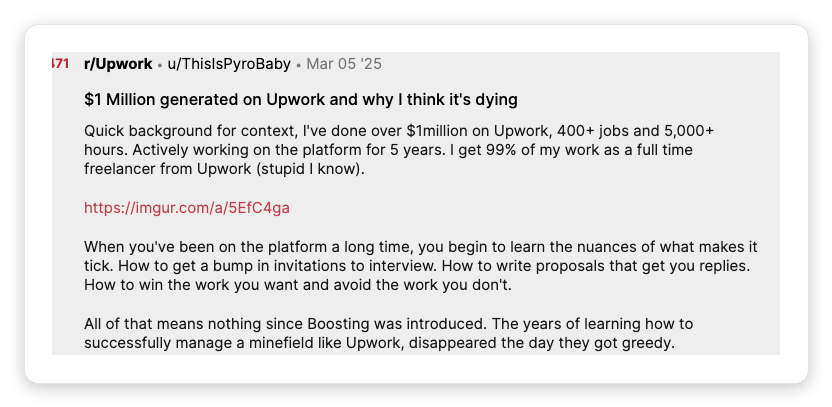
🎥 From GigRadar's Agency Success Course: Sell Yourself First.
The 5 Pitch Frameworks Worth Actually Knowing
You do not need a framework library. You need five, and you need to know which job each one does.
| Framework | Shape | Best for |
|---|---|---|
| PAS | Problem, agitate, solution | Cold email, proposals |
| Before-After-Bridge | Current pain, future state, your bridge | Landing pages, follow-ups |
| SPIN | Situation, problem, implication, need-payoff | Discovery calls |
| WOW-HOW-NOW | Hook, method, proof | Elevator pitch |
| Value proposition | Who you help, what changes, how | One-sentence pitch |
Notice that every one of them starts on the buyer's side, and none open with the seller's credentials. That is not a coincidence, it is the whole point.
Free for Upwork agencies
Your best pitch, sent to the right jobs, at scale
GigRadar operates a real Upwork Business Manager account that submits proposals on your agency's behalf, under human review, using the reply-rate patterns above. Your own account is never touched.
Get Your Free Agency Audit →Test Your Pitch Like an A/B Experiment, Not a One-Off
The senders who win do not write one perfect pitch. They run small, fast tests and let the reply rate decide.
Keep the body identical. Change only the first sentence: a question vs a statement, a problem vs a credential.
Reply rate stabilizes after roughly 50 sends. Below that, you are reading noise.
Then test the next variable: the close, the proof point, the length. One change at a time.
Run new pitches through the Pitch Scorer above before they go out, so you never ship a bin-bound opener by accident.
This is exactly the loop we run inside GigRadar, treating each agency's outbound as a live experiment that sends tested pitches through our Business Manager and feeds reply data back into the next batch. The agencies that grow fastest are the ones who stopped guessing.
If you want the longer playbook on the proposal side specifically, our guide to Upwork proposal templates that convert has 12 fill-in-the-blank examples. For the channel strategy around it, see our outbound sales strategy for agencies, why founder-led sales works until it doesn't, and how the best teams package proof in their case study examples.
The takeaway is simple, and the data backs every word of it: stop pitching yourself. Open on their problem, prove one specific thing, make one easy ask, and let the reply rate tell you the rest.