
Project Management Agency on Upwork: Bill $180/Hr (4 Archetypes). The 2-minute walkthrough of the PM-agency rate tiers, archetypes, and bid-window data. Watch on YouTube.
TL;DR
- The Upwork project management market is bigger than most agencies realise. Over 5,195 active hourly PM jobs and 2,175 fixed-price posts at any moment, tagged with the same "Project Management" skill chip.
- The four archetypes that actually win. Creative Ops, Dev/Tech PM, Marketing Campaign PM, and Fractional COO. Each have wildly different rate ceilings ($25–$400/hr). Picking the wrong one kills your margins.
- Upwork's published guidance puts senior PMs at $100–$150+/hr; PMO freelancers in the US list at $180/hr right now. If your agency is billing $40 blended, you're competing in the wrong tier.
- The "I don't need a PM, just a developer" objection isn't an objection. It's a positioning failure. Two reframes (the coordination-tax math + the continuity insurance) close 80% of the resistance.
- The bid window matters more than the proposal: Admin Support PM jobs reply at 15.38% on weekends vs 7.44% on weekdays. And that's our GigRadar pipeline data, not a hunch.
Most teams running a project management agency on Upwork are bidding like they're freelancers who happened to hire two people.
They send the same proposals as solo PMs and quote the same rates. They lose to the same objection ("I don't need a PM, I need a developer") every Tuesday.
Then they wonder why their close rate hovers at 5% while design-led agencies on the same platform close at 17%.
The fix isn't more proposals. It's picking the right archetype, charging the rate that archetype unlocks, and learning to defuse the two objections that account for most lost deals.
This is the vertical playbook for PM agencies, built from live Upwork PM job data, GigRadar's pipeline of 133,872 outbound proposals, and lessons from one specific course module that nobody outside our paid Agency Success cohort has seen.
The Upwork PM market is bigger than agencies realise
Search "project management" on Upwork right now and the filter sidebar shows 5,195 hourly jobs and 2,175 fixed-price jobs. Over 7,300 active posts tagged with the Project Management skill.
That's just one snapshot, and Upwork only surfaces the last 30 days. The annual flow is multiples of that.
The catch: "Project Management" is a chip clients add to almost any role with coordination in it. Post titles are wild: Operations Manager, Virtual Assistant & Project Coordinator, Interior Design PM, SaaS Operations Manager, Creative Director's right-hand.
All compete for the same skill-tag visibility, but each comes with a different rate ceiling and buyer profile.
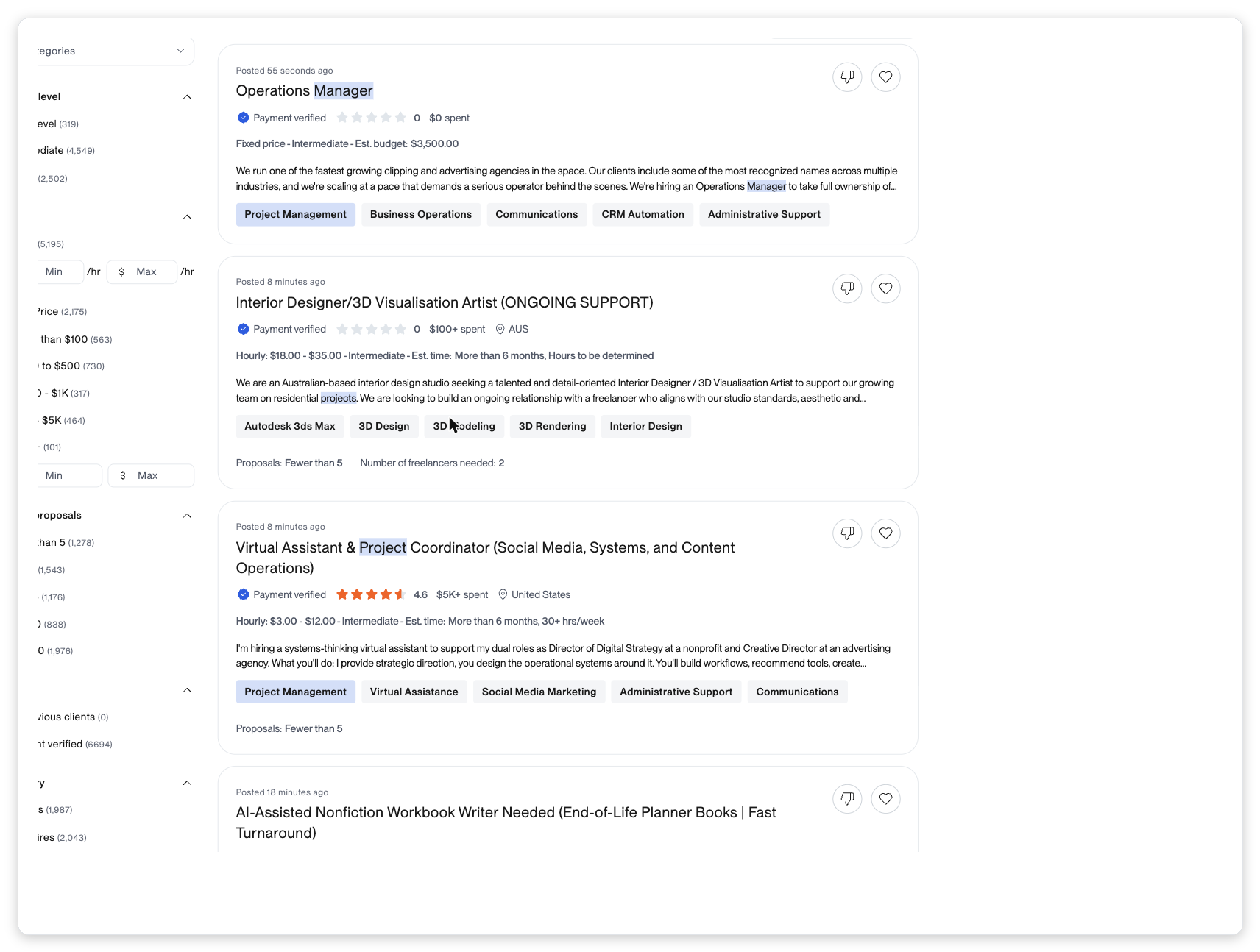
For a PM-focused agency, the spread is the opportunity. A coordinator at $5/hr and a fractional COO at $200/hr are both "project management" to the Upwork algorithm.
Where you position decides whether you're competing against Manila or against McKinsey.
Pick your archetype before you pick your rate
There are four PM-agency archetypes that work on Upwork. Each demands a different proposal posture, a different pricing model, and a different referral path.
Pretending you can do all four is the "we're full-service" trap. It's why generalist agencies bill $40 blended while specialists bill $120.
Creative Operations / Design Ops
You run the production traffic for boutique design, branding, content, or marketing agencies. Your client's bottleneck is intake chaos, missed deadlines, and creative directors interrupted by status questions.
Dev / Technical PM (Scrum Master as a Service)
You shepherd remote dev pods through sprints (standups, backlog grooming, sprint planning, retros). Your edge is that you actually understand Jira boards and can call a senior dev's bluff on a "two-day" estimate.
Marketing Campaign PM
You orchestrate campaigns across SEO writers, paid-ads buyers, designers, and the lifecycle team. Your value is the calendar and the QA gate: nothing ships until you've checked the UTM, the copy, and the brief alignment.
Fractional COO / Ops-as-a-Service
You're a part-time operations executive, not a PM. You design operating systems, set OKRs, build hiring rubrics, and run leadership 1:1s.
The PM work is delivered by your team underneath you; you bill for the strategic layer.
What you can actually charge. By tier, with sources
Upwork's own freelance-PM career guide publishes the rate bands. Most agencies are billing below them because they price against the global supply (Manila, Karachi, Lagos) instead of against the demand they're qualified for.
| Tier | Global supply | Onshore premium | Best buyer |
|---|---|---|---|
| Junior PM Coordinator | $10–$25/hr | $25–$45/hr | Solopreneur with chaotic Notion |
| Mid Project Manager | $25–$60/hr | $60–$100/hr | Boutique agency with 5–15 contractors |
| Senior PM / Program Manager | $50–$100/hr | $90–$200/hr | SaaS startup launching a product |
| Fractional COO | $80–$180/hr | $150–$400/hr | $500K–$2M founder at scale |
Sources: Upwork: Freelance PM Career Guide ($30–60 entry / $60–100 mid / $100–150+ senior); Upwork PMO Freelancers (US) at $180/hr; BLS on 6–7% PM-employment growth through 2033; PMI Earning Power Survey on the PMP salary premium; Glassdoor on US PM salary medians.
Every agency I audit that's stuck under $60/hr blended is competing against the global supply pool on price. The fix is never "raise the rate": it's "rewrite the proposal so a different buyer reads it".
A senior PM cover letter aimed at a SaaS founder doesn't mention "I'm proficient in Asana". It mentions "I've shipped 4 SaaS launches that hit dates within 5% of plan".
The PM Rate Calculator: figure out your real ceiling
Most agencies undercharge because they price off cost (their internal hourly) instead of off the value they unlock for the client. Run your real numbers through this and you'll see how much room you actually have.
Interactive Tool
PM Agency Rate Calculator
Compute the hourly rate that delivers your target take-home. And benchmark it against Upwork's published bands.
The "I don't need a PM" objection. And the two reframes that close it
This is the single most common objection PM agencies face on discovery calls. The client says some version of "I don't want a project manager, I just need a developer / designer / writer".
90% of agencies argue back. The 10% who close do something different.
In our Agency Success course, the Bypass "no agencies" lesson walks through the exact script for this. Here's the full breakdown:
🎥 From GigRadar's Agency Success Course: "Bypass no agencies" lesson, on disarming the four most common agency objections on Upwork.
Reframe 1. The coordination tax math
Your client is paying a developer $70/hr. That developer spends 10 hours a week on coordination work (chasing the designer, clarifying requirements, writing status updates, sitting in standup).
That's $700/week of developer time spent doing what a $60/hr PM does better.
The pitch isn't "you need a PM". It's this:
"Your developer's coordination time is costing you $36K a year. A PM at $60/hr blended would do that work in half the time and free the developer for actual coding."
"The net change isn't an added cost. It's reclaimed margin."
Reframe 2. Continuity insurance
"What's going to happen if your freelancer gets sick, gets the flu, or just gets a headache after a long alcohol night? He's not going to deliver, but we have the whole team."
Bypass "no agencies" lesson, GigRadar Agency Success Course
Most founders have been burned by a single freelancer who disappeared mid-project. Frame the agency as the continuity layer: one PM stays the same; the executors behind them can be swapped.
The client gets one point of contact, one accountable party, and one set of reviews they can leave on Upwork, Clutch, and Trustpilot.
The bid window matters more than the proposal
This is the part most PM-agency playbooks miss. Two things move reply rate by 50–100%, and they're both about when you bid, not what you write.
Our cover-letter analysis pulled 59,339 fixed-price proposals from GigRadar's pipeline (Jan–Feb 2026, full timestamp chain). The reply rate varies wildly by Upwork category and by day of week:
| Upwork category (where PM jobs sit) | Weekday reply | Weekend reply | Lift |
|---|---|---|---|
| Admin Support (VA-PM, coordinators) | 7.44% | 15.38% | +7.94pp |
| Accounting & Consulting (Fractional COO) | 7.36% | 11.50% | +4.14pp |
| Sales & Marketing (Campaign PM) | 9.11% | 12.21% | +3.10pp |
| Web/Mobile/SW Dev (Tech PM, Scrum) | 5.09% | 8.48% | +3.39pp |
| Design & Creative (Creative Ops) | 7.66% | 9.63% | +1.97pp |
Source: GigRadar pipeline data, Jan–Feb 2026. n=59,339 fixed-price proposals with full timestamp chain.
If you run a VA-PM or coordinator agency, weekends double your reply rate. Most agencies turn off their bid scanner on Saturday. Don't.
The 5-minute cliff
The other lever is speed. Reply rate drops sharply at the 5-minute mark after a job is posted: from 9% on jobs bid in the first 4 minutes to 6.9% from minute 5 to minute 6.
Every 30 seconds past 4 minutes costs ~1 percentage point of reply rate.
Manual bidding can't compete with this. Even three PMs on rotation can't watch the feed continuously.
This is exactly the problem we built GigRadar to solve: a scanner that catches the job within seconds, drafts the cover letter using your templates, and submits through our managed business manager so your team isn't tab-switching all day.
Contract structure: the fixed → hourly → retainer escalation
The biggest pricing mistake PM agencies make is locking in hourly from day one. Hourly invites client micro-management ("why is this taking 6 hours?") and caps your margin.
The successful pattern is a three-phase escalation:
A two-week paid pilot: audit current workflows, interview stakeholders, deliver a written ops diagnosis with prioritised fixes. Outcome-priced. This converts at 60–70% close because it's a low-commitment ask.
Set up the workflows you diagnosed: build the Asana templates, write the SOPs, train the existing team, run the first sprint cycle. Capped at 20 hours/week so it's predictable, and the client sees your value land in real-time.
After implementation, transition to a flat monthly retainer with a weekly hour cap. The client is bought-in, the workflows are running, and you can predict revenue.
This is where PM agencies actually scale: recurring revenue from 8–15 retainer clients beats the project-to-project hamster wheel every time.
The tool stack. What to specialise in, what to know
Tool specialisation is the cheapest positioning move a PM agency can make. Five tools dominate Upwork PM job posts; pick one to own, learn two adjacents, ignore the rest.
Asana
Default for creative ops, marketing teams, and boutique agencies; easy to demo. Asana implementation projects price $2K–$8K fixed, making this the best entry point for new agencies.
Monday.com
Marketing/ops dominant with heavy automation features. Higher-ticket clients (Monday's pricing pushes out solopreneurs) makes it strong for campaign PM positioning.
ClickUp
Startups and remote-first teams favor it as an all-in-one (tasks + docs + dashboards). Largest growth surface: Upwork posts for "ClickUp expert" doubled in 2025.
Notion
The fractional-COO operating-system layer. Sell as "Notion operating system build" for agencies: recurring $5K–$12K projects with retainer attached.
Jira
Where the dev-PM money lives, with the highest rate ceiling ($120–$180/hr) because of the technical fluency premium. You need to actually understand sprint mechanics, not just "I've used it".
Free for Upwork agencies
Get 50–100 high-intent PM buyers a week, without watching the feed
GigRadar's scanner catches Upwork PM jobs the second they go live, drafts your cover letter from a tested template library, and submits through our managed business manager. Your account never moves; your team focuses on discovery calls and delivery, not tab-switching.
Get Your Free Agency Audit →The 7-day client kickoff workflow
Every Upwork PM-agency engagement that fails fails in the first 7 days. The client signs, you go quiet for a week to "get organised", and they start questioning the spend.
Run this instead:
Stakeholders, current pain points, top 3 outcomes for the next 30 days. Recording shared in the project workspace within 2 hours.
Project workspace live (Notion or ClickUp), team invited, kickoff doc + stakeholder map + top-30-days plan published.
30 minutes each, surfacing hidden friction, capacity constraints, and tool gripes. You're building a private map of who actually delivers.
Pick the most painful workflow gap from kickoff + 1:1s and fix it (standardise the brief template, set up the weekly status report cadence, or configure recurring sprint planning). Visible win by Friday EOW.
Published format: top 3 wins this week, top 3 risks next week, decisions needed from the client. This sets the rhythm for the entire engagement.
Written, dated, owners assigned, success metrics defined. Reviewed with the client in a 30-min sync; from this point on, every weekly status maps back to this plan.
Certifications: when they matter and when they don't
The PMP debate is exhausted in the freelance community, but for Upwork specifically the answer is binary:
- The client is mid-market or enterprise (procurement teams pattern-match on certifications)
- The PM role is replacing a salaried hire and HR is involved
- The Upwork job post explicitly requires "PMP" or "PMI-ACP" (filter trips on the keyword)
- The client is a solo founder, boutique agency, or Series-A startup (they pattern-match on portfolio)
- The work is creative ops, marketing PM, or fractional COO (operator credibility > methodology certs)
- You already have 2+ named case studies with measurable outcomes. Those outweigh PMP every time
For agencies starting out, skip the PMP unless you're chasing enterprise. Spend the $2K + 200 hours on building one portfolio case study with public client testimony instead.
Strong cover letters and case studies consistently outperform credentials on Upwork in our cover-letter dataset.
Common mistakes that kill PM-agency margins on Upwork
- Pricing against the global supply pool. If you're a US/EU PM agency competing with Karachi at $15/hr, you've already lost. Position against onshore demand only.
- Generalist positioning. "We do all PM work" reads as "we do nothing specific". Pick one archetype, one vertical, one tool.
- Hourly-only contracts. Hourly caps your margin at "hours × rate". Retainers and fixed-price discovery uncap it.
- Selling PM as a separate line item. Bundle PM with delivery. The client sees "managed delivery at $X/hr blended", not "$60 PM + $80 dev itemised". Itemising invites the "we'll cut the PM" objection.
- Manual bidding. The 5-minute reply cliff is real. If you're bidding 3 hours after the post drops, you're already in the 4% reply bucket. Automation isn't optional past a certain volume.
- Skipping Saturday bidding. Admin-Support PM jobs reply at 15.38% on weekends. That's a free 2× lift most agencies leave on the table.
- Treating "I don't need a PM" as a no. It's a positioning failure on your end, not a rejection. The coordination-tax math + continuity insurance reframes close most of them.
The realistic 12-month roadmap for a new project management agency on Upwork
Most new PM agencies overestimate month-1 and underestimate month-9. Here's what the actual revenue ramp looks like for an agency that picks one archetype, one tool, and bids consistently:
| Months | Focus | Realistic MRR | Active retainers |
|---|---|---|---|
| Months 1–3 | Pilot offers, $1.5K–$3K discovery projects, building first 2 case studies | $3K–$8K | 0–1 |
| Months 4–6 | Converting pilots to retainers, raising rates, second PM hire | $10K–$20K | 2–4 |
| Months 7–9 | Specialising in one vertical, automating bid scanning, productising the kickoff workflow | $25K–$45K | 5–8 |
| Months 10–12 | Owner moves to fractional-COO-tier work, team handles delivery, referral pipeline opens | $45K–$80K | 8–14 |
The agencies that don't hit month-9 numbers are almost always the ones who couldn't pick a vertical. If you're 6 months in and still pitching "we do all PM work", that's the constraint, not Upwork's algorithm or the market.
The take-home checklist
If you read nothing else, do these seven things this week:
- ✓Pick ONE archetype (Creative Ops, Dev PM, Marketing PM, or Fractional COO). Rewrite your Upwork profile headline to match within 24 hours.
- ✓Run your numbers through the rate calculator above. If you're priced "Under-priced" or "Over the ceiling", fix it this week.
- ✓Pick ONE tool to be world-class at (Asana, Monday, ClickUp, Notion, or Jira). Drop the others from your profile bullets.
- ✓Build a 2-week fixed-price discovery offer ($1.5K–$5K) and pin it to your profile. This becomes your top-of-funnel.
- ✓Memorise the coordination-tax math reframe. Use it on the next "I don't need a PM" objection.
- ✓Turn on weekend bidding. Your reply rate will climb within 30 days.
- ✓Automate your bidding. Manual can't beat the 5-minute cliff past a certain volume: book a GigRadar audit if you want to see how our scanner handles PM-tagged jobs specifically.
The PM-agency vertical on Upwork rewards specialisation more than almost any other category. Generalists compete against the global supply pool on price; specialists compete against onshore demand on outcome.
The gap between those two positions is the difference between billing $40 and billing $180.
For the proposal mechanics that make those bids actually land, the 12 fill-in-the-blank proposal templates are calibrated to per-category recipes from the same dataset above.
For the broader agency-scaling pivot, our freelancer-to-agency playbook covers the operational layer. And if you're thinking through whether to hire an internal PM vs operate as a PM agency, the Upwork PM hiring guide is the sibling read.