
🎬 BANT Qualification: Why It Fails on Upwork (Real Data) — a two-minute walkthrough of why Budget and Authority invert on a bidding marketplace, and how to reweight the four letters using 133,872 proposals of reply-rate data. Watch on YouTube
TL;DR
- Clients who have spent $500k+ on Upwork reply to 3.85% of proposals. Clients who have spent under $1,000 reply to 8.15%. Budget, the first letter of BANT, points the wrong way here.
- Clients rated 4.8+ reply at 6.51%. Clients rated under 3.5 reply at 13.11%. The buyer everyone qualifies for is the buyer everyone is already bidding against.
- Need and Timeline survive the inversion. A 13 to 16 word job title replies at 9.43%, and a proposal sent 4 to 5 minutes after the post goes live replies at 8.99%.
- Every number here comes from 133,872 outbound proposals in GigRadar's pipeline, December 2025 through February 2026. Baseline reply rate across that set is 7.45%.
- The free scorecard below turns the four letters into one predicted reply rate and one cost per reply, using the visible fields on any Upwork job post.
On Upwork, the client with the biggest budget replies to fewer than half as many proposals as the client with almost no budget at all.
We measured it across 133,872 outbound proposals sent from GigRadar's pipeline between December 2025 and February 2026. Clients with $500k+ in lifetime spend replied to 3.85% of bids.
Clients who had spent between $1 and $1,000 replied to 8.15%.
That single pair of numbers breaks BANT qualification as it is normally taught. Budget is supposed to be the first filter you apply and the strongest signal you have, and on a bidding marketplace it is inverted.
BANT qualification assumes a discovery call you are never going to get
BANT is the sales qualification framework IBM formalised in the 1950s and 60s: Budget, Authority, Need, Timeline. You ask four questions on a discovery call, and the answers tell you whether the deal is real, which is still how Salesforce frames it today.
Every framework built to replace it inherits that assumption. MEDDIC, CHAMP and HubSpot's GPCT all require more conversation than BANT does, not less.
On Upwork you get no conversation. You get a job post, a client sidebar, and a decision that costs Connects at $0.15 each.
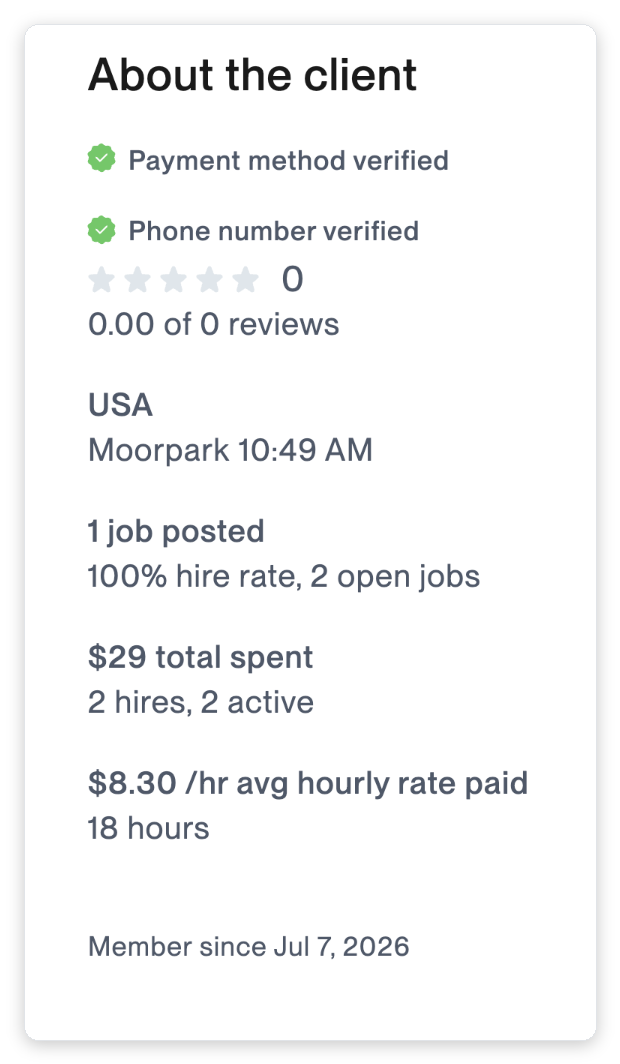
Look at what that panel is telling you. Two green verified badges at the top say Authority, and every row underneath says the same thing in different words: one job posted, $29 spent in total, $8.30 an hour.
Qualification and outreach happen in the same instant. That is the structural difference that makes the standard advice useless here, and it is why "BANT is outdated, use MEDDIC instead" is worse advice on this channel than the 1960s original.
Every qualification framework scores the buyer in isolation, as if your win rate were fixed. In a marketplace it is a function of how many other sellers ran the same checklist on the same lead ten seconds before you did, which makes every green flag a crowding flag too.
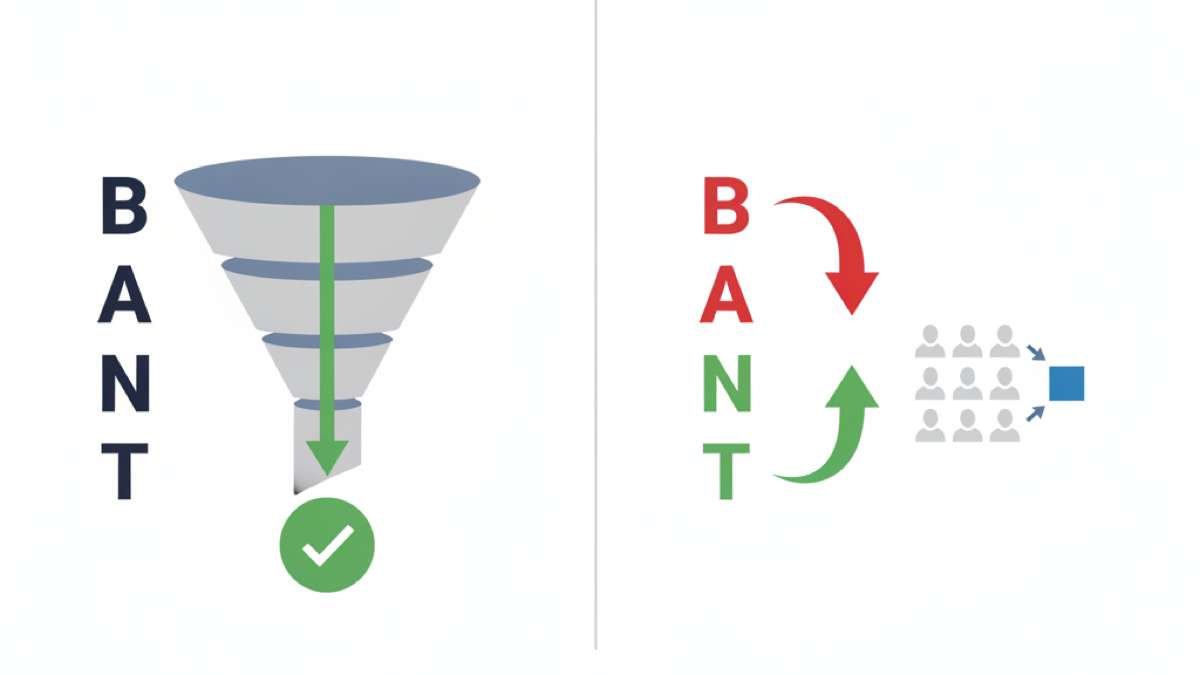
What each letter actually means when you are bidding, not calling
Notice what the right-hand column has in common. Every input is visible before you spend a single Connect, which means the whole framework collapses into a scoring problem rather than a discovery problem.
Score any Upwork job against BANT in twenty seconds
This is the framework as a working tool. Set the six fields to match the job post in front of you, and it returns a predicted reply rate and what a reply would cost you in Connects.
Free Tool
The Marketplace BANT Scorecard
Multipliers derived from 133,872 proposals, December 2025 to February 2026.
How it works: each field carries the observed reply rate for that band, expressed as a multiplier against the mean of its own table, and the multipliers are combined against the 7.45% baseline. It assumes the signals are independent, which they are not, so use it to rank two jobs against each other rather than as a forecast of any single outcome.
Budget: the clients with the most money reply the least
The standard Upwork coaching line is to filter for high spenders. Set a $10k minimum, screen out anyone without a track record, protect your Connects.
Run that filter against outcomes and it costs you replies at every step up the ladder.
Three things are happening at once. Clients past $500k in lifetime spend are professional buyers with established freelancer relationships, they post invite-only work, and their public posts draw enough bids that the marginal proposal is close to noise.
The practical consequence is that a spend floor is not a quality filter. It is a competition filter that you are applying in the wrong direction.
Freelancers already qualify on Budget signals. They just do it by instinct, one job at a time, with no way to check whether the instinct is right.
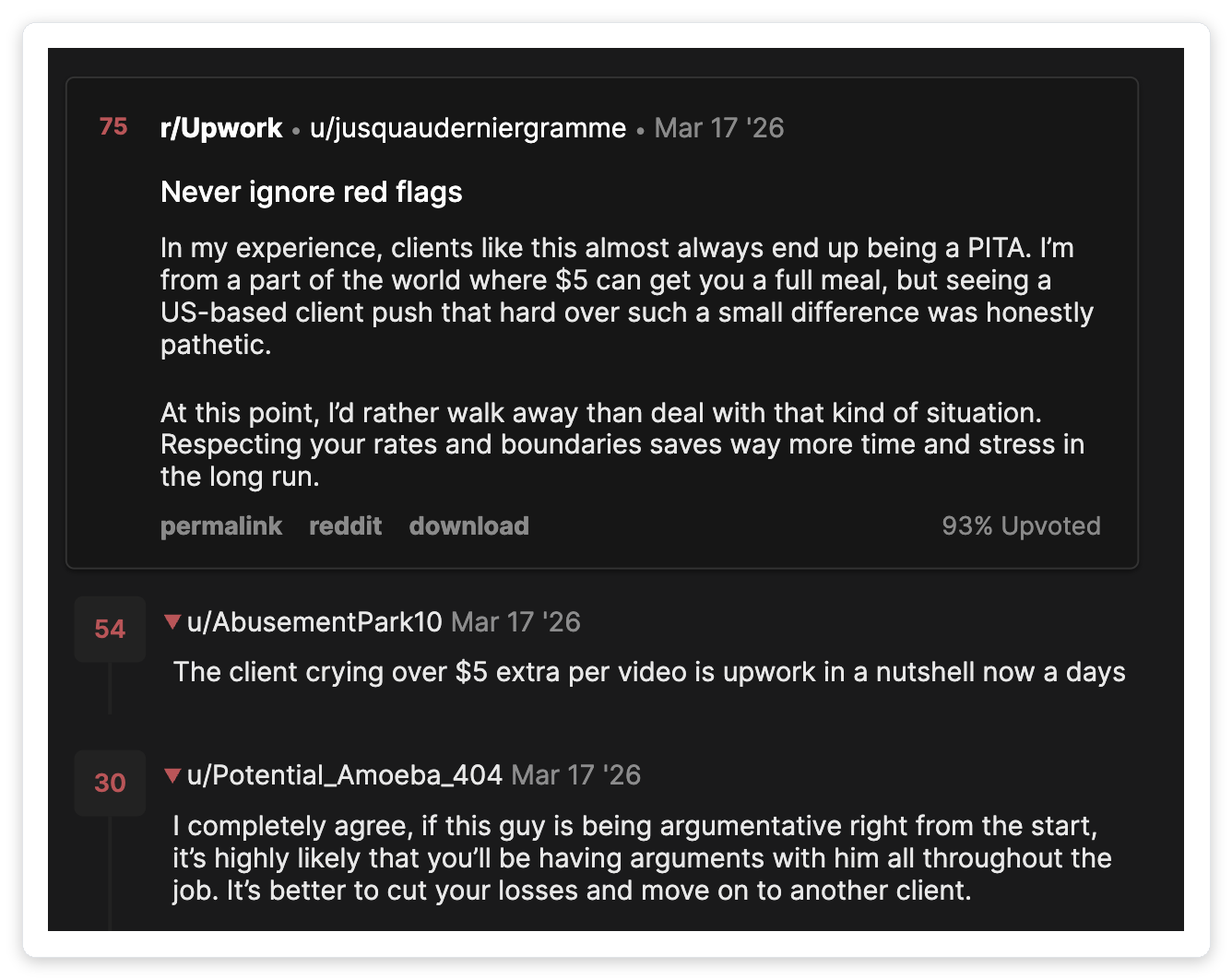
"In my experience, clients like this almost always end up being a PITA. […] At this point, I'd rather walk away than deal with that kind of situation."
u/jusquauderniergramme, post body in "Never ignore red flags", r/Upwork, 74 upvotes, 17 March 2026
That is Budget qualification done by hand, and the instinct is sound. What it cannot tell you is whether the rule generalises, which is the gap the numbers above close.
Authority: only one classic authority signal survives contact with the data
On a discovery call, Authority means finding the person who can sign. On Upwork it usually gets translated into "bid on established, well-reviewed clients", and that translation is where agencies lose the most money.
Sample: 91,056 proposals with client metadata attached, GigRadar pipeline, December 2025 to February 2026.
A verified billing method is the one classic Authority check that behaves the way the framework promises. It is also the only one Upwork treats as a hard payment precondition, since an unverified billing method blocks payment processing outright.
The star rating goes the other way, and it goes there hard. It is shown on the job post, which is exactly why every scanner on the platform filters on it.
Clients sitting below 3.5 stars reply at double the rate of top-rated clients. A client whose last freelancer left them a bad review has a hiring problem and is reading every proposal that arrives.
A high reply rate on low-rated clients is not the same as a high close rate or a pleasant contract. Those clients earned their reviews somehow.
Treat the signal as "this is where conversations are cheap", not "this is where good clients are". Keep your own screening for scope and payment behaviour exactly as strict as it was.
The "exactly one job posted" cohort is the worst on the platform at 5.83%, below even clients who have never posted anything. One post and no follow-through is the signature of a tire kicker, and it is the cheapest exclusion rule you can add to a scanner today.
Need: the job title is the only discovery call you get
Need is supposed to be uncovered by asking questions. You cannot ask, so the job description has to carry the entire weight, and it turns out it carries it well.
Moving from a 6 to 8 word title to a 13 to 16 word one is worth 2.6 percentage points on its own, and the full spread across title lengths is 4.8 points.
A client who writes "Shopify plus Toast marketing and growth specialist for an established coffee brand" has already done the thinking. A client who writes "Web developer" has not, and neither have the eighty other people bidding on it.
Words that move reply rate, in both directions
Sample: 59,339 proposals with the job title captured at bid time. Lift is measured against proposals in the same sample whose titles did not contain the word, which averages about 7.0%, not against the 7.45% global baseline.
"Urgent" is the strongest single word in the dataset, and it is also the only place where Need and Timeline collapse into the same signal. A client typing that word is telling you both that the problem is real and that they will read their inbox today.
The red rows are not a "never bid" list. They are a pricing list: a title naming a role plus a stack is a saturated auction, so bid it with your long-form proposal and your best proposal template, or do not bid it at all.
Timeline: the only BANT letter you fully control
Everyone reads T as the client's buying timeline. On Upwork the timeline that decides the outcome is yours, measured from the moment the post goes live to the moment your proposal lands.
Two separate things are visible in that shape. The first is a genuine first-mover effect that ends abruptly around the five minute mark, once five or six proposals have stacked up and yours stops being at the top of a short list.
The second is stranger and more useful. Reply rate climbs back to 8.07% at twelve to fifteen minutes, which is consistent with clients opening the inbox once when they post and again a quarter of an hour later.
Minutes five through ten is a valley that misses both reading windows. If your median send time sits at seven minutes, you are paying full price for the lowest-yield slot on the curve.
Either get under five minutes or deliberately aim for twelve to fifteen.
The size of the prize varies by category. IT and Networking gains 7.26 percentage points from bidding under five minutes instead of five to ten, Sales and Marketing gains 3.81, and Web, Mobile and Software Development gains only 2.10 because that category is saturated at every point on the clock.
Reweighting the four letters for a bidding marketplace
Put the measured effects side by side and BANT does not need replacing. It needs its weights rewritten, and two of its letters need their signs flipped.
Modern rewrites of the framework, from ZoomInfo's GTM version to Pipedrive's, still open on Budget and still assume a fixed win rate. Neither assumption holds when the same lead is being qualified by eighty other sellers at the same moment.
Spread is the gap between the best and worst observed band within each letter's table.
Ranked by measured spread, here is the order in which these checks actually deserve your attention. Most agencies have this list upside down.
Remove the rating floor from your scanner entirely. It is filtering out the highest-reply cohort on the platform.
The only lever on this list you control completely, and the only one that costs nothing but pipeline speed.
Weight long descriptive titles up, weight role-plus-stack titles down, and surface anything containing "urgent" first.
Replace the "$10k minimum spend" rule with a $1k to $25k target band and watch what happens to reply volume.
The one classic Authority check that holds. Most scanners already have it on, which is why it ranks lower than you would expect.
Narrow but free. Exclude the exactly-one-post cohort and prefer the 6 to 10 band.
Free for Upwork agencies
A scorecard only helps if something acts on it in under five minutes
GigRadar scans Upwork for jobs matching your scoring rules and submits proposals from our own Upwork Business Manager account, which your agency invites through Upwork's official invitation flow. Your freelancer accounts are never touched.
Get Your Free Agency Audit →The version you can act on this week
Three changes, in the order that costs least and returns most. None of them require new software.
Monday: measure your median send latency
Pull last week's proposals and compute minutes between job posted and proposal sent for each one.
If the median sits between 5 and 10 minutes, you are in the valley. That single number is worth more than any scanner change on this list.
Tuesday: delete two filters, add one
Delete the minimum-spend floor and the client-rating floor from your scanners.
Add one exclusion: clients whose posted-jobs count is exactly 1. Keep the verified-billing requirement exactly where it is.
Rest of the week: run both scanners side by side
Leave your old high-spend scanner running and put the new one next to it with the same Connect budget.
Compare replies per 100 Connects after two weeks, not replies per proposal. Connects are the scarce resource, so that is the ratio that decides.
The scorecard as a text block you can paste into your scanner notes
Where this framework breaks
Three honest limits, because a scorecard that claims to work everywhere is a scorecard nobody should trust.
Every number here measures whether a conversation started, not whether a contract closed or what it was worth. A low-rated client who replies fast may still be the contract you regret.
If your bottleneck is close rate rather than reply rate, fix the stage after this one first.
Whale clients also post shorter titles and attract more bids, so the spend effect and the title effect overlap. The scorecard multiplies them anyway, which is fine for ranking two jobs against each other and wrong if you read the output as a precise forecast.
The under-3.5-star cohort is 351 proposals and the "urgent" cohort is 258. Those are the two most quotable numbers in this article and also the two shakiest.
Treat them as strong hints worth testing against your own pipeline, not as settled facts.
What survives all three caveats is the direction of travel. Across 133,872 proposals, the signals that classic BANT qualification tells you to chase are the ones that cost you replies, and the two letters everyone treats as soft are the ones carrying the signal.
If you want the operational version of this without the theory, our guide on qualifying Upwork jobs in 60 seconds covers the manual read, and the Connects cost-per-hire calculator turns the reply rate above into a cost per signed client. For the CRM side of the same problem, our lead scoring template and the definition of a sales qualified lead are the pieces that sit on either side of this one.