
Sales Qualified Lead: Why Big Clients Reply Less: a 2-minute walkthrough of why the MQL-to-SQL machine fails small agencies, and how to qualify by observable buying behavior. Watch on YouTube
TL;DR
- A "sales qualified lead" is a definition your team agrees on, not a fact about the buyer. Most agencies inherit HubSpot's definition and quietly break their own pipeline with it.
- The average lead takes 84 days to reach a sales conversation, and only about 6% of MQLs ever become customers. The MQL stage is where small-agency pipelines go to die.
- BANT and MEDDIC are disqualification machines built for enterprise sales teams with too many leads. A 10-deals-a-month agency has the opposite problem and needs to qualify leads in, faster.
- The signals everyone treats as "high quality" invert in practice. In GigRadar's pipeline, clients who spent $500k+ reply at 3.85%; clients who spent $1k-5k reply at 8.15%.
- Score any lead against observable buying behavior with the free test below, then stop scoring and start sourcing pre-qualified leads.
Only about 6% of marketing qualified leads ever become customers, and the average one sits in your funnel for 84 days before a sales conversation even happens. Paddle and Implisit's pipeline study both land on those numbers.
For an agency that closes 10 deals a month, that is not a funnel. That is a waiting room you are paying rent on.
The problem is not that you are bad at qualifying. It is that you copied a definition of "sales qualified lead" built to protect a 30-person sales team from itself, and you do not have one of those.
This is what a sales qualified lead actually is, why the standard playbook works against you, and how to qualify by what a buyer does instead of what a lead score guesses.
Free Interactive Tool
The Sales-Qualified-Lead Reality Test
Check every signal this specific lead actually shows: the score weights observable behavior, not vibes. No email required.
Uncheck the signals this lead is missing. The score and verdict update live.
A "sales qualified lead" is a definition, not a fact
There is no universal test that stamps a lead as sales-qualified. There is only the line your marketing and sales functions agreed to draw, and the buyer never sees that line.
The stack most agencies inherit has four rungs. Each one is a handoff between two groups of people who do not fully trust each other.
| Stage | What it means | Who decides |
|---|---|---|
| MQL | Marketing Qualified Lead. Hit a behavior or score threshold (downloaded, attended, visited pricing). | Marketing |
| SAL | Sales Accepted Lead. Sales looks at the MQL and agrees it is worth a call. | Sales (accept) |
| SQL | Sales Qualified Lead. Sales has vetted fit, need, and readiness. It becomes a real opportunity. | Sales (qualify) |
| PQL | Product Qualified Lead. The buyer used the product and hit a value milestone. Behavior, not a form. | The product |
Notice what every rung except PQL has in common. It is a status one team assigns to describe a conversation that has not happened yet.
PQL is the only stage defined by what the buyer did, and it converts at 5 to 6 times the rate of a standard MQL, per Paddle. Behavior beats scoring: hold that thought.
The MQL-to-SQL handoff is where agency pipelines quietly die
Aggregate the public benchmarks and the funnel is brutal. Roughly 13% of leads become opportunities, and that transition takes about 84 days on average, according to Implisit's analysis of hundreds of pipelines.
Stack the stages and the leak compounds. Here is what the reported ranges look like across HubSpot, MarketJoy, Gartner-derived data, and Winning by Design.
| Transition | Typical rate | Source |
|---|---|---|
| Website visitor to contact | under 1% (2-5% when optimized) | HubSpot |
| Lead to MQL | 20-25% (benchmark ~22%) | MarketJoy 2024-25 |
| MQL to SQL / opportunity | ~13% avg (12-18% typical) | Implisit, MarketJoy |
| SQL to opportunity (narrow) | 10-12% (up to 59% SDR-sourced) | MarketJoy, TOPO/Gartner |
| Opportunity to closed-won | 6-9% avg (10-28% common) | MarketJoy, Winning by Design |
| MQL to customer (cumulative) | ~6% | Paddle |
Now add the labor. Moving one lead from MQL to SQL takes 8 touches by HubSpot's count, 16 by TOPO's, and 10.6 on the Bridge Group average.
An enterprise SDR does that all day because it is their entire job. You do it between delivering client work, invoicing, and hiring.
The 84-day nurture cadence that a RevOps team runs on autopilot is, for you, 84 days of leads going cold while you are heads-down on a deadline. That is why your sales pipeline stages should have fewer of them, not more.
If your MQL-to-SQL rate is in the low single digits, marketing is sending junk or sales is not acting. If it is above 50%, your MQL bar is so high you are only counting leads you already half-closed.
Practitioners have been saying this out loud for years. The recurring complaint in sales communities is that MQL is a number marketing reports to look busy, and the handoff is theater.
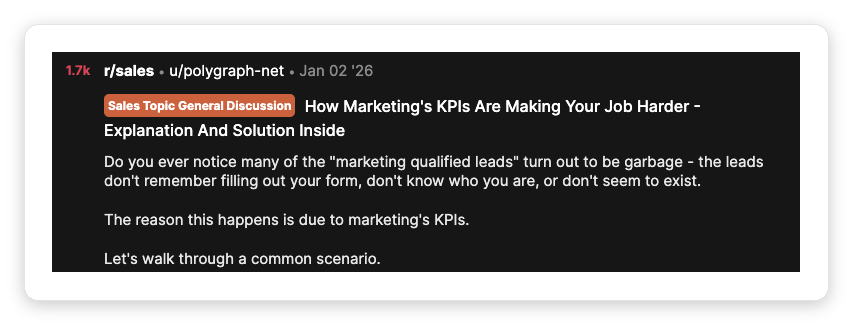
"Half our 'MQLs' were people who downloaded a template and never wanted to talk to sales. We spent a quarter chasing ghosts because a score said they were ready."
Paraphrased consensus from r/sales threads on lead quality
Enterprise qualification frameworks are disqualification machines
BANT, MEDDIC, CHAMP, and the rest were all built to solve one problem: too many leads and expensive reps who must not waste time on the wrong ones. They are filters for abundance.
Your bottleneck is the reverse: you do not have 400 leads to filter down. You have 20, and a MEDDIC checklist just hands you sophisticated reasons to talk yourself out of winnable ones.
| Framework | Checks | Built for | Agency fit |
|---|---|---|---|
| BANT | Budget, Authority, Need, Timeline | Fast transactional filtering (IBM origin) | Usable, but budget-first fires on clients who would pay once they trust you |
| MEDDIC | Metrics, Economic buyer, Decision criteria, Decision process, Identify pain, Champion | Six-figure committee sales | Overkill for a one-decision-maker project |
| CHAMP | Challenges, Authority, Money, Prioritization | Consultative, pain-led selling | Good fit: leads with challenge, not budget |
| GPCTBA/C&I | Goals, Plans, Challenges, Timeline, Budget, Authority + Consequences/Implications | Inbound at scale (HubSpot) | Too many fields for a 20-lead month |
| ANUM | Authority, Need, Urgency, Money | Authority-first triage | Lean and fast: start here if you must pick one |
Every one of these qualifies leads out. Your survival metric is the opposite: how fast you qualify the right ones in, before a competitor replies first.
Replace the qualify-out checklist with one qualify-in question: can I show this specific buyer a result in the first conversation? If yes, the framework fields are academic; if no, no framework will save the deal.
The signals you think mean "qualified" often predict the opposite
Every coaching playbook says the same thing: chase the big-budget, top-rated, enterprise buyer. We tested that assumption against real outcomes and it fell apart.
We looked at 91,056 outbound proposals from GigRadar's pipeline where the buyer's public Upwork stats were visible (January to February 2026). Reply rate is the north-star here and the top line in our sales KPIs, because on our platform a reply is the first observable proof a buyer engaged.
The replies live in the middle band. Clients who have spent $1k to $5k are past the tire-kicker stage but not yet drowning in 100 proposals per post.
The pattern holds across every "quality" signal we checked, and it inverts the conventional filter every time.
Read that middle box again. A 500-person company looks like the dream "qualified" account, yet it is the least responsive segment in the entire dataset: bureaucracy, slow procurement, and vendor-sourcing posts instead of real hires.
The one signal that does behave is payment verification. It is not about size or prestige: it is proof the buyer has actually paid once on this platform, which is behavior again.
Qualify by observable behavior, before the lead exists
Stated intent is cheap and misleading, but purchase history cannot be faked to please you. A buyer who is good at sounding ready will pass any discovery call, then vanish.
So move qualification upstream, off the sales call and into lead selection. Rank prospects on what you can see before you spend a single proposal or hour.
Without a specific ideal-client picture, every lead feels equally random and equally "maybe." The filter starts with knowing exactly who you convert.
Verified payment, spend band, hire history, and posting cadence are all observable before contact. They out-predict any answer a buyer gives on a call.
Mid-spend, solo or small-team, active buyer with 6 to 10 prior posts. Established enough to know what they want, not yet buried in their own pipeline.
A buyer with active intent in the last few days is a qualified lead by definition. Speed-to-first-reply becomes your real qualification KPI.
On a marketplace like Upwork this is literal. A relevant, well-funded job post from a payment-verified buyer is the sales qualified lead, with budget, need, and active intent all confirmed before you write a word.
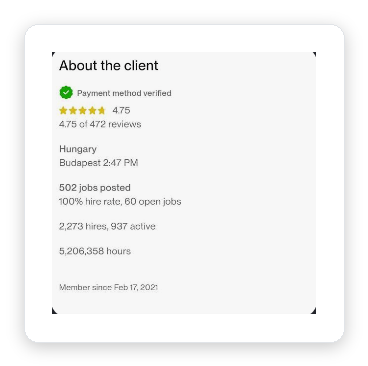
The work is not lead-scoring. It is job-selection, and there is a 60-second way to qualify an Upwork job before you spend a Connect on it.
Here is a walkthrough of doing exactly that research, from GigRadar's Agency Success course.
🎥 From GigRadar's Agency Success Course - "Can't find matching jobs?" on niche, market, and ICP research.
Free for Upwork agencies
Stop scoring leads. Start sourcing pre-qualified ones.
GigRadar surfaces payment-verified Upwork buyers that match your ICP, ranks them by real spend behavior, and submits your proposal from our supervised Business Manager. You bid only on leads that already qualified themselves.
Get Your Free Agency Audit →The two-state pipeline that actually works at agency scale
Once qualification moves upstream, the elaborate MQL / SAL / SQL ladder collapses. At your size you do not need five stages coordinating handoffs between people who are all you.
You need two states.
Someone with observable buying behavior exists: a posted job, a direct request, a verified buyer matching your ICP. No score and no nurture limbo, because either the behavior is there or it is not.
You are in a live conversation moving toward a proposal or a signed scope. The only metrics that matter here are sales velocity and whether you showed a result early.
No card sits in a column for 84 days. A lead is either an active buying signal you are responding to or it is not a lead yet, and that is the entire system.
The take-home qualification checklist
Run every new lead through this before you spend time on it. It is the same logic as the scorer at the top, in a form you can paste into your CRM or a sticky note.
- Has this buyer paid for this kind of work before? (verified spend or hire history)
- Does a defined scope already exist that I did not have to invent?
- Am I talking to the actual decision-maker?
- Is there active intent in the last 7 days?
- Is a budget range already indicated?
- Can I show a result in the first conversation?
Four or more yeses and it is a working lead; fewer than four and it is not sales-qualified yet. Go source one that is, rather than nurturing this one for a quarter.
Frequently asked questions about sales qualified leads
What is a sales qualified lead (SQL)?
A sales qualified lead is a prospect that your sales function has vetted as a real opportunity worth active pursuit, based on fit, need, and readiness to buy. Unlike an MQL, which is defined by marketing behavior, an SQL has cleared a sales-owned bar and typically becomes a pipeline opportunity.
What is the difference between an MQL and an SQL?
An MQL (marketing qualified lead) hit a marketing threshold like downloading content or visiting pricing, while an SQL has been accepted and qualified by sales as ready for a real conversation. Only about 13% of MQLs ever convert to SQL or opportunity stage.
What is a good MQL-to-SQL conversion rate?
Typical B2B MQL-to-SQL conversion runs around 13% on average, with a common band of 12-18%. Rates in the low single digits signal poor lead quality or slow sales follow-up; rates above 50% usually mean the MQL bar is set too high.
Which lead qualification framework is best for a small agency?
Lean frameworks like ANUM (Authority, Need, Urgency, Money) or CHAMP fit small agencies better than MEDDIC, which is built for six-figure committee sales. Better still, move most qualification upstream into lead selection using observable buying behavior.
How long does it take a lead to become sales-qualified?
Across hundreds of pipelines, the average lead-to-opportunity transition takes roughly 84 days. Sourcing leads that already show active buying intent is the fastest way to compress that timeline toward zero.
Do high-budget clients make better qualified leads?
Not necessarily: in GigRadar's pipeline data, buyers with $500k+ lifetime spend replied at 3.85%, while $1k-5k buyers replied at 8.15%. Very large or highly-rated buyers are often saturated with proposals, so mid-band buyers with active intent frequently convert better.