Discovery Call Questions: The 9 That Actually Close (2026) a two-minute walkthrough of the nine questions, the timing, and the data behind them. Watch on YouTube
We pulled 9,971 replied proposals out of GigRadar's pipeline and traced them all the way to a signed contract. 112 of them turned into a hire.
That is a 1.1% reply-to-hire conversion. Every agency owner I talk to obsesses over the number that gets them the reply, and almost none of them can tell me what happens on the call afterwards.
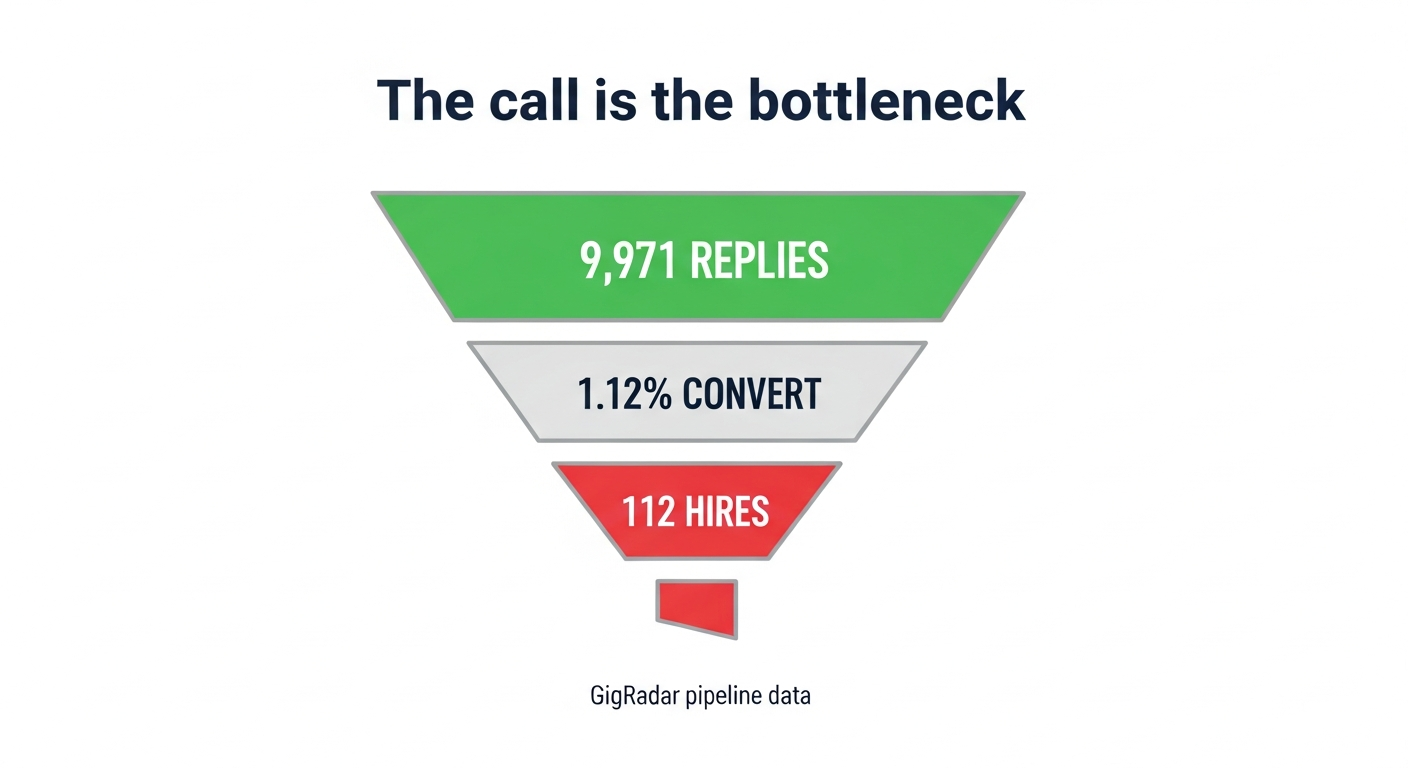
Your reply rate is not the bottleneck. The call is.
Reply rate is the metric the entire Upwork coaching industry optimizes, because it is the one you can move with a template. Hire rate is the one that pays rent.
The two are not the same skill, and our data says they are barely even correlated. Cover letters over 500 words replied at 11.4% and hired at 0% in our sample.
The gap is not evenly distributed. Reply-to-hire conversion in Writing was 5.6%, five times better than the 1.1% we measured in Web, Mobile and Software Development.
A developer with a 12% reply rate and a 1% close rate is running a lead-generation machine attached to a broken sales process. The fix is not another proposal template.
The pattern shows up in the same words every time on r/Upwork. Calls happen, scope goes out, nothing comes back.
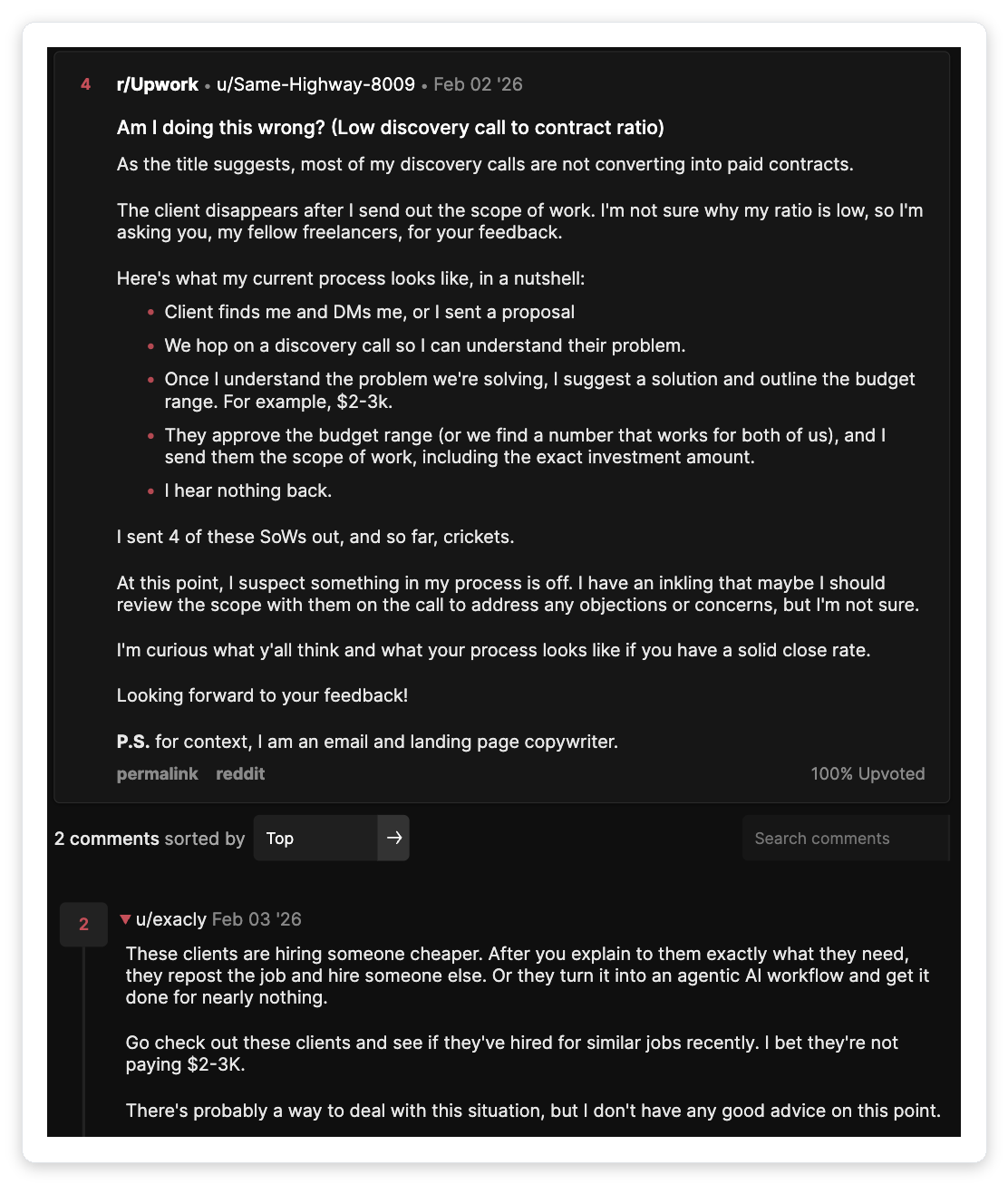
The thread debates the scope document. The scope document is not where the deal was lost.
Build your discovery call agenda
Before the theory, take the tool. It generates a timed agenda, a question budget and a talk-time target for the specific call you have booked this week.
Free Interactive Tool
Discovery Call Question Builder
Pick your call length, deal size and lead source. Get the exact agenda and questions to run.
The 11-to-14 question rule is a decade-old number nobody re-checked
Almost every article ranking for discovery call questions repeats the same two figures: ask 11 to 14 questions, keep a 43:57 talk-to-listen ratio.
Both come from Gong Labs research published nearly a decade ago: the question count from an analysis of 519,000 discovery calls, the ratio from Gong's talk-to-listen study, since rewritten with 2025 data. Both got printed on a cheat sheet that has been copy-pasted into every listicle since, including HubSpot's and Salesforce's.
Gong re-ran the study in 2025 across 326,000 calls. The findings moved, and almost nobody updated their blog post.
| Metric | The decade-old number everyone quotes | Gong's 2025 re-analysis |
|---|---|---|
| Questions asked | 11 to 14 is the sweet spot | Winners asked 15 to 16. Losers asked about 20. |
| Seller talk time | 43% is the golden ratio | Average is still 60%. Won deals 57%, lost deals 62%. |
| What actually separated performers | Not measured | Consistency. Low performers swung from 54% talk time on wins to 64% on losses. High performers stayed flat. |
Source: Gong Labs, 519,000 calls (2016 to 2017) and 326,000 calls (2025).
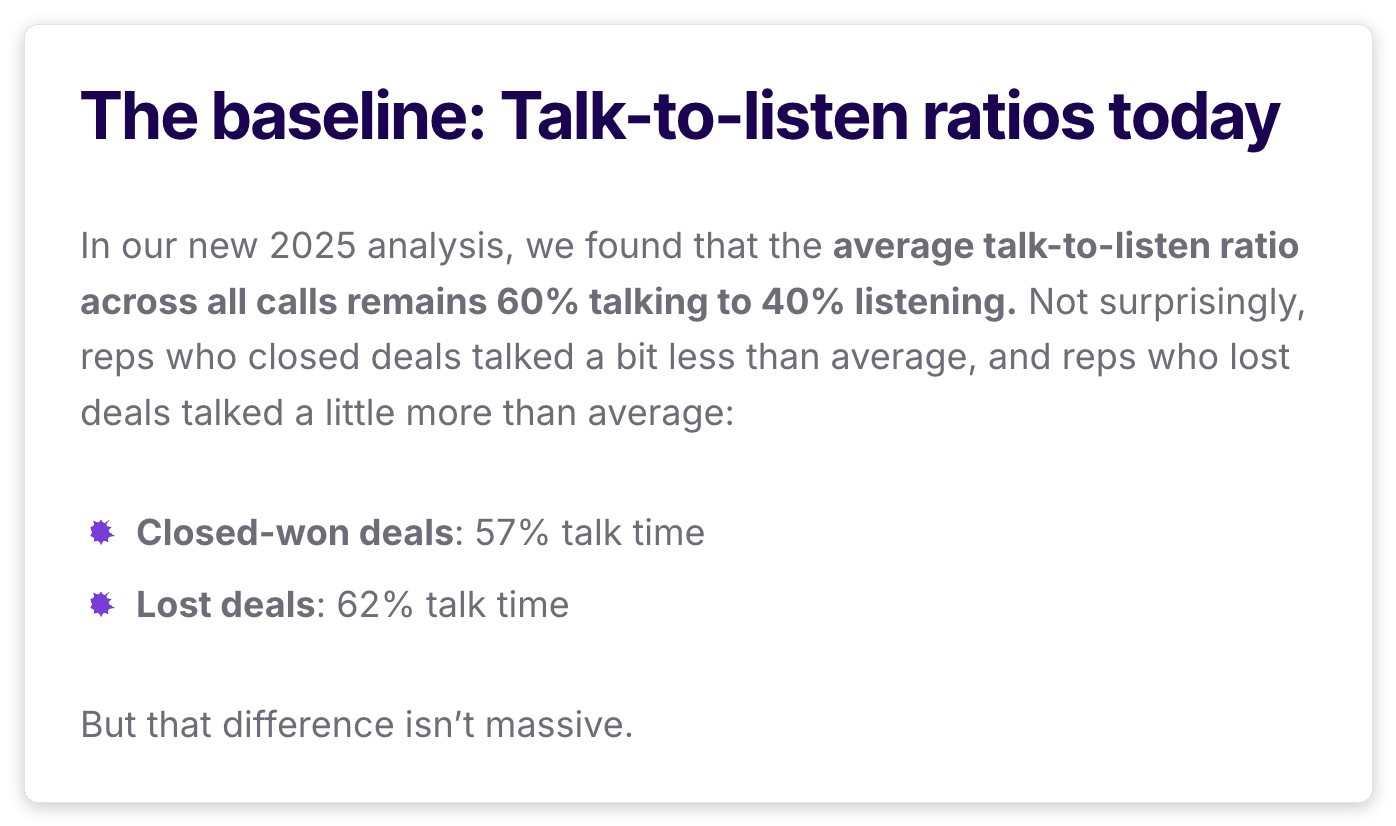
The gap between a won call and a lost call is five percentage points of talk time. That is not something a human can feel or manage in real time.
The variable that did separate the two groups was variance. Losers behaved differently on the calls that were slipping, which is exactly what happens when you improvise.
Consciously managing your talk ratio mid-call introduces the exact behaviour the data punishes. Write a fixed question set, run it on 30 calls, then compare win rates by question set instead of by ratio.
On Upwork you are not discovering anything. You are auditioning.
The classic discovery call assumes an unaware buyer you interrupted. Yours defined the problem, wrote a scope, set a budget range, read your proposal and put you on a 20-minute call.
They are running the same call with three to five other candidates that week, using Upwork's own messaging and video tools, and Uma now pre-screens some of those candidates with an AI instant interview before a human ever joins. Opening with "so tell me about your business" makes you the fourth person to ask it.
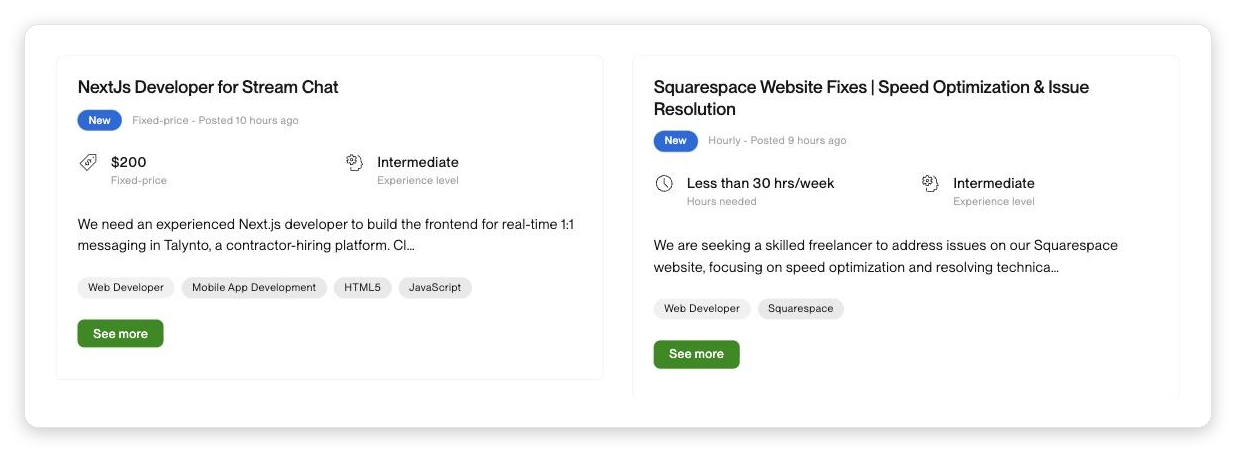
Everything you would normally spend the first ten minutes discovering is either in that post or absent from it on purpose. Reading it properly is worth more than any question you could ask about it live.
This is where the standard advice actively hurts you. The canonical lists, from Calendly's ten questions to Zoho's twenty, all assume a second meeting where the real proposal lands.
"Never pitch on the first call, always book a second" is enterprise advice priced for enterprise deals, where another meeting costs nothing against an $80,000 contract.
At $4,000 with a solo founder who is the decision maker, a second call is a three-to-seven-day gap in which somebody else names a price. Running full MEDDIC qualification on that deal burns more margin in call time than it removes in risk.
Fifteen minutes on the job post, their Upwork hire history, their site. You are looking for the constraint they did not name in the post.
"Reading the post, I think the real constraint is X, not Y. Tell me where I'm wrong." Now the call is a working session and you are the consultant in it.
Confirm or deny, do not survey. The questions in the builder above are ordered for exactly this.
A lean version and a full version. Written scope goes out the same day, not "early next week".
Ask about money in minute three
Every framework finds a way to let you defer budget. BANT names it first and then half the internet teaches you to skip it, SPIN avoids it, and the reflex everywhere is to build value before you talk price.
That ordering assumes calls are free. At a $3,000 project value, thirty minutes of call plus prep plus follow-up is a real slice of the margin, and you are running several of these a week.
Some calls will end inside five minutes once you name the range. That is the win, not the loss, because those hours go back into replying faster to the proposals that did get a response.
The call you should never have booked
The question set that matters most is the one you send before the call exists.
In our data, cover letters that included a Calendly link replied at 1.4%, against 6.8% for proposals containing any URL at all. It is the worst-performing link type in the entire sample.
| What you put in the cover letter | n | Reply rate |
|---|---|---|
| A Dropbox link to a specific file | 798 | 16.17% |
| A Vimeo walkthrough | 846 | 15.25% |
| A Loom walkthrough | 5,067 | 8.82% |
| Any URL at all (control) | 72,217 | 6.79% |
| A Calendly booking link | 218 | 1.38% |
Source: GigRadar internal pipeline data, 133,872 outbound proposals, Dec 2025 to Feb 2026.
Asking for the meeting before you have earned it reads as transactional, and it moves the work onto the client. The sequence that works is reply, qualify by message, then book.
Three questions in the Upwork message thread do most of the filtering, and they cost you nothing if the answer disqualifies them.
That message is the pre-qualifying stage from GigRadar's Agency Success course, where the argument is that the sale starts the moment the client first sees your proposal, not when the call begins.
🎥 From GigRadar's Agency Success course, the "Win in 5 Minutes" lesson on pre-qualifying a reply before you book anything.
Bidding inside 15 minutes and then taking a day to answer the reply is worse than bidding slowly. The mismatch is what tells the client an automation sent the proposal, and it is the fastest way to lose a call you already earned.
The nine questions worth keeping
Every question below earns its place by changing what you do next. If the answer would not change your scope, your price or your decision to walk, cut it.
Tells you which part of your positioning is load-bearing.
The filter. Minute three.
Urgency is the only reliable predictor of a close date.
Surfaces the previous vendor and the real failure mode.
Forces a description of an end state instead of a feature list.
Your lean package writes itself from the answer.
On Upwork the answer is usually nobody, and confirming that is worth ten seconds.
Hands you the objection you were going to hit anyway.
The close, phrased as a process question.
Notice what is missing. There is no "tell me about your company", because you read their profile, and no "what's your timeline for evaluating vendors", because they are hiring this week or they are not hiring at all.
Free for Upwork agencies
Fewer calls. Better calls.
The cheapest way to fix your close rate is to stop booking calls with clients who were never going to hire you. GigRadar operates a real Upwork Business Manager account that your agency invites through Upwork's official invitation flow, submits proposals into the segments that actually convert for your niche, and hands you replies worth answering, without ever touching your own account.
Get Your Free Agency Audit →Stop filtering for the clients everyone tells you to filter for
The standard pre-call filter is client lifetime spend. Bid on the $500,000 client, skip the new one, and you will supposedly get better calls.
Our data says the opposite happens at the reply stage. Clients with $500,000 or more in lifetime Upwork spend replied at 3.9%, while clients in the $1 to $1,000 band replied at 8.2%.
| Client lifetime spend on Upwork | n | Reply rate |
|---|---|---|
| $0 (brand new client) | 25,413 | 6.89% |
| $1 to $1,000 | 11,506 | 8.15% |
| $1,000 to $5,000 | 13,817 | 7.90% |
| $25,000 to $100,000 | 12,977 | 6.03% |
| $500,000 and up | 2,365 | 3.85% |
Source: GigRadar internal pipeline data, 91,056 proposals with client metadata attached.
Big spenders already have freelancers they trust and treat the public bid pool as a price benchmark. The clients past the tire-kicker stage but not yet drowning in vendors are the ones who take the call seriously.
Spend is the wrong pre-call qualifier. What the client says in three messages tells you far more than their lifetime total, which is why the message filter above beats any dashboard job-level screen you can build.
Your no-shows are a booking-window problem, not a reminder problem
RevenueHero tracked 6,428 B2B meetings across 15 industries and found 419 no-shows, a 6.5% rate. Most agencies I audit are running several times that.
The difference is almost never the reminder email. It is how far out the slot sits and how much the client had to commit before it existed.
"Thursday 3pm or Friday 10am your time?" costs the client one word to answer. A scheduling link costs them a decision.
On Upwork the client is interviewing the shortlist this week. A slot six days out means three competitors talk to them first.
Forgive the first miss. On the second, record two minutes explaining their problem, your rough estimate and one next step with a date.
🎥 From GigRadar's Agency Success course, the "meeting no-shows?" lesson on handling repeat misses and unexpected attendees.
A third miss is not a scheduling problem, it is a preview of the project. Clients who treat your calendar casually treat your team the same way once the work starts, which is a pattern worth pricing in before you write a statement of work.
What to change on Monday
Pick one of these, not all four. The point of a fixed question set is that it stays fixed long enough to produce a readable win rate.
- Delete every scheduling link from your cover letters and replace it with the three-question message.
- Move your price range to minute three and track how many calls end early.
- Run the same nine questions in the same order for 30 calls before you change anything.
- Log close rate by pipeline stage instead of reply rate, so you can see which half of the funnel is actually broken.
The agencies that fix this stop describing themselves as good at proposals and start describing themselves as good at founder-led sales. Reply rate gets you the meeting, and the meeting is not the product.
One caveat worth stating: none of this helps if you are selling the wrong thing at the wrong price. If your close rate is under 10% after 30 consistent calls, the problem is your pricing model or your lead definition, not your question list.