
Upwork Enterprise (Now Lifted): The 2026 Agency Playbook. The 2-minute walkthrough on what changed in August 2025, why your free Agency Basic plan is an Enterprise-invite inbox, and the NET-45 cash-flow trap. Watch on YouTube.
TL;DR
- Upwork Enterprise as a brand is gone. On 19 August 2025 Upwork spun the program out into a wholly-owned subsidiary called Lifted, which now also runs full Employer-of-Record and staffing through the Bubty + Ascen acquisitions.
- The Enterprise/Lifted segment was a $27.158M business in Q3 2025 (3% YoY growth, ~13% of total Upwork revenue). Microsoft and Airbnb are named customers.
- If your agency is on the free Agency Basic plan, you can only accept Enterprise invites. Most agencies pay $20/mo for Plus and never realise their free tier was already an Enterprise-invite inbox sitting empty.
- Enterprise hourly ceilings sit roughly 2-3x marketplace rates. The trade is NET-30 to NET-45 cash flow, MSAs, security questionnaires, and 2-4 hour RFP responses you do unpaid.
- Five plays decide whether you win an Enterprise/Lifted contract: Talent Cloud invitations, niche specialisation, Top Rated Plus / Expert-Vetted status, response speed under one hour, and a real security posture (NDA, IP assignment, classification answer ready).
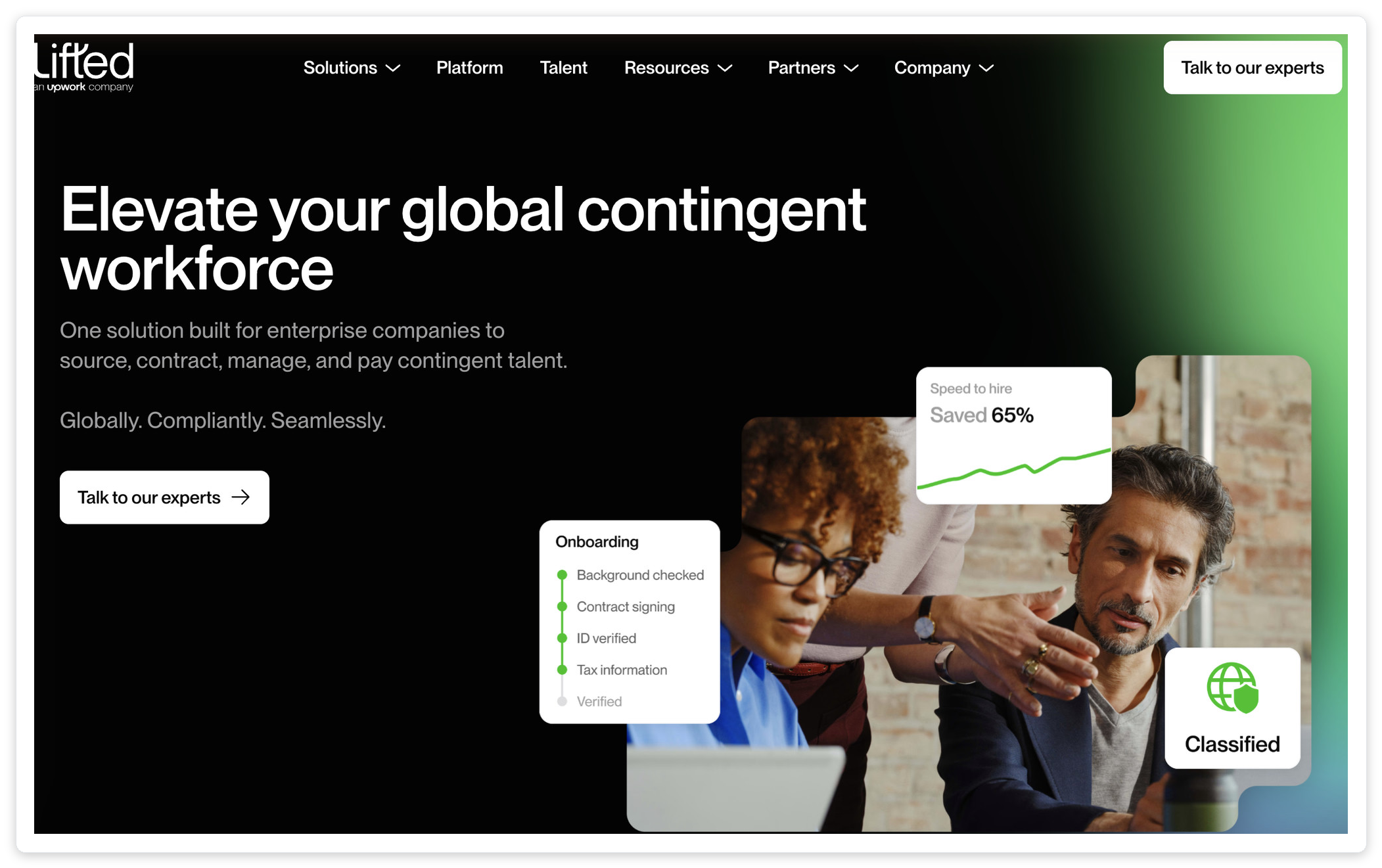
Upwork Enterprise as a product name doesn't exist anymore. On 19 August 2025 Upwork Inc. announced Lifted, a wholly-owned subsidiary that absorbed the Enterprise tier and bolted on Employer-of-Record and staffing capabilities through the Bubty and Ascen acquisitions.
Three months later, on the Q3 2025 earnings call, Upwork's CFO Erica Gessert called Lifted "our journey to unlock the $650 billion contingent work market." Enterprise revenue that quarter was $27.158 million (3% YoY) on a total revenue of $201.7 million.
That's roughly 13% of Upwork's business. And almost no agency I talk to has ever bid on a single one of those contracts.
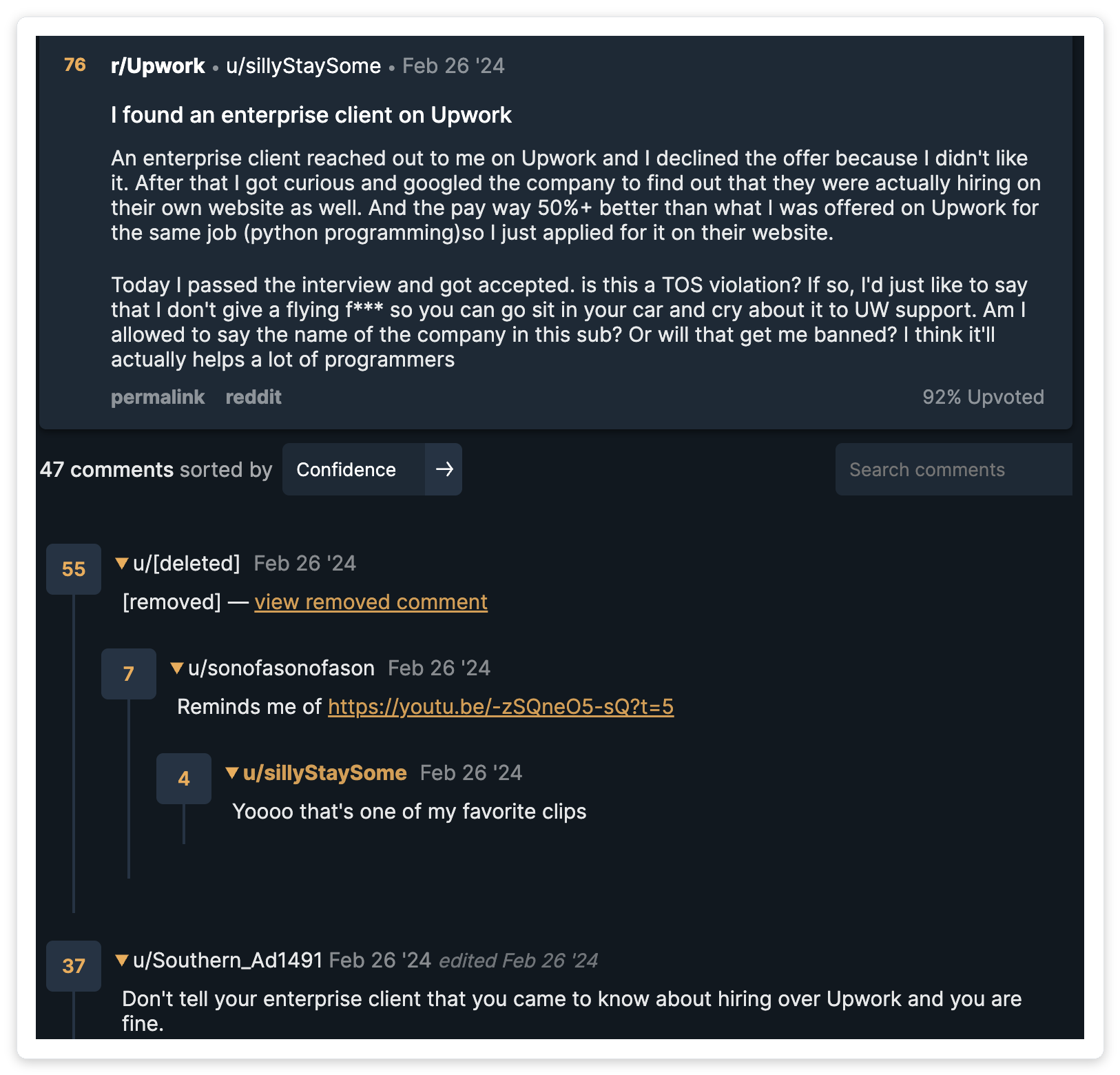
Most Enterprise/Lifted hires never reach the public job feed. They flow through a private "Talent Cloud" of pre-approved freelancers and agencies, plus direct invites from a Customer Success Manager. If you've never been invited, you're not in the cloud. This article is the playbook for getting in.
What "Upwork Enterprise" actually is now (and why it became Lifted)
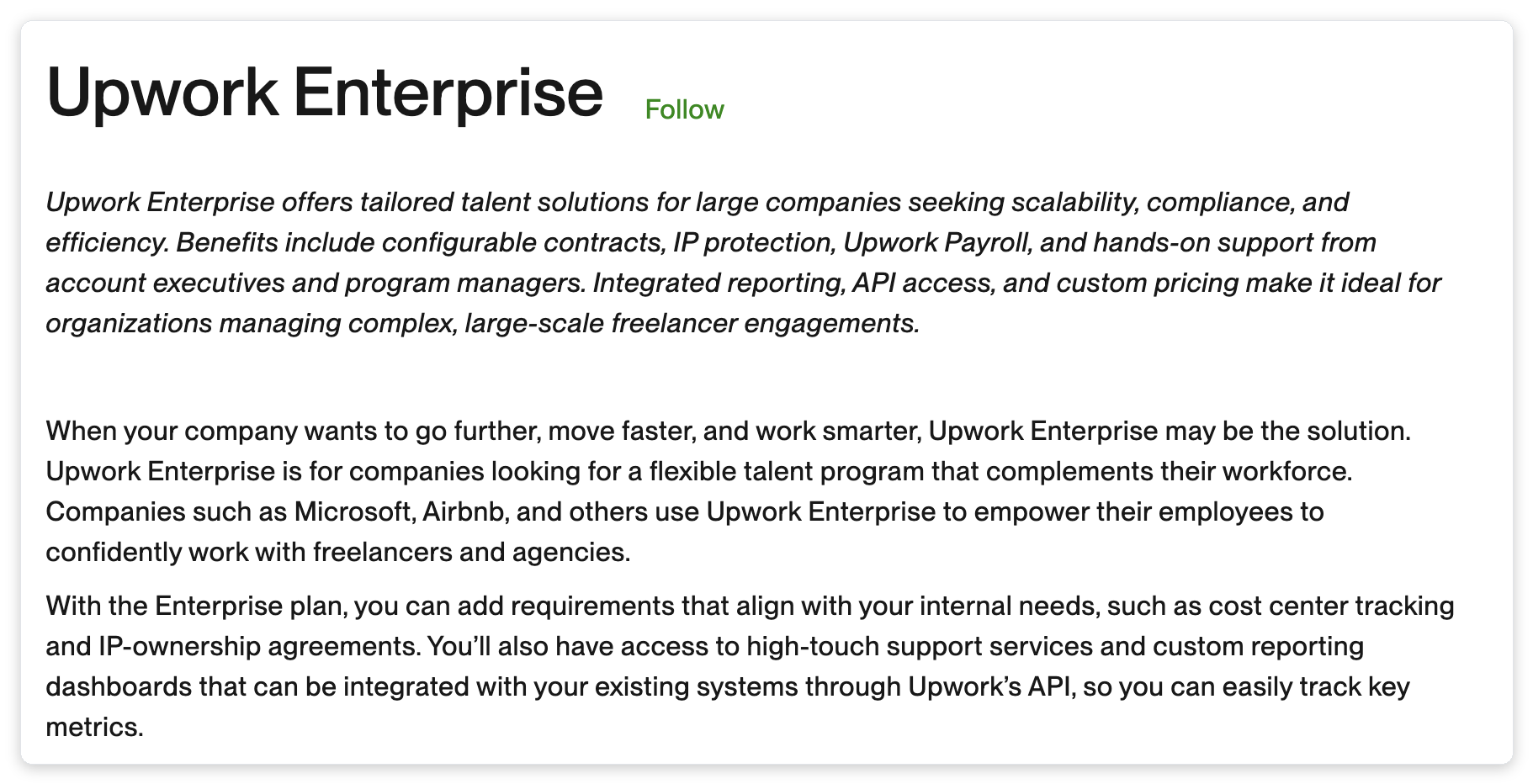
The original Enterprise tier was Upwork's premium offering for large companies (Fortune 500s, post-IPO startups, anyone with a procurement department) that wanted independent contractors but needed centralised billing, MSAs, classification, and a CSM to manage it. Microsoft and Airbnb are the two named logos on Upwork's own help page.
Upwork hit a ceiling because the Enterprise contract type capped them at independent-contractor work. Anything that needed a W-2, a payroll engine, or a full staff-aug arrangement (the bulk of the contingent workforce market) sat outside Upwork, so they bought it.

The Q1 2026 earnings report said the first wave of Enterprise customers will migrate onto Lifted's new platform "by the end of June" 2026. So the brand transition is mid-flight as you read this. For agencies, here's what that means in practice:
Source for the marketplace fee structure: Upwork Pricing 2026. Source for the Enterprise 10% freelancer fee: Upwork's Fee Agreement, section 2.3, which sets the rate at 10% of freelancer fees on any contract with an Enterprise Client unless that client's own contract says otherwise.
The free agency plan most agencies miss: it's an Enterprise-invite inbox
Read this slowly because it's the single biggest oversight I see. Per Upwork's own pricing page, an Agency Basic account (free) lets you do exactly three things:
- Work on existing active projects.
- Use Uma AI on a limited basis.
- Accept project invites from Upwork Enterprise clients.
You can't bid on new projects. You can't accept invites from non-Enterprise clients. You can't buy Connects.
The free tier is, almost literally, an Enterprise-invite mailbox. Upwork built it that way to keep the Enterprise candidate pool full of high-quality agencies that don't need to chase Connects.
An agency that's "Top Rated Plus" with one Enterprise contract closed last year and zero current invites pays nothing. An agency that's bidding on the marketplace pays $20/month for Plus. The free tier exists for the agencies Enterprise clients actually want.
Translation: creating an agency account is the first step toward Enterprise visibility, and you do not need Plus to be discoverable. You need Plus to bid on the marketplace. You need a strong Top Rated Plus / Expert-Vetted profile to be invited to Enterprise. Different surfaces, different fees.
How an agency actually lands a Lifted-tier contract
Here's the order of events I've watched play out for agencies that successfully add Enterprise to their pipeline. None of these are accidents.
Interactive Tool
Are you Enterprise-ready?
Answer 8 yes/no questions about your agency. Score 7+ to start hunting Enterprise. Score 4-6 to fix the gaps first. Score under 4 and you're better off building marketplace reputation.
No data leaves your browser. Score is computed locally.
The 5 plays small agencies actually win Enterprise with
This is what I see working. Skip any one of them and you stay invisible to the CSMs running Talent Cloud invites.
Enterprise CSMs filter Talent Cloud by skill, not by "full-service agency." A "Shopify Plus migrations + headless commerce" agency lands invites. A "Web design and development and SEO and marketing" agency does not. Read the Reddit thread on r/Upwork for any week and you'll see this play out.
Top Rated Plus signals reliability. Expert-Vetted is Upwork's manually-vetted top 1% and shows up on the Business Plus and Enterprise candidate filter. Enterprise CSMs sort by these tiers when populating Talent Cloud. The full requirements are here.
Enterprise interviews use a formal "screening call → technical interview → references" loop. Slow reply on the first message kills the funnel. Treat Enterprise messages like sales-team inbound, not freelance hustle. Speed-to-first-reply is the single biggest signal.
Every Enterprise pitch will ask: do you have an NDA, where is client data stored, who has access, what's your IP assignment language. Have a one-pager ready. Most agencies fumble here and the CSM moves to the next candidate before lunch.
Marketplace contracts pay in 5-7 days through Upwork's escrow; Enterprise contracts use the client's AP cycle. A 5-person agency on a $150K project might float $30K-$50K of payroll for 30-45 days, which is the single most common failure mode I see when an agency wins their first Enterprise contract.
The pricing reality: Enterprise pays more, but slower
This is where most agencies misjudge the math. Hourly rates on Enterprise/Lifted contracts run roughly 2-3x marketplace equivalents because the procurement model is different.
Marketplace clients budget by "what's a fair rate for this skill." Enterprise clients budget at the procurement layer (annual contractor spend) and assume senior expertise.
Rate ranges synthesised from Upwork's freelancer-side Enterprise documentation, public contract postings, and the DigitalMe interview with a $80K+ Enterprise freelancer. Your mileage varies by skill, region, and procurement appetite.
A $150K project at 4 milestones of $37,500 on NET-45 means you might be paying contractors and operational costs for 45 days before the first $37.5K hits your account. Run this math before you sign the MSA, not after.
Free for Upwork agencies
Enterprise jobs disappear in minutes. Catch them in seconds.
GigRadar's bidding system lets you respond to high-budget, payment-verified jobs (the same signal pool Lifted's Talent Cloud filters by) in under a minute. The first reply almost always wins.
Get Your Free Agency Audit →Why most agencies fail at Enterprise even after winning the contract
Winning is the easy part. Surviving the first 6 months separates the agencies that turn one Enterprise contract into a 3-year retainer from the agencies that quietly disappear from Talent Cloud after a single bad project.
Enterprise stakeholders add asks casually ("Can you also brief the marketing team?") and marketplace agencies are conditioned to accommodate. Enterprise expects you to push back via SOW amendments; saying yes to free scope takes a 60% margin contract down to 20% inside one quarter.
The Upwork/Lifted CSM has 50 other contracts on their plate. They're not pitching you to clients out of charity. Show up monthly with metrics, hit deadlines, and they invite you into the next three projects without you bidding. Ghost them and you fall off the list.
A $200K Enterprise project is enticing. Don't hire 4 new contractors against it. The contract ends, the cliff is real, and now you have a payroll problem. Build the team to 70% capacity on Enterprise, leave 30% for marketplace work that backfills.
Enterprise MSAs are dense (IP assignment, indemnity caps, audit rights, termination triggers); don't treat them like a click-through. Spend 4 hours with a contract lawyer the first time, reuse the redlined template forever after, and you avoid signing yourself into unlimited liability for one $50K contract.
What changes for agencies under Lifted in 2026
The transition is mid-flight. Per the Q1 2026 earnings call, the first wave of Enterprise customers migrates onto Lifted's new platform "by the end of June" 2026. Here's what to watch for as the new platform rolls out.
If a Lifted client wants someone on payroll instead of as a contractor, Lifted handles classification through the Ascen acquisition. As an agency owner this affects you only at the team level: a contractor you placed could be re-classified into a Lifted W-2 role mid-engagement, ending your agency margin on that seat. Negotiate replacement language into your SOW.
Lifted absorbed Bubty's contingent workforce SaaS. Expect Talent Cloud to start exposing freelancer/agency analytics back to enterprise clients (utilisation, deadline hit rate, retention). The "shadow report card" agencies don't see today becomes the rubric they're scored on tomorrow. Source.
CFO Erica Gessert told analysts that Lifted will be "margin-dilutive throughout 2026 as we absorb the cost structures and invest in integration and launch." That hints at aggressive sales discounts on enterprise deals to fill Lifted's pipeline. If you've been waiting to bid on Enterprise, the next 6 months is when CSMs are most willing to take a chance on a smaller agency they wouldn't have invited a year ago.
The fastest path in: be the agency that never misses a Talent Cloud invite
The mechanic is simpler than agencies think. Talent Cloud is a list curated by CSMs who scan agency profiles by skill, JSS, and Top Rated Plus / Expert-Vetted status.
Once you're on it, invites come in. Decline two in a row and you drop off the list.
The whole game, then, is staying on the list and never missing an invite.
That means: keep Agency Basic active (free), keep at least one team member with Top Rated Plus or Expert-Vetted, niche tightly so you actually match a skill filter, and check the agency inbox daily. The invites mechanic itself works the same as marketplace invites; the difference is that Enterprise CSMs send fewer of them and pay attention to who declines.
Open your Upwork agency settings today. Confirm Agency Basic is active and your availability is set to "Available." That single change converts you from invisible to discoverable inside Lifted's Talent Cloud.
FAQ
Is Upwork Enterprise the same as Lifted now?
Almost. Lifted is the wholly-owned Upwork subsidiary that took over the Enterprise tier on 19 August 2025 and added EOR + staffing through the Bubty and Ascen acquisitions.
The Enterprise contract type still exists on Upwork.com today (Lifted is just the brand servicing the contract), and the first wave of Enterprise customers migrates onto Lifted's new platform by mid-2026.
What's the cost difference for an agency between Marketplace, Business Plus, and Enterprise?
For freelancer-side service fees, marketplace contracts use the variable 0% to 15% scale rolled out in May 2025, set per contract. Enterprise is the carve-out: section 2.3 of the Fee Agreement fixes the freelancer fee at 10% on Enterprise Client contracts, so that 10% is a rule for one client type and not the retired flat rate everyone paid in 2023.
Client-side fees are 5% on Marketplace (3% via ACH), 10% on Business Plus (8% ACH), and custom on Enterprise.
Do I need Agency Plus to land Enterprise clients?
No. Agency Basic (free) explicitly accepts Enterprise invites. You only need Agency Plus ($20/mo) if you also want to bid on the marketplace. For agencies that exclusively chase invites, Basic is enough.
How long does it take to get from "no Enterprise contracts" to "regular Enterprise invites"?
Realistically 9-18 months, assuming you start from a strong marketplace baseline (Top Rated, $50K+ in earnings, niched discipline). The dependency chain is: Top Rated → Top Rated Plus → first Enterprise contract → CSM relationship → Talent Cloud inclusion. Skipping a step doesn't speed it up.
What's the typical Enterprise project size for a 5-person agency?
Anchor between $50K and $250K per project. Below $50K and the procurement overhead burns the margin. Above $250K and Enterprise clients want a 10-20 person agency with documented SOC 2 / ISO compliance. Right in the middle is the sweet spot.
Can my agency be on both Marketplace and Enterprise simultaneously?
Yes, and most should be. Enterprise contracts are infrequent and high-stakes; marketplace contracts are frequent and lower-stakes. Together they smooth your cash flow because marketplace bills weekly while Enterprise bills NET-30+. Run them as two separate funnels with different reply playbooks.