TL;DR. What actually moves agency invite volume on Upwork in 2026:
- Agencies with JSS at 95%+ start receiving invite rates comparable to top-rated individual freelancers, per GigRadar pipeline data across 3,000+ active agency accounts.
- Upwork's invite-matching layer weights keyword match around 40% and performance metrics around 30%. Most agencies fix the wrong half.
- Specialized profiles disappear on May 28, 2026. Stop optimizing two of them and start consolidating into a single agency profile with niche keyword density.
- Response time under 24 hours plus a clean 90%+ response rate is the cheapest invite multiplier in the system. Ignore invites for a week and the algorithm cuts the supply within two to three weeks.
- The Top Rated Plus badge for an agency automatically inherits to every eligible exclusive agency member, per Upwork support docs. That makes the agency-level badge the highest-impact badge to chase.
Why agency invites are a different game from agency proposals
Most agency owners spend 90% of their bidding budget on outbound proposals. They almost never look at the inbound side, where Upwork's algorithm decides which agencies to surface to clients posting jobs.
That is a mistake. Invites cost zero connects, convert two to four times higher than cold proposals, and tend to come from clients who have already shortlisted you. The whole point is to engineer an agency profile and operating cadence that the algorithm recognizes as worth recommending.
~40% / 30% / 20% / 10%
The approximate weights inside Upwork's invite-matching layer: keyword match, performance metrics, availability alignment, behavioral signals. Source: GigRadar's three-layer ranking analysis using observed pipeline behavior across 3,000+ agency accounts.
Read those weights twice. Forty percent of whether an Upwork client sees your agency in their invite shortlist comes down to whether your title, overview, and skill tags use the same words their job post uses. Thirty percent comes down to JSS, response rate, and contract history. Most agency profiles I audit are weak in both.
Independent profiles get a default visibility boost. JSS at 95%+ is the counter.
Upwork's own search defaults nudge clients toward independent freelancers in generic categories. Agency accounts pay a small structural penalty, which is why most agencies report fewer invites than a comparable solo freelancer running the same niche.
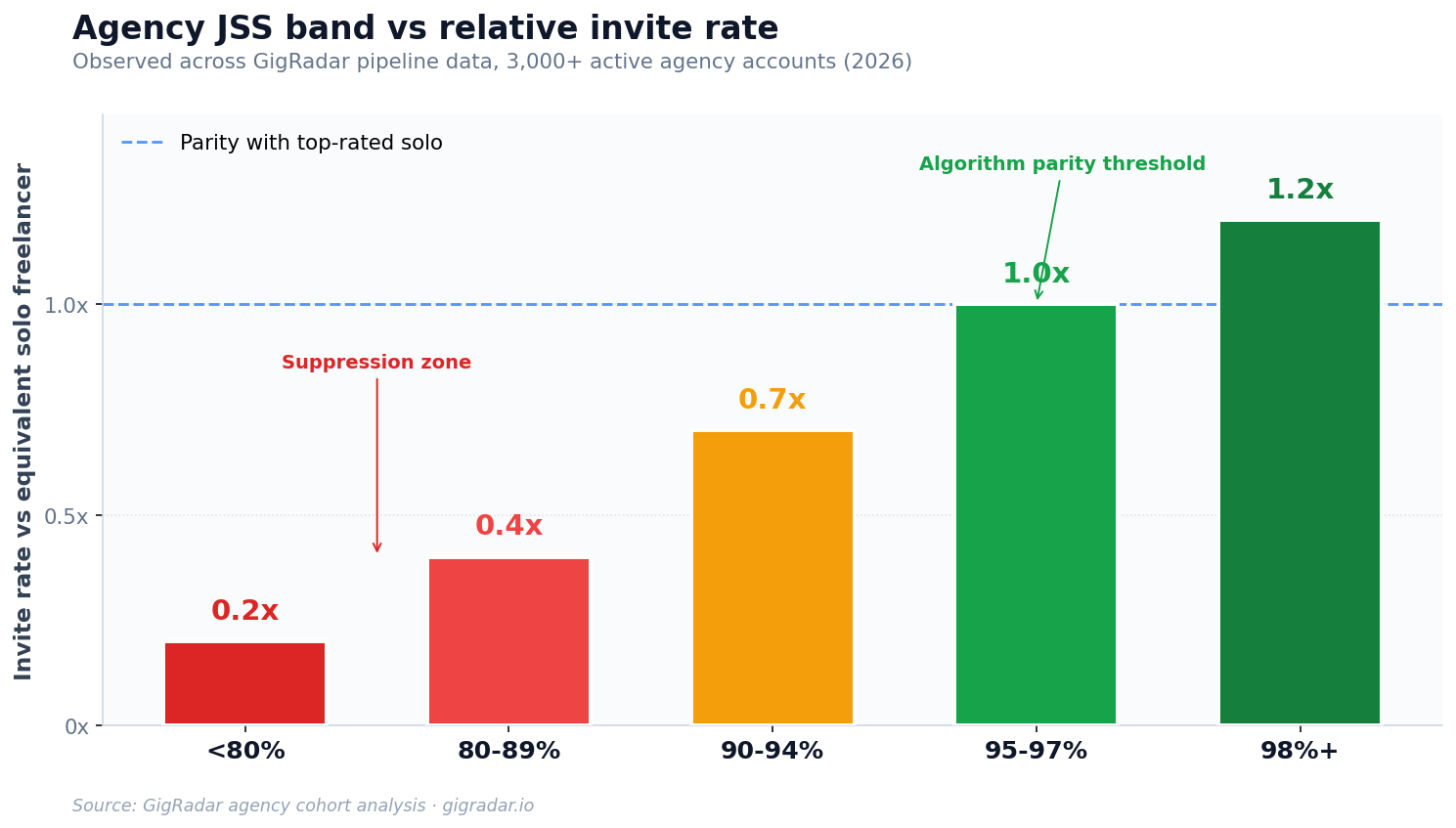
The override is JSS. GigRadar's pipeline data shows that agencies crossing 95% JSS receive invite rates roughly equivalent to top-rated individuals. Below 90%, search visibility is suppressed by the Best Match algorithm. The 85–94% middle band is where most underperforming agencies sit, and it is the single most expensive gap in the system.
JSS Threshold
95%+
The agency JSS level where inbound invite volume starts matching top-rated individual freelancer rates. Below 90% triggers visibility suppression in Best Match. Source: GigRadar agency cohort data.
Score your agency's invite readiness in 60 seconds
Before reading the 12 tactics, run your numbers through the calculator below. It maps to the actual signals Upwork's invite-matching layer reads. The output is a relative invite-readiness score between 0 and 100, calibrated against the agency cohort GigRadar tracks.
Agency Invite Readiness Calculator
Free tool. Nothing is sent anywhere. Calculations run in your browser.
0
Invite Readiness Score
Adjust the inputs above to see your score.
The 12 tactics that actually move agency invite volume
Each of these is in the order an agency owner should fix them. You do not need to do all 12. You need to do the first three properly.
Push agency JSS above 95% before doing anything else
Below 90% suppresses visibility outright. The 90–94% band competes at a structural disadvantage. The 95%+ band starts pulling agency-level invite volume comparable to a top-rated solo. Per Upwork's own JSS docs, the score is calculated daily on a rolling 6/12/24 month window and the best of the three is shown. The fastest move-the-needle action is securing two or three long-term contracts (90+ days), which weight heavily. Our guide on Upwork JSS and badges for agencies walks through the recovery sequence step by step.
Get the agency itself Top Rated Plus, not just individual members
Per Upwork support: when an agency earns the Top Rated Plus badge, every eligible exclusive agency member automatically inherits it. That makes agency-level Top Rated Plus the single highest-impact badge in the system. Our deeper guide on Top Rated and Top Rated Plus for agencies covers the gotchas and how to track your eligibility weeks. Thresholds for agencies: $20K total earnings in the past 12 months, at least one large contract without negative outcomes (Web Dev = $30K, IT/Sales/Marketing/Admin = $20K, Design = $10K).
Treat the title as a 3-layer keyword formula, not a tagline
The pattern that ranks: general service + specialty + tool/platform. Example: "Klaviyo Email Marketing Agency for DTC Skincare Brands" rather than "Email Marketing Specialists". The first 200 characters of overview also get indexed more heavily than the rest. Open 10 recent job posts in your target niche, write down every word the client used, and mirror them across title, overview opener, and tags. The full keyword and overview discipline lives in our Upwork profile optimization guide.
Fill all 15 skill tags from real recent client postings
Skill tags are the second-strongest keyword surface after title. Fewer than 15 leaves search-match capacity on the table. Source the tags by opening five to ten recent job posts you would actually want to win, listing every tag the client used, and ranking them by frequency. Drop generic tags ("Web Development") and prioritize specific ones ("Headless Shopify Hydrogen Migration"). Avoid trending tags you have not delivered: an invite to a profile that does not match the work tanks the invite-to-hire ratio, which feeds back into rank.
Audit response time and response rate weekly
Response rate is the single cheapest lever in the entire system. Agencies maintaining 90%+ response rate at under 24 hours report 3-5x the invite volume of those slipping to 80%. The mechanic is simple: Upwork tracks how often agencies respond to invites, and once you slip, the algorithm reduces the supply within two to three weeks. Assign one operator to clear the agency invite inbox every morning. Decline politely when out of scope. Never ignore.
Use specialized profiles strategically until May 28, 2026
Upwork is removing specialized profiles entirely on May 28, 2026, per the platform announcement. Until then, your main profile plus two specialized profiles is one of the strongest keyword-density plays available. Run one profile for your highest-value niche, the second specialized for a secondary niche, and switch which one is active depending on the type of invite you want. After May 28, all signal collapses into a single agency profile, so use the months before that to test which positioning pulls the most invites and capture the winning copy.
Run a portfolio with at least 6 highlighted items, outcomes-first
Highlighted items are what a client sees first on the agency profile, so treat the top six as a shortlist rather than an archive. The pattern: outcome-framed titles ("Reduced ad spend 38% for a $50M D2C brand") beat skill-framed ones ("Facebook Ads Account"). Pair each item with a real client logo where you have permission, and a measurable result. Visual niches (design, video) see the strongest impact.
Add a 60-90 second video intro to the agency profile
Upwork's algorithm treats a profile video as a strong engagement signal. The optimal length is 60-90 seconds, scripted around: who you are, who you serve, and the one outcome you produce that no one else does. The aim is not polish. It is to give the algorithm a reason to surface you and the client a reason to click.
Build a second agency before you need it
Multiple agency accounts give you three things: a backup if one gets restricted, the ability to run two distinct niche positions without diluting either, and the ability to test pricing tiers in parallel. The most successful pattern is two agencies under the same niche but different rate cards. Example: one priced at $50/hr targeting growth-stage startups, another at $150/hr targeting enterprise. Clients never see that you are an agency in the bid view, so this does not affect view rate. The split lives entirely on the supply-chain side of your operation.
Enable the Available Now badge and update something on the profile every two weeks
Available Now is a filter clients use to find currently-bookable freelancers and agencies. The community signal on it is mixed, but the cost is zero. More importantly, profile freshness is itself a ranking factor: a portfolio update, a new testimonial, or a refreshed overview every two weeks signals an active operator. Old profiles with three-year-old work history rank below identical profiles with recent activity.
Decline politely instead of ignoring out-of-scope invites
An ignored invite hurts response rate. An accepted-but-misaligned invite hurts JSS when the project goes sideways. Decline politely. The algorithm reads "responded and declined" as a positive engagement signal and continues surfacing your profile. The pattern that works: "Thanks for the invite. This sits outside our current focus, which is [niche]. If you ever post something in that lane, we would love to hear from you." Two sentences. Dispatch in 30 seconds.
Stop fragmenting signal across freelancer accounts
The biggest mistake mid-tier agencies make is letting every freelancer on the team also bid from their personal Upwork account. The signal density gets split: the agency does 30% of the bids, freelancer A does 30%, freelancer B does 25%, freelancer C does 15%. The algorithm sees four mediocre track records instead of one strong one. Concentrate at least 70% of submission volume through the agency to compound its behavioral signal. This is the structural reason high-JSS agencies pull more invites than their freelancer peers. They consolidated.
The agency Top Rated Plus thresholds, by category
Agency-level Top Rated Plus inherits to all eligible exclusive members. That is why it is worth chasing aggressively. The earnings hurdle is $20K in the past 12 months plus a large contract in the listed bracket below.
Source: Upwork's official Top Rated Plus criteria (cross-referenced against the Zenlance 2026 Top Rated guide). Worth noting: Customer Service is the only category where the agency threshold matches the freelancer one. In Web Dev, the agency hurdle is double, which is why most agencies who clear it pull a meaningful badge advantage over freelancer competitors in the same niche.
The agency-vs-freelancer invite split, in plain numbers
Agency owners often ask whether to bid through the agency profile or through individual freelancer profiles. The answer, on invites specifically, depends on JSS.
The numbers are observed ratios across GigRadar's pipeline cohort, not Upwork-published figures. The point is the curve, not the precision. Invite volume scales sharply as JSS crosses 95%, and below 90% you are in a hole the algorithm has actively dug for you. For an independent take on the same JSS-rank relationship, see AgencyReview's 2026 Upwork analysis.
How to write the agency overview opener
The first 200 characters of your overview get indexed heavier than the rest. The mistake almost every agency makes is opening with "We are a team of experienced developers..." That phrase contains zero search keywords and zero positioning.
Use this template instead. Replace the bracketed parts with your actual numbers and niche.
The opener does three things at once. It puts your primary keyword in the first 200 characters. It signals specificity (numbers and named segments). And it ends with a clear next-step CTA, which converts both algorithm signal and client clicks.
The Vadym take on agencies that have tried this
I have watched roughly 50 agencies move through this exact playbook in the past 18 months. The agencies that move from 4-6 invites/month to 30+ invites/month do not all run the same niche, but they share three behaviors.
They run a JSS recovery sprint first. Specifically: end every existing contract that has stalled, take on two short-term ($1-3K) projects with clients you know personally to bank fresh 5-star reviews, and apply the rule from GigRadar's Agency Success Course on private feedback: always brief the client to use "Project completed successfully" as the contract-end reason; anything else damages JSS even when public stars are perfect. The course instructor walks through the exact mechanics of how private feedback flows into JSS in the Feedback Mastery lesson:
🎯 Agency Success Course · Feedback Mastery🎥 From GigRadar's Agency Success Course: Feedback Mastery (private vs public feedback, JSS impact, recovering from sub-7 private NPS).
They consolidate signal. They stop bidding from individual freelancer accounts and put 70-80% of bid volume through the agency. The behavioral signal density compounds, and within 60-90 days the invite volume to the agency starts climbing.
They handle invites like a workflow, not an inbox. One operator clears invites every morning, marks them in/out of scope in 60 seconds each, declines the out-of-scope ones politely, and routes the in-scope ones to the right team member to interview-prep within four hours. The whole thing takes 15 minutes a day and protects response rate and JSS simultaneously.
The five mistakes that quietly kill agency invite volume
These are the patterns I see most often during agency audits. Each one is fixable in an afternoon.
Niche'd down so hard the search volume disappeared
"Klaviyo Email Marketing Agency for D2C Skincare Brands in California" is too narrow. Profile views collapse when the exact-match query has almost no monthly volume behind it. Use a single niche with broad enough geography to keep monthly demand viable. Test the niche by counting how many active job posts exist in that exact match per week. Fewer than 5 is a red flag.
Optimizing the freelancer profile but not the agency profile
Many agency owners spend hours on their personal freelancer profile and leave the agency profile half-built. Invites flow to whichever profile the algorithm thinks is the better match. The agency profile is usually starved of keyword density and portfolio depth. Audit both. Time-box: 90 minutes on the agency profile this week.
Treating Expert-Vetted as the holy grail
Expert-Vetted is invitation-only and, per a 2025 audit of 200 top web-dev profiles, currently does not display a unique visible badge to clients in many search modes. They show as Top Rated Plus instead. Chase Top Rated Plus. Stop chasing Expert-Vetted as a marketing goal.
Letting one bad private NPS quietly drag rank for months
Per our analysis of Upwork's algorithm, a 7/10 private NPS is treated as a Passive (negative signal over time) even when public review is 5 stars. After every contract end, ask the client directly whether they would recommend you. If anything below "definitely yes" comes back, request a follow-up call to address the gap before the survey is filled out.
Ignoring response rate during agency vacations
A two-week silent stretch on the agency invite inbox cuts invite supply for the next month. If the team is on holiday, set up someone to triage the inbox or use Upwork's away-message feature. Both protect response rate. Neither is automatic.
Where this fits in the broader agency operating cadence
Invite volume is one of three demand surfaces an agency runs in parallel. The other two are outbound proposals (Best Match layer of the algorithm) and Project Catalog listings (a separate marketplace surface). Most agencies under-invest in invites because the surface is invisible from inside the bidder workflow. You only see proposals you sent, not invites you didn't get.
The fix is to instrument it. Upwork shows your invite count in My Stats. Track it weekly. The chart you want to see: invites trending up, response rate steady at 90%+, response time under six hours, agency JSS holding at 95%+. When that quartet holds for 60-90 days, agency invite volume becomes a compounding asset rather than a coin flip.
Free for Upwork agencies
Audit your agency's invite signals in one click
GigRadar operates a real Upwork Business Manager account that your agency invites in. We track JSS movement, invite volume, and response time across your team and surface the exact signals the algorithm is reacting to.
Get Your Free Agency Audit →Frequently asked questions
Does the agency JSS or the individual freelancer JSS show up to clients in invite search?
Both, depending on which surface the client is searching. Agency-level JSS appears when clients filter for agencies. Individual JSS appears in the broader talent search. If a freelancer is exclusive to an agency, the agency's JSS is shown on their profile. Run both above 95% to maximize coverage. The full agency-vs-freelancer mechanics are covered in our piece on Upwork agency vs freelancer.
What is the fastest way to fix a sub-90% agency JSS?
Take on two to three short-term ($1-3K) contracts with clients you have a relationship with, deliver clean, brief them on private feedback, and close them out within 90 days. Long-term contracts (90+ days) carry more weight, so a single 6-month $5K retainer beats four one-month gigs in the same dollar bucket.
Will the May 2026 removal of specialized profiles hurt agencies more than freelancers?
Slightly more, but not catastrophically. Agencies were using specialized profiles to keep separate niches (e.g. one Shopify, one Klaviyo) without diluting either. After May 28, you consolidate to a single agency profile. The fix is to use the months before then to test which positioning pulls the most invites and capture that copy as your single post-May positioning.
Does boosting a proposal get you more invites?
Indirectly. Boosting only affects the Boosted Slots layer of the algorithm (paid auction above Best Match). Invites come from the upstream Invite Matching layer. A boosted proposal that converts to a hire and a strong review feeds JSS, which feeds invites. A boosted proposal with weak profile-to-job fit creates a bounce signal that lowers organic rank. Our guide on Upwork Boosts and ROI modeling covers when boosting is +EV and when it actively hurts your rank.
How long does it take to see invite volume increase after profile optimization?
Profile-side changes (title, skill tags, portfolio) typically show invite lift within 2-4 weeks. JSS-side changes take 60-90 days because JSS is calculated on rolling 6/12/24 month windows. Plan accordingly: do the keyword and portfolio work this week, but expect the JSS lift to take a quarter.