
🎬 WordPress Agency on Upwork: Win $80-150/hr Jobs (2026): a 2-minute walkthrough of why 67% of WordPress freelancers on Upwork earn under $15/hr while agencies pull $80-200/hr, and the four-pocket filter that flips that ratio. Watch on YouTube
The short version
- Sixty-seven percent of WordPress freelancers on Upwork earn under $15/hr. WordPress agencies on the same platform charge $80–200/hr. The gap is positioning, not skill.
- Upwork's WordPress feed isn't saturated. The bottom 90% of jobs is. Three pockets stay underbid: WooCommerce performance, custom plugin and API work, and headless WordPress builds.
- Filter your feed to fixed-price jobs $1k+, payment-verified clients with 3+ hires, and posts under 5 proposals. That's the smaller pond where agency rates hold.
- Don't lead proposals with "WordPress developer." Lead with the business outcome: LCP under 2.5s, store doing $50k+/mo, GDPR compliance, plugin replacing a $400/mo SaaS.
- Use the WordPress agency job-score tool below before you spend Connects on any post.
Sixty-seven percent of WordPress freelancers on Upwork earn under $15 an hour, per Kinsta's analysis of platform earnings data. The same platform pays WordPress agency teams $80 to $200 an hour for the right jobs.
Both numbers are true at the same time, on the same site, in the same week. The gap isn't a skill question.
The agencies pulling agency rates aren't writing better PHP. They're bidding on different jobs, with different proposals, against a smaller pool of qualified competitors.
The "WordPress is dead on Upwork" thread on Reddit and the agency owner doing $30k/mo from the same feed are looking at the same job board with two different filters on.
The "saturated" myth: 90% of WordPress jobs are saturated. The other 10% is starved.
The complaint that WordPress on Upwork is "dead" is a recurring r/Upwork thread. It's also half-true. Here's the top WordPress-tagged thread from r/Upwork in the past year:
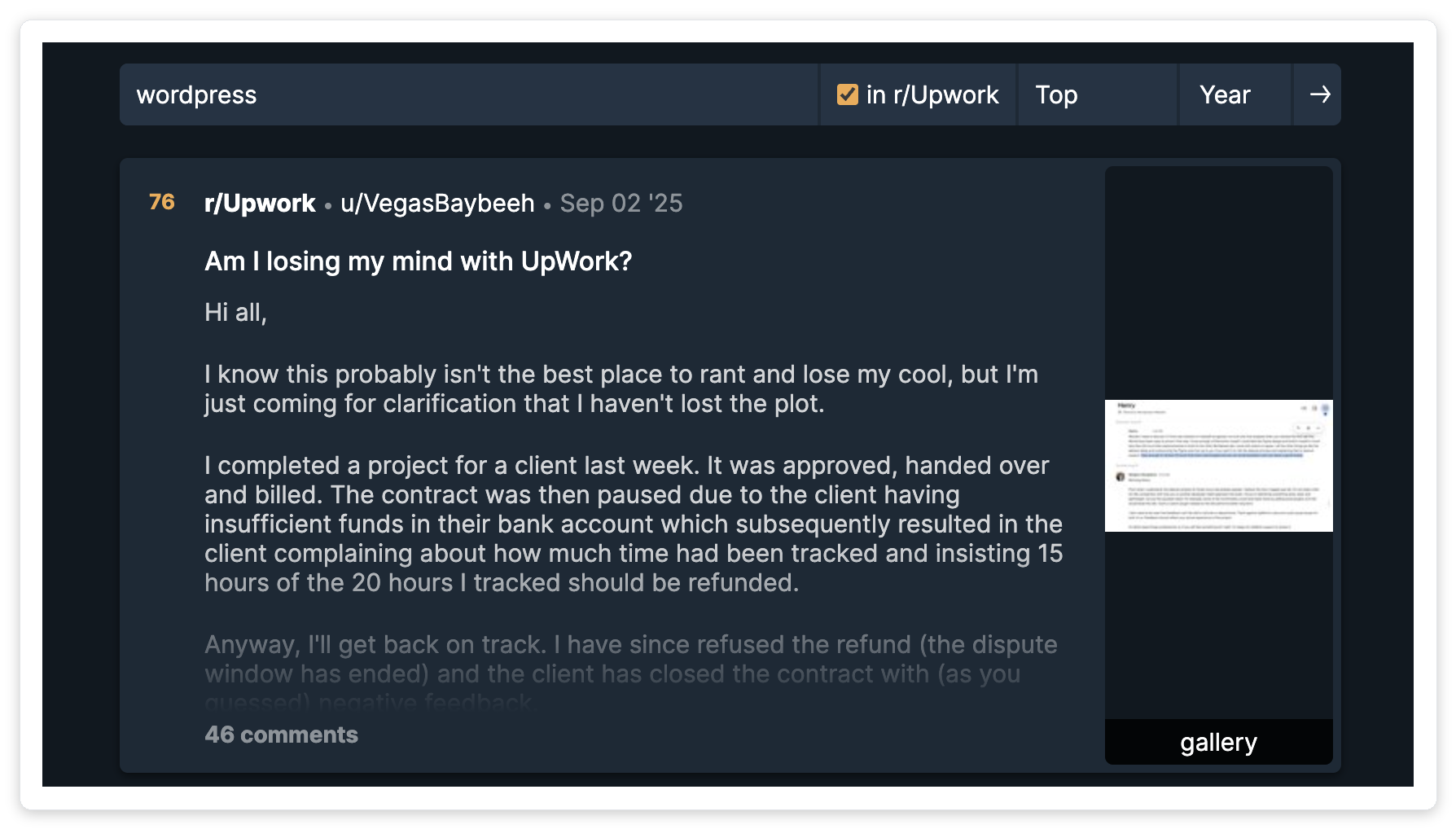
Top r/Upwork thread in the past year searching "wordpress." The WordPress-on-Upwork frustration cycle is real but lopsided. Source.
WordPress runs roughly 43% of the public web, per W3Techs' CMS survey. The platform isn't shrinking.
What's happening is a split inside Upwork's WordPress category that doesn't show up in the keyword "WordPress."
One side is the commodity tier: "Build me a 5-page Elementor site for $300," "Install this theme and add my logo," "Fix my contact form." Hundreds of bidders flood every post.
AI-builders, low-cost-of-living solo freelancers, and outsource shops all live here. Median rate sits at $15 to $28/hr per Upwork's own published WordPress data.
That's the pond everyone fishes in. That's also where the "Upwork is dead for WordPress" complaints originate.
The other side: WooCommerce performance work, custom plugin development, headless WordPress, security and migration projects. Codeable's published rate data puts WooCommerce specialists at $80 to $120/hr, custom plugin developers at $75 to $150/hr, and headless WP architects at $100 to $150+/hr.
Those jobs exist on Upwork. They get under five proposals because most "WordPress developers" can't do them.
Treat "WordPress agency on Upwork" as one feed and you compete with everyone. Treat it as four narrow feeds (WooCommerce performance, plugin/API, headless, security/migration) and you compete with people who actually know what a WP_REST_API endpoint or a Cloudflare Workers cache does.
Different ponds. Same platform.
If your saved search is just the keyword "WordPress" with no exclusions, you're looking at the bottom 90%. The agency-rate jobs don't say "WordPress" in the title; they say "checkout speed," "GDPR cookie banner," "headless Next.js + WP," "plugin to replace Calendly."
What "wordpress agency upwork" actually looks like for an agency owner
Here's the math an agency lead has to do every morning. Your team has four devs.
Loaded cost is roughly $35/hr per seat. To hit a 60% gross margin you need an average billed rate of $90+/hr.
A solo at $25/hr can't sustain that. You can.
If you're bidding on "WordPress" with no filtering, you'll send 20 proposals to win 1 reply. The reason: 18 of the 20 jobs are commodity work where your rate kills you on first read.
Filter to a smaller pond and you flip that ratio.
The four pockets where agency rates hold on Upwork in 2026:
| Typical job | Rate range | Why it pays | |
|---|---|---|---|
| WooCommerce performance | LCP fix on a $50k/mo store; checkout speed; image pipeline; cart abandon rate | $80–120/hr | Direct revenue line. A 1s LCP improvement on a 7-figure store is measurable in dollars. |
| Custom plugin / API integration | Replace a SaaS the client pays $400/mo for; custom Gravity Forms logic; ERP/CRM hookups | $75–150/hr | Real PHP / REST API work. AI tools and template-pasters can't ship it. |
| Headless WordPress + Next.js | Decoupled WP backend, Next.js or Astro frontend, image CDN, ISR/cache logic | $100–150+/hr | Crosses two stacks. Most "WordPress devs" don't know React; most "Next.js devs" don't know WP. |
| Security, migration, recovery | Hacked-site cleanup, host migration, GDPR/HIPAA audit, malware removal | $80–130/hr | Time-critical. Client has lost revenue or is about to. They pay for speed and certainty. |
| "Build me a WordPress site" | 5-page Elementor build, theme install, basic content load | $15–28/hr | Commoditised. Skip these unless you're an entry-level solo testing the platform. |
What GigRadar's first-party data actually shows (March 2026)
The third-party stats in the section above (Kinsta, Codeable, W3Techs) are the public benchmarks. We also run our own numbers from Upwork's job feed and the proposals our 3,000+ customer agencies send, so before the filter playbook here are the four numbers that matter most.
Two things jump out. WordPress is the most competed niche we run proposals through: the reply rate is 36% lower than the platform-wide average across our customer base.
And the median "high end" of the hourly rate clients post on WordPress jobs is $18.80, with a median minimum hourly of $9.75 in the Web Development subcategory. That's the same Kinsta 67%-under-$15 finding from a different angle: agency rates do not exist in the median WP job at all.
| Skill tag (March 2026) | Jobs in feed | Reply rate (GR customers) | Read |
|---|---|---|---|
| WordPress (all) | 11,280 | 3.36% | The crowded base. Most bids land here. |
| WooCommerce | 1,393 (12% of WP) | 3.71% | Higher fixed budgets ($150 median) but reply rate barely above WP base. Agencies still sending generic proposals. |
| Elementor | 1,150 (10% of WP) | 4.59% | The "fast build" tier. Reply rate is above WP base but still below platform average. |
| WordPress Plugin | 276 (2.4% of WP) | 3.62% | Real PHP/REST work, but small slice of the feed. Worth bidding only if you have plugin-dev portfolio. |
| WordPress Theme | 119 (1.1% of WP) | 5.88% | Smallest pool, highest reply rate. Theme dev is the lane most generalists skip. |
WordPress jobs on Upwork are also wider than just "developer" work. Of the 11,280 March 2026 posts, only 27% sit in the Web Development subcategory; 39% are in Web & Mobile Design, 9% are in Ecommerce Development, and another 9% are in Digital Marketing.
The implication: an agency positioned strictly as "WordPress developer" is filtering itself out of more than half its own niche. Design-led WordPress builds, ecommerce WordPress, and WordPress-for-marketing-funnels are all lanes the dev crowd ignores.
The reply-rate gap between WordPress (3.36%) and the platform average (5.27%) is a feed-quality problem, not a proposal-quality one. The next section's filters are designed specifically to close it.
How to filter Upwork's feed down to the 10% worth bidding on
Most agency owners I talk to spend 60 to 90 minutes a day scrolling Upwork. Of that, maybe 4 minutes is spent on jobs they should bid on.
The rest is rejecting noise. Filtering is the single highest-leverage move you can make before you write a single proposal.
The base layer of filters that turns a noisy feed into a useful one for a WordPress agency:
Brand-new clients post the lowest budgets and ghost the most. Three prior hires means the buyer knows the platform, has paid before, and this single filter cuts 40% of feed noise without losing a single agency-rate job.
Agency rates don't survive sub-$1k fixed-price jobs because of scope creep math, and hourly under $40 means the buyer is hunting solo freelancers. Either floor cuts another big chunk of noise.
Replies cluster on the first 5 proposals submitted; after that, the client has stopped reading. Posts with 50+ proposals are dead even when the budget is good.
Use buyer-language strings: (woocommerce) (lcp OR core web vitals OR speed) -tutorial, (wordpress) (gdpr OR hipaa OR pci) (audit OR compliance), (headless wordpress OR decoupled wp) (next.js OR astro). Buyers writing these terms know what they want.
"Urgent" and "fix-quickly" in a $200 budget is a buyer who'll fight you on every milestone. Elementor in the title (without performance language) is almost always the commodity tier.
Save these as four named searches: WP Performance: Woo, $1k+, <5 props, WP Plugin: API, Hourly $50+, Headless WP: Next.js, $2k+, and WP Security/Migration: Verified, <5 props.
Most agency owners need 3 to 5 saved searches, not one. We've published a full filter playbook and 50 copy/paste search recipes if you want the exact strings.
Free tool
WordPress agency Upwork job-score
Score any WordPress job before you spend Connects. Built around the four filters that move reply rate for agencies.
Stop opening proposals with "I'm a WordPress developer with 10 years of experience"
The single biggest reply-rate lift for WordPress agencies on Upwork isn't a better template. It's not opening with the words "WordPress developer."
Buyers paying agency rates aren't shopping for a WordPress developer. They're shopping for someone who'll fix the LCP on their checkout page, migrate their hacked site without losing SEO, or replace the $400/mo SaaS they hate.
One of the GigRadar Agency Success course lessons walks through exactly this scanner-and-cover-letter mismatch. Worth 2 minutes if proposals are a bottleneck:
From GigRadar's Agency Success course: "Scanners That Sell"
Generic WordPress opener
"Hi, I'm a WordPress developer with 10+ years of experience and my team has built over 200 sites specialising in WordPress, WooCommerce, and Elementor. We deliver high-quality work on time."
Outcome-led opener (Woo speed)
"You mentioned LCP at 4.2s on the product page and a $50k/mo store, where the likely culprit is image-CDN config plus Elementor's render path. I'd start with a paid 3-hour audit (GTmetrix benchmark, top 5 fixes, Lighthouse target): if LCP isn't under 2.5s after milestone 1, you don't pay for milestone 2."
The second proposal earns a reply because it does what the buyer hasn't done yet: diagnose. The buyer knows their site is slow but doesn't know why.
The first proposal that names a likely cause and offers a tiny paid first milestone wins, because it eliminates the buyer's biggest fear (paying $5k for nothing). We covered the proposal mechanics in detail in the web-development proposal playbook and our 12 fill-in-the-blank proposal examples.
For every proposal, ask: "If a buyer reads only the first sentence, do they know which job they're reading the proposal for?" If the first sentence could be sent to any WordPress job on the platform, rewrite it.
Copy this opener for WooCommerce performance jobs
The version below has been pulled out as a fill-in-the-blank template; click the button to copy it. Replace the bracketed fields with two specifics from the post and one number from your past work.
Subject: WooCommerce LCP fix on {{store_name}}: 3-hour audit, fixed scope

You mentioned LCP at {{current_lcp}}s on the {{page_type}} page. The likely culprit is {{cause_1}} plus {{cause_2}} on the render path.

Phase 1 (paid, 3 hours, $XYZ):
- GTmetrix benchmark + Lighthouse trace on {{page}}
- Top 5 fixes ranked by ms saved per hour of work
- Lighthouse target: LCP under 2.5s and CLS under 0.1

If the targets aren't hit after milestone 1, you don't pay for milestone 2.

Proof: rebuilt {{past_client_type}} on Woo, LCP {{baseline}}s to {{result}}s, conversion lift {{percent}}%. Sample: {{link}}.

Can start {{start_date}}. Happy to share a 10-minute Loom walking the audit plan if helpful.
The agency premium math: why a 4-person team can charge $100/hr where a solo can't charge $25
Agency owners get pushback on rates and either over-explain or quietly drop the price. The math is the lever.
A solo at $25/hr who needs $4,000 a month gross has to bill 160 hours. Upwork's 10% freelancer service fee plus platform churn means closer to 200 actual hours of selling-and-doing.
That's basically full-time. It leaves no room for sick days, scope creep, or the next month's pipeline.
An agency at $100/hr with four billable people only needs each to bill ~10 hours a week to gross the same $4,000. The other 30 hours per person can be discovery calls, project management, account management, QA, and pipeline.
That's why agency rates aren't optional. They're the only structure that lets the agency model exist.
Buyers paying the agency rate aren't paying for a developer. They're paying for delivery certainty plus a project manager plus QA plus a backup developer if the primary gets hit by a bus.
"Most of my clients are agencies, maybe 90% of the clients are agencies. The most common pushback is 'too expensive.'"
"Why? Because they're paying a freelancer $5/hr in their head."
"The agency premium pays for project management, QA, continuity, and backup; that's what the client is buying."
From the "Bypass 'no agencies'" lesson, GigRadar Agency Success course
If a client says "we usually pay freelancers $25/hr," your one-paragraph reply is this:
"Right, and at $25/hr you'd need ~200 billable hours to deliver this scope: 5 weeks of one person full-time with no QA, no PM, no backup, and no fix-it window."
"We'd deliver it in 2 weeks, you talk to one person not three, and if anything breaks 30 days post-launch we fix it without a new SOW. You're not paying double; you're buying half the timeline and a backstop."
Why GigRadar matters here (and what it actually does)
The math problem an agency owner has on Upwork is bottleneck-stacking. You need to scan 200 to 500 jobs/day across 4 saved searches, qualify the 5 to 10 worth bidding on, draft a personalised outcome-led proposal for each, and submit within minutes of the post going live.
The submission window matters because reply rate dies after the first 5 proposals are in. Doing all of that yourself costs ~3 hours a day.
Hiring a bidder VA to do it costs $1,500 to $3,000/mo plus training plus quality drift.
GigRadar runs that entire stack. We operate a real Upwork Business Manager account as a company.
Your agency invites our BM into your agency through Upwork's native agency invitation flow: the same mechanism Upwork built for hiring an in-house bidder.
Once invited, our system watches your saved searches in real time, scores each job against the criteria you set, and submits a personalised proposal within 60 to 90 seconds of the post going live. Submission is from our BM's Upwork account under our team's supervision.
Your agency account is never touched. If Upwork ever reviews a submission, the review lands on our BM profile, not your freelancer.
For a WordPress agency, the practical effect is that you stop scrolling. Your team sees only the qualified leads that already replied to a proposal.
You spend your time on calls and delivery, not on tab-checking the Upwork feed at 11pm. We've covered the architecture in depth in the Upwork automation explainer and the Business Manager model breakdown.
Free for Upwork agencies
Get every WordPress job worth bidding on, before the proposal count hits 5
We watch your Upwork feed 24/7 and submit a personalised proposal from our managed Business Manager within 90 seconds. You handle calls and delivery; we handle the bid grind.
Get your free agency audit →The honest tradeoffs: when Upwork is wrong for a WordPress agency
Two scenarios where Upwork isn't the right channel, even with all the filtering and automation:
| Scenario | Why Upwork is the wrong fit | Better channel |
|---|---|---|
| Pure enterprise WP ($50k+ projects, 6-month engagements) | Upwork's enterprise tier exists but most agency-grade SOWs route through procurement, not job posts | Direct outbound, agency partnerships, Codeable Enterprise |
| WP retainer-only book of business | Upwork is structured around discrete projects. Maintenance retainers happen there but don't dominate | Past clients, referral, ManageWP/maintenance-platform partnerships |
| Agencies whose mix is <15% WordPress | You'll write WP proposals less often than you should and your reply rate stays low | Pick a different feed (React, Shopify, Webflow) and let WP be opportunistic |
For everyone else (agencies doing $5k to $50k/mo, mixed pipeline, WordPress as one of two or three core stacks) Upwork is one of the few channels where the buyer comes pre-qualified with a budget already on the platform.
The contract infrastructure is also built: escrow, milestones, dispute resolution are all native. The volume is real.
The platform isn't dead. The 90% commodity tier is, but the 10% you should be bidding on isn't.
The first move
If your agency has been on Upwork for 6+ months and your reply rate is under 8%, the problem is almost never proposal copy. It's the feed you're bidding into.
Spend 30 minutes today doing one thing: open Upwork's job search, build the four saved searches above, and read the next 20 jobs that surface in each.
If you can't write a confident outcome-led opener for a given job in 90 seconds, it's not in your pocket. Skip it.
That single change usually moves an agency's reply rate from 3 to 5% to 12 to 18% inside two weeks. Not because the proposal got better, but because the underlying job got better.
Filtering first, writing second. That's the order most agency owners get backwards.