Cold Email vs LinkedIn vs Upwork: Real Reply Rate Data 2026. The 2-minute walkthrough of the channel benchmark, the intent gradient, and the timing math behind a 9% Upwork reply rate. Watch on YouTube.
TL;DR
- Cold email reply rates dropped from 7% to 5.1% in a single year (2024 to 2025) and the median Instantly cohort across billions of sends now sits at 3.43%.
- LinkedIn DMs reply at 10.3% on average, but the channel is hard-capped at ~100 connection requests per week per account, throttling pipeline.
- Upwork proposal reply rates sit between 5.9% and 9.0% by month across 133,872 outbound proposals from GigRadar's pipeline (Dec 2025 to Feb 2026), and reach 10.4% on weekend-posted jobs.
- The structural gap nobody publishes: cold email and LinkedIn are interruption channels with declining returns. Upwork is a buyer-intent channel where the prospect raises their hand first.
- Use the calculator below to compare expected replies and cost-per-reply for your own send volume across all three channels.
In February 2024, Google and Yahoo rolled out new bulk-sender rules that quietly removed roughly half of all cold email teams from inboxes overnight. Microsoft followed in May 2025 with hard-rejects on non-compliant senders to outlook.com, hotmail, and live addresses. Reply rates didn't slowly decline. They fell off a shelf.
Every outbound playbook on the front page of Google still compares cold email to LinkedIn as if those are the only two options. They aren't. The third channel (Upwork) replies at 5 to 15 percent on agency proposals, and the buyer wrote the brief before you ever opened your laptop. That changes the math entirely.
The actual reply-rate benchmarks across all three channels (2025 to 2026 data)
Here is the consolidated benchmark, pulled from the most-cited sources in each ecosystem. Cold email numbers come from the largest published cohorts (Instantly, Hunter, Belkins). LinkedIn numbers come from Engagekit's 2025 benchmark report and Outreaches.ai's multichannel data. Upwork numbers are from GigRadar's pipeline.
| Channel | Avg reply rate | Source / cohort size |
|---|---|---|
| Cold email (Instantly cohort) | 3.43% | Billions of sends, 2026 |
| Cold email (Hunter sequences) | 4.5% | 11M emails, 2025 |
| Cold email (Belkins, 2024) | 5.8% | 16.5M emails, down from 6.8% in 2023 |
| LinkedIn DM (1st-degree) | 16.86% | Engagekit benchmark, Dec 2025 |
| LinkedIn DM (cold, all outreach) | 10.3% | Engagekit benchmark, Dec 2025 |
| LinkedIn InMail (premium) | 6.4% (avg) | LinkedIn Sales Solutions, range 2.5 to 25% |
| Upwork proposal (Jan 2026 cohort) | 9.02% | 56,491 proposals, GigRadar pipeline |
| Upwork proposal (weekend-posted jobs) | 10.37% | 2,334 Saturday-posted jobs |
| Upwork proposal (first 5 minutes) | 9.49% | 2,372 sub-5-min bids, +43% vs 5-10 min |
Sources: Prospeo cold email benchmarks 2026, Engagekit LinkedIn 2025 report, GigRadar pipeline data (133,872 outbound proposals, Dec 2025 to Feb 2026).
Two things stand out. First, the cold email column is in red because every published cohort larger than 100,000 emails has dropped below 6% reply since the bulk-sender rules landed. Second, the Upwork column is in green because the lowest data point is higher than the highest cold email cohort.
LinkedIn's 16.86% number is for first-degree connections, not cold reach. The cold reply rate is closer to 10.3%, and even that rate is throttled by LinkedIn's ~100 invites-per-week ceiling per account.
Compare your own pipeline math (interactive calculator)
Reply-Rate Calculator
Same volume, three channels: how many replies do you actually get?
Pick a monthly send volume (proposals, emails, or DMs). The calculator applies the published 2025 to 2026 reply rates and computes expected replies and cost-per-reply for each channel.
Cost-per-reply is the metric that matters, not raw reply rate. A 3% reply at $0.30/send beats a 10% reply at $5/send if your sales team can handle the volume. The calculator above lets you set realistic per-send costs for your stack.
Why cold email reply rates collapsed (and why it isn't reversing)
The collapse has a date. On February 1, 2024, Google and Yahoo started enforcing three rules on bulk senders: SPF, DKIM, and DMARC alignment, one-click unsubscribe, and a hard spam-rate ceiling of 0.3%. Microsoft followed on May 5, 2025, but with hard rejects (5xx errors) instead of soft bounces.
The result wasn't a smooth decline. According to Autospf's two-year retrospective, only 16% of sending domains have DMARC implemented properly, and 63% of those publish at p=none (no enforcement). The other 84% of domains operate without DMARC entirely. When Gmail flips a switch, that 84% loses inbox placement overnight.
Belkins reported a drop from 6.8% reply rate in 2023 to 5.8% in 2024 across 16.5M emails. Engagekit's 2025 benchmark showed cold email reply rates fell another 27% year-over-year, from 7% to 5.1%. Open rates dropped from 36% to 27.7%.
Add AI-slop saturation on top. Every outbound team now generates personalized first lines with GPT, which means the average prospect's inbox is full of "I noticed you recently posted about" emails that all sound identical. The tactic that worked in 2022 became the default in 2024, and defaults stop converting.
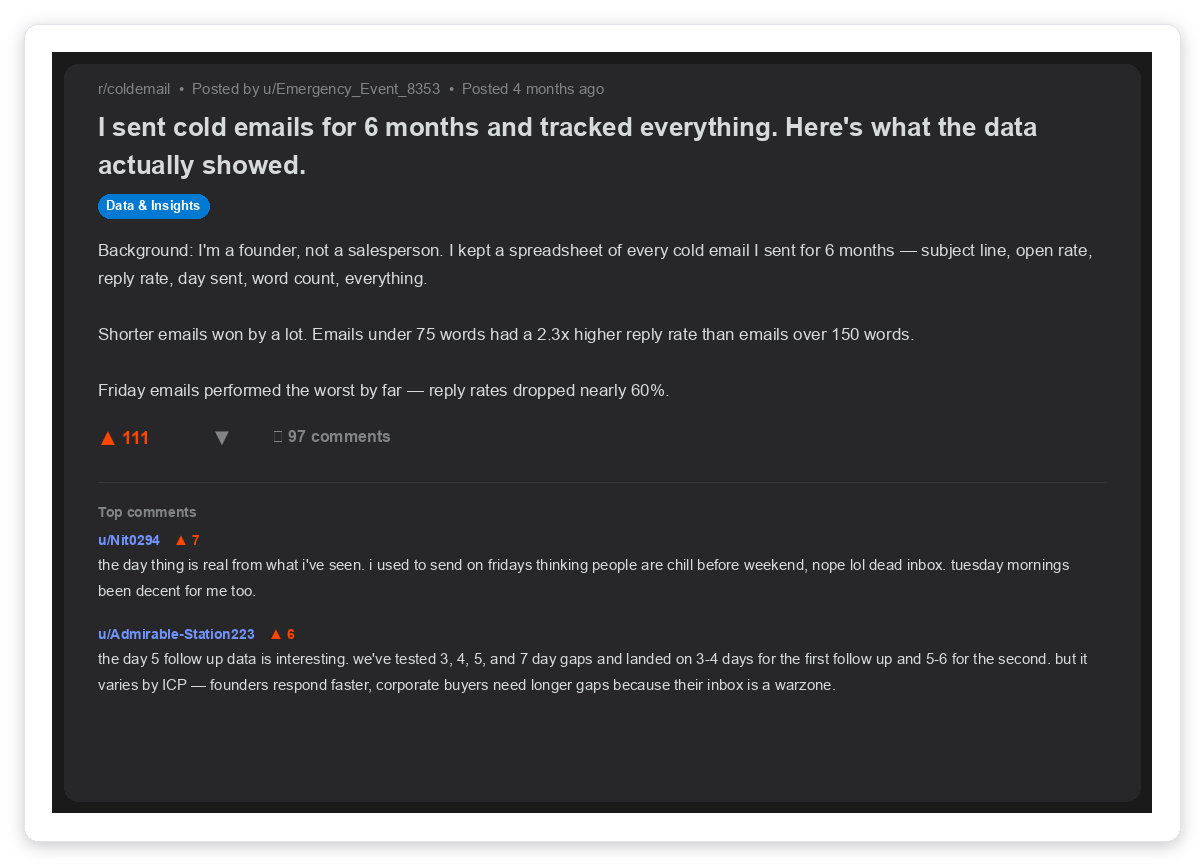
One Reddit operator on r/coldemail summed it up bluntly: "Sent 217,000 cold emails. Watched reply rate collapse from 2.1% to 0.7% as domains burned faster than new ones could be warmed." If you are still running cold email as your primary channel, you are paying a deliverability tax that didn't exist three years ago. We covered the channel-level math in detail in cost per lead by channel.
Why LinkedIn looks better on paper but caps you at the ceiling
LinkedIn's 10.3% DM reply rate is real. So is the 16.86% rate on first-degree connections. The problem isn't reply quality. The problem is throughput.
LinkedIn enforces a soft cap of approximately 100 connection requests per account per week. LinkedIn confirmed this in their official help documentation as a defense against spam. Even at the strong 10.3% reply rate, that means roughly 10 conversations per account per week. To match a single cold email operator sending 2,000 emails per day, you need 20+ active LinkedIn accounts running on rotated IPs.
The Sales Navigator math compounds the ceiling. Sales Navigator Core costs $99.95/month per seat in 2026 (annual billing). To run 20 active accounts you are spending $2,000/month on tooling alone, before warmup, before automation, before the human time to manage 20 personas. We unpack that economics in LinkedIn Sales Navigator pricing.
LinkedIn also limits InMail volume. Premium plans get 5 to 50 InMails per month depending on tier, and credits roll over only up to a 90-day cap. The reply rate is real, the channel is real, and you cannot scale past the ceiling without buying additional seats.
The third channel everyone forgets (Upwork has buyers raising their hand first)
Pull up the SERP for "cold outreach reply rates" or "cold email vs LinkedIn." Read the top 10 results. Not one of them mentions a third option. The entire conversation is two interruption channels arguing about who interrupts better.
That is the gap. Upwork is a buyer-intent channel. The client posted a job. They wrote a brief. They added a budget. They are actively reading proposals. The reply-rate math is structurally different because the qualification step happened before you opened your laptop.
The Upwork numbers above come from 133,872 outbound bid proposals from GigRadar's pipeline, December 2025 through February 2026. Reply is defined as the client opening a chat or assigning the proposal to a hiring room (the canonical reply signal in our analytics). Filter excludes invite-to-interview proposals (which would inflate reply rate ~10x).
| Upwork category | Best CL recipe | Reply rate |
|---|---|---|
| Sales & Marketing | <100w + Loom video offer | 17.9% |
| Design & Creative | <100w + Loom video offer | 20.2% |
| Web, Mobile & Software Dev | 100-199w + "I can deliver" | 14.6% |
| Data Science & Analytics | <100w + similar-project link | 14.2% |
| IT & Networking | 100-199w custom opener | 10.7% |
| Accounting & Consulting | 100-199w custom opener | 10.1% |
Source: GigRadar pipeline data, n=133,872 proposals, Dec 2025 to Feb 2026. Best-performing recipe per category at minimum 200 proposals.
The variance is wide because Upwork rewards specificity. Generic templates reply at 6 to 7%. Recipe-tuned templates in Design & Creative reply at 20.2%. The platform doesn't penalize you for sending volume the way email and LinkedIn do; it rewards you for sending the right shape of proposal at the right time.
Two timing levers double the reply rate
The biggest non-template lever is speed. Bidding within the first 5 minutes after a job is posted lifts reply rate to 9.49%, a +43% premium over the 5-10 minute median (6.66%). After 30 minutes, reply rate drops to 5.50%. Most teams hit 8 minutes by default; the gap between 4 minutes and 8 minutes is worth roughly 2pp.
The second lever is weekend bidding. Saturday-posted jobs reply at 10.37%; Sunday at 9.48%. Weekday-posted jobs sit at 6.3 to 6.8%. The reason is selection: weekend posters are owners making real hiring decisions, not HR routine work. Most agencies turn off scanners on weekends. The data says weekends are the highest-yield window of the week. We dig into the timing curve in our Upwork bidding strategy guide.
The intent gradient (the actual reason the channels behave differently)
Here is the framing that explains all of the numbers above. Cold email and LinkedIn are zero-intent channels. The seller starts the conversation. The buyer never asked. Every interaction starts with a tax: the buyer has to decide whether you are worth their attention before you have earned any.
Upwork is a high-intent channel. The buyer started the conversation. They wrote a brief, set a budget, and clicked publish. Your job is not to convince them they have a problem. Your job is to convince them you are the right person to solve it. That conversation is structurally easier and the reply rate reflects it.
You picked the prospect from a list. They didn't ask. Reply rate is capped by base interest in your category.
You can filter by job title, company size, and recent activity. The prospect has signals but didn't post a brief. Reply rate higher because filtering is sharper, not because intent is real.
The buyer wrote the brief. They added a budget. They clicked publish. Reply rate reflects qualified inbound shaped as outbound.
This is also why the Upwork-vs-LinkedIn comparison breaks if you measure only the reply column. Reply on Upwork means the client opened a chat to discuss your proposal for a job they actively want done. Reply on LinkedIn often means the prospect said "let me know more" because they were polite. The downstream conversion to discovery call is meaningfully different. We covered that funnel math in intent-based outreach for agencies.
Free for Upwork agencies
See your real reply rate by category in 10 minutes
We invite our Upwork Business Manager to your account through Upwork's official invite flow. We bid the right shape of proposal in the first 5 minutes. You get the reply-rate dashboard.
Get Your Free Agency Audit →
How to actually pick a primary channel (decision matrix)
Most agencies don't pick. They run all three at half-speed and complain that nothing converts. The right answer is to pick one as your primary, treat the other two as multipliers, and measure cost per reply (not raw reply rate) as your north star.
| If your bottleneck is... | Primary channel | Why |
|---|---|---|
| Pipeline volume + speed | Upwork | No deliverability tax, no per-account weekly cap, buyer-intent already verified. |
| Account-based deals (large logos) | Better for getting through to a named decision-maker at a specific company. | |
| Net-new categories (test demand) | Cold email | Cheapest per send if your domain hygiene is dialed; only works to test interest at scale. |
| Margin compression (need cheaper CAC) | Upwork | Cost per qualified reply is structurally lower; no $99/seat tooling tax. |
| Existing long-cycle pipeline | Works as a warm-up layer for cold email, not as your primary lead source. |
The hidden answer in this matrix: Upwork wins on two of the five rows that matter most for an agency in 2026 (volume and CAC). The other channels win on narrower edge cases (named-account targeting and net-new category testing). For most agencies most of the time, Upwork is the channel that should be primary, and email + LinkedIn should be the multipliers. We unpack the full GTM stack in outbound sales strategy for agencies.
The channel selection cheat sheet (download CSV)
One reference table you can drop into a Notion doc or share with your sales team. Every number sourced from the cohorts cited above.
Cold Outreach Channel Cheat Sheet (2026)
- Cold email: 3.43% reply, $0.30/send, no per-account cap, +$200/mo deliverability stack.
- LinkedIn DM: 10.3% reply, $1.20/send (Sales Nav), ~100 invites/wk/account hard cap.
- LinkedIn InMail: 6.4% reply average, 5-50 credits/mo by tier.
- Upwork proposal: 9.02% reply, ~$0.75/connect, no per-account cap, no deliverability tax.
- Upwork weekend bid: 10.37% reply (Sat) / 9.48% (Sun).
- Upwork sub-5-min bid: 9.49% reply (+43% vs median).
- Upwork S&M category, <100w + Loom: 17.9% reply.
- Upwork Design category, <100w + Loom: 20.2% reply.
The bottom line on reply rates by channel
If the only thing you remember from this article is the cost-per-reply column of the calculator, you have already updated your channel mix correctly. Cold email and LinkedIn are not dead. They are just expensive in 2026 in ways they weren't in 2022.
Upwork is the channel that nobody benchmarks against in the SERP, which is exactly why it is underpriced. Buyer intent is verified before you write a word. The reply rate reflects that. The bidding mechanic is the only friction, and that friction is fixable. The ceiling on this channel is much higher than agencies treat it.
For a head-to-head Upwork-vs-cold-email walkthrough with specific dollar math, read how to do Upwork outreach for agencies. For the full multichannel coordination playbook, see B2B outreach best practices.