Watch the 2-minute walkthrough: Why 411 cold dials per meeting is broken math, and how the Upwork-warmed call sequence drops cost per meeting from over $1,000 to under $10. Watch on YouTube
TL;DR
- Industry-wide dial-to-meeting in 2026 is 2.7%. Salesfinity's 3.57M-dial dataset says the average SDR needs 411 dials per booked meeting.
- In-house SDR cost-per-meeting is $821 to $1,150. Cold email costs $53 to $98. Phoning a prospect who already replied to you on Upwork costs under $10.
- The phone still wins at one thing: live conversations. The trick is making sure every dial is a warm one, by having the prospect message you first.
- A 4-step Upwork-warmed call sequence (reply → DM → call → demo) collapses the same "cold-call funnel" into a single dial with a 30%+ pickup rate.
- Free calculator below: plug your dial volume, connect rate, and rep cost. The math decides whether cold calling is a channel or a vanity metric for your agency.
Salesfinity analysed 3.57 million outbound dials in 2026 and found that the average B2B SDR needs 411 dials to book one meeting. Cognism's State of Cold Calling, drawn from 204,000+ cold calls, says the industry-average dial-to-meeting rate is 2.7% in 2026, up from 2.3% the year before. Their own SDRs do 11.3%.
For most agency owners, that's a problem. For agencies running Upwork as a lead channel, it's an arbitrage. Every Upwork reply lands in your inbox with a phone number, a name, and a job description attached. That's a 30%+ pickup rate when you dial. The only "cold calling for agencies" strategy worth running in 2026 starts with a warm reply you didn't have to dig for.
Free Calculator
Cost-per-meeting comparison: cold dialing vs. Upwork-warmed dialing
Plug in your real numbers. Output: cost per meeting for each path, side by side.
The 411 problem with cold calling in 2026
Cognism pulled 204,000+ cold calls from B2B SDR teams and published one chart that should end most agency cold-call programs in their current shape. The industry-average dial-to-meeting rate is 2.7% in 2026. That's a modest recovery from the 2.3% bottom in 2025, but down from 4.82% in 2024.
Gong's analysis of 300 million cold calls says the average B2B rep connects live on 5.4% of dials. Top-quartile reps hit 13.3%. Translation: average reps need 19 dials per live prospect, top reps need 8.
Salesfinity's 2026 dataset of 3.57 million dials calculates that the average SDR needs 411 dials to book one meeting. That's two and a half weeks of work, every workday spent on the phone, for one calendar invite.
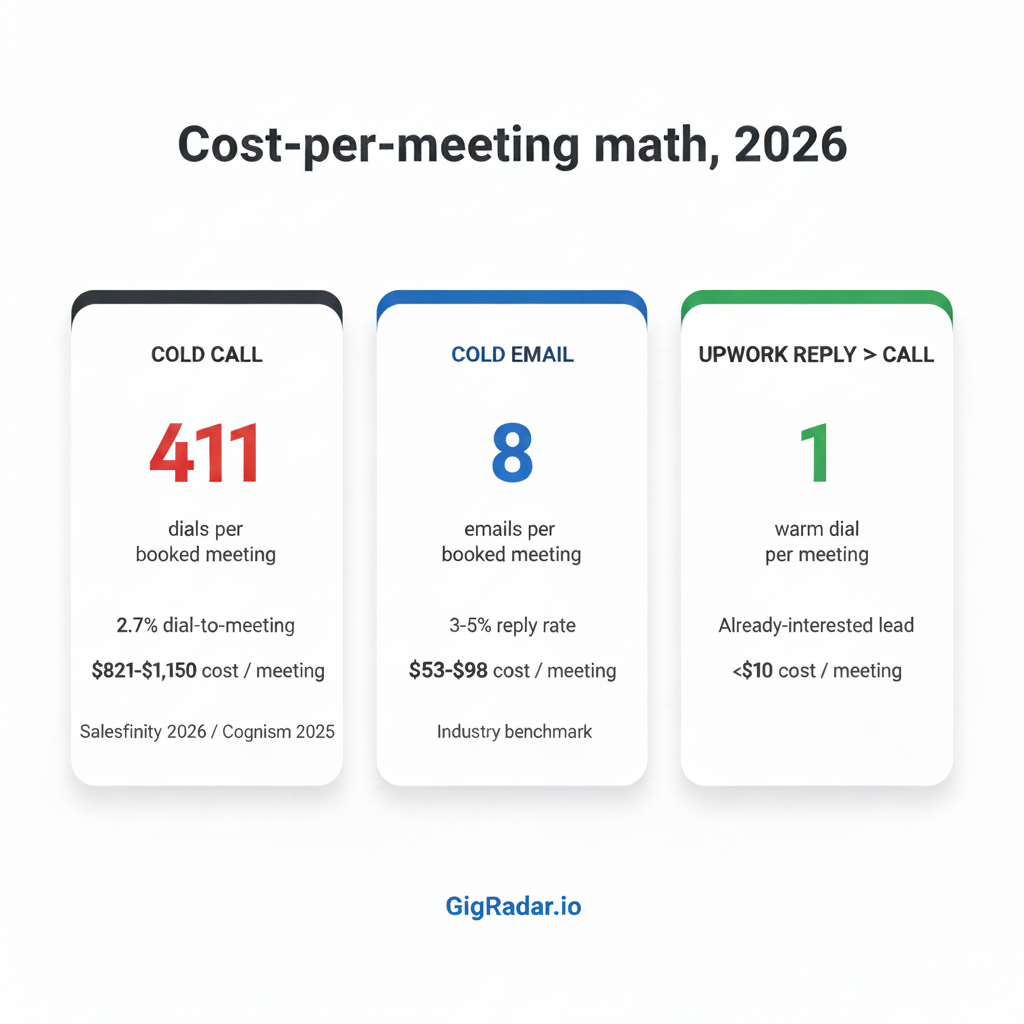
The dollar math is worse. ServiceBell's benchmark of in-house SDR programs puts cost per booked meeting at $821 to $1,150. Outsourced calling lands at $357 to $500. Cold email runs $53 to $98 in DIY mode. For an agency owner doing the math, that's the difference between "cold calling is a profit center" and "cold calling is a logo I keep on my service page."
Cold callers see the math too
This isn't a contrarian take. Walk into r/sales and two of the most-upvoted threads of the past year are mourning the channel.
"Answer rates are dropping. Slowly, but consistently. More people are using features like 'Silence Unknown Callers.' Spam filters are getting better. And now with AI-generated calls hitting the mainstream, I think it's only a matter of time before lawmakers step in like they did with text messaging. We could be heading toward a world where you need permission just to call someone especially in a sales context."
u/MatthewKhela, post body, r/sales, "I Think Cold Calling Is On Its Way Out", 7 August 2025 (550+ upvotes)
"It started with email. Providers have gotten so good at filtering out outreach that almost everything lands in spam. […] Every 'sales guru' says to just 'pick up the phone and start dialing.' But with the introduction of Apple's call screening, how long until that becomes the default for everyone? I've started using it myself, and I haven't answered a cold call since. […] How are you actually finding prospects today? Is outreach truly dead? has the SDR profession simply moved into the history books?"
u/ZangiBangi, post body, r/sales, "Outreach is dead", 23 April 2026 (330+ upvotes)
The interesting part isn't the complaint. It's the path forward. The top-voted replies under "Outreach is dead" all point the same way: networking events, conferences, face-to-face contact. Warm beats cold. Get the prospect to acknowledge you before you reach for the phone.
That's exactly the math Upwork solves for agencies. The platform is the warm-up layer. A reply on a proposal is a prospect who has read your pitch, opened a chat, and given you a name and a budget. Calling that person isn't cold. It's the most legitimate phone-follow-up reason in B2B sales.
Why the phone still works (just not the first dial)
The same datasets that bury cold calling lift it up the moment you change the order of operations. Gong's study found that simply leaving voicemails, even without connecting live, nearly doubled subsequent cold-email reply rates, from 1.81% to 3.44%. Cognism's State of Cold Calling reports that callbacks to previously-contacted prospects have a 26.85% connect probability, more than 4x the cold first-dial rate.
Forrester's buyer-journey research, summarised across multiple sales reports, finds that B2B purchases now take 18+ touchpoints across 4 to 5 channels. The single-channel cold call is fighting math nobody can win. The multi-channel cadence, where the call lands after a prior channel did the warming, is fighting math that's been working since 2015.
Multi-channel cadences with phone as node two (not node one) outperform single-channel outbound by 2x or more in every modern study (Cognism, Salesloft, RAIN Group, Optifai). The phone isn't dead. The cold first dial is.
The Upwork-warmed call sequence: 4 steps, one dial
This is the playbook GigRadar customers run when they layer phone follow-up onto Upwork lead-gen. Every step has a measurable conversion rate. Every step is a warming agent for the next.
The goal of the first contact is the chat invite, not the contract. GigRadar pipeline data shows Upwork reply rates of 8–18% when proposals are matched to fit and sent within minutes. Read the proposal template we use for the reply-first approach.
Don't pitch. Ask. "Quick one, what's the rough timeline you're hoping to hit?" Then: "Happy to walk through how we'd approach this on a 15-min call. Drop your number and a couple windows that work?" About 35–45% of Upwork chats yield a phone number on that ask.
Speed is the difference between a warm dial and a forgotten one. Salesloft's cadence data shows reply-decay starts within the same business day. Two hours later, the prospect is on the next vendor's call.
Five qualifying questions. One scope summary. A booked next-step. The actual close happens on the demo or the proposal call after this one. Pick up the phone to confirm a meeting, not to close one.
What to actually say on the call
This is the opener we recommend in the GigRadar Agency Success course. Copy it. The point isn't the words. The point is that the call's first 8 seconds need to remind the prospect why they're talking to you. Cold-calling habits make even warm prospects suspicious of unknown numbers.
What's happening: you've named the channel that earned the reply (Upwork), the project, and the timeline they gave you. The prospect goes from "who is this?" to "right, the one I messaged" inside ten seconds. That's the entire phone-follow-up game.
Cost-per-meeting across channels (the real table)
The cold-calling-vs-cold-email debate is usually argued on personal preference. Here are the unit economics, sourced from the studies cited above plus GigRadar pipeline data for the Upwork column. Assume one US-based SDR at $5,000/month loaded cost.
| Channel | Activity per meeting | Cost per meeting | Time to first meeting | Best for |
|---|---|---|---|---|
| Cold call (in-house SDR) | ~411 dials | $821–$1,150 | 2–5 days | High-ACV deals, complex demos |
| Cold call (outsourced) | ~411 dials | $357–$500 | 3–7 days | Outbound scale, low-CAC tolerance |
| Cold email (DIY) | ~200 sends | $53–$98 | 4–8 days | Volume top-of-funnel |
| AI SDR | ~varies | $50–$200 | 5–10 days | Cheap experimentation |
| LinkedIn DM | ~150 sends | $80–$140 | 10–16 days | Senior decision-makers |
| Upwork reply → call | ~3 dials per booked call | <$10 | Same day | Agencies with a defined ICP |
Two columns matter. "Time to first meeting" determines how fast your pipeline refills when a client churns. "Cost per meeting" determines how many meetings you can afford. Cold calling loses on both unless the call is warm. The cheapest warming channel in 2026 is a platform that pays you to send the first message.
Free for Upwork agencies
Turn 411 cold dials into 3 warm ones
GigRadar matches your agency to high-fit Upwork jobs and submits proposals from our managed Business Manager. Every reply lands in your inbox with a phone number attached. Your SDRs dial people who already said yes to the chat.
Get Your Free Agency Audit →The agency-success trap behind cold-calling-on-Upwork
The mistake we see most often when an agency with a strong cold-outbound motion lands on Upwork: they copy-paste the cold-call playbook into the proposal. Long pitches. Discovery-call asks. "Let's jump on a 15-minute call" in the cover letter. Result: zero replies, because Upwork buyers are not LinkedIn buyers.
From GigRadar's Agency Success Course: the Rookie Traps for New Agencies lesson explains why the cold-outreach playbook fails on Upwork.
The course lesson lands a single comparison: Upwork is Tinder, not LinkedIn. If the client says "I need a landing page" and you reply with a 17-page deck plus a Calendly link, you've already lost. The two-line message that earns the chat is the warming layer for the phone call that comes after. Reverse the order and the channel breaks.
When cold calling still beats a warm Upwork dial
The honest answer: when your average deal size is $50K+ and your ICP is a named-account list, cold calling is still the fastest path to a high-quality live conversation. RAIN Group's research finds that 82% of B2B buyers accept meetings from sellers who reach out when the timing is right.
For everything below that (agencies selling $5K–$30K projects, sub-$8K monthly retainers, anything where the buyer is comparing 3 to 5 vendors with a fixed budget), the Upwork-reply-then-call path is faster and roughly 80x cheaper per meeting.
If your ICP is enterprise-only with named-account budgets above $100K and your average sales cycle is 6+ months, Upwork is the wrong channel and the warming math doesn't apply. The buyers you want aren't browsing Upwork jobs. They're on LinkedIn, ZoomInfo lists, and your competitor's customer pages, and they pick up the phone for the right pitch.
The take-home, one paragraph
Cold calling in 2026 is a slow, expensive, low-yield channel for B2B agencies. The phone is still the highest-intent live conversation tool in sales, but only when the dial lands on a prospect who's already raised their hand. Upwork is the cheapest way to generate that hand-raise at scale. Calculator above is the unit-economics version of this paragraph. Plug your numbers in. The math will tell you where to send your next 80 hours.
Read the channel-by-channel reply-rate comparison, or get the reply-first Upwork proposal template we use for step 1 of the sequence. For the broader Upwork-as-a-channel argument, see when to use Upwork vs. cold email vs. LinkedIn and cost per lead by channel.