
🎬 11 Account-Based Marketing Examples That Moved Real Pipeline. A 2-minute walkthrough of the campaigns, the three ABM tiers, and why Upwork is the ABM channel most agencies overlook. Watch on YouTube
TL;DR
- The best account-based marketing examples all share one move: a small, hand-picked account list plus a personalized touch. Sendoso and Cradlepoint opened $2.36M in pipeline and 50 demos from a single direct-mail play.
- Directive cut TigerConnect's cost-per-lead 71% on LinkedIn by targeting job titles instead of industries. PathFactory drove a social-commerce SaaS to 129% more pipeline and 167% more revenue won.
- ABM is not one thing. It is three tiers (one-to-one, one-to-few, one-to-many), and a 2 to 20-person agency can run all three if it picks the right tier per account.
- The channel almost no agency counts as ABM is Upwork: the account already posted the job (a live intent signal), so you skip the awareness spend and go straight to a personalized pitch.
- Use the free ABM ROI planner below to size your own play before you spend a dollar on gifting or ads.
A single direct-mail campaign opened $2.36 million in opportunities and booked 50 demos for one B2B company. Not a quarter of ads. Not a year of webinars. One creative package, sent to a hand-picked list of accounts (Sendoso and Cradlepoint case study).
That is the promise buried inside every good account-based marketing example: fewer targets, more relevance, better economics. The problem is that most "ABM examples" articles show you the logo wall and skip the number that matters.
I run GigRadar, and I have watched hundreds of agencies try to buy their way into ABM with a tool and a target list, then wonder why the pipeline never showed up. So this is a list of 11 real account-based marketing examples with the actual results attached, the benchmarks that make ABM worth it, and the one demand channel that behaves like ABM but almost nobody treats that way.
Free Interactive Tool
ABM Tier Planner and ROI Calculator
Enter your target list, deal size, and current win rate. Get a recommended tier, the tactics that fit it, and a benchmark-based revenue projection.
What actually separates ABM from demand gen
Traditional demand gen optimizes for volume: fill the funnel, pass the leads, hope enough convert. Account-based marketing flips the funnel and starts with a named list of best-fit accounts, then treats each one as a market of one (Terminus).
The reason this matters is not philosophy. It is the conversion math. Personalized ABM landing pages convert at 15 to 25% versus 5 to 10% for generic pages, a 2 to 3x lift (GenPage).
Here is the honest version of the comparison, using 2024 to 2026 benchmarks. Read it as "what you trade when you go from casting a wide net to naming your accounts."
| Dimension | ABM (2024 to 2026) | Traditional demand gen |
|---|---|---|
| Starting point | Named list of best-fit accounts | Top-of-funnel lead volume |
| Win rate | Up to 60% higher with account-based ads | Baseline |
| Avg deal size | ~20% larger | Baseline |
| Landing page conversion | 15 to 25% | 5 to 10% |
| Cost per account | High (personalized assets) | Low per lead, high waste |
| Right when | Few, high-value, committee-bought accounts | Many, self-serve, low-value buyers |
Sources: Huble, S2M Group, The ABM Agency, GenPage.
Notice the tradeoff. ABM costs more per account, so it only wins when the deal is big enough and the buyer is a committee, not a credit card. If your service sells to a solo founder for $400, this whole playbook is the wrong tool. If it sells to a VP for $40,000, keep reading.
11 account based marketing examples that moved real pipeline
Every example below is a named, published campaign with a result attached. I have grouped them by tactic, and tagged each with the ABM tier it belongs to, so you can see what is realistic for your team size.
Sendoso and Cradlepoint: direct mail as a door-opener
Cradlepoint needed to break into private companies and public agencies at the same time. A tiered gifting program run through Sendoso opened $2.36M in opportunities and booked 50 demo meetings from a single campaign, with follow-ups adding $530K in influenced pipeline (Sendoso).
Tier: one-to-one / one-to-few. Best when deal value justifies a physical touch.
Directive and TigerConnect: LinkedIn ABM by job title
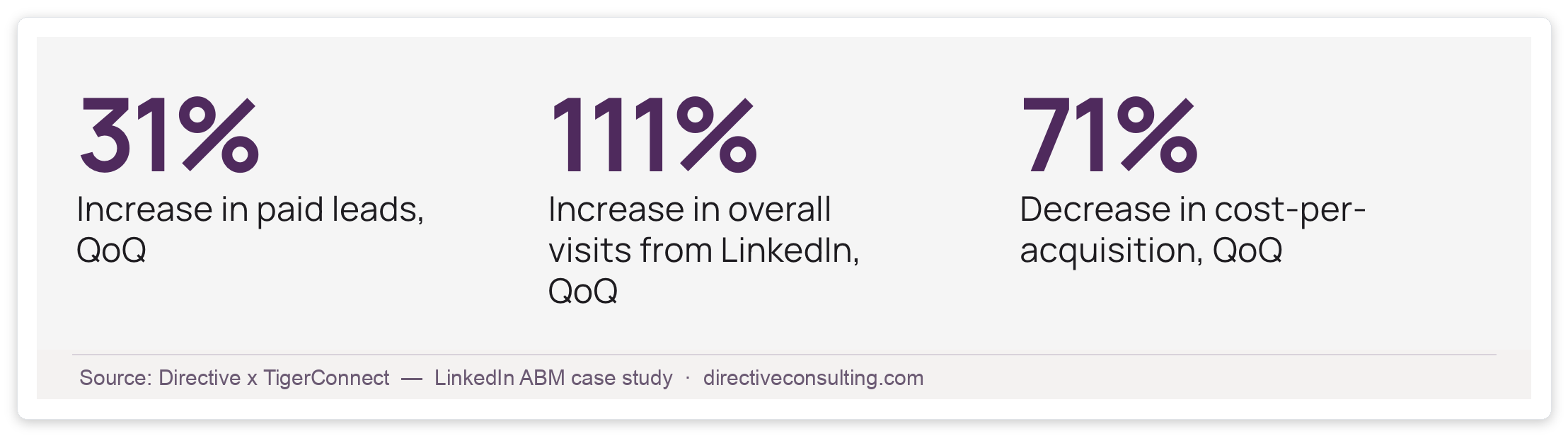
Directive ran LinkedIn ads for a healthcare communication company, then layered ABM on top by targeting specific companies, job titles, and medical skill sets. Targeting by job title (not industry) delivered the most leads at the lowest cost: a 71% drop in cost-per-action, a 31% rise in paid leads, and 111% more LinkedIn visits on only 15% more spend (Directive).
Tier: one-to-few. The most agency-friendly example on this list.
PathFactory and a social-commerce SaaS: content intelligence
By tracking how target accounts actually consumed content and tailoring journeys around it, the program hit 129% more pipeline generation, 57% more opportunities created, and 167% more revenue won (PathFactory).
Tier: one-to-few. Proof that "what they read" beats "what you pushed."
The ABM Agency and Payscale: concentrate the traffic
After shifting to account-based tactics, Payscale saw a 6x increase in revenue ROI and a 500% increase in target-account traffic (The ABM Agency).
Tier: one-to-few. The point is driving the RIGHT accounts to a page, not more accounts.
Inverta: insight-led one-to-one
Deep account research, personalized content, and tight sales alignment for a defined target set drove roughly $1.3M in pipeline (Inverta).
Tier: one-to-one. Research is the tactic, not an afterthought.
Demandbase and Thoughtworks: AI-driven segmentation
Thoughtworks used Demandbase to align its segmentation strategy, streamline sales focus, and surface AI-powered account insights, replacing manual list-building and generic vertical targeting with intent-based cohorts (Demandbase).
Tier: one-to-few / one-to-many. Segmentation is the product here.
BT Global Services: 100 iPod Shuffles for 100 security chiefs
BT sent 100 Chief Security Officers an iPod Shuffle pre-loaded with audio interviews on security themes, tying a memorable physical gift to content the recipients actually cared about (Demandbase).
Tier: one-to-few. The gift carried the message, not just a logo.
Ariba: the remote-control Porsche with a catch
Ariba shipped executives a remote-control Porsche Boxster, but held back the controller. To get it, the prospect had to attend an event or take a meeting: a "give to get" that tied the gift to a concrete action (Demandbase).
Tier: one-to-one. Gifting only works when it earns the next step.
Inkling: the die-cut gift you unlock with a demo
Inkling mailed a die-cut printout of a gift (an Amazon Echo) with a note: take the demo and the real device ships. It is the same "give to get" logic as Ariba, at a fraction of the cost (Demandbase).
Tier: one-to-few. Proof you do not need a big budget to run this play.
Uberflip: one hub, one account
Uberflip curated a single content hub for one high-value account, so every case study, video, and asset spoke to that company's exact vertical and role mix. Its gifting play for onboarding hit an 80% completion rate (Uberflip).
Tier: one-to-one. A personalized hub is a microsite you do not have to build from scratch.
StrategicABM: one-to-few for AVEVA, Acxiom, and BlueBotics
StrategicABM builds cluster-based programs, wrapping groups of similar accounts in coherent, multi-channel narratives across email, social, events, and direct mail for brands like AVEVA, Acxiom, and BlueBotics (StrategicABM).
Tier: one-to-few. The scalable middle most agencies should live in.
The three ABM tiers, and which one you can actually run
The examples above are not random. Each sits in one of three tiers, defined by how many accounts you target and how much you personalize per account (N.Rich).
One-to-one
Under ~20 strategic accounts
Bespoke microsites, direct mail, executive dinners. Highest cost per account, highest impact. Examples: Ariba, Uberflip, Inverta.
One-to-few
Clusters of similar accounts
Semi-personalized by industry or challenge. The scalable middle. Examples: Directive, PathFactory, StrategicABM.
One-to-many
Hundreds of accounts
Account-based ads and dynamic pages at scale, driven by intent data. The warm-up layer. Example: Demandbase segmentation.
A 2 to 20-person agency should live in one-to-few, reserve one-to-one for its top 5 to 10 accounts, and use one-to-many only to warm a broader list before promoting the best-fit accounts up a tier. Trying to run one-to-one across 100 accounts is how small teams burn out and blame ABM.
The ABM channel most agencies overlook: Upwork
Here is the uncomfortable part. Every example above spends real money to manufacture something Upwork gives you for free: an in-market account raising its hand.
When a client posts a job, that is the single strongest intent signal in B2B: budget, need, and timing, all declared in public. You are not buying awareness or guessing at fit. You are choosing which already-interested accounts to pursue and how personally to pitch them. That is account-based marketing with the hardest step already done.
Upwork even hands you the firmographics an ABM platform charges for. You can filter by payment-verified status, total spend, hire history, average hourly rate paid, and client rating, then send a proposal written for that exact account. It is one-to-one ABM at small-business scale, minus the microsite budget. For the full channel comparison, see our breakdown of cold outreach reply rates by channel and when to use Upwork versus cold email.
The catch is the same one that sinks expensive ABM: generic beats nobody. Our own pipeline data makes that painfully clear.
We analyzed 133,872 outbound proposals from GigRadar's pipeline (December 2025 to February 2026). Proposals bid at under half the client's budget replied at 20.6%, while budget-matching bids replied at just 8.8%. Opening the note with a question added another 3.08 percentage points in our 30-feature model. The lesson is the same as the ABM lesson: relevance and positioning win, generic loses.
Source: GigRadar internal pipeline data, 133,872 proposals, Dec 2025 to Feb 2026.
Compare that cost per conversation to a $2.36M direct-mail program. For agencies selling marketing or lead-gen services, a personalized reply on Upwork costs the price of a lunch. That is why we treat it as the most under-priced ABM channel in B2B, and why the agencies winning on Upwork are running account-based discipline, not spray-and-pray.
Where GigRadar fits
GigRadar runs the account-based part of Upwork for agencies through a real Upwork Business Manager account. Your agency invites our BM through Upwork's official invitation flow, the same role you would use to onboard a hired bidder.
Proposals submit from our BM under our team's supervision, so your own freelancer account is never touched. If Upwork reviews a submission, the review lands on our BM profile, not yours. You get the account selection and personalized outreach of ABM, without buying a gifting platform or building a microsite.
Free for Upwork agencies
Turn Upwork into your best ABM channel
Target payment-verified, best-fit clients and send account-personalized proposals at scale, run from our supervised Business Manager. Your account stays untouched.
Get Your Free Agency Audit →The five mistakes that make ABM fail
Most failed ABM programs fail the same handful of ways. Every one of these shows up in the benchmark research, and every one is avoidable.
A one-off LinkedIn burst with no sales follow-up is not ABM, it is a media experiment. ABM is an operating model. Companies with aligned sales and marketing see 24% faster revenue growth over three years (The ABM Agency).
41% of marketers name poor targeting as a top reason they lose customers (Madison Logic Harris Poll). In ABM, a bad list wastes a concentrated budget. Directive proved job-title targeting beat industry targeting outright.
Loading an account list into an ad platform and serving everyone the same creative is not ABM. Without personalization you lose the 2 to 3x conversion lift that makes ABM worth the cost.
Impressions and clicks do not pay salaries. Teams with sophisticated ABM measurement see 41% higher win rates and 27% higher margins (S2M Group). Measure account-level pipeline and revenue, not reach.
A gift with no follow-up, or a microsite the sales team never mentions, wastes the whole play. The winning examples orchestrate touches into one journey. Our guide to omnichannel outreach coordination covers the sequencing.
Your first 30-day ABM play, step by step
You do not need a platform contract to start. Here is a 30-day sequence a small agency can run with a spreadsheet, a landing page, and its existing outreach.
Define one tight ideal customer profile. List 20 named accounts that fit on revenue, industry, and a real trigger (funding, a hire, a job post). Get sales to sign off on the list.
Group the 20 into 3 or 4 clusters. Write a value proposition and one personalized asset per cluster (a landing page or a short teardown), not per account. That is one-to-few.
LinkedIn ad or connection, then a personalized email, then a direct outreach on the channel where the account is in-market. On Upwork, that means a scoped proposal on their live job. Sequence, do not blast.
Track engaged accounts, meetings booked, and pipeline created, by account. Promote hot accounts to a one-to-one touch. Cut cold ones and refill the list.
Take-home: your ABM account-selection checklist
Download the 12-point checklist as a CSV and score every account before it goes on your list.
Account based marketing examples: FAQ
What is a simple example of account-based marketing?
Pick 20 named target companies, build one personalized landing page and message per small cluster of them, then run a coordinated LinkedIn, email, and direct-outreach sequence at just those accounts. Directive did exactly this on LinkedIn for TigerConnect and cut cost-per-lead 71%.
What are the three types of ABM?
One-to-one (under ~20 strategic accounts, fully bespoke), one-to-few (clusters of similar accounts, semi-personalized), and one-to-many (hundreds of accounts via account-based ads and intent data). Most small agencies should center on one-to-few.
Does ABM actually outperform demand gen?
On the right accounts, yes. Top marketers report 81% higher ROI, personalized pages convert 2 to 3x better, and average deal size runs about 20% larger. It underperforms when the deal is small or the buyer is a single self-serve user.
Can a small agency run ABM without a big platform?
Yes. A spreadsheet for the account list, LinkedIn for targeting, a landing-page builder, and an e-gifting vendor cover most of it. Inkling's die-cut-gift play shows you can run "give to get" on a tiny budget.
How is Upwork an ABM channel?
A posted job is a declared intent signal from a specific account. You can filter by firmographics (payment-verified, spend, hire history) and send a proposal written for that account, which is one-to-one ABM with the awareness step already done. See our channel reply-rate comparison.
What is the most common ABM mistake?
Running it as a one-off campaign with no sales alignment and no personalization, then measuring clicks instead of account-level pipeline. That turns ABM back into spray-and-pray with a nicer label.
Account-based marketing works because it does the opposite of what most funnels do: it starts with who, not how many. The examples that moved millions all picked a short list and made each account feel singled out. You can copy that discipline this month, and if you sell to Upwork buyers, the hardest part (finding in-market accounts) is already done for you. Related reading: scaling GTM without paid ads and B2B lead generation software.