🎬 B2B Outreach Best Practices: Upwork vs Cold Email vs LinkedIn (2026 Data). The cost-per-meeting math across three channels, with a decision tree by agency deal size. Watch on YouTube
TL;DR
- Cold email reply rate has crashed from 6.8% in 2023 to 3.43% in 2026. That is a 49% decline driven by Gmail's bulk-sender enforcement and inbox saturation.
- Upwork reply rate sits at 7.45% (GigRadar pipeline benchmark, 133,872 proposals) with top-quartile teams hitting 12–17%, and CAC of $150–400.
- LinkedIn InMail averages 10–25% reply rates but caps at 200–400 connection requests/week per account, so it cannot scale past 3–5 operators.
- For agencies under $30K/month MRR, the math is decisive: 50% Upwork, 25% referrals, 15% content, 10% cold email. Skip LinkedIn unless deals exceed $5K.
- The cost-per-meeting calculator below gives you the dollar number for your specific deal size and reply rate so you stop guessing.
In 2026 the average B2B cold email costs $1,500–$15,000 per booked meeting at industry-average reply rates. The agencies still defaulting to it are funding a habit, not a pipeline.
The relative economics of the three channels (cold email, Upwork, LinkedIn) have flipped twice since 2023. Most agencies are running the 2021 playbook in a 2026 market.
The framework below is based on aggregate data across 133,872 Upwork proposals from GigRadar's customer pipeline, the Instantly 2026 cold email benchmark, and Cleverly's LinkedIn outreach benchmarks.
The 2026 reply-rate hierarchy is settled, but the headlines hide the trap
Here's the data on average reply rate across each channel for B2B agency outreach. The spread is wider than people realize.
| Channel | Avg reply rate | Top-quartile | Cost per reply | Time to first reply |
|---|---|---|---|---|
| Cold email | 3.43% | 10–15% | $65–75 | 24–48h after warmup |
| Upwork outbound | 7.45% | 12–17% | $16–48 | Same day (often <1h) |
| LinkedIn InMail | 10–25% | 30–40% | $6–15 | 24–72h |
Sources: Instantly 2026 benchmark report, GigRadar pipeline data Dec 2025–Feb 2026, Cleverly LinkedIn benchmarks.
Read this table once and you'd think LinkedIn wins everything. That's the trap.
Reply rate is the input metric, not the output. The output is cost per booked meeting, and that depends on three things the headline rate ignores: how many people in your ICP actually use the channel, how the channel scales, and how much infrastructure you have to buy before you can send.
A 25% LinkedIn reply rate sounds amazing until you realize Sales Navigator caps you at ~150 InMails/month per seat: 37 replies/month maximum per operator. Cold email at 3.43% on 50/day delivers 51 replies/month at the same throughput, with completely different infrastructure cost.
Why cold email reply rates collapsed (and aren't coming back)
The structural shift happened in February 2024 when Google and Yahoo enforced their bulk-sender authentication requirements. SPF, DKIM, DMARC, and one-click unsubscribe became mandatory at 5,000+ daily emails.
Most cold email programs failed silently. Their tools "sent" the emails but never authenticated them properly, so messages went to spam without any visible bounce.
That deliverability hit alone cost 5–10 points. The deeper problem is on the buyer side.
B2B decision-makers now receive over 120 sales emails per week, up from 35 in 2020. They've trained themselves to skim and delete anything that pattern-matches "agency pitch."

What people miss when comparing cold email to Upwork: the 3.43% rate is itself a survivor-bias number that only counts campaigns reaching the inbox. Average inbox placement in 2026 is 89%, meaning 11% of "sent" emails never arrive.
Effective reply rate against the list you actually bought is closer to 3.05%.
The cost-per-meeting calculator (use this before you allocate budget)
Interactive Tool
Channel cost-per-meeting calculator
Enter your numbers. The tool computes which channel actually wins for your specific deal size, target meeting volume, and reply-to-meeting conversion.
Run your numbers above. The winner is rarely the channel with the highest reply rate; it is the channel with the lowest infrastructure cost relative to your target volume.
When Upwork wins (and why most agencies underweight it)
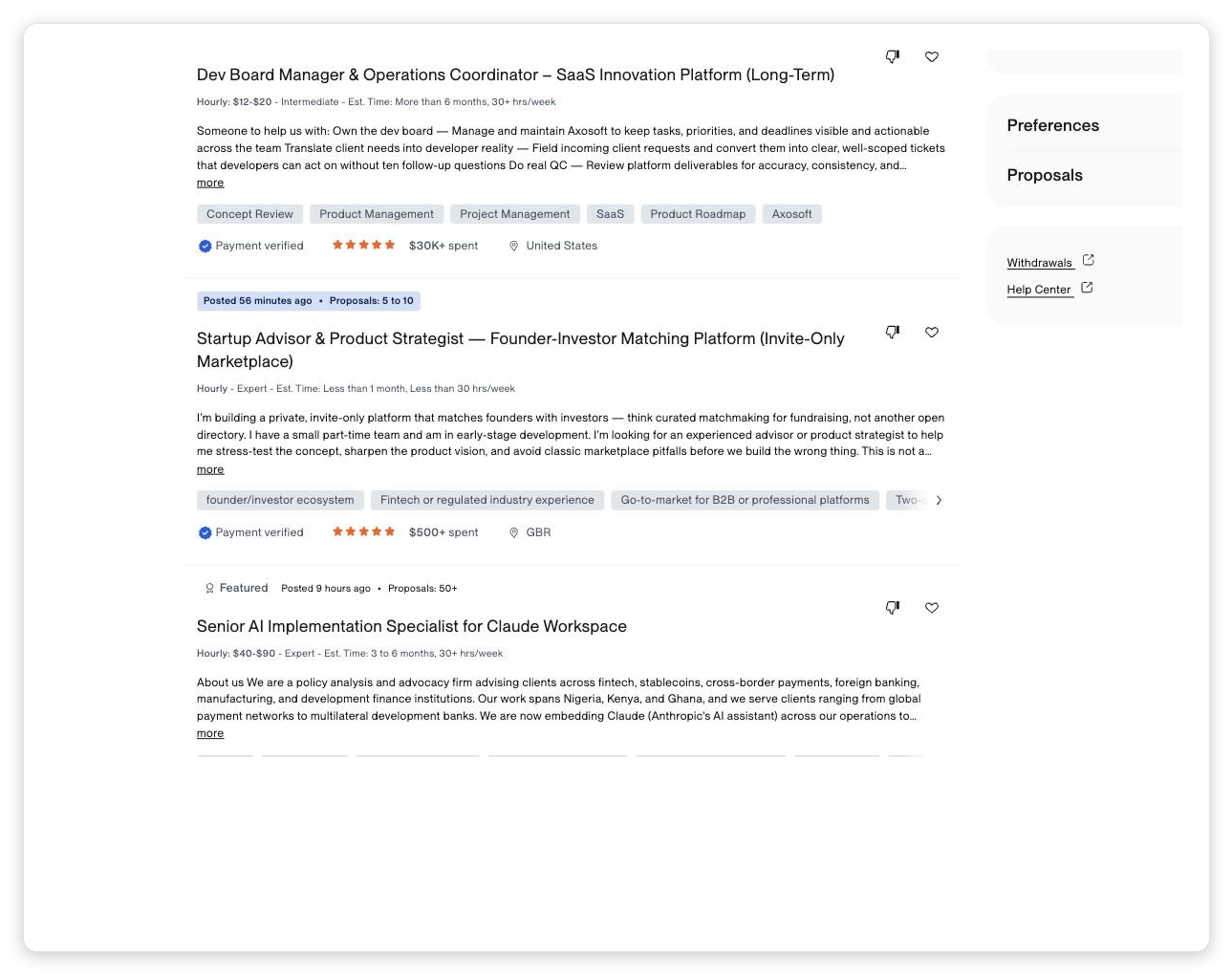
Upwork wins for any agency with average deal size $3,000–$30,000 that needs pipeline this month. The mechanism is buyer pre-qualification: the client posted a job, defined scope, set a budget, and verified payment before you ever appeared.
None of that is true on cold email. None of it is true on LinkedIn outbound.
A job post means the buyer already lost the "do we hire?" debate internally. Cold email targets people who haven't even decided to spend yet.
Upwork guarantees message delivery. No SPF, no DKIM, no warmup tools, no $300/month per inbox. Just $0.60 per connect.
Top-quartile teams who respond within 5 minutes of a job posting see 8.99% reply rate versus 5.34% for those bidding 30+ minutes after.
Because the budget is already approved. Compare to cold email's 5–10% close rate from positive replies, where you still have to convince the buyer to allocate budget.
Most marketing agency owners come from a paid-media background and treat Upwork as "freelancer marketplace" beneath them. The pipeline math does not care about status anxiety.
Upwork's $60–72 cost per lead is the cheapest acquisition channel I've benchmarked outside referrals. The one trap: Upwork carries account-suspension risk if you violate the platform's automation rules.
Stay manual or use platform-compliant tools. Never let a single channel exceed 30% of your revenue, and read the automation safety breakdown before you touch any browser extension.
When cold email wins (and it's a smaller window than the gurus admit)
Cold email wins for one situation only in 2026: named-account outbound to enterprise targets, where the average deal size is north of $30,000 and you need to reach specific people who never post on Upwork.
The reason cold email survived the 2024 deliverability collapse at the enterprise level is that high-deal-size senders run small lists with deep personalization. A 50-account ABM list, with hand-researched openers tied to recent funding rounds or leadership changes, generates 10–15% reply rates because the message actually feels like 1:1 outreach.
Below $30K deal size, cold email infrastructure eats the margin. A 20-inbox program runs $604–$1,122/month before labor, and at 3.43% reply rate with 10% close rate you need 1,470 sends per closed deal. The unit economics do not clear on $5K contracts.
What separates the agencies who still make cold email work in 2026 from the ones burning $5K/month on broken sequences:
- Deep personalization, not "hey {firstname}". Every email references something specific that happened to the recipient in the last 30 days.
- Named accounts (50–200), not lists (5,000+). Generic blasts get filtered. Specific outreach lands.
- Multi-channel sequences. Email + LinkedIn touch + occasional phone. Single-channel cold email ROI has been negative for two years.
- Dedicated IPs and pre-warmed domains. Shared IPs are reputation roulette. Investment matters.
- Two-line subject lines under 27 characters. The single highest-leverage variable on open rate.
If you don't have all five, your cold email program is bleeding budget. The cold email subject line breakdown covers the open-rate math, and the email warmup tools comparison covers infrastructure.
When LinkedIn wins (and why volume is the catch)
LinkedIn wins on quality. A LinkedIn reply is a higher-intent reply than a cold email reply because the recipient has self-identified as professionally active, has a verified employment record, and showed up in the platform's professional context.
The numbers back this up: 14–18% of LinkedIn replies convert to meetings versus 4–8% for cold email. That's a 2–4.5x quality lift on the same funnel stage.
The catch: LinkedIn's volume ceiling is brutal. Connection request limits cap at 200–400/week per established account, drop to 50/week for new or low-acceptance accounts, and InMail credits run 15–50/month depending on subscription tier. To hit the same throughput as one cold email operator (250 emails/day), you'd need 5+ LinkedIn operators with separate Sales Navigator licenses.
That doesn't make LinkedIn wrong. It makes LinkedIn a precision channel, not a scale channel. Use it for the warmest 20-30% of your ICP, accounts where personal connection beats volume, and pair it with one of the other two for breadth.
For agencies running paid LinkedIn programs, see the LinkedIn automation breakdown on what the platform actually flags versus what people fear.
The decision tree (use this, not your favorite channel)
Match the channel to the agency's deal size and stage. Below is the allocation I'd recommend at three common revenue tiers.
Primary: Upwork at 50% of pipeline. Add referrals (25%), content (15%), cold email (10%) only after you exceed $50K MRR. Skip LinkedIn for now.
40% cold email, 30% Upwork, 20% content/SEO, 10% referrals. Cold email becomes viable here because $1,500 CAC clears on $25K+ deals. Add LinkedIn for the top 50 accounts.
Cold email + LinkedIn primary, Upwork irrelevant. Enterprises don't post on Upwork. Run signal-anchored ABM with 50–200 named accounts, multi-touch sequences over 3 weeks.
The principle is consistent: channels are budget categories, not religions. The agencies hitting $1M+ ARR have all done the math and rebalanced when it stopped working. The agencies stuck under $300K ARR are usually defending a 2021 channel mix in a 2026 market.
Free for Upwork agencies
Skip cold email warmup. Get pipeline this week.
GigRadar's Upwork business manager submits proposals from our supervised account on your behalf. Same buyer pool, no infrastructure tax, first-reply same day.
Get Your Free Agency Audit →The risk profile every channel hides until you're committed
Reply rate is one input. Failure mode is the input that determines whether your pipeline survives a bad quarter.
| Channel | Failure mode | Recovery time | Severity |
|---|---|---|---|
| Cold email | Domain burn (>2% bounce) | 2–4 weeks new domain warmup | Medium. Recoverable |
| Upwork | Account suspension (ToS) | Appeal: 2 days, 30% success | High. Pipeline disappears |
| Soft restriction (24–72h) | ID verification, 1st-time pass | Medium. Multi-account distributes |
Upwork's account-suspension risk is the existential one. If 50% of your pipeline runs through one BM-invited account and Upwork suspends, you have zero pipeline tomorrow. The mitigation is structural: never let any single channel exceed 30% of revenue, and run two channels in parallel even when one is winning.
Cold email's domain burn is recoverable. New domains cost $15–30 and reputation rebuilds in 2–4 weeks.
The compounding risk is that most agencies don't realize their reputation is degrading until inbox placement falls below 80%, which can take 3 months of bounce-spike accumulation.
LinkedIn's account restriction is the least painful because each operator has a separate account. One ban doesn't kill the channel.
The risk is reputational: once flagged, accounts often see permanent algorithm throttling that's invisible to the user.
What the top 10% of agencies actually do (and you should copy)
The 2026 pattern from the agencies hitting $1M+ ARR while their peers stagnate at $300K is not "they picked the right channel." It's that they orchestrate two-to-three channels in coordinated sequences instead of treating each as a silo.
- Email first, LinkedIn 2–3 days later. Email establishes presence and detail. LinkedIn provides the credibility check that accelerates the meeting booking from interested to committed.
- Upwork in real time, alongside everything else. Upwork captures demand that already exists. The other channels create demand. Different jobs, different timing.
- Channel-specific copy, not the same template. The "I help [audience] do [outcome]" line that works in cold email reads as desperate on LinkedIn. The personal opener that works on LinkedIn reads as casual in a cold email subject line.
- Cohort tracking by channel of origin. Same lead source, completely different LTV. LinkedIn-sourced leads I see often outrank Upwork-sourced ones on retention. Upwork-sourced ones rank higher on initial deal size.
- Quarterly rebalancing. The mix that worked in Q1 may underperform in Q3. Reply rates drift. Cost-per-meeting drifts. The agencies that rebalance quarterly outperform those that lock in a "winning" mix.
If you take one thing from this article: stop running one channel because it's familiar. Run the cost-per-meeting calculator above with your real numbers, pick the two channels that come out cheapest for your deal size, and rebalance every 90 days when the data tells you to.
The reply rate hierarchy in 2026 is settled. Most agency owners just haven't updated their playbook yet.
For the deeper Upwork mechanics, see our data-backed bidding strategy framework. The marketing agency lead generation playbook covers the full multi-channel allocation.
For agencies coming from a referral-only world, the B2B lead generation guide walks through the first 90 days.