🎬 Upwork Outreach: Why You Lose in 7 Minutes (133K Proposals Analyzed) — We analyzed 133,872 proposals to find the exact minute reply rates collapse and what top agencies do differently. Watch on YouTube
TL;DR
- Upwork outreach is a speed and targeting problem, not a volume problem. Agencies bidding within 5 minutes reply at 8.99%. Wait 7 minutes and it drops to 6.47%.
- The average agency reply rate is 7.45% across 133,872 proposals. Top quartile hits 12.86%. The gap is system, not talent.
- Opening with a question lifts reply rate +479% vs bottom-quartile agencies. "Just saw your post" adds +3.47 percentage points over baseline.
- Naming your job scanner by outcome ("email marketing for SaaS") instead of tech stack ("React developer") adds +2-3pp to reply rate.
- The Business Manager model lets agencies automate outreach end-to-end through Upwork's native invitation system. No browser extensions, no account sharing, no TOS violations.
You are not losing on Upwork because your proposals are bad.
You are losing because you are 7 minutes late.
I know this because we tracked 133,872 outbound proposals across GigRadar's pipeline (Dec 2025 to Feb 2026) and mapped exactly when each one was sent relative to when the job posted.
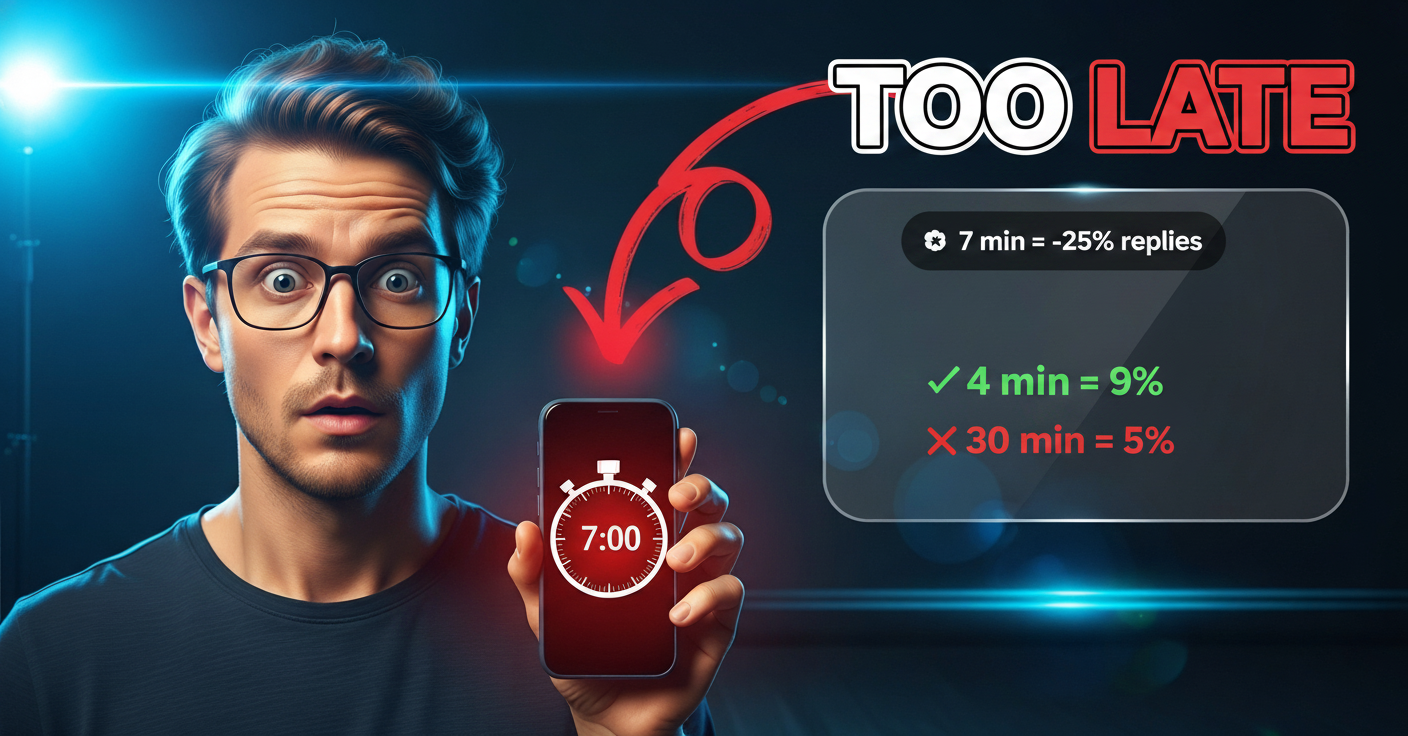
The reply rate at 4 minutes: 8.99%, at 7 minutes: 6.47%, at 30 minutes: 5.34%.
Every Upwork outreach guide you have read tells you to "personalize your proposals." That is true but incomplete.
Personalization is table stakes. The variable that actually separates a 3.76% agency from a 12.86% agency is system design: how fast you see jobs, how you filter them, what your first sentence says, and whether a human is reviewing each bid at 2 AM.
This article breaks down the complete upwork outreach system that top-quartile agencies run. First-party data from our pipeline, with the specific numbers and patterns most Upwork content never touches.
The 5-minute cliff: why speed is your highest-leverage outreach variable
Most agencies treat proposal speed as a nice-to-have. The data says it is the single largest controllable lever in your entire outreach system, and Upwork Community forums are full of freelancers discovering this the hard way.
We pulled 59,339 proposals with full timestamp chains (job published → proposal sent) and mapped reply rate by minute. It is not a gentle slope; it is a cliff.
Source: GigRadar pipeline data, n = 59,339 proposals with full timestamp chain, Jan-Feb 2026.
This pattern mirrors what Harvard Business Review found in sales leads: response time is the single largest predictor of conversion.
The practical takeaway: if your system cannot submit within 5 minutes of a job posting, aim for the 12-15 minute window instead. The 5-10 minute valley is the worst possible timing.
What top-quartile agencies actually do differently (and it's not what you think)
We sorted 322 GigRadar customer teams by reply rate and compared what the top 25% do versus the bottom 25%. The results contradicted most of the advice you will find on YouTube.
| Behavior | Bottom Quartile (3.76%) | Top Quartile (12.86%) | Relative Lift |
|---|---|---|---|
| Opens with a question | 2.4% of proposals | 14.2% of proposals | +479% |
| Uses client's first name | 15.1% | 29.1% | +93% |
| Mentions Loom video | 7.6% | 13.6% | +78% |
| Any video offer | 13.4% | 22.0% | +64% |
| Opens with emoji | 11.7% | 6.4% | -46% |
| Bullet list anywhere | 30.3% | 20.7% | -32% |
| AI-cliché phrase count | 0.167 per CL | 0.125 per CL | -25% |
Source: GigRadar pipeline data, 322 teams with ≥100 proposals each, Dec 2025 – Feb 2026.
The single biggest differentiator is the question opener. Not mentioning your portfolio, not listing your skills: asking a specific question about the client's project.
Here is what this looks like in practice.
❌ Bottom quartile opener
"I came across your job posting and I believe I'm a great fit. I have 7+ years of experience in web development and have worked with similar projects..."
Reply rate: 3.6%
✅ Top quartile opener
"Just saw your post. Are you building the checkout flow from scratch, or refactoring what's already there? That changes the timeline significantly."
Reply rate: 10.92%
Notice what the top version does: it proves the bidder read the job description, surfaces a decision the client needs to make, and creates a reason to reply. No credentials, no experience dump, no bullet list of skills.
Free Upwork Outreach ROI Calculator
Before you change anything about your outreach system, know your current numbers. This calculator shows your cost per reply and cost per hire based on your actual connect spend, proposal volume, and reply rate.
Upwork Outreach ROI Calculator
Connects cost calculated at current Upwork pricing ($0.15/connect). Time cost assumes $50/hr opportunity cost; ROI = (monthly revenue from hires) / (monthly connect spend + time cost).
Your job scanner is the real outreach strategy
Most agencies think of Upwork outreach as a proposal problem. It is a filtering problem.
The scanner (or saved search) that decides which jobs hit your inbox determines your reply rate before you write a single word.
We analyzed scanner configurations across our customer base and found a pattern that nobody talks about: how you name your scanner predicts your reply rate.
| Scanner Name Pattern | n (proposals) | Reply Rate | Lift vs Base |
|---|---|---|---|
| "video" / "animation" / "motion" | 1,106 | 10.76% | +3.81pp |
| "ads" / "paid media" | 3,384 | 9.66% | +2.81pp |
| "USA" / "North America" | 6,266 | 8.62% | +1.79pp |
| "email" / "Klaviyo" | 3,226 | 8.31% | +1.36pp |
| "shopify" | 1,647 | 6.07% | -0.97pp |
| "wordpress" / "WP" | 1,051 | 4.95% | -2.11pp |
| "react" | 2,990 | 3.71% | -3.48pp |
Source: GigRadar pipeline data, 59,339 proposals by scanner name keyword, Jan-Feb 2026.
This is not about the scanner name itself. The name reflects what the scanner targets.
Scanners built around outcomes ("video production for SaaS," "email marketing for eCommerce") point at Sales & Marketing category jobs, which reply +3pp better than the saturated Web Dev pool. Scanners built around frameworks ("React," "WordPress") point directly at the most competitive lanes on the platform.
The daily outreach system that top agencies run
Stop thinking about Upwork outreach as "sending proposals." Think about it as running a pipeline. The agencies hitting 12%+ reply rates all follow a version of this system.
Job scanning (continuous, automated)
New jobs matching your criteria surface within 2-3 minutes of posting via a scanner with keyword + budget + client history + payment verification filters running continuously. Why RSS feeds are not enough for agencies.
Job scoring (instant, before a human sees it)
Not every matching job is worth a proposal: score by client payment verification status, hire rate above 50%, budget above your floor, fewer than 15 existing proposals, posted within the last hour. How to read hidden budgets on Upwork.
Proposal drafting (AI-assisted, human-reviewed)
AI reads the job description, the client's history, and your case study library and generates a draft that opens with a specific question. A human reviews and adjusts before submission: 2-3 minutes per proposal instead of 25-30.
Submission (within the 5-minute window)
The proposal submits while the job is still fresh, and first-mover advantage is real: +2pp reply rate for bids landing in the first 5 minutes. How to budget your connects for speed.
Follow-up (24-48 hours, one touch)
A single follow-up message 24 hours after submission: a relevant case study link, a quick Loom walkthrough, or a specific question you forgot to ask. How to message on Upwork and get a reply.
Analytics review (weekly, 30 minutes)
Track reply rate by scanner, time-to-submit, connect spend vs hires, and cost per hire by category, then kill underperforming scanners and double down on the lanes producing replies. Set up your proposal analytics dashboard.
Manual vs automated outreach: the real numbers
The debate over manual vs automated Upwork outreach usually misses the point. The question is not whether to automate, but what to automate.
| Metric | Manual (VA + spreadsheet) | Automated pipeline |
|---|---|---|
| Proposals per day | 3-5 per seat | 20-50 per scanner |
| Time per proposal | 25-35 minutes | 2-3 minutes (review only) |
| Time-to-bid from job posting | 1-4 hours (VA checks periodically) | 3-5 minutes (automated detection) |
| Coverage (hours/day) | 8-10 hours (VA working hours) | 24 hours (continuous scanning) |
| Reply rate (typical) | 4-8% | 8-15% (speed + targeting lift) |
| Monthly connect spend | $30-80 | $100-300 |
| Monthly VA/labor cost | $800-2,000 | $0 (time redirected to closing) |
| Effective cost per hire | $400-800 | $100-250 |
The cost per hire difference is not about volume. It is about the speed advantage and the 24/7 coverage.
A VA checking Upwork every 2 hours misses 80% of the first-mover windows. An automated scanner catches all of them.
Upwork's rules on outreach automation (what's allowed, what's not)
Upwork's Terms of Service draw a clear line. Understanding it matters because crossing it gets your agency suspended.
✅ Allowed
- Job search and filtering automation
- AI-assisted proposal drafting
- Client research and data gathering
- Follow-up message scheduling
- Performance analytics and time tracking
- Any workflow where a human reviews each proposal before submission
Source: Upwork Terms of Service
❌ Not allowed
- Fully automated submissions without human review
- Bot-generated spam messages
- Fake reviews or testimonials
- Mass messaging to clients
- Browser extensions that submit proposals on your behalf
- Sharing login credentials with third-party tools
Flags: identical phrasing across proposals, inhuman submission speed, bids outside your skill category.
The key phrase is "human-in-the-loop." Upwork explicitly allows AI-assisted proposal writing, but they do not allow fully automated submission.
This is where the Business Manager model becomes relevant. Two compliant architectures exist for agency-scale outreach, both documented in Upwork's Business Manager help center.
| Architecture | How it works | Who submits | TOS status |
|---|---|---|---|
| Filter-and-draft | Tool finds jobs, drafts proposals. Freelancer reviews and clicks Submit from their own account. | The freelancer | Compliant |
| Business Manager model | Agency invites a BM through Upwork's native system. BM submits proposals under their own identity with human oversight. Agency account is never touched. | The invited BM | Compliant |
GigRadar operates the Business Manager model. Your agency invites our BM through Upwork's official invitation flow, and proposals submit from our BM's own account under our team's supervision.
Your freelancer account is never touched, and if Upwork reviews a submission, the review lands on our BM profile, not yours. Read the full technical breakdown.
Free for Upwork agencies
Stop browsing Upwork manually. Start running a pipeline.
GigRadar's Business Manager scans, scores, drafts, and submits proposals across your agency 24/7. You review, we handle the rest.
Get Your Free Agency Audit →The opener phrases that actually move reply rate
Your cover letter opener is not a formality. It is the highest-signal element in your entire proposal.
We tested specific opener phrases across 133,872 proposals and found a +5.5 percentage point swing between the best and worst versions of the same idea.
Source: GigRadar pipeline data, n = 133,872 proposals, Dec 2025 – Feb 2026.
Active immediacy ("just saw") beats passive serendipity ("came across," "stumbled upon"). The first signals you are paying attention right now; the second sounds like an accident.
Upwork outreach vs cold email: where to put your budget
Agency owners running outbound often ask whether Upwork or cold email is the better channel. The data makes a strong case for Upwork as the primary channel for agencies under $50K/month in revenue.
The CAC difference comes from buyer intent. A cold email lands in the inbox of someone who never asked for your help.
An Upwork job post is a buyer who has already secured budget, defined the scope, and decided to hire. Cold email averages 3-5% reply rates according to Belkins' analysis of 16.5 million emails, while Upwork payment-verified jobs run 20-35%.
This does not mean cold email is useless. If you chase enterprise deals above $50K or have a 50-company target list, keep it running as 20% of your pipeline.
But if your agency does $5K-$30K/month in contracts, Upwork should be your primary outreach channel. Read the full outbound channels comparison.
The 5 mistakes agencies make with Upwork outreach
After managing outreach pipelines for thousands of agencies, these are the patterns that keep showing up in underperforming accounts.
Optimizing proposal copy before fixing targeting
Agencies rewrite their cover letter 50 times while bidding on dead jobs. Fix what you bid on first. Why proposal generators solve the wrong problem.
Treating Upwork like a job board instead of a pipeline
Logging in once a day, scrolling the feed, sending 3 proposals, and hoping. This is not outreach; this is browsing.
Scaling headcount instead of scaling systems
Hiring another VA to send more proposals just multiplies your losses if the targeting is off. If your team cannot see new jobs within 5 minutes across 5+ profiles, adding people does not fix the bottleneck.
Using browser extensions that share your credentials
Chrome extensions that submit proposals require your login, meaning a third-party server has your Upwork password and Upwork flags them for identical user agents, IP mismatches, and robotic click patterns. How to automate without risking your account.
Measuring reply rate instead of cost per hire
A 20% reply rate means nothing if you are spending $300/month on connects for $500 contracts. The metric that separates $3K/month agencies from $30K/month agencies is cost per hire.
Building your outreach system this week (no tools required)
You do not need to buy software to improve your upwork outreach. Start with what you have.
Day 1: Audit your current numbers
Pull your last 30 proposals and log time-to-submission, proposal count, and whether you got a reply, then calculate your current reply rate and average time-to-bid. How to track your proposal response rate.
Day 2: Rebuild your saved searches
Name each search by outcome, not tech stack, and add filters: payment verified, hire rate above 50%, budget above your minimum, posted within last 24 hours with mobile notifications enabled. The complete search filter guide.
Day 3: Rewrite your opener
Replace any "I came across" or "I am writing to express" opener with "Just saw your post" followed by a specific question about the project. Test for 20 proposals and measure the reply rate change.
Day 4-5: Schedule two bid sprints
Check for new jobs twice daily (8-9 AM and 1-2 PM in your target clients' timezone), respond within 15 minutes, and skip anything older than 4 hours or with 20+ proposals. Optimize your connects budget for bid sprints.
Day 6-7: Review and adjust
Compare your reply rate from this week to your baseline, then kill the worst-performing search and double down on the best one. Check your rates against category benchmarks.
When to upgrade from manual to automated outreach
Manual outreach works for solo freelancers and small agencies doing $3K-$8K/month. You are ready for automation when you hit any of these signals.
| Signal | What it means | Next step |
|---|---|---|
| Sending 5+ proposals/day manually | You have proven the channel works. Time to scale. | Add AI-assisted drafting to cut time per proposal to under 5 min. |
| Missing fresh jobs because you were asleep/busy | Coverage gap is costing you first-mover advantage. | Automated scanning with instant alerts. |
| Reply rate plateaued at 4-6% | Likely a targeting or speed issue, not a writing issue. | Rebuild scanners with outcome-based naming. Track time-to-bid. |
| Managing 3+ freelancer profiles | Manual coordination breaks above 2 profiles. | Centralized pipeline with per-profile scanners and analytics. |
| VA cost exceeds $1,000/month | The labor cost of manual outreach is now the bottleneck. | Compare VA cost to automated pipeline cost per hire. |
The upgrade path is not "replace humans with bots." It is "redirect human time from scrolling and typing to reviewing and closing."
The best agencies still have a human approve every proposal; they just removed 90% of the manual work before the approval step. Read the full auto-bidding comparison.
🎥 From GigRadar's Agency Success Course: the Low View/Reply Rate lesson breaks down the exact diagnostic process for fixing underperforming outreach.