
Watch the 2-minute walkthrough above, or read the full breakdown below.
TL;DR
- Apollo starts at $49 per seat per month, self-serve, no contract. ZoomInfo SalesOS floors at ~$14,995 per year with a mandatory annual lock and auto-renewal.
- Apollo claims 97%+ email accuracy; real-world tests land at 65 to 80%. ZoomInfo claims 90 to 98%; real-world is 75 to 85%. The gap matters more than the database size.
- ZoomInfo paid out a $29.55M class-action settlement in Nov 2024 over how it uses contact names on free preview pages. Your agency inherits zero risk, but it tells you something about the sales motion.
- The math that actually matters: cost per booked meeting. A 3-seat ZoomInfo SalesOS Professional deal costs ~$19,500/year. At a 3% reply rate and 30% reply-to-meeting, that's ~$22 per meeting if you send 2,500 emails/seat/month.
- For Upwork agencies specifically, neither tool is the right primary channel. Upwork's Business Manager invitation model delivers warm inbound replies at 8 to 22%, not 3 to 5%. Apollo or ZoomInfo become a secondary layer, not the engine.
Apollo's published price for one Basic seat is $49 per month, billed annually. ZoomInfo's published price for the same seat is "talk to sales".
Three independent 2026 pricing breakdowns from Evaboot, Cleanlist, and Cognism all converge on the same floor: $14,995 per year for ZoomInfo SalesOS Professional with 3 seats. That's a 305× delta on the same job-to-be-done.
The interesting question is not "which one has better data." It's "which one is the wrong choice for your agency's specific outbound math."
Most of the debate online stops at feature checklists. This article runs the cost-per-meeting numbers, then explains why Upwork agencies in particular are usually picking the wrong fight.
Run your agency's seat count, send volume, and expected reply rate through the calculator below to get a real cost-per-booked-meeting number for each tool, then read the rest with that figure in mind.
The cost-per-meeting calculator (free)
Pricing pages compare the wrong number. Per-seat per month doesn't tell you what each booked meeting actually costs once you account for accuracy, deliverability, and reply rate.
This calculator does that math for the four most common configurations. Cost per lead by channel is the real comparison metric, not seat cost.
Interactive Tool
Apollo vs ZoomInfo cost-per-meeting calculator
Plug in your real outbound volume. The output is what a booked meeting costs you on each platform.
Annual cost
$2,844
Meetings/year
945
Cost per meeting
$3.01
vs $5K retainer break-even
0.6 closes/yr
Plug in your numbers. The cost-per-meeting flips dramatically once you cross the $15K floor.
The pricing reality: $49 self-serve vs. $14,995 sales call
This is the single biggest difference, and it's not really about the dollars. It's about the contract structure.
Apollo publishes four tiers on a page anyone can read. You sign up with a credit card, you can cancel any month, and the Free tier is real enough to prove value before you pay anything.
Apollo's Fair Use Policy caps credits at min($ paid / $0.025, 1,000,000 credits per account per year). That's generous enough that small agencies never hit it.

Apollo.io's four published tiers as of May 2026: per-seat monthly, annual billing, self-serve. Source: apollo.io/pricing.
ZoomInfo publishes nothing. Their pricing page describes "factors that influence cost" (seats, credits, features) and asks you to book a demo.
The FAQ explicitly denies that pricing starts at $15,000. Every recent third-party teardown puts the floor at exactly $14,995 a year for SalesOS Professional with 3 seats.
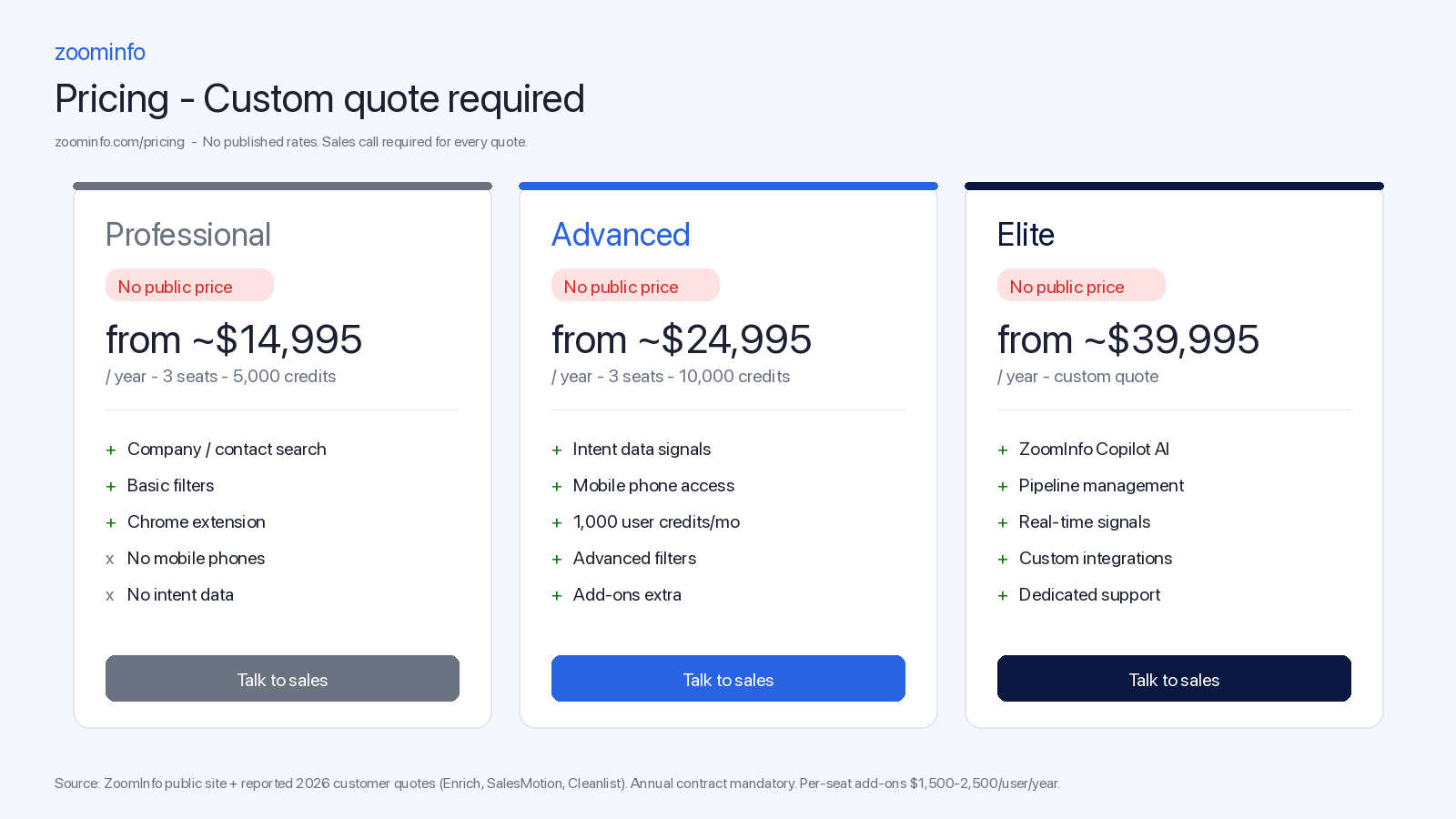
ZoomInfo's three SalesOS tiers, reconstructed from 2026 customer quotes published by Evaboot, Cleanlist, and Cognism. The "No public price" badges are real, not editorial.
The structural details that matter for an agency owner:
| Contract dimension | Apollo | ZoomInfo |
|---|---|---|
| Minimum term | None (monthly OK) | 12 months, 24+ common |
| Auto-renewal | Yes, but month-to-month | Yes, annual |
| Cancellation | Self-serve in settings | Sales / legal escalation |
| Floor spend (3 seats) | $1,764/year (Basic) | ~$19,500/year (Professional + seat fees) |
| Free tier | Yes, 1 seat after 100 days | None |
| Mid-year downsize | Anytime | Renewal only |
The recurring complaint pattern in agency communities is not "ZoomInfo's data is bad." It's "we signed before our outbound engine was ready, and now we're stuck for 12 more months."
That's a contract-structure problem, not a data problem.
Sales-only pricing means every prospect negotiates a different rate, and agencies that don't know the floor pay more. The $14,995 number isn't a secret, it's just deliberately not on the page.
Database size is a vanity metric; accuracy is the real number
Apollo claims 230 to 275 million contacts across 30 million companies.
ZoomInfo claims 320 million contacts (or 500 million in newer messaging) across 100 million companies. ZoomInfo is the larger database, full stop.
Now the relevant number. Multiple independent tests in 2026 put real-world email accuracy at:
A 2026 YouTube test by an outbound consultancy ran 1,000 "verified" Apollo leads through a deliverability check and recorded only 73% landing.
A FundraiseInsider field comparison placed Apollo at 65 to 80% user-reported accuracy and ZoomInfo at 75 to 85%.
The gap matters because it compounds. A 10-point accuracy difference on 100,000 sends per quarter means 10,000 emails landing in nothing.
That's 300 to 500 lost replies at a 3 to 5% reply rate. At a 30% reply-to-meeting conversion that's 100 to 150 lost meetings per quarter, which probably crosses your agency's break-even.
US mid-market and enterprise direct-dial mobile numbers, especially calls into senior buyers at $5M+ revenue companies. For email-first SMB outbound, the gap is smaller than the price gap.
The $29.55M lawsuit that quietly closed in November 2024
ZoomInfo paid out a $29.55 million right-of-publicity class action settlement in late 2024 covering California, Illinois, Indiana, and Nevada.
The claim: ZoomInfo's free preview pages used non-customer individuals' names and identities to advertise paid subscriptions, violating state right-of-publicity statutes. ZoomInfo's own SEC filing confirms a $30.1M charge in 2024.
A second Datanyze (a ZoomInfo subsidiary) action settled in Feb 2025 for an undisclosed amount. A Washington Personality Rights Act case filed Sept 2024 is still active.
There's also a federal securities class action in W.D. Washington alleging insiders sold $1.2 billion in stock while making misleading statements about the subscriber base; the court allowed key claims to proceed in October 2025.
You inherit zero direct legal exposure from buying a ZoomInfo seat (the settlements are about ZoomInfo's data acquisition and marketing, not its customers). But the pattern tells you what kind of vendor you're contracting with: aggressive sourcing, opaque sales motion, multi-year auto-renewals that get litigated.
Apollo has its own controversies (the Apollo CEO's "data is fluid" remarks, sporadic GDPR friction in EU campaigns), but nothing at the $29M-scale right-of-publicity level. The risk profile is different.
The real ROI math: cost per booked meeting at scale
Pricing pages compare seat costs. Agencies should compare cost-per-meeting.
Here's the math for a 3-person prospecting team sending 2,500 cold emails per seat per month (typical mid-volume agency).
| Configuration | Annual cost | Emails/year | Replies (3.5%) | Meetings (30%) | Cost/meeting |
|---|---|---|---|---|---|
| Apollo Pro × 3 seats | $2,844 | 90,000 | 3,150 | 945 | $3.01 |
| Apollo Org × 3 seats | $4,284 | 90,000 | 3,150 | 945 | $4.53 |
| ZoomInfo Pro × 3 seats | $19,495 | 90,000 | 3,150 | 945 | $20.63 |
| ZoomInfo Advanced × 3 seats | $32,495 | 90,000 | 3,150 | 945 | $34.39 |
| ZoomInfo Elite × 5 seats | $54,995 | 150,000 | 5,250 | 1,575 | $34.92 |
ZoomInfo's accuracy edge would have to translate into a 7× higher reply rate to close the gap. It doesn't.
The real edge case where ZoomInfo wins on cost-per-meeting is when meetings are with $250K+ ACV enterprise buyers, and volume is low (50 hand-picked accounts per seat per month, not 2,500). For broader pipeline math, see our channel-by-channel CPL breakdown.
Take your average new-client lifetime value, divide by the configured annual cost above, and you get the closed clients you need to break even. For most agency retainers ($3K to $10K/month, ~$30K LTV), Apollo Pro closes under one client; ZoomInfo Pro needs 0.65; Elite needs 2.
Where each tool actually wins (be honest with yourself)
Both tools have legitimate use cases. The mistake agencies make is buying the wrong one for their outbound shape.
For Upwork-side context on this same decision, see when to use Upwork vs cold email vs LinkedIn.
SMB outbound, email-first sequences, 2 to 5 seat teams, average retainer under $10K/month, ICP that tolerates 80% accuracy, and the freedom to pause and restart outbound as client work fluctuates.
Enterprise/mid-market outbound, phone-heavy workflow, tightly-defined ABM lists of 50 to 500 accounts, average retainer above $15K/month, and you genuinely need org charts plus intent signals plus Chorus conversation intelligence as a package, and you sell "we use ZoomInfo + intent" as part of the pitch.
You're an Upwork agency. The decision-makers you actually convert are sitting inside Upwork's UI posting jobs (not in Apollo's database), have explicitly opted into being pitched, and reply at 3 to 7× higher rates than cold email.
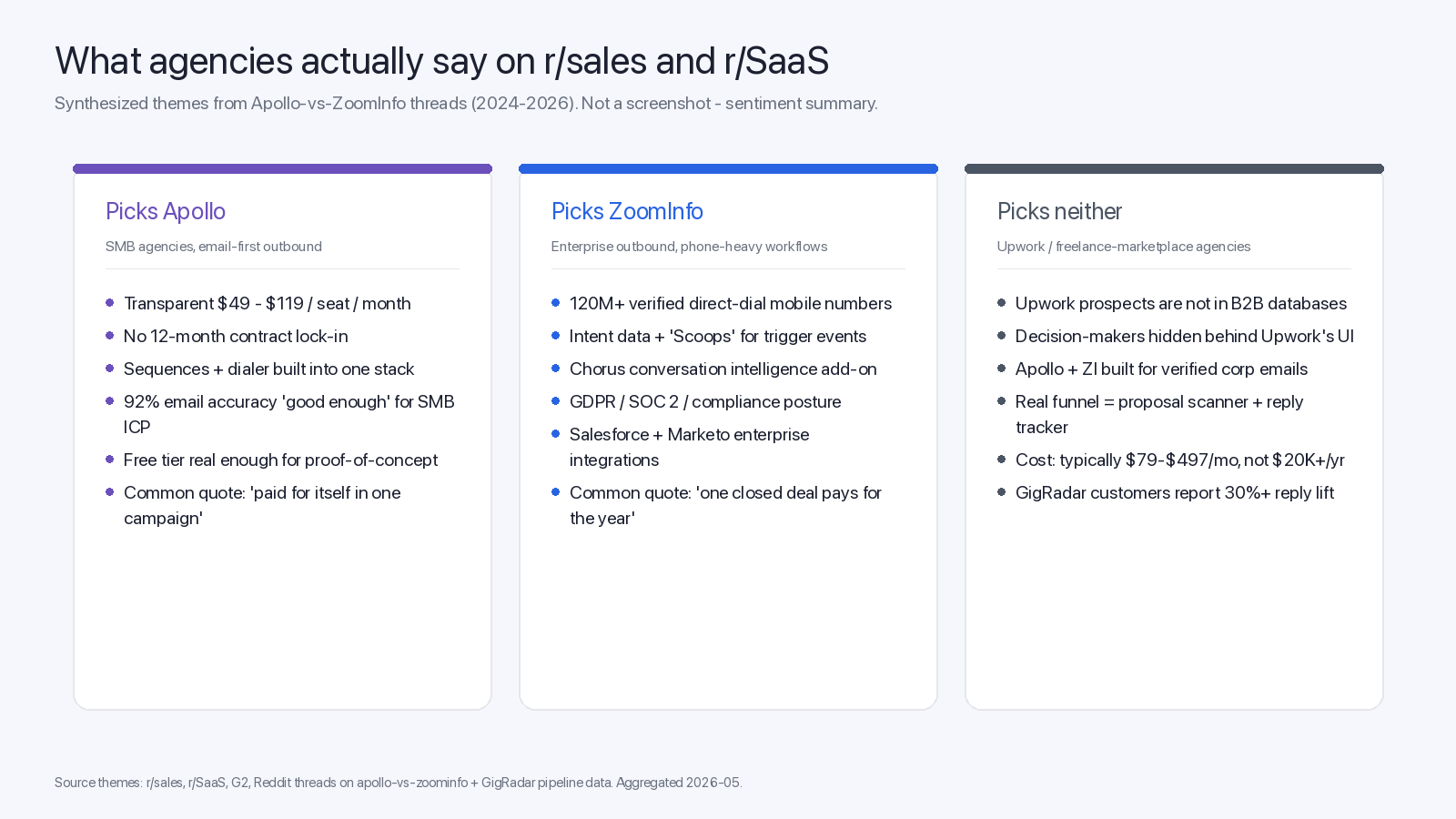
Synthesized themes from r/sales, r/SaaS, and G2 reviews on the Apollo vs ZoomInfo debate, plus GigRadar pipeline data for the Upwork outbound case. Source: aggregated 2026-05.
The third option Upwork agencies should price into the comparison
Cold email reply rates run 1 to 5% across most B2B verticals. Woodpecker's 2026 cold email benchmark puts the typical range at 1 to 8.5%.
Belkins' 16.5M-email study averaged 5.8%. Best-case for a well-executed Apollo or ZoomInfo motion is around 5 to 8%, with top campaigns hitting 10%.
Upwork's Business Manager invitation model operates on a completely different mechanic. Buyers post jobs explicitly soliciting outreach.
GigRadar's analysis of 133,872 outbound proposals from December 2025 to February 2026 found:
The optimal recipe is short (50 to 99 words), opens with a question, and offers a Loom video. GigRadar's bidding research walks through the full 110-insight breakdown.
The 8 to 22% range is on the same input (one bid sent) as Apollo's 3 to 5% reply rate on one email. The buyer is just much warmer.
GigRadar operates a real Upwork Business Manager account; your agency invites our BM through Upwork's official invitation flow, the same role you'd use to onboard a hired bidder. Proposals submit from our BM under our team's supervision, never from your freelancer account (the full BM model is in our Upwork API breakdown and the automation primer).
The point is not that Upwork replaces cold email. It's that for an agency whose ICP overlaps with what gets posted on Upwork (most B2B service agencies: SaaS, eCom, dev shops, design studios, marketing teams), the Upwork channel hits before the Apollo channel does.
The cost-per-meeting math is closer to $1 to $3 per warm reply than to $20 per cold meeting.
Run both: Apollo or ZoomInfo for the accounts you cannot reach inbound, the Upwork BM model for the warmest 30 to 50% of your pipeline. Pricing the latter into the comparison usually changes the answer.
For Upwork agencies
Get the warm-inbound layer Apollo can't build
GigRadar's invited Business Manager submits proposals from our team's Upwork account, not yours. Your agency keeps a clean profile, your freelancers stop drowning in proposal admin, and the 8 to 22% reply rate beats every Apollo benchmark we've seen.
Book a 20-minute demo →The buyer's checklist (save this for your next vendor call)
Before you sign with either tool, the rep should answer all of these without escalation.
Print this before your demo
FAQs Upwork agency owners actually ask
Is Apollo's free tier real enough to test before paying?
Yes for the first 100 days. Apollo's free tier gives unlimited email credits and 5 mobile credits per month, capped at 1 seat after the 100-day mark.
That's enough to validate accuracy on 200 to 500 sample contacts and decide whether to upgrade. ZoomInfo has no equivalent.
Can I really get ZoomInfo for under $14,995?
Occasionally, with aggressive Q4 negotiation. Cleanlist's March 2026 quote confirmed $14,995 as the floor for SalesOS Professional.
Multi-year commitments and seat-count escalation get you a small discount; single-year first-time deals do not.
What's the right setup for an Upwork agency that also runs cold email?
Most agencies in this position pay for Apollo Professional at 2 to 3 seats ($1,896 to $2,844/year) and run Upwork as the primary inbound channel via GigRadar's BM model.
The Apollo seat covers off-Upwork lookups (specific accounts, decision-maker enrichment) and a small cold sequence to verticals where Upwork volume is thin. ZoomInfo only enters the picture once the agency moves into enterprise retainers above $15K/month.
Does ZoomInfo's data accuracy beat Apollo enough to justify the price gap?
For email, no. The real-world gap is 10 to 15 percentage points (Apollo 65 to 80% vs ZoomInfo 75 to 85%).
For US direct-dial mobile numbers in mid-market and enterprise accounts, yes. ZoomInfo's edge is real and probably worth the price if phone outbound is your primary motion.
For everything else, the price gap is bigger than the quality gap.
Will signing up for either tool put my agency at legal risk?
No. Both companies' lawsuits and settlements involve their own data sourcing and marketing practices, not their customers' usage.
Your downstream TCPA, CAN-SPAM, and GDPR obligations are the same regardless of which database the contacts came from. What you do with the data is your liability, not theirs.