
CAC Calculator: Free Calculator + Benchmarks (2026)
🎬 CAC Calculator walkthrough — why blended CAC hides your weakest channel, the 3:1 LTV:CAC rule and when it lies, CAC payback math, and why Upwork is the cheapest high-intent acquisition channel for agencies. Watch on YouTube
TL;DR
- CAC = total sales and marketing spend ÷ new customers won in the same period. The version most agencies quote leaves out salaries and tools, so it understates the real number by 2–4×.
- The 3:1 LTV:CAC rule is the floor, not the goal. Above 5:1 usually means you are underspending on a segment that is clearly worth more.
- For a cash-tight agency, CAC payback period beats LTV:CAC. A 3:1 ratio that takes 14 months to repay can still bankrupt you; a 2:1 that repays in month one funds the next hire.
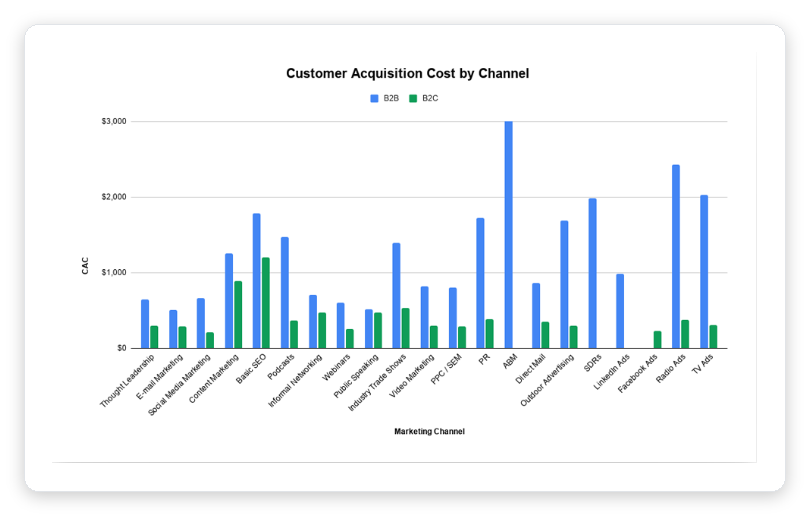
- Channel CAC varies 7×: roughly $510 for email and $647 for thought-leadership SEO, up to $1,980 for outbound SDRs and $4,664 for ABM (First Page Sage, 2026).
- The calculator below turns your spend, retention, and margin into CAC, LTV, the LTV:CAC ratio, and payback in months, each scored against agency benchmarks.
Blended CAC is the number that makes a struggling agency look healthy. Average one $647 SEO client with one $4,664 ABM client and you get a tidy "$2,600 CAC" that describes neither.
It hides the one channel that is quietly bleeding you, because the cheap channel scaling masks the expensive one failing.
I have watched agency owners defend a paid-ads channel for a year because their blended CAC looked fine. The blend was carrying a referral pipeline doing all the work while the ads lost money on every signup.
CAC is only useful when you compute it honestly, per channel, and read it next to two metrics almost nobody pairs it with: payback period and gross margin.
This guide gives you the exact formula, the fully-loaded version investors and acquirers actually use, the channel-by-channel benchmarks, and a calculator that scores your CAC, LTV:CAC ratio, and payback period in one pass.
Interactive Tool
CAC Calculator
Enter your spend, what a client is worth, and your margin. Get CAC, lifetime value, the LTV:CAC ratio, and CAC payback in months, each scored against agency benchmarks.
What CAC actually measures, and the version most agencies report
Customer Acquisition Cost is the average you spend to win one new paying client over a defined period. The formula is deliberately simple.
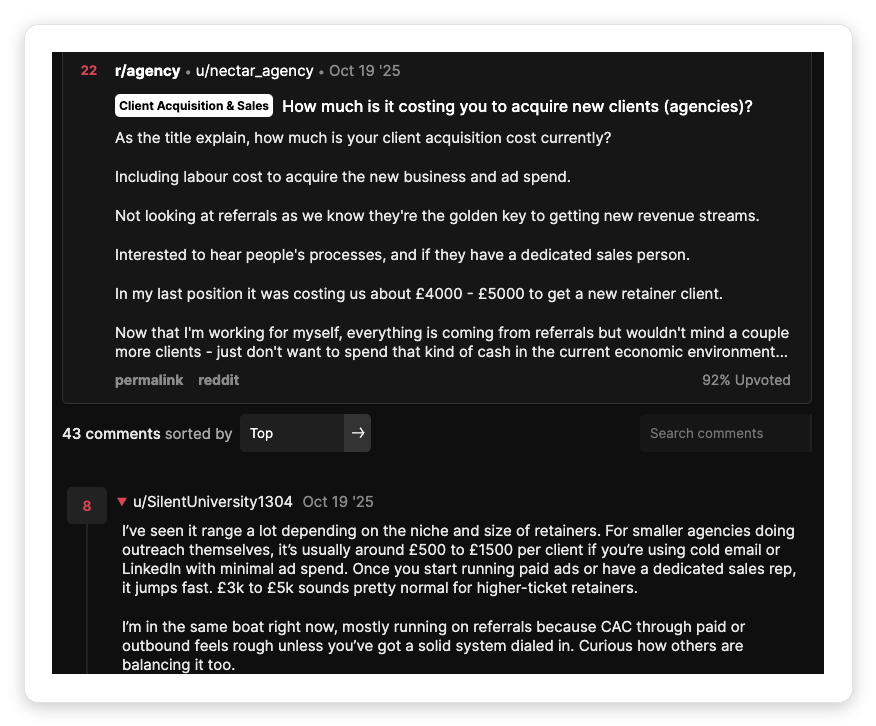
The trap is in "total." As HubSpot's CAC guide spells out, the line items that belong in "total spend" go well beyond ads. Most agencies count ad spend and tool subscriptions, then stop. They leave out the salaries of the people doing the selling, which is where the real money goes.
That gap is the difference between paid CAC and fully-loaded CAC.
Ad spend plus the tools directly tied to it. Useful for judging a single campaign in isolation. Flattering, because it ignores the most expensive input: people.
Ad spend, tools, sales and marketing salaries, commissions, agency overhead, and the owner's pitch time costed at an hourly rate. This is the number that decides whether a client expands or erodes profit.
As Wall Street Prep and Paddle both stress, the moment you raise outside money or sell the agency, only fully-loaded CAC counts. Reporting the paid-only number to yourself is how you end up subsidising acquisition without noticing.
If you cannot state CAC per channel and per service line, you do not know your CAC: you only know a weighted average of one thing working and three things you are afraid to look at. Blended CAC always drifts down as your cheapest channel scales, which is exactly when owners keep funding the expensive channel that is losing money.
The 3:1 LTV:CAC rule, and when it is lying to you
The single most-quoted benchmark in unit economics is a 3:1 ratio of lifetime value to acquisition cost. For every $1 you spend to acquire a client, you want at least $3 back over the relationship.
That 3:1 floor is endorsed by HubSpot, Chargebee, Wall Street Prep, and Paddle alike. Below 1:1 you are destroying value on every client you win.
Here is what almost no CAC guide will tell you: a very high ratio is also a problem.
An LTV:CAC of 6:1 or 7:1 looks like a trophy. It usually means you are underinvesting in a segment that is clearly worth more, and leaving growth on the table to protect a vanity number.
| LTV:CAC | What it means for an agency |
|---|---|
| < 1:1 | Unsustainable. Each client destroys value. Fix CAC or retention before you spend another dollar. |
| 1:1 – 2:1 | Fragile. A small CAC rise tips you into losing money. Raise LTV or cut the weak channel. |
| 2:1 – 3:1 | Borderline. Acceptable if payback is fast. Monitor closely. |
| 3:1 – 5:1 | Healthy and investor-friendly. Good acquisition efficiency with room for overhead and profit. |
| > 5:1 | Often underinvestment or underpricing. Test paying more for your best segment, or raise prices. |
The agency move is not to drive one global ratio down. It is to raise CAC where LTV justifies it and kill the channel entirely where it does not. A segment that retains 18 months and refers two more is worth paying 2:1 to win.
Pair this with disciplined value-based pricing and the ratio takes care of itself, because you are lifting LTV at the same time.
CAC payback period: the number that keeps you solvent
LTV:CAC tells you if a client is worth winning eventually. It says nothing about whether you survive long enough to collect.
That is what CAC payback period measures: how many months of margin it takes to earn back what you spent to acquire the client.
For a cash-tight agency this is the metric that matters most. A 3:1 ratio that takes 14 months to repay can still bankrupt you. A 2:1 that repays in month one funds your next hire.
Ratios flatter. Payback tells you whether you live to see the lifetime value.
| Segment / context | Typical CAC payback | Read |
|---|---|---|
| SMB B2B SaaS (<$15K ACV) | 8–12 months | Healthy |
| Mid-market SaaS ($15K–$100K) | 14–18 months | Acceptable |
| Median B2B SaaS (all) | 15–16 months | Benchmark |
| Agencies (practical target) | 6–12 months | Aim here |
| Anything > 18 months | 18+ months | Risky for agencies |
Benchmarks here are adapted from Benchmarkit's 2026 B2B SaaS data and pipeline studies that put the median B2B payback at 15–16 months, with best-in-class under 12. Agencies rarely have SaaS-style growth capital, and SaaS Capital's retention research shows SMB-heavy businesses carry the most churn risk, so most owners should aim for payback under a year and treat anything past 18 months as a flashing light.
Paying back CAC out of revenue is a lie you tell yourself. You only keep the margin. A $3,000 CAC on a $2,000/month client at 60% margin repays in 2.5 months, not 1.5. The calculator above uses the margin version.
What a client actually costs by channel
The most useful thing you can do with CAC is stop blending it and look channel by channel. The range is enormous.
The most rigorous public dataset comes from First Page Sage's CAC-by-channel benchmarks, measured as largely-loaded CAC after each channel cleared its initial learning period.
| Channel (B2B) | Typical fully-loaded CAC | Character |
|---|---|---|
| Email marketing | ~$510 | Cheap at scale, needs a list |
| Thought-leadership SEO | ~$647 | Compounds, slow ramp |
| Referrals / networking | ~$711 | Feels free, capacity-bound |
| PPC / Google Ads | ~$802 | Scales linearly with spend |
| LinkedIn Ads | ~$982 | Pricey clicks, strong B2B intent |
| Content marketing | ~$1,254 | Front-loaded, long payoff |
| Outbound SDR | ~$1,980 | Salary-heavy, needs volume |
| Account-based marketing | ~$4,664 | Only for large contracts |
Two channels at $510 and $4,664 are both "marketing." Blend them and you learn nothing. Read them apart and the strategy is obvious: feed the cheap, scalable channels and reserve the $4,664 motion for contracts big enough to carry it.
Five ways agencies fool themselves on CAC
Each of these makes your number look better and your decisions worse. They are listed in order of how often I see them wreck an agency's reporting.
- 1 Excluding salaries, tools, and overhead. Paid-only CAC ignores the most expensive input in a services business: people. Fully load it or you are flying blind on profitability.
- 2 Misaligning time frames. Spend this month wins clients next quarter. Divide January spend by January signups and your CAC swings wildly month to month for no real reason.
- 3 Counting leads instead of customers. Cost per lead is not CAC. Dividing spend by leads hides a bad close rate and makes a broken funnel look efficient.
- 4 Mixing new acquisition with expansion. Upselling an existing client costs roughly half what winning a new one does. Blend them and you overstate efficiency and hide weak new-business performance.
- 5 Ignoring gross margin in payback. You repay CAC out of margin, not revenue. Skip the margin step and every payback estimate is too optimistic by exactly your cost of delivery.
Why Upwork is the cheapest high-intent channel agencies have
Here is the part most CAC guides skip. Once you compute CAC per channel, the next question is which channel delivers buyers who are already in-market.
That is where Upwork quietly wins, and it is a different claim than "cheapest CAC on a spreadsheet."
Email and SEO can post a lower nominal CAC, but they are slow and capacity-bound. The "free" referral and marketplace pipeline is not free either. The cost is capacity: senior time you cannot 3× next quarter when you need to.
Upwork inverts the usual funnel. The client already has budget, already has intent, and already posted the job. You are not creating demand, you are answering it.
The intent shows up in the response data. GigRadar's pipeline data for May 2026 shows an overall reply rate of 5.8% across 67,600 outbound agency proposals, rising to 8.7% in Sales & Marketing (n = 13,583).
Put that against paid channels where a 1–2% lead-to-reply rate is normal and the channel-CAC math tips hard toward the marketplace.
That consistency is the whole problem. New-business CAC only stays low if your proposal volume stays predictable, and manual bidding is the first thing that slips when delivery gets busy.
That is the exact gap GigRadar closes. We operate a real Upwork Business Manager account.
Your agency invites our BM through Upwork's official invitation system, the same role you would use to onboard a hired bidder. Proposals submit from our BM under our team's supervision, your own freelancer account is never touched, and if Upwork ever reviews a submission, the review lands on our BM profile.
The result is a steady top-of-funnel of payment-verified, intent-rich clients at a CAC most outbound channels cannot touch. You can see how the model works in our breakdown of Upwork automation, compare it against other cost-per-lead-by-channel numbers, and read how we think about client retention that lifts LTV.
Free for Upwork agencies
Make Upwork your lowest-CAC channel
We run an Upwork Business Manager that submits proposals on your agency's behalf, so new-business CAC stops depending on whoever remembered to bid this week. Get a free audit of your pipeline.
Get Your Free Agency Audit →Run your real numbers
The fastest way to know whether your acquisition is healthy is to stop quoting a blended average and put real numbers through the calculator at the top.
Then ask the cheaper question: which channel delivers in-market buyers at the lowest fully-loaded cost? For most Upwork agencies, the marketplace beats every outbound line they run.
Pair CAC discipline with a predictable acquisition channel and the unit economics take care of themselves. For the rest of the metric stack, our MRR calculator and guide to founder-led sales cover the retention and acquisition sides.