
Watch the full walkthrough of the bidding framework covered in this article.
TL;DR: What 133,872 proposals taught us about Upwork bidding strategy
→ Bidding within 5 minutes of a job posting lifts reply rate by 43% over the platform median. Each 30-second delay after that costs ~1 percentage point.
→ Weekend-posted jobs reply at 9.5-10.4% vs 6.3-6.8% on weekdays. Most agencies turn off their scanners on Saturday, and the data says that is the worst possible decision.
→ Boosting 16-20 Connects is the only positive-ROI band. Boost 21-30 Connects and your reply rate actually drops below the zero-boost baseline.
→ Fixed-price bids cost $17.10 per reply vs $27.95 for hourly. That is a 39% gap most agencies never measure.
→ 67% of automated proposals land on jobs where other agencies using the same tools also bid. Scanner uniqueness is the real competitive moat.
47% of all Upwork proposals are sent within the first 5 minutes of a job posting, according to Upwork Community discussions. Their win rate is 7.2%: the lowest of any timing bracket.
The freelancers who apply 2 to 4 hours later hit 24.3%. Three times higher, same platform, same clients.
That single stat breaks every "bid fast or die" guide you have read. And it only scratches the surface of what your upwork bidding strategy is actually getting wrong.
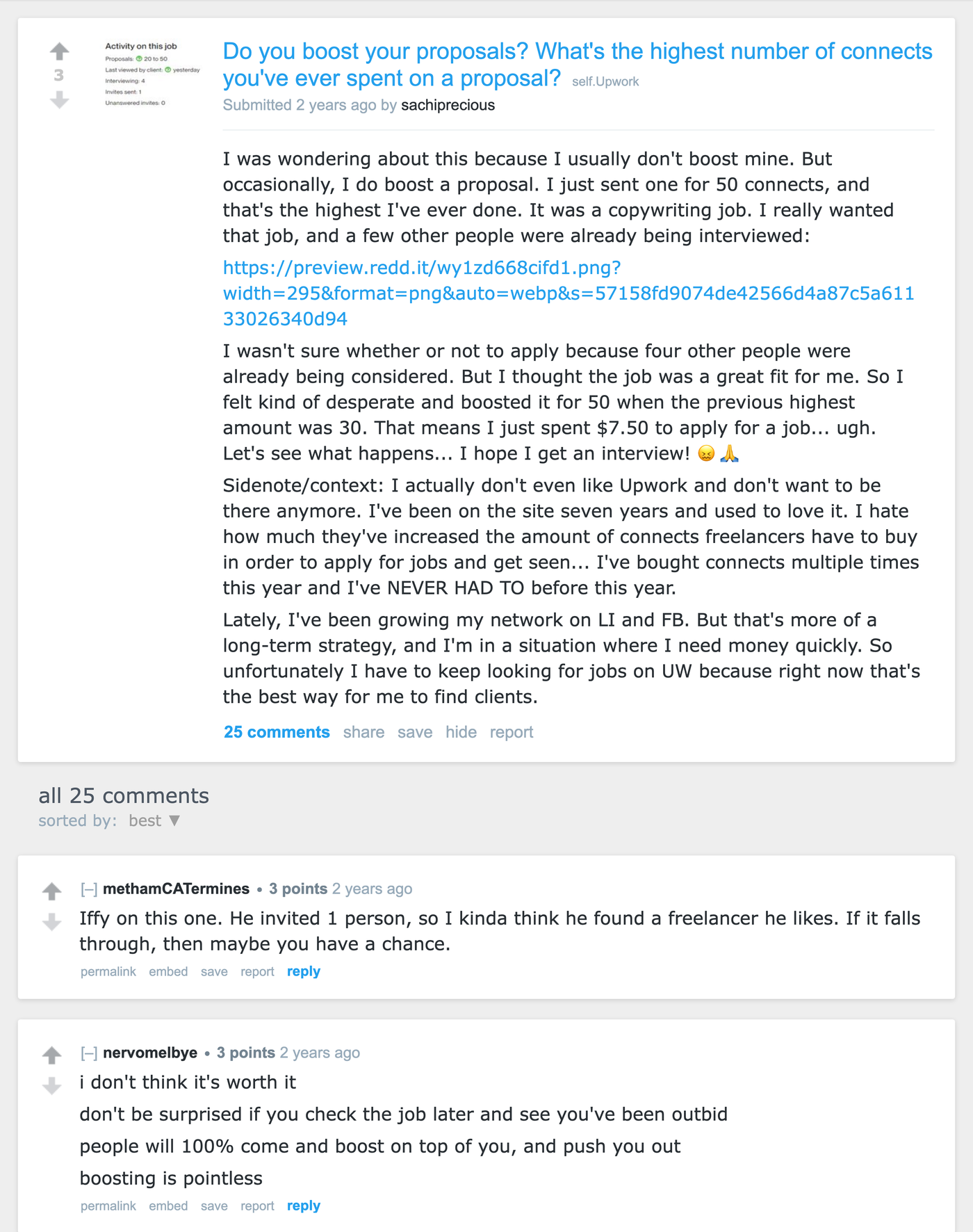
A freelancer burning $7.50 of connects on one bid, and the reply telling her someone will outbid it anyway (r/Upwork, July 2024). The problem is not connects, it is where and when those connects land.
We analysed 133,872 outbound proposals from GigRadar's pipeline (Dec 2025 to Feb 2026). Three variables explain most of the variance in reply rate: when you bid relative to the job posting, which day and hour the job was posted, and how many connects you spend per bid.
Proposal quality matters, but it matters less than most agencies think. A mediocre proposal that lands in the first 5 minutes beats a perfect one that arrives 30 minutes late.
the 5-minute cliff (and the 12-minute rebound nobody talks about)
Here is what the reply-rate decay curve actually looks like, minute by minute. This is 59,339 proposals with full timestamp chains from job-published to proposal-sent.
| Minutes after job posted | Proposals (n) | Reply rate | vs median |
|---|---|---|---|
| 3-4 min | 371 | 11.86% | +78% |
| 4-5 min | 1,979 | 8.99% | +35% |
| 5-6 min (THE CLIFF) | 5,698 | 6.91% | +4% |
| 7-8 min (local minimum) | 9,699 | 6.47% | -3% |
| 8-9 min | 6,164 | 6.26% | -6% |
| 12-15 min (REBOUND) | 6,763 | 8.07% | +21% |
| 15-20 min | 4,825 | 7.19% | +8% |
| 20-30 min | 2,587 | 6.42% | -4% |
| 30-60 min | 974 | 5.34% | -20% |
| 1-2 hours | 252 | 5.56% | -17% |
Source: GigRadar pipeline data, 59,339 proposals, Jan-Feb 2026.
Two distinct things are happening here. The first is the 5-minute cliff: reply rate drops from 9% at minute 4-5 to 6.9% at minute 5-6.
One minute, two full percentage points. The early bidders sit at the top of a fresh inbox, and once five or more bids pile up, every new bid loses 25% of its value.
The second phenomenon is the 12-15 minute rebound. Reply rate jumps from 6.3% at minute 8-9 back to 8.1% at minute 12-15.
The most likely explanation: many clients check their inbox twice (once when they post the job, then again 10-15 minutes later). Bids arriving in the 5-10 minute valley miss both reading windows.
Speed premium by category (sub-5-min reply rate vs 5-10 min)
IT & Networking agencies get the largest speed premium: +7.26 percentage points for sub-5-min bids. Web/Mobile gets a smaller but still meaningful +2.1pp lift.
your upwork bidding strategy in one calculator (free tool)
Plug in your category, weekly connect budget, and preferred bid times. The calculator returns your optimal bid allocation based on the reply-rate curves above.
Upwork Bid ROI Calculator
the weekend secret most agencies are sleeping through
Every upwork bidding strategy guide tells you to bid early and often. Our data says something different.
| Day job was posted | Proposals (n) | Reply rate | vs weekday avg |
|---|---|---|---|
| Monday | 11,634 | 6.79% | baseline |
| Tuesday | 12,378 | 6.44% | -5% |
| Wednesday | 13,012 | 6.34% | -7% |
| Thursday | 8,114 | 6.69% | -1% |
| Friday | 5,550 | 6.63% | -2% |
| Saturday | 2,334 | 10.37% | +52% |
| Sunday | 6,317 | 9.48% | +39% |
Source: GigRadar pipeline data, 59,339 proposals, Jan-Feb 2026.
Weekend-posted jobs reply at 9.5-10.4%. Weekday jobs reply at 6.3-6.8%, which aligns with what freelancers on r/Upwork have noticed. That is a 50% premium, sitting unclaimed every Saturday and Sunday.
Two compounding reasons. Clients who post on weekends want to make a hire (they are not HR departments routinely posting boilerplate on Tuesday morning).
Second, far fewer freelancers bid on weekends, so each bid faces less competition for attention.
Weekend lift by hour (UTC)
How much higher the reply rate is on weekends vs weekdays at each hour
The peak weekend premium hits at 6 AM UTC (1 AM ET / 10 PM PT). That is Friday evening US time, when startup founders post jobs after their workweek. Reply rate: 16.88%.
(Sunday 6AM UTC)
(Friday 11AM UTC)
and worst timing
boost is a substitute for speed, not a multiplier of it
The popular narrative: boosted proposals get you to the top of the client's feed, more visibility, more replies. The data tells a different story.
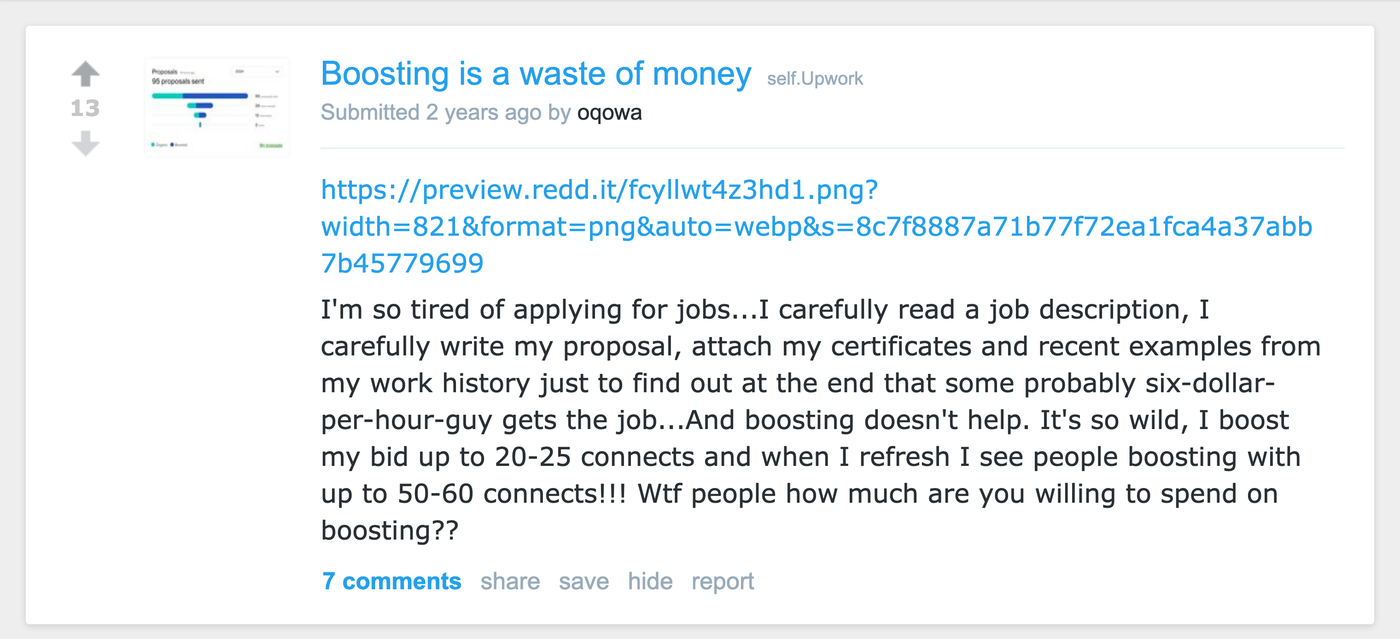
This complaint shows up on r/Upwork weekly (r/Upwork, August 2024). The problem is not that boost does not work, it is that boost only works in one specific band.
| Boost amount (connects) | Proposals (n) | Reply rate | Lift vs no-boost |
|---|---|---|---|
| 0 (no boost) | 41,808 | 6.75% | baseline |
| 6-10 | 1,376 | 7.34% | +0.59pp |
| 11-15 | 3,224 | 7.72% | +0.97pp |
| 16-20 (SWEET SPOT) | 4,386 | 8.37% | +1.61pp |
| 21-30 (DEAD ZONE) | 5,542 | 6.53% | -0.22pp |
| 31-50 | 1,732 | 8.07% | +1.33pp |
| 51+ | 1,032 | 9.10% | +2.35pp |
Source: GigRadar pipeline data, 59,339 proposals with boost tracking.
Boosting 16-20 connects is the highest-ROI band, costing about $2 per additional reply over baseline. Boosting 21-30 connects is worse than not boosting at all: your reply rate drops below the zero-boost baseline.
But the real insight is how boost interacts with speed.
| Setup | Reply rate | What it means |
|---|---|---|
| Weekday + late + no boost | 6.22% | The floor |
| Weekday + late + boosted | 7.05% | Boost recovers +0.83pp |
| Weekday + sub-5min + no boost | 8.69% | Speed alone beats boost |
| Weekend + late + boosted | 10.82% | Weekend + boost combo |
| Weekend + sub-5min + no boost | 13.33% | The pinnacle. No boost needed. |
| Weekend + sub-5min + boosted | 9.92% | Over-boost HURTS |
1. If you bid sub-5-min: do not boost. You are already at the top of the inbox.
2. If you bid 15-60 min late: boost 16-20 connects on fixed-price bids only.
3. Never boost in the 21-30 range. Pick ≤20 or ≥31.
4. Allocate boost budget disproportionately to Saturday and Sunday submissions. Boost ROI is 80% higher on weekends.
the job scoring signals that save 60% of your connects
Most agencies bid on every job that matches their keyword filter. The signals are in the job listing itself, and they predict reply rate before you type a single word.
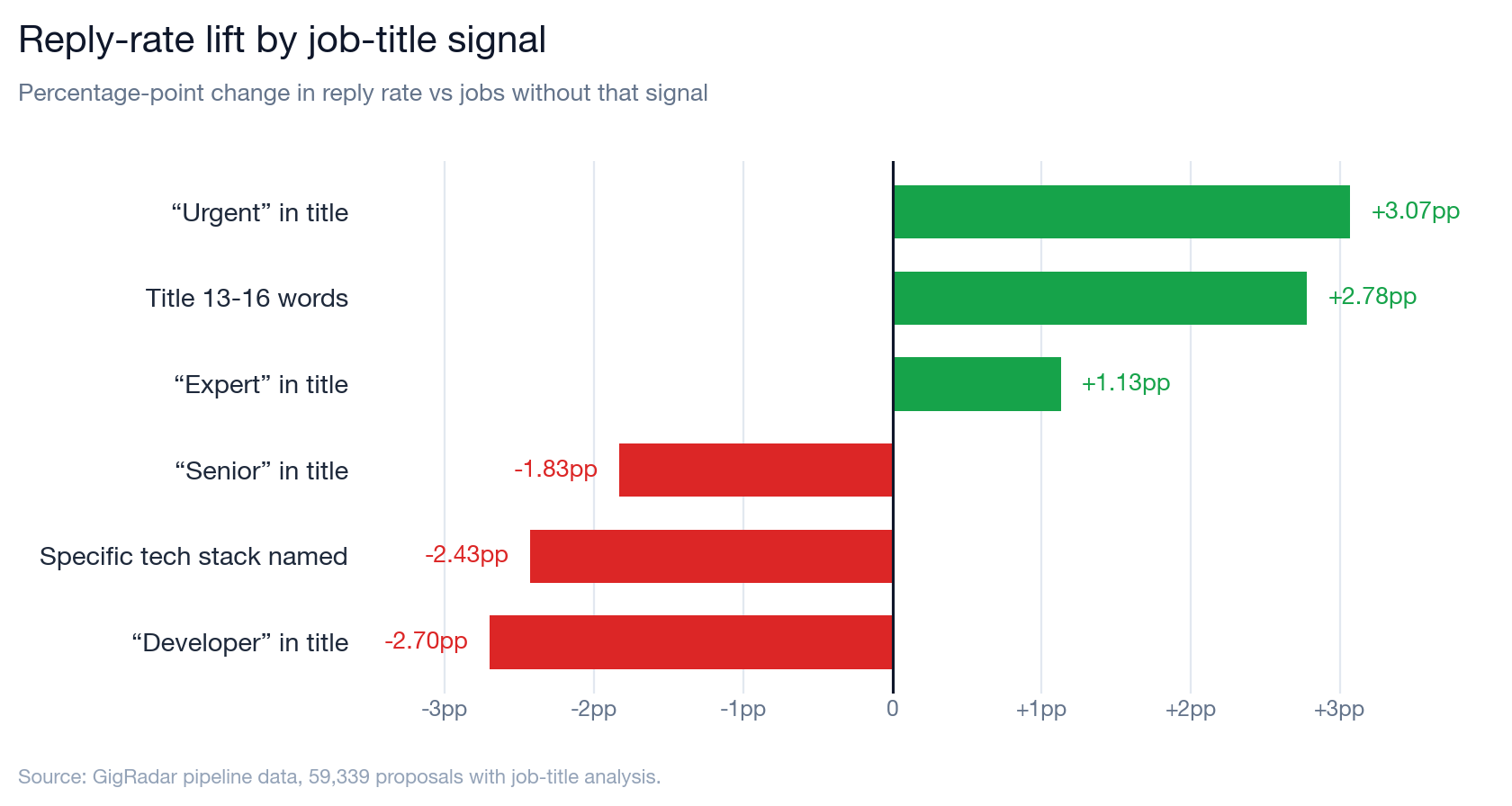
Every signal ranked by lift, from GigRadar's 59,339-proposal job-title analysis. All of it is visible in the listing before you spend a single connect.
| Signal | Reply rate (with) | Reply rate (without) | Impact |
|---|---|---|---|
| "Urgent" in title | 10.08% | 7.01% | +3.07pp |
| Title 13-16 words (descriptive) | 9.43% | 6.65% | +2.78pp |
| "Expert" in title | 8.03% | 6.90% | +1.13pp |
| "Developer" in title | 4.87% | 7.57% | -2.70pp |
| Specific tech stack named | 5.05% | 7.48% | -2.43pp |
| "Senior" in title | 5.35% | 7.18% | -1.83pp |
Source: GigRadar pipeline data, 59,339 proposals with job-title analysis.
Clients who write a descriptive, 13-16 word title are specific about what they need and read proposals carefully. These jobs reply +2.8 percentage points better than the typical 6-8 word title.
Job titles that name a role plus a technology ("WordPress Developer", "Senior React Engineer") replicate the saturated-category problem. They attract the most competition and reply the lowest.
The lesson is not "never bid on them." It is: if you do, expect 1.5-2x lower reply rate and bid accordingly.
60-second job scoring checklist (copy this)
your biggest competitor might be sitting in your own dashboard
This is the finding that surprised us most. When multiple agencies using the same automation tools bid on the same job, reply rate collapses.
| Agencies bidding on same job | Proposals (n) | Reply rate |
|---|---|---|
| 1 (only your team) | 19,727 | 9.44% |
| 2 teams | 12,202 | 7.41% |
| 3 teams | 7,990 | 6.57% |
| 4-5 teams | 9,096 | 5.08% |
| 6-10 teams | 8,046 | 4.50% |
| 11+ teams | 2,278 | 2.11% |
Source: GigRadar pipeline data, 59,339 proposals across 30,964 distinct jobs.
Reply rate falls 4.5x when 11+ teams bid on the same job. And 67% of all automated proposals land on jobs where at least one other agency is also bidding, consistent with Upwork's own guidance on proposal competition.
Two-thirds of your connect budget is fighting for attention against agencies with similar templates, similar timing, and similar targeting. The advantage of speed evaporates when everyone's system shows up at the same time.
Free for Upwork agencies
Stop guessing which jobs to bid on
GigRadar's Business Manager bids on your behalf in under 5 minutes, targets low-density jobs your competitors miss, and tracks reply-rate economics per scanner. Your account is never touched.
Get Your Free Agency Audit →the connect economics most agencies never measure
Every agency tracks proposal volume. Almost none track cost per reply by category. The variance is 6x.
| Category | Avg connects/send | Reply rate | $/reply |
|---|---|---|---|
| Writing | 1.80 | 1.88% | $14.30 |
| Sales & Marketing | 1.70 | 1.71% | $14.88 |
| Design & Creative | 1.41 | 1.40% | $15.15 |
| IT & Networking | 2.72 | 1.52% | $26.90 |
| Data Science & Analytics | 2.68 | 1.22% | $32.85 |
| Web, Mobile & SW Dev | 2.33 | 1.02% | $34.21 |
fixed-price bids
hourly bids
with fixed bids
Web/Mobile/SW Dev replies cost $34.21 each in connects vs $14.30 for Writing (at $0.15/connect). The saturated-category penalty is real, and most agencies absorb it silently because they never run the math.
Fixed-price bids cost 39% less per reply than hourly bids across every category, a finding that matches forum consensus about fixed-price advantage. If the job description allows it, default to fixed-price.
The reply-rate lift from fixed bids (per our proposal response rate analysis) compounds with the Upwork contract structure cost savings.
🎥 From GigRadar's Agency Success Course: Win in 5 Minutes. Speed in the pre-qualifying stage matters as much as speed in bidding.
the 4-week upwork bidding strategy system (steal this)
Everything above collapses into a system you can implement in four weeks. Each week builds on the last.
Week 1: Baseline your numbers
Track every proposal: time-to-bid (minutes from post), day/hour of posting, connects spent, reply (Y/N). After 20-30 proposals, you will see which timing brackets perform and which burn budget.
Add two columns to your tracker: "Minutes to Submit" and "Proposals at Submit." You will likely see the cliff after minute 5 and the drop after 10 competing proposals.
Week 2: Implement job scoring
Use the 60-second scoring checklist above. P1 jobs (25-30 score) get bids immediately with optional 16-20 connect boost; P2 jobs (20-24) get bids today, no boost; below 20: archive.
Target: cut proposal volume by 30-40% while maintaining or increasing reply count. If your P1 reply rate is not at least 2x your P3 rate, your scoring criteria need tightening.
Week 3: Activate weekend and off-peak bidding
Set alerts for Saturday and Sunday postings in your target categories. Schedule two weekend "bid sprints" of 45 minutes each (one Saturday morning, one Sunday morning in your target client's timezone) and move 20-30% of your weekly connect budget to weekends.
Track the delta. If weekend reply rate is not at least 30% above your weekday average, your category may be an exception (check category benchmarks for your niche).
Week 4: Optimize connect allocation and scanner uniqueness
Review your proposal tracker and calculate $/reply by category, by day, and by bid type (fixed vs hourly). Shift connect budget toward the lowest $/reply segments and default to fixed-price bids wherever the job description allows.
Audit your job filters: if 60%+ of jobs you bid on also have 10+ other proposals at submission time, your filters are too generic. Narrow to descriptive 13+ word titles, payment-verified clients, and under-fished subcategories that deliver the cheapest replies.
The system is three dials: speed (bid sub-5 or at minute 12-15), timing (weekends and off-peak hours over weekday rush), and targeting (score jobs, avoid saturated scanners, default to fixed-price). Turn all three and the math compounds.
Eight hours a week of strategic, deliberate bidding outperforms twenty hours of panic-rush proposals. The agencies winning on Upwork in 2026 are not writing better proposals: they are writing faster ones, on the right jobs, at the right times.