
Customer Lifetime Value Calculator for Agencies
🎥 Watch: how to calculate your real, margin-based CLV and the CLV:CAC ratio that caps your acquisition budget.
TL;DR
- The customer lifetime value most agency owners quote is a revenue number, and revenue-based CLV overstates a client's real worth by your entire cost to deliver. Use gross margin or the number is fiction.
- CLV on its own tells you nothing. Divide it by what a client costs to acquire (CAC): below 3:1 you are overpaying, 4-5:1 is healthy, and the 2025 B2B SaaS median sits at 4.1x.
- Your CLV:CAC ratio is the ceiling on your acquisition budget. Knowing it is what lets you decide how aggressively to spend on Connects, ads, or a bidder.
- Retainer agencies should worry above 20% annual client churn; the best hold 8-10%. That lifespan input swings CLV more than your pricing does.
- Use the calculator below to get your margin-based CLV, your CLV:CAC ratio, and the most you can afford to pay for a new client in about 30 seconds.
Most agency owners can tell you their monthly recurring revenue to the dollar and have no idea what a single client is actually worth over the full relationship. That gap is where budgets get set wrong.
When someone finally does the math, they almost always do it with revenue. A client pays $4,000 a month and stays two years, so they call that client worth $96,000.
That number is comforting and useless for the one decision it should drive: how much you can spend to win the next one. If your gross margin on the account is 40%, the client is worth $38,400 in profit, not $96,000.
Set your acquisition budget off the bigger number and you will quietly buy clients you lose money on. The fix takes two inputs most owners never write down.
Calculate your customer lifetime value
Enter your own numbers below. The calculator shows both the revenue figure you probably quote and the margin figure that should govern spending, then checks it against your acquisition cost.
Free Interactive Tool
Customer Lifetime Value Calculator
Built for service agencies. Works for monthly retainers and project work.
Two numbers do most of the work here: gross margin and lifespan. The next two sections are why each one wrecks the answer when you get it wrong.
Your revenue number is lying to you
The single most common CLV mistake is using revenue instead of margin. It is the first thing analysts flag when they audit a company's numbers.
Agencies do it worse than most, because delivery labor eats a huge share of every dollar. Take a clean example from a startup-finance breakdown.
A product at $100 a month with 75% gross margin and 5% monthly churn has a revenue CLV of $2,000. The real, margin-based CLV is $1,500.
That $500 per customer is not a rounding error. It is the gap between a channel that scales and one that quietly bankrupts you (Gradient Growth).
Agencies feel this harder than SaaS. A software business keeps 70-80 cents of every revenue dollar; an agency running freelancers keeps 40-50 after paying for delivery.
So when an owner brags about a "$96,000 client," the profit that client actually contributes is closer to $40,000. Revenue tells you the client is big; margin tells you whether the client is worth keeping.
If you take one rule from this page, run every CLV number through your gross margin before you let it touch a budget. That single step is what the calculator does for you above.
Which CLV formula actually fits an agency
There is no single CLV formula, and picking the wrong one is the second-biggest error. The right one depends on whether you bill retainers or projects.
| Your model | Formula (margin-based) | When to use it |
|---|---|---|
| Monthly retainer | Monthly revenue × gross margin × lifespan (months) | Predictable recurring accounts |
| Churn-based retainer | (Monthly revenue × gross margin) ÷ monthly churn rate | When you track churn, not lifespan |
| Project-based | Project value × projects/year × margin × relationship years | Repeat project clients |
| Discounted (advanced) | Margin × [retention ÷ (1 + discount − retention)] | Long relationships, money-now-vs-later matters |
The churn-based version hides a trick worth memorizing: lifespan is roughly 1 divided by your churn rate. A 2.5% monthly churn implies a 40-month average life (the standard retention model, also laid out by Wall Street Prep).
That is why a tiny change in churn moves CLV more than a price increase does. Retention is the highest-leverage input on the whole page.
For subscription-style retainers, the cleanest reference formula is average revenue per account times gross margin, divided by revenue churn (Twilio Segment, and Baremetrics on why revenue-based versions overestimate). The calculator above uses the lifespan form, because most owners can estimate "how long a client stays" more honestly than a monthly churn percentage.
CLV means nothing until you divide it by CAC
A big CLV number is not a trophy. It is only useful next to what a client costs to acquire.
The ratio of the two, CLV to CAC, is the one metric that tells you whether your growth math works. Everything else is decoration.
The benchmark almost everyone cites is 3:1, meaning a client returns three dollars of lifetime value for every dollar spent acquiring them (Chargebee). Below that you are overspending; far above it, say 8:1, you are probably underinvesting in growth and leaving clients on the table.
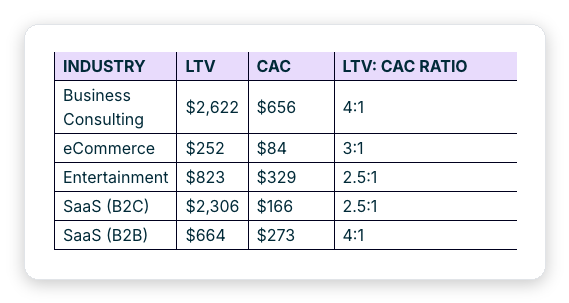
The floor has moved up. The 2025 median B2B SaaS company runs a 4.1x CLV:CAC ratio, so 3:1 is now the minimum investors accept, not the target (Aleph, 2026).
Treat 3:1 as "do not go below" and aim for the 4-5x band. That leaves room to spend on growth without buying clients you cannot service profitably.
This ratio is the ceiling on your acquisition budget, not an academic score. Once you know your margin CLV, dividing by three gives you the absolute most you can pay for a client and still hit a sustainable 3:1.
Spend more than that and you are underwater on every deal. The calculator flags this for you the moment you enter a CAC.
What a healthy client lifespan looks like for an agency
Lifespan is the input agency owners guess most wildly, and it swings CLV harder than anything else on the page. Get it from your actual retention data, not from optimism.
The agency-specific benchmark is clear. A retainer agency should worry if annual client turnover climbs above 20%, because that usually means another 20-30% is already at risk.
Project-based shops can live with 30-50% annual turnover if the pipeline refills it, and the best retainer agencies hold churn to 8-10% a year (Sakas & Company, echoed by Swydo). If you are above the worry line, a structured onboarding and QBR cadence like our customer success plan template moves the number more than any pricing tweak.
One more warning that matters for CLV: track revenue churn, not just logo churn. Keeping 90% of your clients means nothing if the 10% you lost were your biggest accounts.
Weight the number by dollars, or your CLV will describe a client base you no longer have. Logo counts flatter you; revenue churn tells the truth.
Why Upwork is the cheapest place to raise your CLV:CAC ratio
There are only two ways to fix a bad CLV:CAC ratio. Raise the top (bigger, longer, higher-margin clients) or shrink the bottom (spend less to win them).
Most agencies obsess over the first and ignore the second, which is backwards. CAC is the number you can actually move this week.
This is where acquisition channel decides everything. Paid ads and outbound SDRs can push CAC into the thousands per client.
For the agencies we work with, Upwork is consistently the cheapest channel that still produces qualified, ready-to-buy demand. That drops the denominator and lifts the whole ratio.
The catch is that winning on Upwork used to mean burning hours and Connects on proposals nobody read. If you have priced that pain, our breakdown of cost per hire on Upwork Connects and the CAC calculator show exactly where the money goes.
Pair this page with the payback period calculator and the break-even calculator and you have the full unit-economics picture for a client. Together they answer "can I afford this client, and when does the profit start."
GigRadar exists to collapse that acquisition cost. We operate a real Upwork Business Manager account, and your agency invites our BM through Upwork's official invitation flow, the same role you would use to onboard a hired bidder.
Proposals submit from our BM under our team's supervision, so your own freelancer account is never touched. If Upwork ever reviews a submission, the review lands on our BM profile, and the result is more qualified replies per dollar.
Free for Upwork agencies
Lower your CAC, and every client is worth more
GigRadar automates qualified Upwork outreach through our own Business Manager, so you win more clients per dollar and lift your CLV:CAC ratio.
Get Your Free Agency Audit →Five ways agencies get customer lifetime value wrong
Every one of these produces a CLV number that looks fine and points you at the wrong decision. Ranked by how often it wrecks an acquisition budget.
Inflates every client's worth by your entire cost to deliver. The default error, and the most expensive.
One blended CLV describes nobody. Segment by acquisition channel and service tier, or you will fund the wrong channel.
A high CLV with an unknown CAC is a vanity metric. The ratio is the point, not the raw number.
Losing 10% of clients is fine unless they were 40% of revenue. Weight lifespan by dollars.
CAC is what it costs to win a client, while ongoing delivery belongs in margin. Double-counting it breaks both numbers.
Frequently asked questions
What is a good customer lifetime value?
There is no universal dollar figure, because it depends on your pricing and margin. The number that matters is the ratio: margin-based CLV should be at least three times your cost to acquire a client, ideally four to five.
Should CLV use revenue or profit?
Profit, specifically gross margin. Revenue-based CLV overstates a client's worth by your entire cost to deliver, which for an agency running freelancers is roughly half of every dollar.
How do I estimate client lifespan if I do not track churn?
Lifespan is roughly 1 divided by your churn rate. If about 2% of clients leave each month the average client stays around 50 months, and at 4% a month it is closer to 25.
How does CLV set my marketing budget?
Divide your margin CLV by three. That is the most you can spend to acquire a client and still hit a sustainable 3:1 ratio, and it is a hard ceiling rather than a target.
Why is my CLV:CAC ratio more important than CLV alone?
A large CLV is meaningless if it costs almost as much to win the client. The ratio tells you whether your growth is profitable, which is how investors and operators actually judge unit economics.
Run your own numbers in the calculator at the top, then do the one thing most agencies never do: check the margin figure against your acquisition cost. If the ratio is under three, the fix is almost never your pricing.
It is your CAC, and that is the number you can move fastest. Lower the cost of winning a client, and every client on your books is suddenly worth more.