
🎬 The 5-touch follow-up email sequence: why one follow-up lifts replies 65.8%, why 40% of clients only answer after the 4th, and how to give every email a job. Watch on YouTube
TL;DR
- One follow-up lifts replies by 65.8% (Backlinko, 12M emails), yet 48% of reps never send one (Woodpecker, 20M emails). The single follow-up is the highest-ROI email in your pipeline.
- The "2 to 3 follow-ups is the sweet spot" advice is calibrated for cold spray-and-pray. On warm B2B leads, ~40% of clients only answer after the 4th follow-up (GigRadar Agency Success course).
- A template is worthless without a goal per touch. Five "just checking in" emails train the prospect to ignore you. Give each email a different job: bump, implied-progress, pure value, direct check, breakup.
- Keep every follow-up under 80 words, same thread for the first two, and space them ~3 days apart (spacing beats back-to-back by 31%, per Belkins).
- Use the free generator below to build a personalized 5-touch sequence in 30 seconds.
Sending one follow-up instead of none lifts your reply rate by 65.8%. That number comes from Backlinko's analysis of 12 million outreach emails, and it is the closest thing to a free lunch in outbound.
And yet 48% of sales reps never send a single follow-up after the first email goes quiet, according to Woodpecker's read on 20 million cold emails. Half the pipeline gets abandoned one email in.
The reason is not laziness. It is that most people reach for a "follow up email template," paste "just checking in" for the third time, feel like a nuisance, and quietly stop.
This guide fixes the actual problem: every touch in your sequence needs a different job, or the template is just polished noise.
Build your 5-touch follow-up sequence (free generator)
Fill in four fields and get a full sequence: a polite bump, an implied-progress nudge, a pure-value touch, a direct status check, and a breakup email. Each one follows the word-count and cadence rules the data supports.
Interactive Tool
Follow-Up Sequence Builder
No signup, and nothing leaves your browser. Copy each email or download the whole sequence.
Want the reasoning behind each touch before you send them? The rest of this article is why the sequence looks the way it does.
Why one follow-up is the highest-ROI email you will ever send
The gap between "one email" and "one email plus one follow-up" is not marginal. It is the biggest single lever in cold outreach, and it costs you one extra send.
Woodpecker's data is blunt: 58% of replies come from the first email, and 42% come from follow-up steps. A one-touch campaign throws away nearly half its potential responses before anyone even reads the second message.
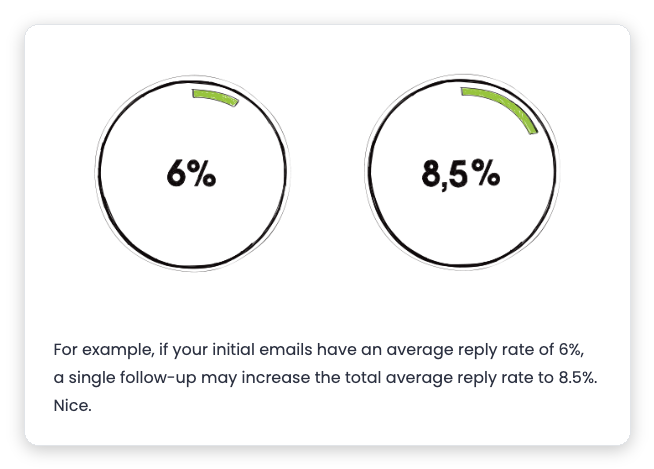
Read the two ends of that chart together: the first follow-up is your best marginal email, and the breakup at the end out-performs the middle of the sequence. The dead zone is touches 4 and 5 sent as more "any update?" filler.
The "2 to 3 follow-ups" sweet spot quietly tells you to quit before the money
Almost every listicle repeats the same rule: two to three follow-ups is the sweet spot, gains flatten after that. It is true, and it is also the wrong advice for the leads that actually matter.
That rule is an average across millions of cold, low-intent, mass-blast emails. On a prospect who already replied, took a call, or asked for pricing, the curve looks completely different.
Stopping at three on a high-intent lead is not discipline. It is leaving the most persuadable segment on the table because a blog post about cold spray told you persistence looks desperate.
GigRadar's Agency Success course breaks down the exact sequence in the "when clients ghost you" lesson. The instructor uses four follow-ups plus one breakup, and each has a distinct goal instead of a warmed-over "did you see my message?":
🎥 From GigRadar's Agency Success Course: the "when clients ghost you" lesson.
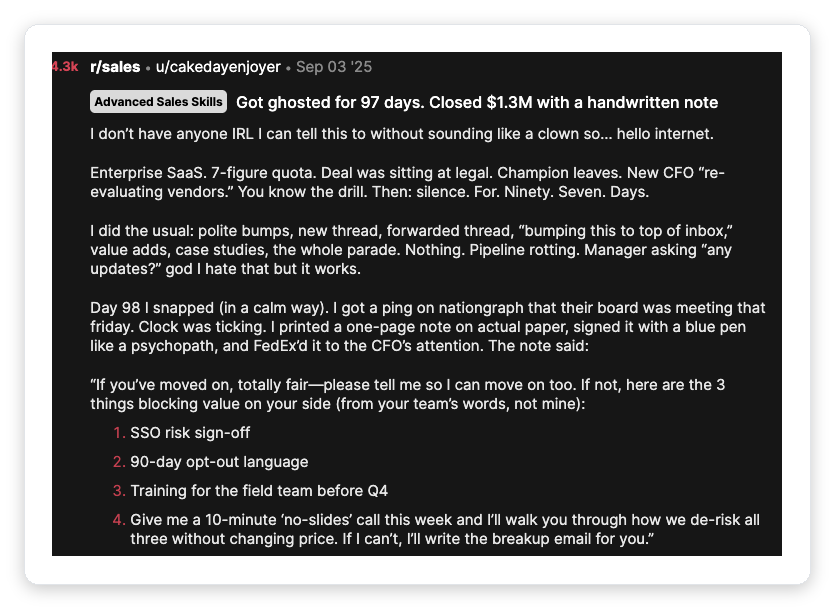
The nuance for warm leads: any new reply resets the sequence. Treat it as a fresh conversation, and if they hired someone else, still ask why so your next pitch lands better.
The 5-touch framework: give every email a different job
Here is the whole system, where each touch has one goal and the goal is what makes the email worth opening. Copy the templates in the next section, but internalize the jobs first.
Goal: push your message back to the top of the inbox. One line, no guilt-trip, sent once.
Goal: break the buying atmosphere. Act as if work has begun and surface two real questions, and the momentum pulls the prospect back in.
Goal: give, ask nothing. A relevant article, a benchmark, or a heads-up about a change in their space, and when they say thanks the door reopens.
Goal: get a status. Ask plainly how they want to proceed or whether they chose someone, since a clear no frees your pipeline as much as a yes.
Goal: create a real deadline like "this is my last message unless I hear back." People dislike losing an option, so this is often the email that gets the reply.
If all five emails carry the same payload (mild nag, soft ask), the prospect learns by touch two that your name means "nothing new, safe to skip." Different jobs keep re-earning the open.
The follow-up email templates (copy these)
These are the five touches as fill-in templates. Swap the brackets, keep them short, match the tone to the relationship, and let the generator above personalize them for you.
Write these once and save them as reusable snippets. Composing a custom note for every silent lead is the tax that makes people quit following up. For subject-line variants that survive the mobile inbox, see our 50+ cold email subject lines and free scorer.
Cadence: when to send each follow-up
Timing is not a detail: waiting about three days between messages produced a 31% higher reply rate than sending them back to back, per Belkins. Too soon reads as needy, too late and they have forgotten you.
| Touch | When | Cold outbound | Warm / high-intent |
|---|---|---|---|
| Initial | Day 0 | First contact | Reply within 24h of the call |
| Follow-up 1 | Day 3 | Polite bump | Next business day |
| Follow-up 2 | Day 7–10 | New angle / value | Implied progress |
| Follow-up 3 | Day 12–17 | Pure value | Pure value |
| Follow-up 4 | ~Day 21 | Often skip on cold | Direct status check |
| Breakup | Day 21–30 | Final touch | Final touch |
For cold sequences, the research consensus is the 3-7-7 cadence (Day 0, 3, 10, 17), which captures roughly 93% of total replies by day 10. For warm leads, tighten the front and keep going to the fourth touch, because that is where the 40% live.
Send on the prospect's business days, and lean on Tuesday through Thursday, which outperform Monday and Friday in most benchmark reads. If deliverability is shaky, no cadence saves you, so warm the sending domain first.
Free for Upwork agencies
Your follow-ups only matter if the pipeline is full
GigRadar runs outbound on Upwork for agencies through our own Business Manager account, so a steady stream of warm client replies actually lands in your queue to follow up on.
Get Your Free Agency Audit →Keep every follow-up under 80 words (and 4 more mistakes that kill replies)
Length is the quietest killer. Boomerang's analysis of 40 million emails found reply rates peak at 50 to 125 words for a first touch, with 75 to 100 words the sweet spot.
Follow-ups should run even shorter, 25 to 60 words, because the context already exists in the thread. Top-performing campaigns keep every email under 80 words, follow-ups included.
The other four mistakes that flatten reply rates:
- New subject line every time. Keep follow-ups 1 and 2 in the same thread. Same thread preserves context and skips the subject-line lottery. Switch to a fresh subject only when you change the value proposition (touch 3 onward).
- "Just checking in" with no new reason. If the email does not carry value, a question, or a decision that is about to close, it announces that you want something and offers nothing.
- Firing follow-ups back to back. Same-day or next-hour nudges read as desperation. Three days of spacing is the measured winner.
- Never sending the breakup. It is the only email in most sequences with a real deadline, which is exactly why it out-replies the touches before it.
For where email sits against other channels when a prospect goes cold, our breakdown of when to use email vs LinkedIn vs Upwork and the actual reply rates by channel are worth a read.
For Upwork agencies: the follow-up happens in the chat, not the inbox
If you win clients on Upwork, the follow-up sequence rarely lives in email. It lives in the Upwork message thread after a prospect replies to your proposal, and the same five jobs apply.
One rule dominates there: speed. If you bid in the first ten minutes but take a day to answer their reply, you break the trust the fast proposal built and the client reads the mismatch as automation.
The counterintuitive part: on Upwork you often should not send a bare "did you see my message?" reminder. We unpack when silence works better in never follow up on Upwork. The 5-touch jobs still apply, but the polite bump gets replaced by patience plus a value touch.
This is where structuring your pipeline matters more than any single template. GigRadar runs outbound on Upwork for agencies through a real Business Manager account, which your agency invites through Upwork's official invitation system, the same role you would use to onboard a hired bidder.
Proposals submit from our BM under our team's supervision, and your own freelancer account is never touched. That steady flow of warm client replies is the only thing that makes a follow-up sequence worth having, so see how the numbers work on the pricing page or map your pipeline with our free sales pipeline template.
Follow-up email FAQ
For cold outbound, 2 to 3 follow-ups is the researched sweet spot. For warm, high-intent leads, go to 4 follow-ups plus a breakup, because roughly 40% of clients answer only after the fourth.
About 3 days for the first bump, then space subsequent touches 3 to 7 days apart. Belkins found ~3-day spacing lifted reply rates 31% versus back-to-back sends.
Keep follow-ups 1 and 2 in the same thread (Re: original subject) to preserve context. Switch to a fresh subject only when you change the value proposition, typically from the third touch.
Yes. Breakup emails commonly out-reply the fourth and fifth touch because they create a real deadline, with reported response rates ranging from about 14% up to 33%.
Shorter than the first: aim for 25 to 60 words with one clear ask. Top-performing campaigns keep every email, follow-ups included, under 80 words.
Start with the free sequence builder above, then refine each touch with the jobs framework. The template is only as good as the reason you send it.