PPC Agency Lead Generation: How to Get Google Ads Clients on Upwork in 2026
🎬 How PPC Agencies Get Clients on Upwork in 2026. The 2-minute walkthrough covers buyer signals, scanner setup, and the Daniil Berkelia case (4 clients in 60 days). Watch on YouTube
TL;DR for PPC agency owners
- Upwork has roughly 1,600 open PPC roles at any moment and about 3,700 active Google Ads jobs in the search index. That's a pipeline most PPC agencies leave on the table because they think Upwork is "all $5/hour beginners."
- The PPC clients worth chasing on Upwork have three signals: payment-verified, $10K+ lifetime spend, and the words "Performance Max", "conversion tracking", "GA4", or "audit" in the brief. Filter on those three and you skip 80% of the time-wasters.
- One Ukrainian PPC agency we work with (Daniil Berkelia, 19-person team, Google + Meta + paid social) closed 4 new clients in 60 days sending only 7 bids per day after they tightened minus-words, plus-words, and country filters in their GigRadar scanner.
- The math that matters: at $50–$100 average cost per lead and a 12–18% reply rate, a PPC agency needs roughly $400–$700 in connects per month to land 1–2 retainer clients worth $2K–$5K each. Use the calculator below to plug in your own numbers.
Most PPC agency owners I talk to write off Upwork in the first 30 seconds. They search "Google Ads", see a $200 fixed-price job from a Vietnamese furniture store, and conclude the platform is dead.
That search is the problem. There are 1,600 open PPC roles on Upwork right now and 3,715 Google Ads jobs in the index (you can verify the count on Upwork's live Google Ads jobs page), but a serious one looks nothing like the one you just rejected.
Cooper Lutz, a top 1% expert-vetted Upwork freelancer who's managed $130M+ in Google Ads spend, says average active client spend on the platform hit a record $5,000 per quarter in 2026, up 7% year-over-year. The clients have gotten richer; the agencies bidding on them have not.
This article is for PPC, Google Ads, Meta Ads, and paid-search agencies specifically. If you sell SEO retainers or do generic lead gen, almost none of this applies to you.
The PPC Agency Upwork Calculator: how many connects do you actually need?
Before the rest of the article, plug your real numbers in. The math is simple but most PPC agencies don't do it, which is how they end up either over-spending on connects or quitting Upwork three weeks in convinced it doesn't work.
Interactive Tool
PPC Agency Upwork Pipeline Calculator
Estimate how many connects, bids, and replies you need to land 1–3 PPC retainer clients per month.
Why most PPC agencies misread Upwork at first glance
The first search you ran was probably "Google Ads" with no other filter. That returns the entire bottom of the market: the $50 audit, the "fix my campaign in 1 hour" job, the small business owner who learned about Upwork from a Reddit post.
Real PPC retainer clients on Upwork hide behind specific phrases and budget chips. Look at this slice from the search results:
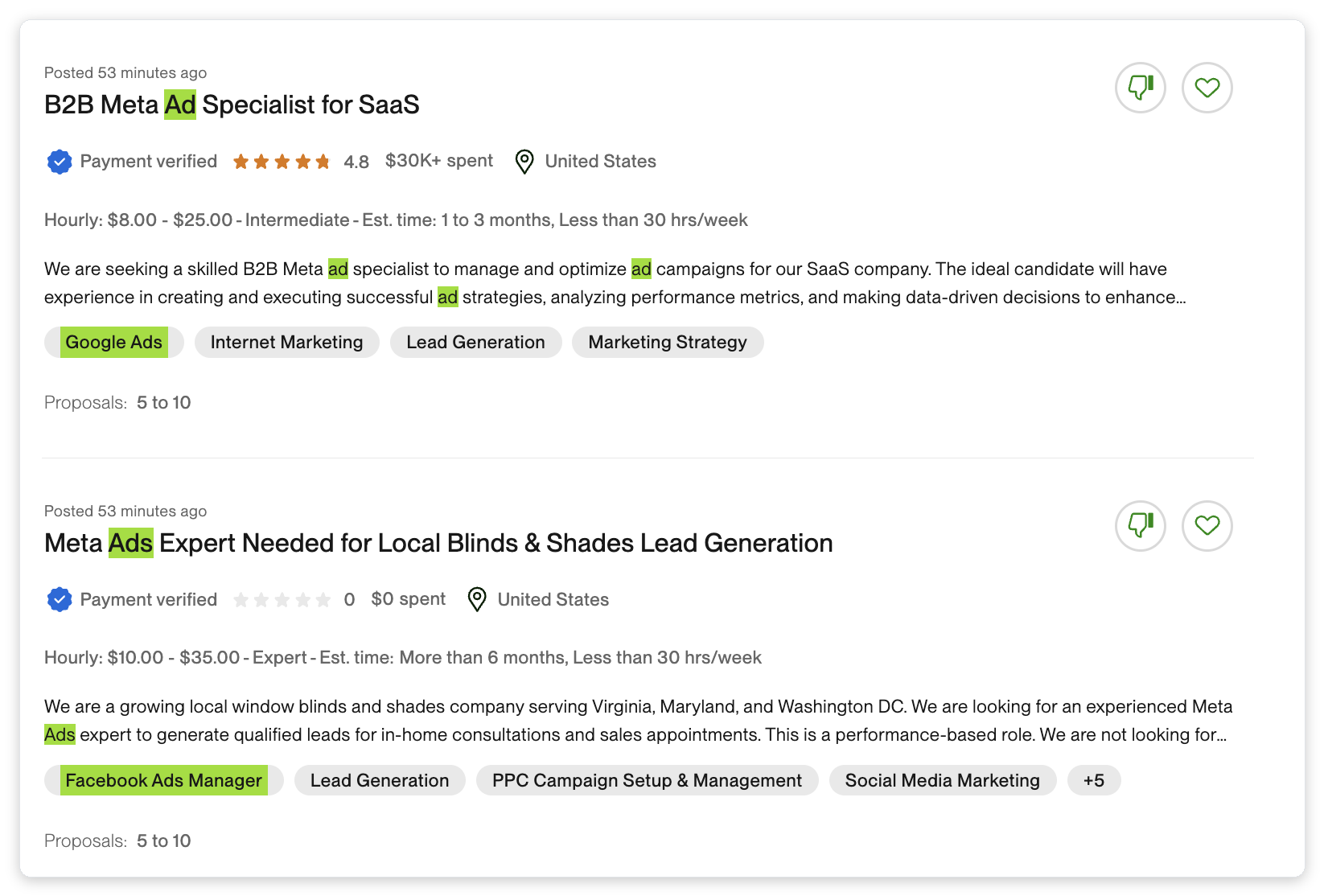
Two real PPC jobs on Upwork: Meta Ads for a SaaS B2B company ($30K+ verified spend, $8–25/hr) and Meta Ads for a local home-services lead-gen play. Neither one looks like a $5/hr race to the bottom.
The two jobs in the screenshot share the signals every PPC retainer client posts: payment-verified, real spend history on the client side, a hourly band that respects expert work, and a brief that names the platform and the goal (B2B SaaS demand, local lead gen). These get 5–10 proposals, not 50.
A PPC job posted under generic categories like "Marketing" or "Sales & Marketing" with no spend history and no budget is almost always either a tire-kicker or someone planning to spend $200/month on ads. You will not retain them.
Filter them out at the scanner level, not at the cover-letter level.
The 7 PPC-specific buyer signals that predict a $2K+/month retainer
After watching hundreds of PPC agencies bid through GigRadar, a small set of signals separate "this client will retain for 6+ months" from "this is a one-off audit they'll never act on". Read the job post for these before you write a single line of cover letter.
A job that scores 5+ on this rubric is worth a personalized bid and 14 connects. Below 0, don't bid even if you have spare connects.
The opportunity cost of writing a custom letter to the wrong client is the entire ROI of the channel.
What real PPC clients on Upwork look like (Reddit confirms)
Upwork agencies often think the platform is invisible to "real" buyers. It isn't.
Local service businesses spending $10K+/month on Google Ads quietly hire there, complain about it on Reddit, and rehire when contracts end:
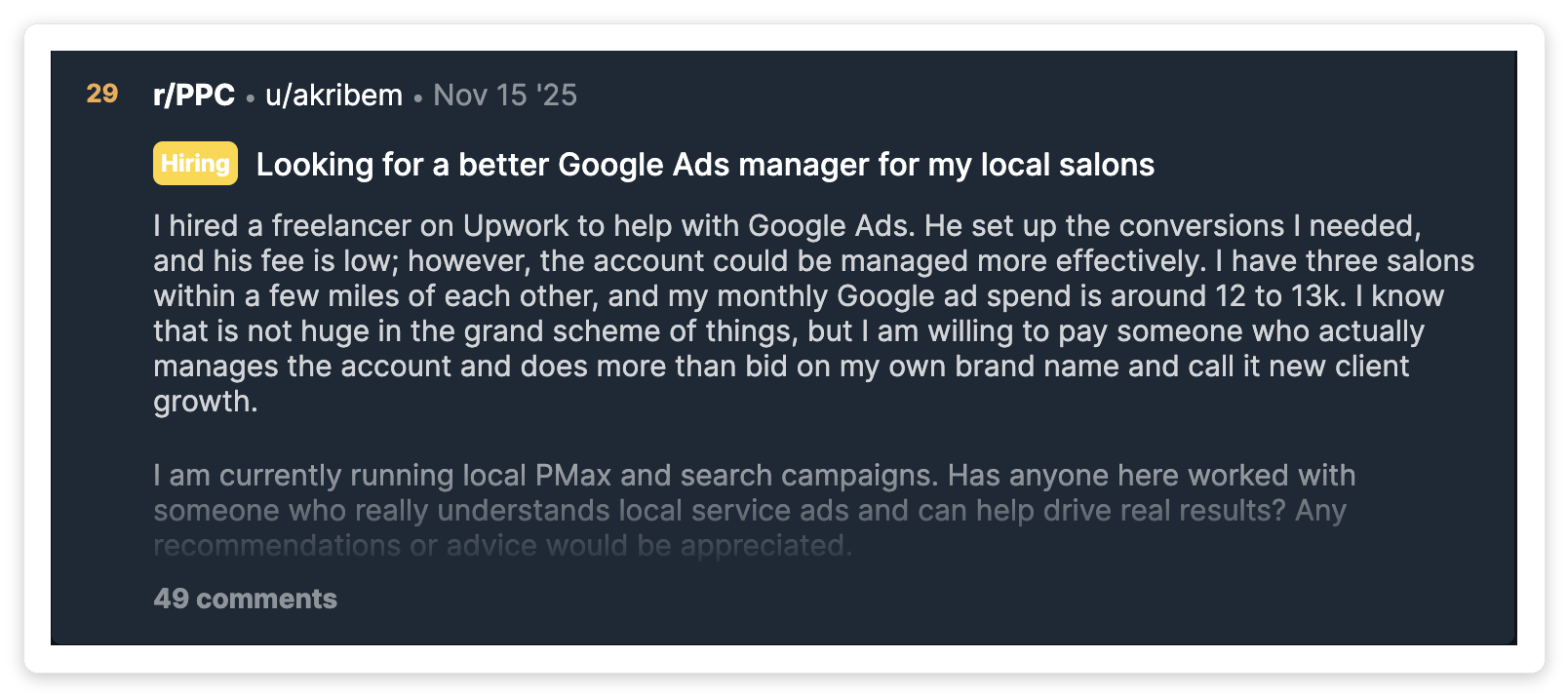
r/PPC thread from a salon owner with 3 locations and $12–13K monthly Google Ads spend, openly discussing the freelancer they hired on Upwork (source: r/PPC). This is the buyer profile you're after, and they're not hiding.
"I have only one hundred dollars for the whole project, can you do that for me?"
Actual reply pattern from clients we filter out at the scanner level (paraphrased from the GigRadar Agency Success course, "Irrelevant Replies" lesson)
The Upwork PPC market is bimodal. The bottom half is the $100 client.
The top half is a 3-location salon spending $13K/month and willing to pay $80/hour for a real audit. Same platform, completely different buyer.
Your filter and your cover letter decide which one finds you.
The PPC scanner setup that filters out the bottom 80%
This is the GigRadar setup walkthrough specific to PPC agencies. The exact filter values change based on your team size and price point, but the structure is the same.
Plus-keywords (the "yes" list)
"Google Ads", "PPC", "paid search", "Performance Max", "PMax", "Meta Ads", "Facebook Ads", "search campaigns", "shopping campaigns", "GA4 conversion tracking", "AdWords audit". 8–12 phrases is the sweet spot; fewer and you miss jobs, more and you bleed into adjacent niches like SEO or social media management.
Anti-keywords (the "never" list)
"intern", "junior", "beginner", "low budget", "small budget", "$100", "$50", "looking for cheap", "Pakistan only", "India only", "TikTok", "influencer", "SEO only", "content writing", "graphic designer". Add the platforms you don't run.
A Google Ads shop should also exclude "Bing only" and "Microsoft Ads" if those aren't in the playbook.
Client filters (the structural ones)
Payment verified: required. Lifetime spend: $5K+ minimum, $10K+ if you only do retainers.
Average rate paid: $35+/hr. Country: tier-1 only if your pricing demands it (US, UK, Canada, Australia, Western Europe).
Hire rate: 30%+ to skip serial posters who never close.
Budget filters
Hourly minimum: $40/hr (raise to $60/hr if you bill US clients at $100+). Fixed-price minimum: $1,500.
Ignore the "no budget specified" jobs unless the brief is exceptional. Daniil's team at the agency we cite below started with $0 minimum and got buried in $200 jobs; raising the floor to $1,500 fixed and $40/hr hourly was the single change that lifted retainer close rate.
Category filters
"Search Engine Marketing (SEM)", "Search Engine Optimization (SEO)" (because clients tag PPC jobs under SEO often), "Marketing Strategy", "Lead Generation", "Display Advertising". Don't include "Social Media Marketing" unless you do paid social.
That category is full of organic-only jobs.
One critical detail from the Agency Success course: anti-keywords are wrecked by syntax mistakes. Excluding "react native" without quotes accidentally excludes every job mentioning React.
For PPC scanners, wrap multi-word excludes in quotes: "low budget", "Pakistan only", "$100". Otherwise the scanner reads them as ORs and your filter does nothing.
From GigRadar's Agency Success Course. The Irrelevant Replies lesson walks through pattern-hunting on bad replies and tightening anti-keywords.
Same logic applies to PPC scanners.
The Daniil Berkelia case: 4 PPC clients in 60 days, 7 bids per day
Daniil runs sales for a 19-person Ukrainian PPC agency (16 PPC + targeting specialists, 3 SMM). Before GigRadar, he spent 3–4 hours a day writing 10 customized bids by hand.
Half his replies came from the wrong country at the wrong price. The full case study lives here with the verbatim transcript of how the team optimized.
The interesting part isn't that he closed clients. It's that the system worked only after he narrowed the scanner.
From his words: "It started working great only in the second or third month after we fixed everything: minus words, plus words, countries." Loose filters drowned them in irrelevant replies. The fix was scarcity, not volume.
Other PPC-relevant data points worth pulling for your own benchmarking. From our analysis on Upwork bidding, Max Radko at IT Squad (web dev agency, not PPC, but the bidding mechanics are identical) lifted reply rate from 5–7% to 15–25% by combining personalization with automation.
Average response time fell from 2 hours to 9–10 minutes. Monthly sales tripled.
For PPC specifically, expect a similar reply-rate ceiling: 12–18% on a tight scanner is realistic. Below 10% means the cover letter or the first line is failing.
Above 20% means you're either underpricing or you've cracked positioning, in which case raise rates.
The PPC cover letter that doesn't sound like the other 47
Most PPC cover letters open with one of three lines: "Hi, I have 5 years of Google Ads experience", "I'd love to help you grow", or "I read your job post carefully". All three are dead.
The client has read those exact sentences in 47 other proposals.
The cover letter that converts on a PPC job opens with a specific observation about the client's existing setup. Here's the template we recommend to GigRadar customers running PPC scanners.
Copy it, adapt the variables, and save it as a starting point. Never send it verbatim:
The pattern: one specific observation about their existing setup, one verticalized credibility line, one zero-risk next step (Loom audit). No "I would love the opportunity".
No bullet list of services. No 5-paragraph life story.
The "specific observation" line is the only one a tool cannot generate. AI can write the rest.
The first sentence is the one a human needs to write because it requires actually opening the client's site or ad library and looking. Automation alone never beats automation plus human judgment on the first sentence (more cover letter patterns we've tested).
What to do in the first 24 hours after a PPC client replies
Speed and structure matter more than the cover letter at this point. The bid got you on the shortlist; the next 24 hours close the deal or burn it.
Most agencies waste this window with discovery questionnaires.
0–10 minutes: reply with two questions and a calendar link
Ask: (a) what's their current monthly ad spend; (b) what conversion they care about (form, call, transaction). Then drop a 30-min calendar link.
Don't pitch. Don't price.
Get the call booked.
1–2 hours: send a 90-second Loom looking at their landing page
Even before they answer the two questions. Open their site, screen-record yourself spotting 2–3 things wrong with their current setup (LP friction, weak conversion event, mismatched ad → LP message).
This is the move that makes them cancel meetings with the other 4 freelancers.
4–24 hours: confirm the call and send a 1-page agenda
4 bullets: account access workflow, 30-day plan structure, pricing model (hourly vs fixed retainer), case studies. Brings the call's outcome into focus before it starts.
They show up ready to buy, not ready to interview.
On the call: pitch the audit, not the retainer
For a $2K+/month retainer, lead with a $300–$500 paid audit instead. Lower commitment, higher close rate.
Of the audits, 60–70% convert to retainer if the audit recommendations are real. Cooper Lutz makes this exact point: Upwork is selling fewer-but-richer relationships in 2026, and the audit is the lowest-friction entry into that relationship.
How GigRadar fits into a PPC agency's pipeline
The honest framing. GigRadar operates a real Upwork Business Manager account that your agency invites into your team through Upwork's official invitation flow.
The same role you'd use to onboard a hired bidder or ops lead.
Behind the BM, the automation runs: filtered job feed against your scanner, AI-drafted cover letters with personalization, sub-10-minute response time, all proposals submit from our BM account under our team's supervision. Your freelancer account is never logged into.
If Upwork ever reviews a submission, the review lands on our BM profile, not yours.
For PPC agencies specifically, three pieces matter:
- Scanner with PPC keywords + anti-keywords pre-loaded. The setup walkthrough in the section above is the one we configure for every PPC customer in onboarding.
- Speed. Cooper's data on Upwork in 2026 says proposals submitted in the first hour have 3–5x higher interview rates than those after 24 hours. Manual bidding cannot keep pace; an automated BM can.
- Daniil's pattern, repeatable. 7 bids/day, 60 days, 4 clients, $5K MRR added. Not because of magic but because the filter was tight, the cover letters were verticalized, and the BM submitted at speed.
Built for PPC + paid social agencies
Get your PPC scanner set up in 30 minutes
We'll configure your plus-keywords, anti-keywords, and client filters for the PPC vertical, then run a free pipeline audit on your Upwork account.
Get Your Free Agency Audit →The PPC channels Upwork actually beats (and the ones it doesn't)
Upwork is not the only channel for a PPC agency. It's a particularly good one for a specific phase of growth.
Here's where it fits versus the alternatives we see PPC agencies using. The cost-per-lead numbers come from First Page Sage's industry CPL benchmarks for marketing services and our own pipeline data:
Daniil's team explicitly tested all five. Telegram bots ($30 for 100–200 leads) had cheap volume but conversion was terrible because Ukrainian local pricing didn't match international service rates.
Word-of-mouth was 10/10 quality but unscalable. Cold email and LinkedIn worked at $5K+ retainers but had 12-week sales cycles.
Upwork won the "fast pipeline at $2–5K MRR" slot, which is exactly what most PPC agencies need to fill between referral lulls.
Three honest tradeoffs to understand before starting
This is the section most lead-gen articles skip. The case for Upwork as a PPC pipeline isn't that it's painless.
It's that the pain is bounded and predictable.
The first 30–60 days will feel slow. Daniil's case: month 1 was tweaking filters, month 2 was the first 4 closes.
If you bail at week 3 because nothing has hit, you'll never see the curve. Plan a 90-day commitment or don't start.
Upwork takes a 10% service fee on freelancer earnings. For a $2,500/month retainer that's a $250/month hit.
Build it into the price quoted on the first call, not as a "surprise" fee mentioned later.
Some PPC clients will try to migrate the contract off Upwork after month 3 to avoid fees. This is allowed once the relationship is established but watch the timing, because Upwork's TOS limits direct hire conversion mechanics.
What to do this week if you're a PPC agency owner
Concrete actions in order. Don't skip steps.
Run the calculator above with your real numbers
Plug in your average retainer, realistic reply rate (start with 12% if you've never bid before), and conservative close rate (15%). The output tells you whether to invest 30 hours into setting this up or skip the channel.
Build the scanner using the 5-step setup
Plus-keywords, anti-keywords, client filters, budget filters, category filters. Whether you do this manually inside Upwork's job alerts or through GigRadar, the structure is identical.
Write 10 cover letters using the template
Send them. Track reply rate.
After 30 bids you'll have data on what your true reply rate looks like (vs the projected 15%). Adjust the first sentence pattern based on which ones got opened.
For every reply, send the Loom audit within 2 hours
This is the closing move. The freelancer who sends a Loom in hour 2 wins over the freelancer who sends a polished PDF deck on day 3.
Apply that rule even before you've automated anything else.
At day 30, audit your numbers and decide
If reply rate is below 8%, the cover letter or first line is failing. If reply rate is healthy but no closes, the call structure is failing.
Diagnose the right one. Read our bidding diagnostic if you're unsure which.
For more on the underlying mechanics of bidding speed and proposal volume, see our guide on Upwork bidding strategy. For the PPC-vertical perspective on agency formation, how to start a PPC agency covers the upstream decisions you make before client acquisition becomes the bottleneck.
And for the broader case that Upwork is a real B2B channel and not just a freelance marketplace, how Upwork automation actually works explains the BM model and the speed advantage in detail.
The honest summary for a skeptical PPC agency owner
If you read this and your reaction is "this still sounds like more work than it's worth", that reaction is probably correct for some PPC agencies. If you're already at $50K+ MRR with a saturated referral pipeline and a 90-day enterprise sales cycle that works, Upwork is a side channel at best.
If you're a 2–8 person PPC shop sitting at $5K–$25K MRR, watching referral lulls between months, and burning cash on cold email tools that produce $250 leads, Upwork is the cheapest pipeline you can build in 30 days. The math in the calculator is conservative.
Daniil ran 7 bids per day for 60 days and added $5K MRR. Most of you can replicate that with one well-tuned scanner and the cover letter template above.
The wrong move is to bid the wrong way: scattered, slow, with a generic cover letter, on jobs that will never retain. That confirms the "Upwork is dead" narrative for you and you'll never come back.
Tighten the filter, raise the floor, send the Loom, and the channel works.
Go / no-go decision matrix
2–8 person PPC team, $5K–$25K MRR, referral pipeline lumpy, willing to invest 30 days into scanner + cover letter tuning before judging results.
$50K+ MRR with saturated referral pipeline, enterprise-only sales motion, or willing to commit fewer than 4 weeks. Upwork rewards consistency and you'll quit before the curve hits.
Solo PPC freelancer trying to formalize into an agency. Test with manual bidding for 30 days first; if reply rate hits 10%+, automation makes it scale.