
🎬 Break-Even Calculator walkthrough: why your break-even is a client count (not a revenue target), and how to read CAC payback in months. Watch on YouTube
TL;DR
- Your break-even is fixed costs divided by contribution margin (price minus variable cost per unit), not fixed costs divided by price. Divide by price and you will underestimate the clients you need, sometimes badly.
- The calculator below turns your real numbers into three answers: units to break even, revenue to break even, and how many months it takes to earn back what you spent to win a client (CAC payback).
- Professional-services gross margins average around 30%; SaaS runs 70–85%. A healthy CAC payback is under 12 months, and 5–7 months for top performers.
- Once you can see your break-even and payback in one place, the next question is obvious: which acquisition channel pays itself back fastest? For most agencies we work with, that answer is Upwork.
A digital agency billing $4,000/month per retainer with $60,000 in fixed costs does not break even at 15 clients. It breaks even at 24. The 9-client gap is the difference between "we're fine" and a payroll run that clears by luck.
That gap exists because most owners divide fixed costs by their price. The correct denominator is contribution margin, and the free break-even calculator below does the arithmetic for both unit count and revenue in real time. Feed it your own fixed costs, price, and delivery cost, and it will also tell you how many months of gross margin it takes to earn back a customer you paid to acquire.
The break-even calculator: enter three numbers, fix one blind spot
Everything downstream of a wrong break-even is wrong: your sales target, your hiring plan, your runway math. Enter your monthly fixed costs, your average price per unit (a retainer, a seat, a project), and the variable cost to deliver that one unit. Add a target profit and your acquisition cost if you want the full picture.
Interactive Tool
Free Break-Even Calculator
Works for agencies, SaaS, e-commerce, and service businesses. Nothing is stored or sent anywhere.
Salaries, rent, tools: costs that don't move with volume.
Monthly retainer, seat price, or project price.
Freelancer pay, hosting, direct delivery cost per unit.
Leave 0 for pure break-even.
Sales + marketing spend ÷ new customers won.
Retainers/seats one customer pays for. Usually 1.
The formulas run entirely in your browser. Sources for every benchmark and formula are linked throughout this article, starting with the U.S. Small Business Administration's break-even guidance.
Why contribution margin, not price, is the denominator
Break-even is the point where total revenue equals total cost, so profit is exactly zero. Both the SBA and Investopedia define it that way. The formula that actually matters:
Break-even in units
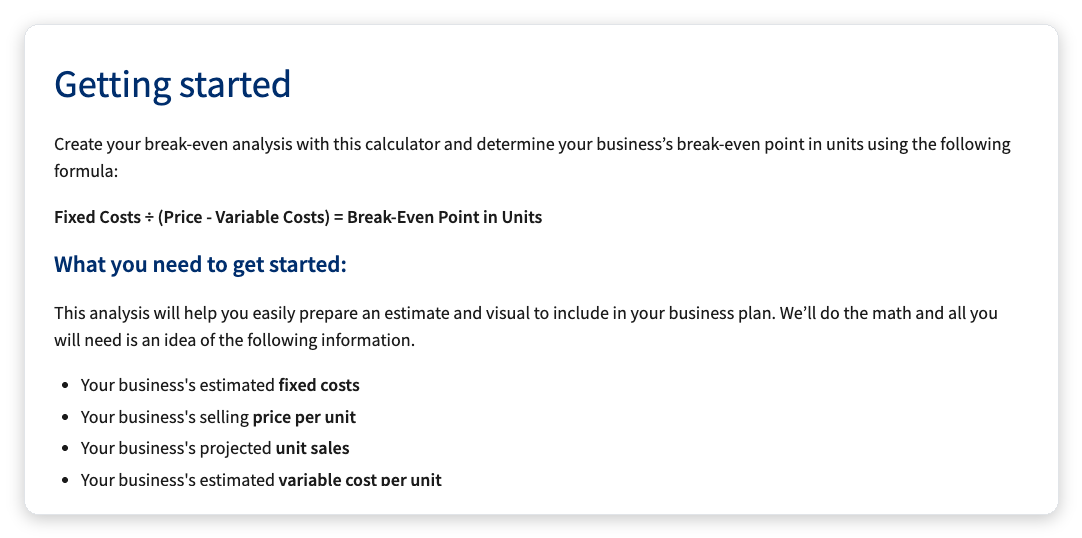
Fixed Costs ÷ (Price − Variable Cost per unit)
The bracket is your contribution margin: what one unit contributes to fixed cost after its own delivery cost.
The most common mistake in break-even analysis is dividing fixed costs by price instead of by contribution margin, which quietly assumes each unit costs nothing to deliver. Principles of Accounting calls the correct version the "break-even shortcut": fixed costs over contribution margin per unit.
Here is what the error costs a real agency. Same $60,000 fixed, same $4,000 price, $1,500 to deliver each retainer:
| Method | Denominator | Break-even clients | Reality at that count |
|---|---|---|---|
| Divide by price (wrong) | $4,000 | 15 | Losing $22,500/mo |
| Divide by contribution margin (right) | $2,500 | 24 | Profit $0 (true break-even) |
At 15 clients you bill $60,000 but spend $22,500 delivering them, so you are $22,500 underwater while your spreadsheet says "break-even." The Corporate Finance Institute is blunt about why: contribution dollars cover fixed costs first, and only the surplus is profit.
Break-even in revenue, when "units" don't map cleanly
If you sell a messy mix (some retainers, some one-off projects, some seats), a client count is awkward. Switch to a revenue target using the contribution margin ratio, the share of each dollar left after variable cost.
The two views always agree because they are the same equation rearranged, a point Patriot Software lays out step by step. Founders and CFOs usually prefer the revenue number; delivery leads prefer the client count. The calculator shows both so nobody has to convert in their head.
Want the margin math on the revenue you keep instead of spend? The companion CAC calculator and ARR calculator plug into the same model from the other direction.
Target profit is just break-even with a bigger goal
Nobody builds an agency to hit zero. The good news: the target-profit formula is the break-even formula with your desired profit bolted onto fixed costs, because Principles of Accounting treats target income as "an added increment of fixed costs."
$60,000 fixed + $30,000 target = $90,000 to cover with contribution margin.
$90,000 ÷ $2,500 = 36 clients to clear a $30,000 monthly profit.
24 to survive, 36 to thrive. That 12-client gap is the number your acquisition engine has to produce.
That third step is where break-even stops being an accounting exercise and becomes a go-to-market plan. Twelve clients is a pipeline target, and a pipeline target has a cost. Which is the whole reason the next section exists.
CAC payback: break-even, but measured in months
Unit break-even asks "how many." Time-based break-even asks "how long until a customer I paid to acquire has paid me back." That is the CAC payback period, and Stripe defines it as acquisition cost divided by monthly gross-margin dollars per customer.
CAC payback (months)
Cost to acquire a customer ÷ Monthly gross margin per customer
Take the same agency: it spends $12,000 to win a retainer client who contributes $2,500/month in gross margin. Payback is $12,000 ÷ $2,500 = 4.8 months. If that client stays 18 months, roughly 13 months of contribution margin land as profit. The SaaS CFO frames a cohort's acquisition cost as an upfront fixed cost and its monthly margin as the contribution, which is exactly the break-even formula, run against time instead of units.
If your CAC payback is longer than your average customer lifetime, you lose money on every customer you acquire. No volume fixes that. Lower CAC, raise price, or cut delivery cost. Fix the unit economics before you scale the spend.

What good actually looks like: 2026 benchmarks
Your break-even is only as trustworthy as the margins you feed it. These are the reference points to sanity-check your inputs against, pulled from named primary sources rather than vibes.
| Business model | Typical gross / contribution margin | Healthy CAC payback | Source |
|---|---|---|---|
| Professional services / agency | ~30% gross margin | Under client lifetime (often 4–6 mo) | Projectcor |
| Advertising agency (operating) | 15% healthy, 20–30% high performers | Tied to retention | NetSuite |
| SaaS / subscription | 70–85% subscription gross margin | <12 mo; 5–7 mo top-tier | Stripe |
| E-commerce / DTC | 20%+ healthy, 25–35% best-in-class | Under 12 mo | Wayflyer |
One trend worth knowing before you set a payback target: Benchmarkit's 2025 SaaS data shows median payback periods have stretched about 12.5% since 2022 as acquisition got more expensive. The bar for "efficient" is moving, which is exactly why cheap channels are getting more valuable, not less.
Five break-even mistakes that wreck the model
The formula is simple. The inputs are where founders quietly lie to themselves. These are the five errors that turn a correct formula into a dangerous plan, in rough order of how often they sink agencies.
The headline error. It assumes zero delivery cost and understates break-even every time (source).
Per-customer ad spend and commissions scale with volume. Bury them in "fixed" and your contribution margin is fiction (CFI).
One blended margin across services with wildly different economics hides your money-losers. Model each line or use a weighted average.
A 4.8-month payback is only good if clients stay past 4.8 months. Short lifetimes turn "efficient" acquisition into a leak.
Prices, delivery costs, and CAC all drift. Break-even is a live dashboard number, not a one-time startup calculation.
The channel question your break-even is really asking
Once your break-even and target-profit numbers are set, the whole business narrows to one job: produce the client gap (12, in our example) at the lowest possible CAC and the fastest possible payback. Break-even is the target. Acquisition cost is the variable you actually control.
This is where the model gets opinionated. The agencies that track CAC and payback per channel almost always find the same thing: their cheapest, fastest-payback acquisition channel is Upwork. Buyers arrive with budget and intent already attached, so the gross-margin dollars start clearing acquisition cost in weeks, not quarters. We break the per-channel comparison down in cost per lead by channel and the reply-rate reality check in cold outreach reply rates by channel.
Rerun the calculator with a channel-specific CAC in the acquisition field. A channel that halves your CAC halves your payback months, often the single biggest lever on the whole model, ahead of price changes that risk churn.
The catch on Upwork has always been throughput. Winning enough of those pre-qualified jobs to move your client count means submitting fast, consistently, and at volume, which is where most agencies quietly cap out, and where GigRadar comes in.
Free for Upwork agencies
Lower your CAC on your fastest-payback channel
GigRadar runs high-volume, human-reviewed Upwork proposals through a dedicated Business Manager so your agency wins more of the pre-qualified jobs that hit break-even fastest. Battle-tested across thousands of agencies.
Get Your Free Agency Audit →Margin of safety: how far you can fall before you're back underwater
Break-even tells you the floor. Margin of safety tells you how much cushion sits between your current sales and that floor, so it doubles as a risk gauge. EBSCO frames it as how far sales can drop before you hit break-even.
Sales can fall 40% before this agency is losing money. An agency with a 10% margin of safety and a client on the edge of churning is running a very different risk than one at 40%, even if both are "profitable" today. That is the resilience read break-even alone can't give you.
How to use these numbers this week
The calculator is worth ten minutes only if it changes a decision. Here is the fast loop:
Actual fixed costs, actual blended price, actual delivery cost including freelancer pay. Rounding here is how the model lies.
That client gap is your quarterly acquisition quota. Write it on the wall.
Enter each channel's CAC and see which one clears fastest. Then put your budget there. For a broader metrics stack, see the MRR calculator and net revenue retention guide.
Break-even is not the finish line. It is the line that tells you which acquisition channel earns the right to your next dollar. Run yours, find your gap, and point it at the channel that pays itself back first.