
🎬 Sales Commission Calculator walkthrough: the four commission structures, the revenue-vs-margin trap, and why caps cost you more than accelerators. Watch on YouTube
The Short Version
- Every commission plan reduces to one formula: commission = base × rate. The only real decision is what you put in "base" (revenue, gross margin, or attainment) and where the rate steps up.
- Paying commission on revenue instead of gross margin is the single most expensive default. At a 40% margin, a 10%-of-revenue rate is really 25% of your margin, and it pays reps to discount.
- The 50/50 base-to-variable split is a SaaS benchmark. Agencies selling a delivery promise should usually run base-heavier (65/35 or 70/30).
- Hard caps demotivate at the worst possible moment. Above quota, your fixed rep cost is already covered, so accelerators are the cheapest growth capital you will ever buy.
- Rep commission is variable CAC. Fold it into channel cost and your "free" referral leads stop looking free. Use the calculator below to price your plan against your real margin.
Close a $100,000 project at a 40% gross margin and pay your rep 10% of revenue, and you did not spend 10%. You spent $10,000 out of $40,000 of margin: 25 cents of every profit dollar, handed over on a number your finance team probably still files under "cost of sales" instead of CAC.
Most sales commission calculators online stop at revenue × rate and call it a day. That formula is correct and almost useless, because it hides the two decisions that actually decide whether your plan builds a sales team or bleeds your P&L: what the commission is calculated on, and how the rate behaves above and below quota.
This calculator models all four structures: straight commission, base plus commission with live On-Target Earnings, tiered accelerators, and margin-based plans. It also shows the number no plug-in tool shows you: commission as a percentage of your margin, not just your revenue.
Interactive Tool
Free Sales Commission Calculator
Pick a structure, enter your numbers, and see the payout, total comp, and what it really costs against margin.
Estimates for planning only, not tax, legal, or accounting advice. Margin health bands follow the 5–15%-of-revenue guideline common in B2B and agency comp design.
Every commission plan is one formula. Most agencies get the base wrong
Strip the jargon and every structure is the same skeleton: commission = base × rate, then total pay = fixed salary + commission. CaptivateIQ and HubSpot both anchor on that one line, and everything fancier is a modifier bolted on top.
The four structures the calculator models are the four you will actually meet:
| Structure | Formula | Best for |
|---|---|---|
| Straight commission | C = revenue × rate | Resellers, referral partners, pure closers |
| Base + commission | Total = base + (revenue × rate) | The default B2B / agency AE plan |
| Tiered / accelerator | Higher rate above each quota band | Rewarding overperformance |
| Margin-based | C = (revenue − COGS) × rate | Agencies with variable delivery cost |
The number that ties them together is On-Target Earnings (OTE): annual base plus the variable a rep earns at 100% of quota. QuotaPath frames it as OTE = base + variable-at-quota, and it is the single input most owners set by gut instead of math.
A rep on a $60,000 base earning 10% on an $840,000 quota takes home $84,000 of variable at target, so OTE = $144,000 and the implied rate is roughly 10%. Switch the calculator to "Base + Comm." to see your own split.
Paying on revenue instead of margin is paying reps to discount you to death
A rep is a rational optimizer of exactly one number: the one their check is calculated on. Make that number booked revenue, and a 10% "let me shave the price to close it" discount costs the rep 10% of their own commission while it vaporizes a third of your profit.
Qobra lays out the math plainly: on a $100,000 deal with $60,000 of delivery cost, gross margin is $40,000. A 10% revenue commission pays $10,000 on that deal, while a 10% margin commission pays $4,000: same headline rate, very different bill.
Headline rates alone tell you almost nothing, because the number they apply to is the whole game. Industry benchmarks span 5% to 20%, and the spread is mostly about what sits underneath the percentage.

The behavioral fix is boring and immediate: move the base to gross margin, or at least add a margin gateway so no deal pays commission below a floor. The reflexive discounting stops inside one pay cycle, because now the rep only wins when you win.
Reps will complain the day you announce it, and that complaint is the signal it is working, not a bug. Chris Hart, who designs comp for professional-services firms, goes further and splits agency commission across three bases roughly 30–40% each: recognized revenue, realized project margin, and quota attainment.
His breakdown of services commission plans is the antidote to booking-only pay that rewards deals which never deliver their booked value. If you have never priced your services against delivery cost, our guide to value-based pricing pairs with this directly.
The 50/50 split is a SaaS import agencies should not copy blindly
Ask the internet for a pay mix and it says 50/50, and that is a real benchmark: Optymyze's 2026 data and Bridge Group's 2024 report both put SaaS account executives near a 50/50 mix with a quota around 4.2x OTE. The mistake is copying it without asking whether your rep controls the outcome the way a SaaS AE does.
A SaaS AE sells a product that performs identically for every buyer. An agency seller sells a delivery promise executed by freelancers they do not manage, and a slice of "won" revenue churns in the first 90 days for reasons the rep never touched.
Loading that role with high variable just imports delivery risk into comp. That is the actual root cause of the mid-year clawback wars reps rage about.
| Role | Typical OTE | Base : Variable |
|---|---|---|
| SDR / BDR | ~$85K | 70 : 30 |
| Account Executive (SaaS) | ~$195K | 50 : 50 |
| Customer Success Manager | ~$138K | 80 : 20 |
| Sales Engineer | ~$200K | 70 : 30 |
| First-line Sales Manager | $200K–$280K | 60 : 40 |
Source: Optymyze 2026 benchmarks and QuotaPath.
Run base-heavier (65/35 or 70/30), then tie a small slice of variable, say 20%, to 90-day retention paid in arrears. You raise the quota-to-OTE ratio to keep total cost flat, and you stop clawing money back after the fact.
Caps are the wrong lever. Accelerators are the cheapest growth capital you will buy
Once a rep clears quota, the economics invert. Their base, benefits, and overhead are already fully covered by the on-quota deals, so every dollar above quota arrives with near-zero fixed cost attached.
Paying a 1.5x accelerator on that dollar is buying near-100%-contribution revenue at a discount. It is the cheapest growth capital on your P&L, and a cap throws it away.
Prowi's accelerator data shows the standard shape: 1.5x on the first tier above quota, 2x on the second, and anything past 3x flagged as high-risk. Keep it to two to four tiers, because a rep who cannot do the math in their head cannot be motivated by it.
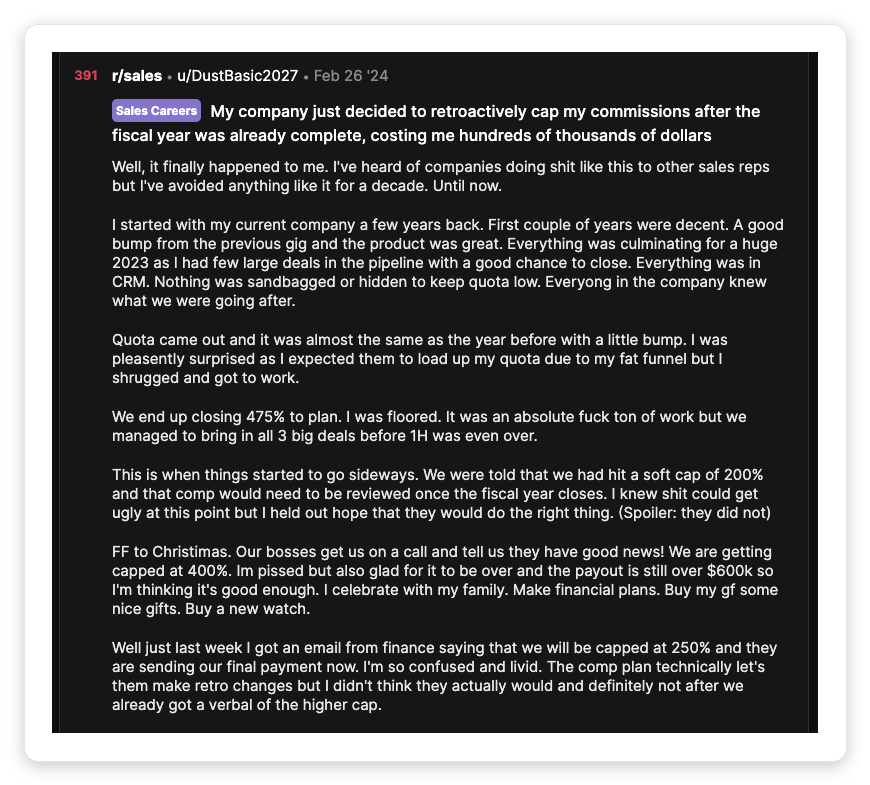
Capping right at that point, to stop a rep out-earning the founder, is lighting near-free-margin revenue on fire to protect a feeling. If a rep hitting 150% makes you want to cap, your quota was set too low.
Fix the quota (target 3x to 5x OTE in bookings) instead of punishing your best closer for a planning error. To see how attainment ripples through the funnel, our win rate calculator and sales velocity guide are the companion tools.
Your rep's commission is CAC, and it hides inside your cheap channels
Commission is variable customer-acquisition cost, full stop. If you close a deal and pay 10%, that 10% belongs in blended CAC next to ad spend and SDR salary, but most agencies book it under "cost of sales" and leave it out of the CAC number they optimize against.
The non-obvious trap: it hides inside your "free" channels. Agencies compute channel CAC as spend divided by customers, so a referral or inbound lead looks nearly free.
But if a rep closed it and took full commission, that "free" lead carries the exact same commission cost as a brutal cold-outbound deal. The cost did not vanish: it moved from the marketing line, where you attribute per channel, to the payroll line, where nobody attributes it by source.
Allocate commission to the channel the lead came from, then pay a reduced rate on marketing- and referral-sourced deals the rep did not originate (full rate on self-sourced outbound, half on inbound). Almost no agency does this, which is exactly why "just get more referrals" quietly erodes margin instead of expanding it.
Fold commission in and the rankings flip. Your "expensive" outbound channel often has a lower fully-loaded CAC than the referral channel you thought was free, because it justifies the rep effort you are paying for either way.
For agencies, the cheapest fully-loaded channel is frequently Upwork, where the buyer already has intent and budget so a rep closes faster and cheaper than off a cold list. Price it yourself with our CAC calculator, payback period calculator, and cost-per-lead-by-channel breakdown.
Free for Upwork agencies
Your cheapest sales channel is the one your commission plan ignores
GigRadar runs your Upwork pipeline through a real, human-supervised Business Manager so reps close pre-qualified, high-intent deals. Lower fully-loaded CAC, even after commission.
Get Your Free Agency Audit →The five commission mistakes that quietly kill sales teams
Every one of these has a body count of quit reps and blown quarters behind it. They are ordered by how much damage they do before anyone notices.
Rewards discounting and big-but-unprofitable deals. Add a margin base or a minimum-margin gateway (Qobra).
Retroactive changes claw back income reps already earned in their heads, which breaks trust and invites legal risk. Change prospectively, rarely, and with notice (WorldatWork).
Once a rep hits the cap, extra deals pay nothing, so they stall or sandbag them to next period. Use decelerators and windfall clauses instead of a ceiling (Prowi).
More than four accelerator tiers and reps cannot mentally price their next deal, so the incentive stops steering behavior. Two to four, maximum.
Recovering commission on churn or cancellation with no written rule is the fastest way to make a good rep update their LinkedIn. Define "earned" in writing and align payout timing to cash collected.
Take-home: a one-page commission plan health check
Before you ship any plan, run it through these six checks. Copy the block, paste it into your plan doc, and treat any "no" as a fix, not a footnote.
COMMISSION PLAN HEALTH CHECK
[ ] Base of commission is gross margin, or has a minimum-margin gateway
[ ] Commission as % of gross margin is under ~20% at target
[ ] Pay mix fits the role (agency AE base-heavier than SaaS 50/50)
[ ] Accelerators above quota, no hard cap
[ ] Four or fewer tiers a rep can calculate in their head
[ ] "Earned" is defined in writing; clawbacks are ruled, not ad-hoc
Pair the checklist with the calculator at the top: if your commission-as-%-of-margin readout lights up amber or red, you are in the revenue trap, so fix the base before you touch the rate. For the broader money model around it, our break-even calculator and retainer pricing guide close the loop from commission cost to profit.